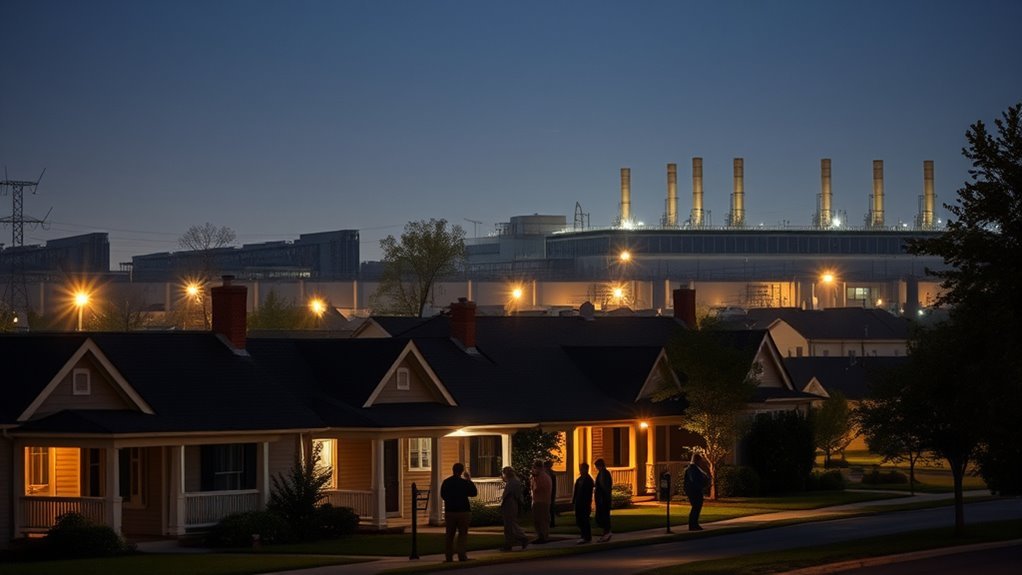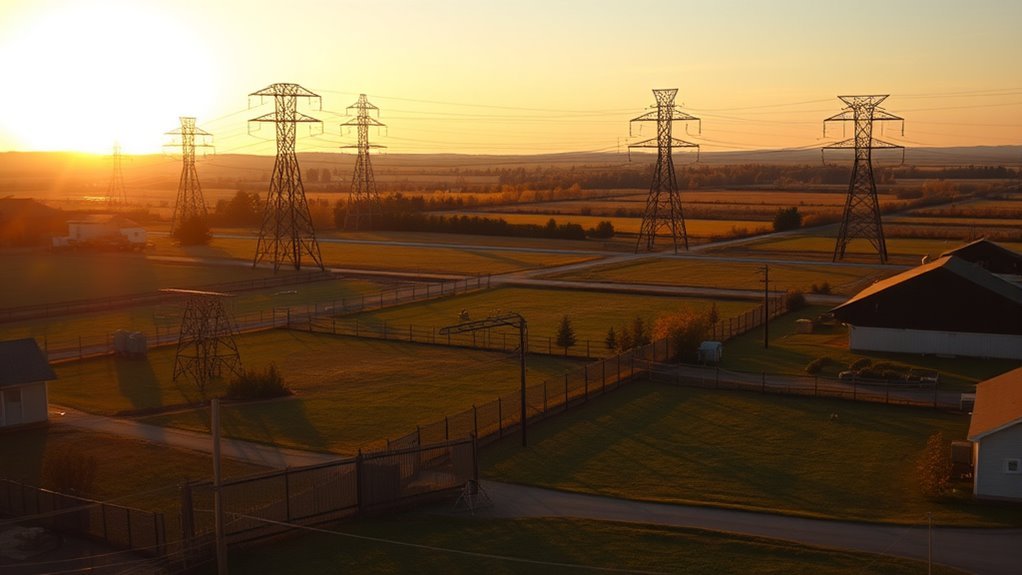

Artificial intelligence is turning electricity into one of the defining bottlenecks of the modern economy, and the scramble to build new high voltage power lines is colliding head on with some of the most sensitive issues in American property law. Communities that once treated transmission corridors as a distant backdrop are discovering that AI demand can bring massive steel towers to their farms, backyards, and main streets, and eminent domain is suddenly part of the conversation again.
How AI is reshaping the power grid
Training and running large AI models requires enormous and continuous electricity, especially for clusters of data centers in places like Northern Virginia and surrounding states. That demand does not grow gently. It arrives in chunks when a hyperscale campus or a regional AI cluster lights up, and grid planners then have to find ways to move gigawatts of power from generation to these new loads.
Regional transmission organizations such as PJM Interconnection, which coordinates the grid in all or parts of thirteen states, have begun flagging reliability violations tied to rising demand and generator retirements in their planning studies. When internal upgrades are not enough, those studies point to new long distance transmission projects that cross multiple counties and, inevitably, privately owned land.
Reliability warnings are quickly translating into concrete plans for new corridors carved across private landscapes
This is where AI moves from being an abstract technology story into a very physical one. For landowners, AI demand is not a model on a server. It is a proposed right of way cut through fields, forests, and driveways, with tall structures that can change the character and value of their property for generations.
Eminent domain and the meaning of public use
Eminent domain is the legal authority that allows government to take private property for public use in exchange for monetary compensation. In the United States that power is rooted in the Fifth Amendment and mirrored in state constitutions, which generally require that any taking be for a public use and accompanied by just compensation. Even when private utilities construct and own transmission lines, eminent domain remains a government power, exercised directly by public bodies or through delegated authority when projects are deemed to serve a public use. Over the twentieth century that concept expanded beyond obvious cases like roads and schools to include infrastructure such as railroads, pipelines, and regulated utilities.
Today many privately owned utilities and transmission companies can exercise eminent domain under state law when a project is deemed necessary for the public and voluntary land acquisition fails. They typically start with offers to purchase land or obtain easements that grant limited rights to access, construct, and maintain lines. If negotiations break down, they may ask a court to condemn the property. In those proceedings the core question is often whether the project truly serves a public use, and whether the compensation offered matches fair market value rather than the subjective attachment owners have to their land.
For conventional transmission lines that move electricity broadly across the grid, regulators and courts have usually accepted that providing reliable power is a public use, even when a few large industrial or commercial customers drive much of the load. The AI era is forcing a reexamination of that assumption.
When AI demand complicates public benefit
As AI data centers grow into major drivers of new transmission, some communities and legal scholars are asking whether lines built primarily to serve a narrow set of corporate customers still fit comfortably within the public use framework. The benefits are real but uneven. A new line that reduces congestion can lower wholesale prices or improve reliability for a wide region, yet its most obvious winners may be a handful of technology firms whose business models depend on cheap, abundant compute.
State constitutions and courts do not all answer this tension in the same way. Some apply deferential standards and focus on system wide reliability, while others take a harder look when private commercial benefits seem to dominate. That divergence is creating a patchwork in which similar AI related transmission projects can move smoothly in one jurisdiction and run into intense legal, political, and grassroots resistance in another.
Local perception matters. When landowners believe a line is essentially an extension cord for distant data centers, rather than a shared public asset, opposition tends to harden. In Maryland, for example, critics of a major proposed transmission project argue that it will function mainly as an extension cable for Northern Virginia data centers, despite developer claims that it is needed to prevent rolling blackouts and strengthen the backbone of the grid. That kind of narrative can shape how courts and regulators view public benefit, even when technical studies emphasize broader reliability goals.
The Maryland Piedmont Reliability Project as a test case
The Maryland Piedmont Reliability Project has become one of the clearest windows into these emerging tensions. It is a proposed approximately seventy mile high voltage transmission line across Baltimore, Carroll, and Frederick Counties that PJM awarded to PSEG Renewable Transmission LLC to address forecasted reliability violations in the region. The project is designed as a five hundred kilovolt alternating current line capable of moving large amounts of electricity over long distances.
The planned route would connect an existing Baltimore Gas and Electric transmission right of way in northern Baltimore County to the Doubs five hundred kilovolt station in southern Frederick County, creating a new corridor through largely rural and agricultural landscapes. Different public documents describe the line length as between sixty seven and seventy miles, reflecting variations between early planning estimates and refined routing analysis. The project is currently expected to enter service around June 2027 if approved, with a total cost estimated at about 424 million dollars in in service year terms.
PJM selected PSEG’s proposal in December 2023 after a competitive planning process, concluding that internal upgrades and existing corridors would not be sufficient to handle rising demand and generation changes. Since then PSEG has worked with routing consultants to evaluate multiple path options before settling on a proposed route, designated Route H, which it now presents as the least disruptive alignment given technical and environmental constraints.
On the regulatory side, PSEG has filed or prepared to file an application for a Certificate of Public Convenience and Necessity with the Maryland Public Service Commission, the formal process that will determine whether the project can be built. That process involves public hearings in the affected counties, evidentiary hearings, and extensive opportunities for written comment, including a dedicated email address for residents to submit views and concerns.
State and local officials are not treating this as a routine upgrade. Frederick County’s government has stated that it strongly opposes the project, citing threats to homes, businesses, agricultural heritage, environmental resources, and historic amenities, even while noting that it lacks direct approval authority. Carroll County has published detailed information explaining that PJM determined a new overhead transmission line is necessary due to significant system overloads, yet it also points residents to the Public Service Commission process as the venue for formal input.
The Maryland Energy Administration has issued its own summary emphasizing that the project remains a proposal subject to PSC review and encouraging public engagement. At the state level, Governor Wes Moore has raised pointed questions about the overall benefits of the project, stating that the single most important factor remains unclear: the comprehensive benefit to Marylanders. That kind of framing signals that the usual assumption of broad public use is not automatic when a line is closely linked to data center growth.
Grassroots opposition has coalesced as well. Organizations such as Stop Maryland Piedmont Reliability Project argue that the line will cut a new path through the three counties, destroy more than 1200 acres, and permanently change the character of rural communities. They emphasize that many of the targeted properties have been in families for generations and that the proposed right of way would bring visual, noise, and potential health concerns that are difficult to capture in standard appraisals.
Law firms advising affected landowners have begun publishing guides explaining what the project entails, how many routes are under consideration, and what rights owners retain if PSEG seeks easements or condemnation. These materials underscore that eminent domain remains a live possibility once regulatory approvals are in place and negotiations fail, even though the developer publicly stresses voluntary agreements where possible.
For AI watchers, the Maryland case is notable for another reason. Planning documents and news coverage highlight data center growth among the drivers of rising load, and some critics explicitly portray the line as infrastructure primarily for distant technology corridors rather than Maryland residents. The debate is less about whether electricity is a public good and more about whose economic priorities should shape the landscape.
What this means for landowners, utilities, and AI companies
From a landowner’s perspective, the renewed use of eminent domain for AI related transmission projects revives long standing concerns about fairness and autonomy. Just compensation in legal terms is typically pegged to fair market value, which may not reflect emotional attachment, legacy uses, or the future potential that owners see in their property. Court fights over valuation can be protracted and stressful, and even when owners prevail financially, the physical presence of a transmission corridor is permanent.
Communities also worry about cumulative effects. A single line might be tolerable, but as data center clusters grow, residents fear a rolling wave of projects that slowly convert rural regions into infrastructure corridors. In places like the Maryland Piedmont region, where agriculture and heritage tourism are central to local identity, those changes feel existential.
Utilities and grid operators face a different kind of pressure. Their mandate is to keep the lights on and prices stable, and the technical case for new transmission can be compelling when load is rising and generation patterns are changing. However, when the most visible beneficiaries are AI firms, they risk being cast as agents of corporate expansion rather than neutral stewards of public reliability. That perception can erode trust and slow projects through litigation, political intervention, and organized resistance.
AI companies themselves are not direct parties to most eminent domain proceedings, but they are increasingly at the center of the narrative. Their choice of locations and timelines can dictate where and when new lines are needed, and their reputations suffer when communities conclude that local landscapes are being sacrificed for remote profits. Some technology firms have started exploring ways to contribute to community benefits, local tax bases, or grid enhancing investments that go beyond their immediate needs, in an effort to demonstrate that they are partners rather than extractive forces.
Policy and legal questions emerging from AI power lines
The convergence of AI demand, transmission expansion, and eminent domain raises several hard policy questions.
One is how regulators should weigh narrowly concentrated commercial benefit against diffuse public reliability. If a line prevents blackouts for an entire region while also enabling billions of dollars in data center investments, does that make it more, or less, clearly a public use? The answer may vary by jurisdiction, but cases like the Maryland Piedmont Reliability Project suggest that courts and commissions will need to articulate clearer standards.
Another question is whether traditional cost allocation methods remain politically sustainable. In PJM, the costs of high voltage regional projects are spread across customers under federal methodologies, meaning residents who see a line pass through their land may still pay for part of it on their bills. When they believe the primary goal is to serve remote AI infrastructure, that arrangement can look doubly unfair.
There is also growing interest in alternatives. Opponents of the Maryland project argue that other options have not been fully considered, including deeper upgrades to existing corridors, localized generation closer to load, and demand side measures. Grid planners respond that technical studies have already weighed those paths and found them insufficient, but the gap between engineering conclusions and public intuition is widening.
Finally, the AI era may test the limits of judicial deference to expert planning bodies. If courts start to see repeated patterns where technology driven projects concentrate benefits while dispersing burdens, they may narrow the definition of public use or require more explicit demonstration of shared advantage, particularly under state constitutional provisions.
What to watch next
The Maryland Piedmont Reliability Project is still moving through regulatory review, public hearings, and detailed route evaluation. Whatever the outcome, it will set expectations for future AI related transmission proposals, not only in Maryland but across other PJM states wrestling with similar challenges.
Several trends are worth watching.
First, how clearly developers and grid operators communicate the link between AI demand, overall regional reliability, and long term energy strategy. When the narrative focuses solely on data center growth, it strengthens the sense that eminent domain is being used for narrow corporate ends. When it connects the project to broad decarbonization, resiliency, and affordability goals, the public use case becomes more understandable.
Second, whether AI companies begin to participate more directly in community and policy solutions. That could include co funding grid upgrades that have broad benefits, supporting local conservation and preservation efforts in affected corridors, or advocating for siting practices that minimize new greenfield routes by prioritizing existing rights of way.
Third, whether states refine eminent domain laws and transmission siting standards to address AI specific scenarios. Legislatures might, for example, require more detailed analysis of who benefits from a project, mandate enhanced compensation or mitigation measures for landowners near data center driven lines, or create stronger mechanisms for community input before routes are locked in.
The central takeaway is that AI is no longer just a matter of algorithms and cloud platforms. It is reshaping physical landscapes, legal doctrines, and community politics. Transmission lines that once attracted little notice are becoming flashpoints where questions about public use, corporate power, and local identity converge. Those arguments are already migrating from regulatory dockets and county meetings into everyday conversation on social platforms, and they will continue to evolve as more AI related projects appear in maps and survey stakes, and in the comment threads of places like reddit.
Conclusion
The AI power boom is colliding with private property rights
Artificial intelligence is no longer just a software story. It is becoming a land and power story, and it is starting to run straight through farms, ranches, and backyards. As data centers that support AI systems demand enormous amounts of electricity, utilities and developers are planning new high voltage transmission lines that often cross privately owned land. When landowners refuse to sell, power companies are increasingly looking to eminent domain as the legal tool that can clear a path.
This is why the issue matters now. The buildout of AI infrastructure is accelerating faster than the grid was ever designed to handle, and the legal fights around these power lines are turning into a test case for what counts as a public use in the age of AI. The outcome will shape not only how quickly AI can expand, but also how secure property rights and local consent remain in the face of large scale technological projects.
How AI changed the scale of data center power demand
To understand why transmission corridors are back in the spotlight, it helps to look at the numbers.
Traditional cloud data centers already use a great deal of power. A conventional facility can consume as much electricity as ten thousand to twenty five thousand homes. Newer AI heavy facilities are at another level. Hyperscale data centers optimized for AI workloads can draw as much power as one hundred thousand homes or more.
In the early phase of the AI boom in 2023, data centers in the United States consumed about one hundred seventy six terawatt hours of electricity, roughly equivalent to the entire electricity use of Ireland. Analysts expect this figure to double or even triple by 2028 if current AI trends continue. Some AI tasks are especially energy intensive. For example, producing a five second AI generated video can use roughly as much electricity as running a microwave continuously for over an hour.
This surging demand does not occur in isolation. It hits grids that were already grappling with renewable integration, the retirement of older power plants, and growing electrification of transport and heating. Interconnection queues for large facilities are long, and many regions simply do not have enough existing transmission capacity to serve clusters of new AI data centers. As a result, new lines are not optional. They are becoming prerequisites for AI expansion.
Why utilities are planning new transmission corridors
Utilities and developers are reacting in two main ways.
- They are pursuing more private and onsite generation. Large AI deployments increasingly include their own power plants in the project footprint, ranging from natural gas turbines to large battery installations and renewable projects. This behind the meter strategy gives operators more control over reliability and project timelines, but it still usually depends on grid connections for backup or export.
- They are pushing for new transmission lines and corridors. Where AI data centers connect to the bulk power system, utilities often need high capacity lines to move power from generation rich areas to new load centers. The United States Department of Energy has revived a process to identify National Interest Electric Transmission Corridors that are considered critical to reliability and economic development. In late 2024 the department advanced three proposed corridors into a deeper analysis and public engagement phase, based on earlier comments and system needs. These corridors can streamline certain federal approvals, though they do not by themselves authorize land seizures.
The challenge is geographic. High voltage transmission works best with long, relatively straight routes, which rarely align with property boundaries. That sets up a direct collision between regional grid planning and individual landowners.
Eminent domain enters the AI infrastructure story
Eminent domain is the government power to take private property for public use, with the requirement that affected owners receive just compensation. In the United States, utilities or transmission developers can often exercise this power directly if state law delegates condemnation authority for approved projects.
For AI related transmission, the central legal question is whether a line that primarily serves a privately owned data center can be treated as a public use.
Reporting on current projects indicates that utilities are already invoking or preparing to invoke eminent domain when negotiations with landowners stall. Where voluntary purchases or easements are refused, companies are turning to condemnation proceedings to secure rights of way for lines that will deliver large blocks of power to AI focused facilities.
These conflicts are especially visible in states that host clusters of planned data centers, including many in the South and Midwest, and in rural counties that previously had little or no data center development. Landowners in those regions are encountering detailed right of way offers, followed by condemnation threats if they do not sign.
It is important to note a key uncertainty. Some coverage frames eminent domain use for AI transmission as a rapidly expanding practice, but the actual scope and frequency of forced takings remains unclear and varies by state and by project. Many lines are still built through negotiated agreements, and in some cases projects are modified or relocated in response to local opposition.
How the law on public use became so contested
The unresolved nature of these fights has deep roots in American eminent domain law.
Under the United States Constitution, private property can be taken only for a public use and with just compensation. Modern litigation has often turned on how broadly to interpret public use. The most famous example is the Supreme Court decision in Kelo v. City of New London in 2005. The court held that economic development could count as a public use even when property was transferred from one private owner to another, as long as the project served a broader public purpose such as jobs or tax revenue.
Kelo sparked widespread backlash. Many states responded with legislation or constitutional amendments that tightened the definition of public use or restricted takings that primarily benefit private parties. Courts at the state level have also interpreted Kelo differently, sometimes applying stricter standards than the federal baseline.
Transmission projects for AI data centers sit squarely in this contested area. Whether a particular line qualifies as a public use depends on several factors:
- State statutes and constitutional provisions that define or limit public use.
- How utilities and regulators characterize the benefits in filings, for example as reliability improvements, congestion relief, or support for broader load growth rather than a single facility.
- The factual record about who can access the line, whether it adds capacity for other customers, and how costs are allocated.
Courts are likely to scrutinize claims that a line built primarily to serve one hyperscale data center is really a public project, especially in states that reacted strongly against Kelo.
Regulators are trying to keep up with AI driven demand
Regulators are not ignoring the issue. At the federal level, the Federal Energy Regulatory Commission launched a major effort in June to push regional grid operators to adjust their planning and interconnection rules in light of fast rising demand from AI data centers and other large loads. The goal is to ensure that these users can connect without imposing unfair costs on existing customers and without undermining reliability.
The Department of Energy’s corridor designations are another tool, intended to identify routes where new lines are in the national interest and to coordinate federal review. However, neither FERC nor DOE directly decides when eminent domain is appropriate for specific parcels of land. That authority is still shaped primarily by state law, state public utility commissions, and state courts.
At the local level, zoning boards, county commissions, and community stakeholders are asserting their own leverage. They may not be able to block a state approved line outright, but they can influence routing, conditions, and timelines. Local resistance can significantly raise costs and delay projects, which in turn affects AI companies that depend on timely power connections.
What this means for landowners, communities, and AI companies
For landowners:
- The stakes are both financial and personal. Even when compensation is offered, owners may feel they have little meaningful choice if a project has been approved and condemnation is looming. The perception that a private technology firm is the primary beneficiary can heighten resentment.
- Legal challenges are possible but often costly and slow. Owners can contest both the amount of compensation and the claim that the taking is truly for a public use, but outcomes are uncertain and heavily dependent on state law.
For communities:
- AI data centers bring potential benefits in the form of tax revenues, construction jobs, and in some cases long term employment and infrastructure improvements.
- They also bring pressures on land, water, and local grids. AI driven facilities can require large quantities of electricity and, in some designs, significant water for cooling, which has already raised concerns in some regions.
- Transmission lines alter landscapes and may affect property values along their routes. Communities are weighing those costs against broader economic promises.
For AI and technology companies:
- Power availability has become a strategic constraint. Analysts now describe AI power demand as rivaling that of heavy industry, which makes energy planning a central factor in where and how companies deploy large AI clusters.
- Companies are being pushed further into the energy business. By investing in private generation and in some cases partnering directly on transmission projects, they assume new responsibilities for maintenance, safety, and regulatory compliance.
- Their reputations are on the line. Public narratives about companies that gain from land seizures, even if carried out through utilities and legal mechanisms, can affect trust and social license to operate.
How this differs from earlier infrastructure battles
The United States has a long history of building major infrastructure through private land, from railroads to interstate highways to earlier generations of power lines and pipelines. In that sense, the use of eminent domain for energy facilities is not new.
What is different today is the combination of three factors:
- The speed and scale of demand growth. The AI boom compresses timelines. Where traditional industrial growth unfolded over decades, AI data center demand is rising sharply over a few years, giving communities less time to adapt.
- The perception of private benefit. Highways and regional grid backbones were more clearly framed as serving the general public. Lines built largely to serve specific data center clusters can look and feel more like private infrastructure with public side effects.
- A more skeptical post Kelo legal and political environment. Many voters and lawmakers are more wary of expansive readings of public use than they were in earlier eras, which means each new project is more likely to become a flashpoint.
The result is a friction point where cutting edge digital technology meets older, slower approval systems and deeply held views about land and community autonomy.
Key takeaways and what to watch next
Several themes are emerging from the current fights over AI related power lines across private land.
- AI is now constrained by physical infrastructure, not just algorithms. Electricity, land, and transmission rights of way are becoming as critical to AI expansion as chips and models. Companies that ignore this reality risk serious delays and public backlash.
- Eminent domain will be tested in new ways. Courts and regulators will be forced to clarify when a project that heavily benefits a private AI operator can still count as a public use, especially in states that tightened standards after Kelo.
- Data and transparency gaps remain. Despite rising concern, there is still limited systematic information on how often eminent domain is actually being used for AI related projects compared with negotiated deals. Better disclosure from utilities and regulators would improve public debate.
- Policy is shifting but not yet settled. Federal initiatives on transmission corridors and grid planning, combined with state law changes and local resistance, are creating a moving landscape. Outcomes will differ by region, which may influence where AI firms choose to locate.
- There is room for better solutions. Co locating data centers near existing generation, investing in grid upgrades that also benefit other customers, and engaging communities earlier and more honestly could reduce the need for contentious takings. Some companies are already experimenting with more collaborative models, though evidence of long term success is still emerging.
The next few years will reveal whether societies treat AI infrastructure as a shared public backbone, similar to past utility networks, or as private industrial buildouts that must be constantly negotiated with existing communities. Either way, AI’s hunger for electricity has made questions about power lines, property rights, and democratic consent impossible to ignore. reddit