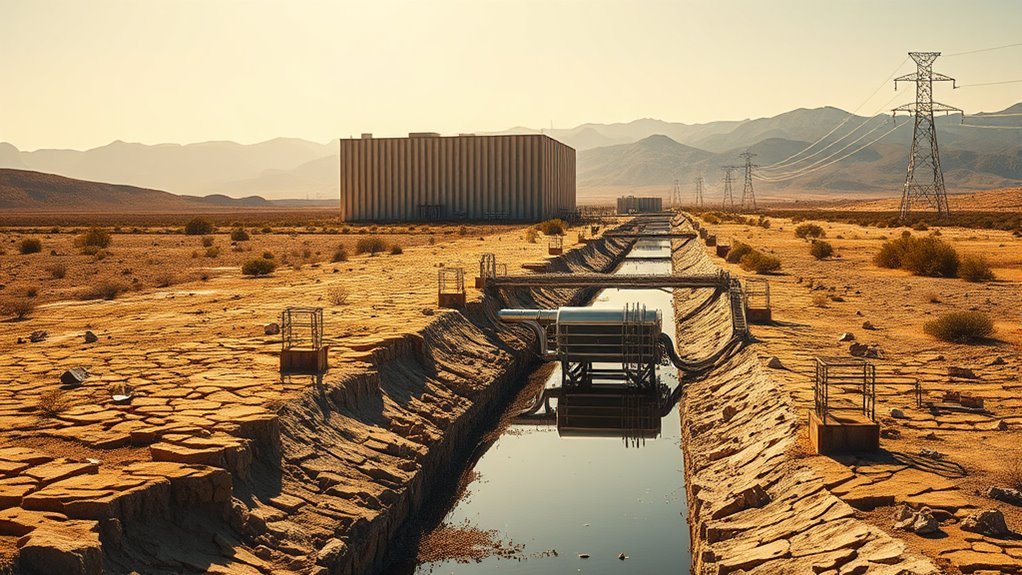

California is racing to build the infrastructure that will power the next wave of artificial intelligence, and water is quickly becoming one of the most contentious pieces of that puzzle. Nowhere is that clearer than in the Imperial Valley, where a single proposed AI data center is forcing the region to ask a basic question that will echo across the industry: how much fresh water should machine learning be allowed to consume in a drought stressed river system.
A new kind of resource fight in Imperial Valley
Imperial Valley Computer Manufacturing, led by developer Sebastian Rucci, is pushing plans for what could become one of California’s largest AI focused data centers near the city of Imperial in the southeastern corner of the state. The project is designed as a roughly 330 megawatt complex with close to one million square feet of floor space and an investment cost in the ten to fifteen billion dollar range, depending on the phase and source consulted.
To keep that facility cool, the company is seeking a substantial share of Colorado River water. Different filings and reports describe the request as about 260 million gallons per year or roughly 750 thousand gallons per day, equivalent to around 880 acre feet and similar to the annual needs of about seven thousand three hundred local residents. Rucci argues that the project would have no net impact on the river because his company has leased roughly 160 acres of farmland and intends to fallow that land, redirecting the existing irrigation allocation from crops to data center cooling. This methodology concerns places the data center in direct competition with agriculture for the same water and turns a local land use decision into a much broader debate about how the Colorado River should be used in the age of AI.
An AI complex seeks Colorado River cooling water equal to thousands of residents, claiming neutrality by fallowing local farmland
From recycled water promises to a river lawsuit
When the project was first introduced, its water strategy was framed as a proof point that high intensity AI infrastructure could grow without touching the Colorado River at all. Rucci and his firm repeatedly pledged that the complex would rely entirely on recycled municipal wastewater purchased from nearby cities such as Imperial and El Centro. A February blog post from his law firm even stated that the facility bought wastewater that would otherwise be discarded and did not use a single drop of the Colorado River.
Behind the scenes, however, negotiations to secure enough reclaimed water proved difficult. According to coverage of the lawsuit and local reporting, talks with municipal providers broke down after months of effort, with cities balking at the volume, reliability commitments, or infrastructure costs required to guarantee a continuous supply for such a large industrial user.
Once that recycled water plan collapsed, Imperial Valley Computer Manufacturing turned to the Imperial Irrigation District, the powerful agency that controls Colorado River deliveries in the valley. The company applied for industrial water service, arguing that IID had a legal duty to provide water on reasonable and nondiscriminatory terms to lands within its boundaries. IID denied the application, and in June 2026 Rucci filed suit in Imperial County Superior Court seeking court ordered access to roughly 260 million gallons of river water per year for the project.
At the same time, county officials, facing rising public concern over water, air quality and energy demand, imposed a temporary forty five day moratorium on new data center approvals, prompting Rucci to seek a restraining order against the county as well. In a matter of months, what began as a local development proposal became a test case for how far AI developers can push existing water institutions in the Colorado River basin.
Why AI data centers consume so much water
To understand why the Imperial project needs that much water, it helps to look at how modern data centers are built and operate. High density AI servers draw enormous amounts of power and generate intense heat, especially when they are tightly packed in racks running computationally heavy training and inference workloads around the clock.
Most large facilities manage that heat with cooling systems that either actively evaporate water in cooling towers or circulate chilled water through heat exchangers. In hot, arid climates like the Imperial Valley, where summer temperatures regularly soar and humidity is low, evaporative cooling is particularly attractive from an engineering standpoint because it can be more energy efficient than fully air cooled systems.
The tradeoff is straightforward but stark. The more you lean on evaporation for efficient cooling, the more water you consume.
Industry data and operational experience suggest that a 100 megawatt data center can draw around one million gallons of water on the hottest days, while the very largest hyperscale campuses may use several million gallons daily, volumes comparable to the needs of tens of thousands of residents. Those numbers are not fixed. They depend heavily on design choices such as cooling technology, server layout, and the extent to which operators are willing to invest in alternative systems like dry cooling, advanced heat recovery, or greater use of reclaimed water.
In other words, the Imperial project is not an outlier in its order of magnitude. It reflects a design pattern that has become common as AI workloads push facilities toward higher power densities and more intensive cooling regimes.
The Colorado River context that makes this fight different
What makes the Imperial Valley case so charged is where the water would come from. The Colorado River is the only major source of fresh water for the valley and a lifeline for cities, farms and ecosystems across a basin that supports roughly forty million people in seven states. Farmers use the majority of California’s Colorado River allocation, often cited at around eighty percent, making agriculture the backbone of local water budgets and a key part of the broader system of interstate river compacts and agreements.
Imperial Valley itself holds some of California’s largest rights to the river and in recent years has used more Colorado River water than all of Arizona and Nevada combined. That scale is a reminder that even relatively modest new claims, like a few hundred million gallons per year for a single data center, are layered on top of a heavily allocated and politically sensitive resource.
From a legal perspective, Rucci’s argument that fallowing farmland keeps the project impact neutral engages directly with existing practices in the basin. Water transfers from agriculture to urban or industrial uses, often paired with compensated fallowing, have become one of the ways the region has managed growth without formally increasing overall allocations.
But these transfers have historically been negotiated through explicit agreements and regulatory review, not asserted via unilateral claims that an irrigation district must provide service on demand.
Local residents and water experts are also quick to point out the optics. When a project is sold to the public on a promise that it will not touch the river and then turns to the river once recycled options prove hard to secure, it erodes trust in both the developer and in the narrative that AI infrastructure can be inherently water responsible.
The bigger picture of California data center water use
It is important to see the Imperial Valley dispute not as a one off anomaly but as a visible case in a much larger trend. Data center water use in California has been climbing rapidly. On site cooling and process water jumped from 1.33 billion liters in 2019 to 2.84 billion liters in 2023, and projections place statewide data center consumption somewhere between 74.54 and 116.63 billion liters by 2028.
Those estimates imply annual growth on the order of seventeen to twenty three percent, assuming current buildout plans continue. That growth is driven both by traditional cloud services and by new AI specific infrastructure. Communities across the state are now fielding proposals for multibillion dollar data center clusters in places like the Imperial Valley and the broader Lithium Valley region, where developers pitch synergies between clean energy, critical mineral production and digital infrastructure.
The pattern is becoming familiar. A company arrives promising high tech jobs, tax revenue and global relevance. Only after the enthusiasm builds do residents start asking hard questions about water, energy and pollution. In several cases, including Imperial County, that scrutiny has already led to pauses or moratoria while local governments try to understand what they are signing up for.
Economic opportunity versus local risk
From a business perspective, the Imperial project captures the promise that AI infrastructure offers to rural regions that have not traditionally benefited from the tech economy. Imperial County has long struggled with high unemployment and a narrow economic base centered on agriculture. The county’s unemployment rate hovers around 17%, underscoring how deeply residents are searching for new kinds of work.
A ten billion dollar data center complex with sustained demand for construction, security, operations and support services would represent a significant new economic pillar. County supervisors who backed the project before the moratorium emphasized job creation and the possibility of attracting related investments in fiber, energy and specialized services.
For local farmers and many residents, though, the risks feel much more immediate. Redirecting irrigation water from fields to servers raises questions about long term land use, local food production, dust and air quality on fallowed lands, and what happens if future drought or federal cuts force reductions in agricultural allocations.
If a data center is tied to a specific farm entitlement and that entitlement is curtailed, does the facility reduce operations or does pressure build to keep cooling water flowing even as crop water is cut further? Those are not abstract concerns. The Colorado River basin is already negotiating reductions in use to stabilize reservoirs, and Imperial Valley is a major part of that conversation.
There is also a trust issue. When a developer reverses course on a central environmental claim and then sues local institutions to obtain water, it signals a willingness to treat legal and political systems as obstacles to be overcome rather than partners in designing sustainable infrastructure. That does not mean the project has no merits, but it does complicate the social license that large industrial facilities increasingly need.
What this means for AI infrastructure and policy
Stepping back, the Imperial Valley case highlights several important inflection points for AI infrastructure.
First, water is becoming as critical a constraint as electricity. Hyperscale AI facilities already face grid and transmission challenges. When they are sited in arid regions, they will increasingly run into water limits as well. That will push operators toward locations with more resilient supplies, deeper reclaimed water systems, or cooler climates where air based and dry cooling are more viable.
It may also force a rethink of how tightly AI workloads are concentrated in a handful of massive campuses versus more distributed architectures.
Second, the case underscores the need for clearer transparency and reporting. Today, many communities only learn about the true water and energy demands of data centers late in the permitting process. California and other states are likely to move toward requirements that data center developers disclose projected daily and annual water use, cooling technologies, and contingency plans if primary water sources become constrained.
That kind of disclosure is essential if local governments are going to weigh tradeoffs honestly.
Third, the lawsuit tests how existing water agencies will interpret their obligations in a changing economic landscape. If courts side strongly with the idea that irrigation districts must provide industrial water whenever a landowner proposes a reallocation from agriculture, it could accelerate a shift of Colorado River water from farms to AI and other tech uses.
If courts allow districts more discretion to consider basinwide sustainability and local priorities, developers will need to negotiate more collaboratively and perhaps accept stricter conditions or limits.
Finally, the dispute surfaces the role of technology choices. There are meaningful differences in water demand between evaporative cooling towers, hybrid systems and more advanced approaches that combine heat recovery, closed loop chillers and aggressive use of reclaimed water.
AI operators that want to build in sensitive basins will increasingly have to prove they are selecting designs that minimize water withdrawals, even at higher capital cost or somewhat lower energy efficiency.
Key takeaways and what to watch next
The Imperial Valley AI data center fight is not just a local zoning battle. It is an early test of how far communities will go to protect finite water supplies as AI infrastructure scales, and how willing developers are to align their designs with that reality. Several practical lessons stand out.
- AI data centers in arid regions will face intense scrutiny over water and will need credible plans that prioritize recycled sources, robust monitoring and fallback options if primary supplies falter.
- Commitments about not using sensitive resources like the Colorado River must be backed by enforceable conditions, not just marketing language. Reversals on those promises carry real reputational and political costs.
- Local governments benefit from pausing when uncertainty is high and insisting on independent analysis of water, energy and air impacts before locking in long term approvals.
- Developers who treat irrigation districts and communities as partners rather than opponents are more likely to find workable solutions, including structured fallowing programs, shared investment in reclaimed water infrastructure and more conservative cooling designs.
Looking ahead, the outcome of the Imperial Valley lawsuit and the county moratorium will send a signal far beyond one project. If the data center proceeds largely as proposed, it will demonstrate that agricultural water can be redirected to AI infrastructure in the Colorado River basin with relatively limited procedural friction.
If regulators or courts impose strict conditions or block key pieces of the plan, it will push the industry toward more water efficient technologies and more cautious site selection.
For AI to grow in a way that is genuinely sustainable, especially in regions already living under the shadow of drought, developers and policymakers will have to treat water as a core design constraint, not an afterthought that can be litigated away.
The Imperial Valley story suggests that communities are increasingly ready to demand that level of seriousness from anyone who wants to build the physical backbone of the AI era.
Conclusion
The battle over water for Californias proposed AI data center in Imperial Valley is a preview of how artificial intelligence will collide with the limits of critical infrastructure across the American West. At the center of the fight is a plan to redirect hundreds of millions of gallons of Colorado River water each year from farmland to a high power computing complex, raising hard questions about who gets to use scarce water as AI demand explodes.
Why this water fight matters right now
Imperial Valley Computer Manufacturing wants to build what would be the largest AI focused data center in California, a roughly three hundred thirty megawatt complex in the desert east of San Diego. To keep that facility cool, the company is seeking about two hundred sixty to two hundred eighty seven million gallons of Colorado River water per year, equivalent to roughly seven thousand three hundred Imperial County residents annual use and about seven hundred fifty thousand gallons a day.
On paper that is a tiny slice of the Imperial Irrigation Districts enormous water portfolio, which totals about three point one million acre feet of Colorado River water annually and represents more than seventy percent of Californias legal entitlement from the river. Yet the Colorado River already supplies drinking water to around forty million people and supports vast agricultural regions, all under long running stress from drought and over allocation.
This combination of relatively small local impact and huge symbolic stakes is why the case has drawn national attention. It crystallizes a larger tension between fast growing AI infrastructure and the physical limits of water, energy and land in places that are already stretched.
How the Imperial Valley project evolved
Imperial Valley Computer Manufacturing, led by developer Sebastian Rucci, originally pitched the project as a water responsible AI complex that would rely entirely on reclaimed municipal wastewater rather than drawing directly from the Colorado River. In early plans, Rucci said the company had agreements to purchase up to six million gallons per day of treated wastewater from the nearby cities of El Centro and Imperial, with the data center itself using about one eighth of that volume and the rest routed to help refill the shrinking Salton Sea.
That vision unraveled when the two cities declined to provide the reclaimed water, citing practical and financial concerns about supplying such large volumes and upgrading infrastructure to move it to the site. After those negotiations failed, the developer shifted strategy and filed a lawsuit in Imperial County Superior Court in June seeking Colorado River water from the Imperial Irrigation District instead.
The lawsuit asks for roughly two hundred sixty million gallons of river water annually for cooling, or about eight hundred eighty acre feet per year, and argues that this water would come from one hundred sixty acres of nearby farmland the company purchased that already has rights to water service. Rucci has framed the plan as a reallocation rather than an increase in total demand, claiming that the farmland would be fallowed and that the data center would use about the same water as a one hundred sixty acre farm, resulting in what he describes as zero net impact on the river.
Local officials and residents have not universally accepted that framing. Imperial County initially approved the project, which was advanced without a full environmental review, but later reconsidered aspects of its support amid mounting public concern over water, power use and governance. The Imperial Irrigation District, a powerful water authority with senior Colorado River rights, declined to provide service, prompting the current legal battle over whether the district is obligated to honor the companys request tied to its farmland holdings.
How much water do data centers actually use
The scale of the Imperial Valley request sits within a broader pattern of rising data center water consumption. A detailed study on data center water use in California found that smaller facilities might use on the order of eighteen thousand gallons per day, mid sized centers around three hundred thousand gallons per day, and hyperscale facilities approximately five hundred fifty thousand gallons per day for on site cooling. By comparison, the proposed Imperial Valley complex would be at the upper end of that range or somewhat above it, given the seven hundred fifty thousand gallons per day cooling figure cited in project documents and media reports.
In aggregate, data centers historically used a relatively modest share of Californias total water, with one estimate pegging statewide on site data center water use at about one thousand seventy eight acre feet around three hundred fifty million gallons in twenty nineteen, though that amount more than doubled by twenty twenty three as cloud infrastructure expanded.
At the national and global level, however, analysts are warning that the rapid growth of AI specific infrastructure could push water demand to a new scale. A recent study cited by advocates at Food and Water Watch suggests that by twenty twenty eight, AI focused data centers across the United States could use as much water for cooling as about eighteen and a half million households. Separate estimates highlighted in public discussions around the Imperial Valley project suggest that AI data centers worldwide may need between roughly six hundred ninety seven million and one point four five billion gallons of new water every day by the end of this decade, with California alone potentially needing hundreds of millions of dollars in water system upgrades to support the industry.
These figures do not mean that every AI data center will trigger a crisis. They do underscore that cooling decisions at each facility are starting to add up. The Imperial Valley case is significant because it is one of the first very large AI specific proposals to collide directly with a river whose flows and allotments are already the subject of intense interstate and tribal negotiation.
Economic promises versus agricultural and community risk
Supporters of the Imperial Valley project emphasize jobs, tax revenue and diversification for a region often described as economically distressed. They note that the requested water represents roughly zero point zero two eight percent of the Imperial Irrigation Districts total annual supply, a fraction small enough that it easily fits within a twenty five thousand acre foot industrial set aside that currently has only about one thousand two hundred acre feet allocated. From this perspective, using several hundred million gallons for high value computing could be seen as an efficient tradeoff compared with traditional agriculture, especially if the farmland involved is fallowed and no new river allocation is required.
There is also a strategic argument. Backers contend that locating a large AI data center near abundant solar resources and existing transmission lines could help California maintain leadership in advanced computing, attract adjacent industries and solidify the states role in global AI development. For Imperial County, this kind of anchor project promises construction activity, long term technical employment and indirect benefits for local services and suppliers, all meaningful in an area where farm work dominates and unemployment has historically been high.
Opponents and skeptics do not contest that the share of total water is small. Their concerns center on precedent, equity and hydrological risk. Environmental groups such as Food and Water Watch argue that using Colorado River water for a water intensive data center is the wrong direction at a time when climate change is tightening supplies and negotiators are struggling to secure long term agreements that balance the needs of cities, tribes and farmers from Colorado to California.
From the perspective of many Imperial Valley farmers, rebranding farmland water rights as a resource for a distant cloud computing economy feels like a shift in the social contract. For more than a century, the regions water has been justified and defended as the backbone of agricultural production that feeds the country, not as a subsidy for data infrastructure whose benefits may flow to tech companies and distant users.
Local residents also raise practical questions. Even if the water volume equals the usage of about seven thousand three hundred people, they ask whether those gallons should be reserved as a buffer for future municipal growth, climate uncertainty or habitat restoration instead of being locked into an industrial cooling requirement that might be hard to adjust later.
Governance and the future of water rights in an AI era
Legally, the case turns on how flexible existing water rights and service obligations are. The Imperial Irrigation District holds senior rights and has historically managed allocations for agriculture, limited industry and urban use under state and interstate frameworks that were not written with hyperscale AI infrastructure in mind. The developer is arguing that purchasing land with water rights and offering to fallow those acres should entitle the project to use that same volume for cooling, essentially treating water as a transferable asset within the district.
Water agencies and many legal scholars caution that such transfers are more complicated than they appear. Moving water from irrigated fields to a permanent industrial user can change return flows, groundwater recharge patterns and local ecosystems, even if total withdrawals from the river remain similar. It also raises questions about how much discretion agencies like the Imperial Irrigation District have to refuse service for new uses they see as inconsistent with their mission or risky for long term planning.
The Imperial Valley dispute is not happening in isolation. Across the West, regulators are beginning to study data center water use more systematically and explore rules that could push new facilities toward reclaimed water, dry cooling technologies or siting in less stressed basins. California research on data center water regulation already highlights the need for clearer disclosure of water use, better alignment between energy and water planning, and more rigorous environmental review of very large projects, all themes that are echoing in the public debate around this AI complex.
What this means for AI and for business strategy
For technology companies and investors, the Imperial Valley fight is an early signal that AI infrastructure decisions cannot treat water as an afterthought. Siting algorithms that once focused heavily on power price, fiber connectivity and tax incentives now need to incorporate water risk, community sentiment and regulatory trajectories as first order constraints.
Projects that depend primarily on fresh river water in drought sensitive basins are likely to face growing scrutiny, delays and legal challenges. By contrast, facilities that design for reclaimed water use, advanced cooling systems with lower consumption, or locations in more resilient watersheds may enjoy a strategic advantage, even if upfront costs are higher.
For local governments and economic development agencies, the case offers a cautionary lesson about negotiating with fast moving AI developers. Imperial County initially embraced the project without full environmental review, banking on promises of reclaimed water and minimal river impact that later proved uncertain. As AI infrastructure proposals proliferate, more jurisdictions will need clear frameworks for vetting water, energy and land impacts before approvals, rather than relying only on project level assurances.
At a societal level, the dispute is sharpening a broader conversation about which sectors should have priority access to scarce water when everyone claims high value uses. Agriculture, cities, tribes, ecological restoration and now digital infrastructure are all making claims on the same finite rivers. Choices made in cases like Imperial Valley will influence expectations in other basins, from the Rio Grande to regions in the Midwest and Southeast that are beginning to see similar tensions between data centers and local water users.
Key takeaways and what to watch next
This case is about much more than one desert data center. It shows how the frontier of AI is pushing deep into the machinery of water law, regional planning and local politics. The volume of water at stake in Imperial Valley is small relative to total Colorado River withdrawals, but symbolically it stands for a new category of demand that is growing fast and tends to be concentrated in already stressed regions.
Several themes are worth watching as the dispute moves through the courts and public hearings. One is whether the legal system treats farmland water rights as easily repurposed for industrial AI infrastructure or insists on stricter checks, particularly around environmental review and community input. Another is how regulators respond to the broader wave of AI driven water demand, including possible requirements for reclaimed water use, transparency in reporting and integration of data center plans into basin wide climate resilience efforts.
However the Imperial Valley case is resolved, it will not be the last time that advanced computation collides with questions of scarcity, equity and regional resilience. The decisions made here will help define the unwritten rules for how societies prioritize digital infrastructure versus farms, homes and ecosystems in a hotter and more resource constrained world. For AI developers, utilities, and communities alike, treating water as a central design constraint rather than a background utility is no longer optional. reddit