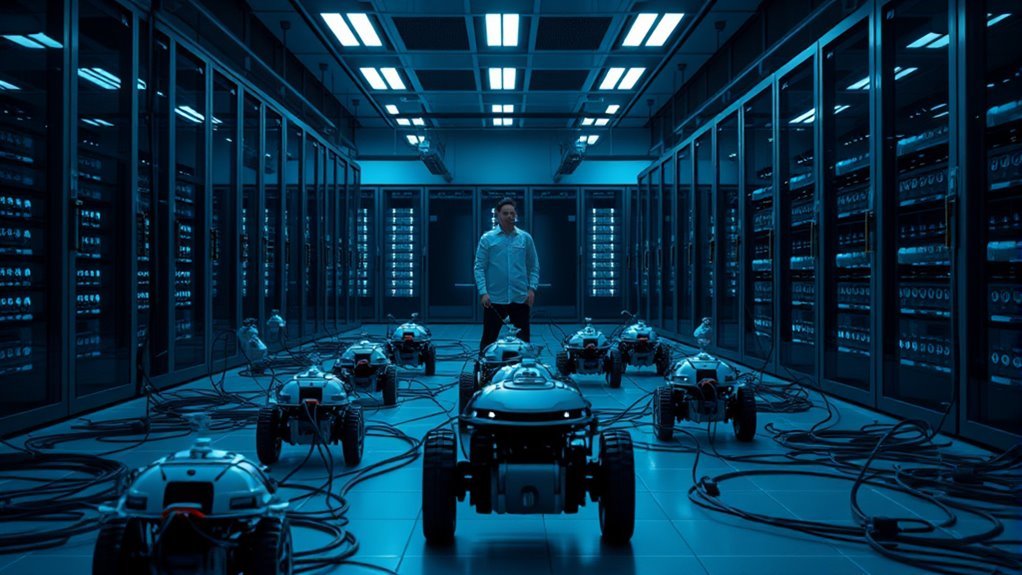
The Moonshot AI story is about much more than a single Chinese startup and a few racks of Nvidia hardware. It is quickly becoming a test case for how far Washington will go to defend its lead in advanced artificial intelligence and to punish what it sees as illicit use of US chips and models.
Why This Matters Now
Moonshot AI did not appear out of nowhere. Its Kimi K3 model landed in an already tense environment where the United States has spent years tightening controls on advanced semiconductors and cloud infrastructure for Chinese firms. Kimi K3 stunned many observers with its capabilities and its unusually open weights, and that alone would have invited scrutiny. Moreover, AI risks categorized alongside epidemics and cyberattacks raise the stakes for such technologies.
What turned scrutiny into a sanctions conversation are two specific allegations from senior US officials. First, that Moonshot AI accessed Nvidia GB300 processors from the Blackwell generation through servers located in Thailand in violation of US export controls. Second, that the company engaged in large scale distillation of proprietary American models, including Anthropic’s Fable family, to bootstrap Kimi K3.
Those claims sit at the intersection of hardware policy, cloud regulation, and intellectual property law. They are why Moonshot is now being discussed alongside Huawei and other Chinese firms that have previously triggered some of the harshest US technology sanctions.
The Long Build Up In US AI Hardware Controls
To understand the Moonshot case, it helps to look at how the United States arrived at the current regime for AI chips.
Across multiple administrations, Washington has progressively restricted export of high end GPUs and accelerators to Chinese entities, arguing that access to top tier compute can accelerate military and surveillance capabilities. Blackwell chips including the GB300 are classified as among the most sensitive of Nvidia’s data center products and are explicitly banned from sale to Chinese companies.
By contrast, somewhat less capable processors such as Nvidia’s H200 have been allowed into China in controlled quantities under license and case by case review. This tiered system reflects a clear policy logic. The United States wants to preserve a meaningful gap in access to frontier level compute while allowing limited commercial engagement at lower performance tiers that are considered less strategically dangerous.
Kimi K3 arrives in the middle of this delicate balancing act. Allegations that Moonshot AI effectively tapped Blackwell class compute through Thailand threaten to undermine confidence in the entire structure of export controls.
What US Officials Say Moonshot AI Did
Michael Kratsios, Director of the White House Office of Science and Technology Policy, publicly accused Moonshot AI of acquiring servers equipped with Nvidia GB300 chips and accessing those GB300s via Thailand to train its models. He framed these actions as violations of US export rules and of the terms of service imposed by American AI providers whose models were allegedly distilled. US trade officials say the Bureau of Industry and Security has opened a federal investigation into whether Moonshot’s use of Nvidia hardware and proprietary American AI models for Kimi K3 breached those same export rules and contractual restrictions.
Reports from Quartz, Japan based outlets, and financial media all describe a similar picture. Moonshot AI is said to have either purchased GB300 equipped servers or gained remote access to such infrastructure deployed in Thailand, using that environment to power training for Kimi K3.
Nvidia has stated that it complies with export control regulations and does not exploit loopholes, while declining detailed public comment on the specific Moonshot allegations. Moonshot AI and Chinese government representatives have also not offered substantive public responses, leaving the claims largely one sided for now.
This asymmetry of information is important. Independent technical evidence about where and how Kimi K3 was trained has not yet been fully aired in public, and even some experts interviewed by technology publications have urged caution about drawing sweeping conclusions from limited data.
The Cloud Loophole And The Thailand Question
The focus on Thailand is not incidental. It speaks directly to what US trade officials are calling the cloud loophole.
Under current rules, certain high end chips cannot be exported to Chinese entities or physically installed in China. However, the regulations are less explicit about scenarios where a Chinese company remotely accesses compute hosted in a third country, whether through a subsidiary, a colocation provider, or a public cloud offering.
Investigators at the Bureau of Industry and Security are scrutinizing whether Chinese firms including Moonshot AI are using overseas infrastructure to gain de facto access to restricted chips. If a Chinese company can simply rent time on foreign GB300 servers and drive training jobs from Beijing, then the practical effect is similar to owning those chips on Chinese soil.
That possibility raises uncomfortable questions for regulators about how far export controls should extend into service based models and the governance of cross border cloud platforms. Several reports quote US officials describing this as a structural vulnerability in current policy that needs to be closed, not just a one off Moonshot issue. The outcome of the investigation will likely shape future rules for AI infrastructure providers in Southeast Asia, Europe, and even the United States.
Kimi K3 And Why It Raised Red Flags
Kimi K3 is reportedly the largest open weight language model currently available, with a scale that puts it in direct comparison with the most advanced systems from OpenAI and Anthropic. It has been marketed as a model that matches or surpasses Western competitors at dramatically lower runtime costs, thanks in part to aggressive optimization and system design.
That combination of size, openness, and performance generates both excitement in the research community and alarm in policy circles. From a technical perspective, it shows how quickly global players outside the usual US based ecosystem can catch up when they have sufficient talent and compute.
From a policy perspective, it intensifies concerns that export controls and intellectual property safeguards are not keeping pace with the speed of AI progress. It is notable that some experts interviewed by technology media have suggested that exploiting Anthropic’s Fable model alone is unlikely to fully explain Kimi K3’s capabilities. They point instead to broader factors such as large scale data collection, sophisticated training pipelines, and possibly significant access to high end hardware whether through licensed or unlicensed channels.
This split between political narratives and technical nuance is characteristic of high stakes AI debates. It reinforces the need to separate what can be independently validated from what remains allegation or inference.
Distillation Where The Line Between Common Practice And IP Theft Is Moving
Model distillation is a standard technique in machine learning. A more capable teacher model generates outputs that are used to train a student model, often yielding smaller systems that retain much of the teacher’s competence. In research and open source contexts, this is considered normal practice, especially when the teacher is itself open or permissively licensed.
The controversy arises when distillation targets proprietary closed models whose operators explicitly forbid such use in their terms of service. Kratsios alleged that Moonshot AI ran large scale distillation operations targeting Anthropic’s Fable model to help create Kimi K3. Anthropic has separately warned about what it calls industrial scale extraction campaigns aimed at its most advanced systems.
According to several outlets, US briefings claim investigators have identified watermarks and other signals in some Chinese models that are consistent with outputs from US large language models, which officials interpret as evidence of systematic harvesting rather than incidental benchmarking.
Treasury and Commerce officials are beginning to frame such activity as intellectual property theft rather than fair use, especially at scale and when it appears designed to recreate restricted capabilities in competing systems. This reframing matters because it opens the door to financial sanctions and Entity List designations based not only on hardware violations but also on data and model misuse.
At the same time, it is important to acknowledge that technical and legal communities are far from consensus on where the boundary should lie. Training on the outputs of a proprietary system sits in a gray zone that touches copyright, contract law, and trade secrets. The United States is clearly moving toward a stricter stance, but not every jurisdiction will follow that interpretation immediately.
What Sanctions Could Look Like In Practice
If Moonshot AI is found to have violated export controls or engaged in conduct that US authorities deem IP theft, several tools are potentially on the table.
Commerce could add Moonshot AI and associated entities to the Entity List. In practice, that would sharply limit their ability to buy US hardware, software, and cloud services, and it would pressure allied countries to adopt similar restrictions. Treasury could impose financial sanctions that cut Moonshot off from US capital markets and complicate transactions through international banking channels.
For a fast growing AI startup, either step would be existential. Sanctions would raise costs, disrupt access to advanced chips and tooling, and deter foreign partners from collaboration or investment. They would also send a strong signal to other firms that are considering aggressive strategies for acquiring compute or training on proprietary models.
From a broader industry perspective, sanctions could accelerate the bifurcation of AI ecosystems. Chinese firms might double down on domestic supply chains and alternative hardware providers, while US and allied companies reinforce technical and contractual barriers around their models and cloud platforms. Over time, this could lead to parallel stacks of hardware, software, and data practices with limited interoperability.
Yet sanctions also carry risks. They can push sensitive activities deeper into opaque networks, encourage workarounds such as black markets for chips, and make it harder for regulators and researchers to engage constructively with foreign labs. Some experts have already noted the existence of informal channels for acquiring restricted hardware, suggesting that enforcement is never perfect even when rules are strict.
Implications For Technology, Business, And Society
On the technology side, the Moonshot case will likely influence how labs around the world think about training pipelines. Expect more emphasis on verifiable provenance of data and outputs, clearer documentation of hardware environments, and stronger internal controls to ensure compliance with export rules and provider terms.
Businesses that rely on US cloud and model providers may see tighter contractual guardrails. Providers will be motivated to monitor usage patterns more closely, to detect large scale distillation behavior, and to log where workloads are originating and what infrastructure they touch. This could raise compliance costs but also enhance trust for enterprise customers.
Societally, the episode underscores how AI is no longer just about innovation and competition in a commercial sense. It is part of a larger geopolitical contest where models and chips are treated as strategic assets. Regulatory moves that might have been niche a decade ago now have ripple effects across academic research, startup ecosystems, and even consumer access to advanced tools.
How This Fits Into The Broader US China Tech Contest
The Moonshot allegations fit into a continuum that includes export controls on Huawei, restrictions on advanced lithography equipment, and tightening rules on data transfers and surveillance technology. They show that large language models are now firmly within the core of technology competition, not at the periphery.
For China, the lesson is that success with models like Kimi K3 will automatically trigger questions about provenance and compliance. For the United States, the challenge is to design rules that genuinely protect strategic interests without strangling the legitimate global exchange of ideas and innovation.
Other countries watching this dispute will be thinking about their own positions. Southeast Asian nations hosting data centers, European cloud providers, and allied governments will have to decide how closely to align with US interpretations of cloud based export controls and IP theft in the era of model distillation.
What To Watch Next
Several threads will determine where this story goes.
Whether investigators publish more detailed evidence tying Kimi K3 training runs to specific GB300 installations in Thailand or elsewhere. Whether Moonshot AI or Chinese authorities offer a technical rebuttal or alternative narrative, for example by disclosing training infrastructure and data sources.
Whether US agencies move from public criticism to formal designations or sanctions, and how quickly they do so. Whether major US AI firms update their terms of service and enforcement tools in light of this case, perhaps setting new norms for how distillation and benchmarking are allowed or restricted.
Each of these developments will influence not only Moonshot’s future but also how the global AI community understands acceptable practice in a world where compute and models are both heavily contested resources.
Takeaways And Forward Looking Insights
The Moonshot AI controversy is a reminder that frontier AI is now inseparable from geopolitics and trade law. Training a state of the art model is no longer just a matter of talent and engineering. It is also a matter of where your servers sit, whose chips you use, and which models you touch during development.
If US authorities ultimately impose sanctions, Kimi K3 may become a cautionary tale about the cost of operating in the gray zones of export controls and IP. If the evidence proves more ambiguous and sanctions are withheld, it could instead push policymakers toward more precise rules for cloud based compute and model usage.
Either way, expect more focus on traceability. Labs will need to show not only that their models work but that they were trained in ways that regulators and partners consider legitimate. Transparent documentation of hardware, cloud providers, and teacher models will become part of the trust equation, not just performance benchmarks.
For practitioners, the practical guidance is straightforward. Know the rules for the jurisdictions you touch. Treat proprietary models as sensitive assets and respect their usage policies. Plan infrastructure so that you are not inadvertently crossing red lines on export controls.
The Moonshot case may feel specific today, but it is an early signal of how governments intend to police the next wave of AI development. The labs that adapt quickly will have a better chance of building powerful systems that are not only technically impressive but also durable in a world of increasingly assertive regulation.
Conclusion
Washington’s threat to sanction Moonshot AI is not just another skirmish in the long running technology rivalry between the United States and China. It marks a moment when AI training practices and chip access are being pulled into the same enforcement frame that has already reshaped global trade in semiconductors and advanced computing.
Why this story matters right now
The immediate trigger is a set of allegations that Moonshot AI, a Beijing based lab, trained its Kimi K3 chatbot by systematically distilling Anthropic’s Fable model at industrial scale, while also tapping restricted Nvidia Blackwell GB300 hardware through offshore data centers. US officials say they can see traces of US models embedded inside Chinese systems and describe these activities as coordinated distillation attacks rather than ordinary model benchmarking or fine tuning.
Treasury Secretary Scott Bessent has publicly warned that sanctions and placement on the Commerce Department’s Entity List are on the table for Chinese AI firms that engage in covert model theft, explicitly tying future penalties to patterns of distillation he considers evidence of intellectual property violations. At the same time, the Commerce Department’s Bureau of Industry and Security is examining whether companies such as Moonshot have illegally accessed restricted US chips, including GB300 servers that are barred from sale to Chinese entities, possibly via infrastructure in Thailand or other third countries.
These moves come as frontier models are growing more capable and security sensitive, which has pushed both Washington and Beijing to treat advanced AI systems more like controlled strategic technologies than ordinary software products.
How we got here
The hardware side of this story began in earnest in twenty twenty two when US regulators told Nvidia and other chipmakers to stop exporting their high end A100 and H100 series accelerators to China and Russia, along with any chips with comparable performance that could be used for large scale training. Those early rules signaled that Washington considered cutting edge AI hardware a national security concern, and they have since expanded to cover newer generations such as Nvidia’s Blackwell GB300 line for Chinese customers.
On the model side, concerns about distillation have been building throughout twenty twenty six. In February Anthropic revealed that three Chinese labs DeepSeek, Moonshot AI, and MiniMax had systematically extracted capabilities from its Claude models through more than sixteen million API exchanges, describing a distillation cascade in which outputs from expensive frontier systems are harvested to train cheaper domestic models. Later in the year, Anthropic accused Alibaba’s Qwen lab of carrying out the largest known distillation campaign, with almost twenty nine million exchanges, while Moonshot’s own activities against Anthropic were reported at over three million exchanges.
By July senior US officials were willing to name specific companies and models. White House science and technology policy director Michael Kratsios accused Moonshot AI of covertly distilling Anthropic’s Fable model to build Kimi K3 and of using GB300 equipped servers despite export controls, drawing a direct line between model level conduct and hardware enforcement. Treasury officials then paired those claims with explicit warnings that Chinese firms engaging in similar patterns of behavior could face sanctions and Entity List designations.
In parallel, Chinese authorities have started exploring their own export controls on AI models. Reuters reporting and subsequent analysis describe Ministry of Commerce meetings in mid twenty twenty six with Alibaba, ByteDance, and Zai about restricting overseas access to China’s most advanced systems, including unreleased frontier models and open weight releases that have been a key channel for global adoption. That suggests Beijing now views leading AI models as national assets that may be subject to outbound controls analogous to Washington’s hardware restrictions.
What Washington is actually investigating
There are two distinct threads in the Moonshot case.
First is the question of model provenance. US officials allege that Kimi K3 was trained in part by feeding Anthropic’s proprietary Fable model vast numbers of prompts and using the resulting outputs as labels, in a way designed to replicate Fable’s behavior rather than merely benchmark or refine Moonshot’s own system. They point to digital watermarks and other technical signatures that US labs embed in their outputs as evidence that Anthropic content has been deeply integrated into Chinese models.
Second is the issue of chip access. The Commerce Department’s Bureau of Industry and Security is examining whether Moonshot AI or related entities have used Nvidia GB300 hardware, which falls under US export restrictions for Chinese firms, by routing training workloads through servers in places such as Thailand and possibly via cloud providers that may not have fully enforced US rules. If investigators conclude that export controls were violated, Moonshot could be added to the Entity List, cutting it off from future access to US technology including cloud based services and specialized hardware. Treasury, for its part, is assessing whether the alleged distillation activities rise to the level of sanctionable intellectual property theft that would justify financial penalties and restrictions on US persons dealing with the company.
None of these actions has been finalized. Commerce officials describe the process as ongoing and preliminary, and Moonshot has not publicly responded in detail to the claims, leaving important technical questions still unanswered.
Distillation is moving from research trick to regulatory flash point
Model distillation began as a relatively innocent technique in the research community. Labs often train a smaller or more efficient system to mimic a larger one by learning from its outputs, a practice that helps deploy AI on devices with limited compute or reduce inference costs. In many settings that is uncontroversial.
The tension arises when distillation becomes an industrial scale campaign targeted at proprietary frontier models that incorporate confidential safety techniques, security relevant capabilities, and expensive human feedback. Anthropic’s disclosures about millions of exchanges with Chinese labs and the recent accusations against Moonshot and other firms show distillation being used strategically as a way to capture the behavior of US models that are not themselves licensed or open weight.
US officials now describe these large campaigns as distillation attacks, a phrase that signals their view that the practice, at scale and without permission, crosses from clever engineering into unauthorized copying of protected intellectual property. Treasury’s warning that open source is not a free pass to appropriate American IP underlines how regulators are drawing new boundaries in an environment where model weights, APIs, and open source releases blur traditional legal categories.
For labs worldwide this is a notable shift. Many teams have quietly used outputs from API accessible models to bootstrap their own systems, often assuming that paying for usage and respecting rate limits was enough. The Moonshot case suggests that regulators are prepared to scrutinize logs, query patterns, and watermark evidence to decide whether a training regime constitutes legitimate use or actionable theft.
Chips and models are converging into a single control system
The Moonshot investigation sits at the intersection of hardware and software control regimes. On one side, Washington is tightening restrictions on high end Nvidia chips, making it harder for Chinese labs to train large models domestically or through foreign cloud providers. On the other, US agencies and labs are experimenting with digital watermarks and provenance frameworks to track how frontier models are used in downstream training and to flag suspicious patterns of distillation.
Beijing is responding in kind. The Ministry of Commerce discussions about limiting overseas access to top Chinese models indicate that China is building its own software layer export controls, potentially requiring filings for basic tools, security reviews for intermediate systems, and domestic only rules for the most advanced models. Analysts note that this mirrors the trajectory of hardware controls and risks creating a world of two partially isolated AI ecosystems, each treating its frontier models as strategic assets with restricted circulation.
For global companies, this convergence means that compliance can no longer focus on one side alone. Cloud providers need to know which chips are being used for which customers, where those servers are located, and whether any activity might violate export rules. AI developers need to track which external models, data sources, and APIs feed into their training runs and maintain documentation that can withstand regulatory audits.
What this means for AI labs and businesses
If Washington follows through with sanctions or an Entity List designation, Moonshot AI would join firms such as Huawei in facing broad restrictions on access to US technology, including chips, cloud services, and some software tools. That would be a significant shock for any lab trying to operate at the frontier, and it would send a signal to other Chinese companies, including Alibaba and its Qwen division, that distillation campaigns against US models carry real commercial risk.
Even without immediate sanctions, the threat is already reshaping incentives. US labs are likely to invest more in watermarks, logging, and monitoring of API usage to detect large scale siphoning of their models, and they may tighten terms of service or limit available capabilities for untrusted markets. Chinese labs face a more complex environment as they navigate domestic rules on data and security, potential outbound model controls, and foreign enforcement actions that could cut off essential hardware and cloud access.
For multinational firms that rely on AI tooling in both jurisdictions, the situation introduces new operational and legal uncertainties. Due diligence on vendors now has to consider not only data privacy and safety practices but also the provenance of models and hardware, with boards asking whether any key suppliers might suddenly lose access to US chips or be targeted by sanctions.
There is also a broader societal implication. As AI systems become woven into critical infrastructure, finance, and media, governments are understandably concerned about who controls the most capable models and how they are trained. At the same time, aggressive unilateral enforcement can fracture global research collaboration and undermine fledgling efforts at bilateral AI safety dialogue between the United States and China. Balancing legitimate protection of IP and security with the need for shared standards and cooperative risk management will be difficult, and the Moonshot case is an early test of how far each side is willing to go.
What remains uncertain
Several key questions are still open. Investigators have not yet published technical evidence about the scale and exact nature of Moonshot’s distillation activities, beyond high level descriptions and aggregate query counts from Anthropic and US officials. Export control findings regarding Nvidia GB300 access are also pending, and public reporting suggests that internal government discussions about adding Moonshot to the Entity List or imposing sanctions are still at an early stage.
Chinese policy on outbound model controls is similarly unsettled. The meetings with leading platforms such as Alibaba and ByteDance point to serious intent, but analysts note that China has not yet codified a full framework, and practical enforcement across fast moving open source channels will be challenging.
There is also the matter of precedent. If Washington sanctions Moonshot primarily for distillation, that would effectively define a new category of AI specific IP violation and could shape how courts and regulators view similar practices in other jurisdictions. If instead the case ends with quieter export control enforcement and informal pressure, the lesson for labs may be more about careful routing of compute and less about rethinking training norms.
Takeaways and what to watch next
Moonshot AI has become a focal point for a wider set of questions about how far governments will go to police model training and hardware access in the age of frontier AI. US officials are signaling that industrial scale distillation against proprietary models and creative workarounds of chip bans are no longer tolerated as standard practice, but rather treated as potential IP theft and export control violations with real economic consequences.
In the coming months several inflection points will determine how disruptive this shift becomes. Key markers include any formal findings by the Bureau of Industry and Security on Nvidia hardware access, Treasury decisions on sanctions or related financial measures, and concrete steps by Beijing to implement outbound model controls that mirror US chip restrictions.
Regardless of the immediate outcome, the direction is clear. Frontier AI development is moving into a world where provenance documentation, watermarking, and careful compliance are as central to competitive strategy as scaling compute or hiring elite research talent. Labs and businesses that embrace rigorous transparency around how their models are trained and what hardware they rely on will be better positioned to navigate the emerging rules. Those that treat distillation and creative chip routing as cost saving shortcuts may find themselves at the center of the next enforcement wave. reddit