
Artificial intelligence is starting to do something biologists have dreamed about for decades: listen carefully enough to hear structure in the sounds of other species. That shift matters right now because the same techniques that transformed machine translation and speech recognition are being aimed at whales, dolphins, birds, and insects, backed by serious funding, large scale data collection, and increasingly ambitious claims from the labs involved. AI safety is becoming a crucial consideration as these technologies evolve.
From science fiction to serious programs
For much of the twentieth century, decoding animal communication sat somewhere between mainstream ethology and science fiction. Early work on dolphin communication in the nineteen sixties and seventies generated grand promises, but the tools never matched the ambition. Decades of research on dolphin cognition, including gesture-based communication studies, suggest that their vocalizations may encode complex languages that AI systems are only now becoming powerful enough to probe. Researchers relied on tape recordings, manual spectrograms, and simple statistical analyses. They could count call types and correlate some sounds with clear behaviors, but they could not uncover deeper structure with any confidence.
Armed with tape decks and spectrograms, early dolphin research glimpsed voices it lacked tools to truly decode
What changed is the arrival of modern machine learning. The same pattern recognition methods that can distinguish one human voice from another in a noisy room now operate on terabytes of underwater audio, forest soundscapes, and bird colonies. Organizations such as Earth Species Project have formalized this shift by making decoding nonhuman communication their sole mission and building teams that combine AI researchers with field biologists and conservation practitioners.
Earth Species Project, founded in the late twenty tens, has grown into one of the best-known groups in this area, operating as a nonprofit that aims to use frontier AI to understand and eventually interact with animals at scale. The organization has articulated a technical roadmap that moves through four phases, from assembling and cleaning data to learning general acoustic representations, to decoding meaning, and finally to interactive communication experiments. That staged approach is important because it keeps expectations realistic and separates ambitious long-term goals from the near-term utility of better pattern detection.
How AI is actually listening to animals
The core technical shift is that models no longer depend on human-labeled examples of what each call means. Instead, self-supervised and unsupervised methods learn structure directly from raw audio in much the same way large language models learn from text.
In practice, researchers place dense networks of recorders around habitats, attach tags to individual animals where feasible, and sometimes use drones or autonomous vehicles to extend coverage offshore. These systems stream continuous sound along with time stamps and, when possible, video or movement data from biologging tags. That creates a rich pairing of vocalizations with context such as who was nearby, what the animals were doing, and which environmental events were occurring, such as prey bursts or passing ships.
Self-supervised models can then learn to compress this audio into latent representations that capture recurring units, rhythms, and combinations without being told in advance what to look for. Later, those patterns are linked back to observed behaviors in a more classic supervised step. The goal is to move from shallow clustering of sounds by frequency to discovering internally coherent units that might correspond to names, group identifiers, or activity-specific signals.
Because labeled biological data are expensive, there is intense interest in multimodal and cross-species foundation models. Earth Species Project describes its aim as building species-agnostic foundation models of animal communication, the acoustic equivalent of general-purpose language models but trained on diverse animal sounds rather than primarily human text. These foundation models are expected to support downstream tasks such as automatic call clustering, event detection, individual recognition, and eventually the generation of candidate signals for controlled playback experiments.
Case study: Sperm whales and the search for structure
The strongest demonstration so far that these methods can reveal deeper structure comes from work on sperm whales. Sperm whales communicate using patterns of clicks called codas. Earlier research identified about twenty-one distinct coda types, a relatively small repertoire that suggested a limited system.
Using modern AI methods on almost nine thousand recordings, researchers working with the CETI initiative and collaborators expanded that repertoire to about one hundred fifty-six distinct coda types. They also identified more basic building blocks inside codas that behave a little like phonemes in human language, with features such as rhythm, tempo, and additional ornamental clicks combining to create different codas.
Crucially, this pattern looks combinatorial rather than reflexive. The whales seem to construct codas and sequences of codas from a finite set of acoustic features, which in principle allows a large space of possible messages, much like humans combine phonemes into words and words into sentences. Researchers argue that such combinatorial structure is a prerequisite for more advanced linguistic properties, even if no one is claiming that sperm whales use language in a human sense yet.
AI did not solve the entire problem here, but it made the search tractable. Models could sift through thousands of hours of recordings, test different ways of grouping codas, and highlight subtle timing differences that human listeners would likely miss. That is exactly the kind of pattern discovery at scale that this new wave of animal communication research depends on.
Foundation models for animal communication
The move toward foundation models represents a strategic bet. Instead of building one bespoke model for dolphins, another for sperm whales, and another for birds, organizations like Earth Species Project are developing general architectures that ingest many kinds of audio data and learn representations that transfer across species.
On the technical side, this means training large audio language models on mixtures of human speech, music, and environmental sounds, then fine-tuning or adapting them with focused animal datasets. The hypothesis is that some structural regularities, such as the way temporal patterns encode information, will be shared across very different acoustic systems. If so, a model that has already learned to compress and predict complex human audio may need less animal-specific data to reach useful performance.
ESP describes its work on multimodal foundation models for animal language processing as creating something like the GPT-4 of animal communication, with a single architecture that can support a spectrum of tasks rather than one specialized system per species. Their public technical roadmap emphasizes interoperable datasets, open-source tooling, and clear evaluation benchmarks, which are all crucial if this field is going to mature beyond isolated case studies.
Implications for science, business, and society
If these efforts succeed even partially, the consequences will extend well beyond academic curiosity.
For basic science, better tools for decoding animal communication will transform ethology. Researchers would be able to quantify social relationships, track group decision-making, and monitor stress or excitement levels without always needing direct visual observation. Sperm whale work already hints that some marine mammals may use more structured communication systems than previously assumed, which could push comparative cognition research to reconsider old assumptions about the uniqueness of human language.
In conservation, always-on acoustic monitoring driven by AI could act as an early warning system. Automated recognition of species-specific calls and distress signals could help detect illegal hunting, map migration routes, and identify critical habitats more efficiently than periodic surveys. Earth Species Project explicitly frames its mission as amplifying the voice of nature and rebalancing the relationship between humans and the natural world, which aligns with a broader trend of connecting AI development to ecological goals.
There are business implications as well. Companies already sell AI-enabled bioacoustic monitoring for wind farms, shipping routes, and agricultural settings. More capable models could accelerate that market, from precision agriculture systems that respond to livestock vocalizations to maritime monitoring tools that help fleets comply with noise regulations and marine protection measures. Frontier animal communication models could become a specialized infrastructure layer that many such applications rely on, similar to how general language models now sit underneath chatbots and productivity tools.
Socially, the prospect of more meaningful exchanges with animals could change public attitudes quickly. Earth Species Project has begun surveying global opinion on AI and interspecies communication and has found considerable interest along with concern about the potential for misuse. As these stories move from research journals into mainstream media, expect debates about animal personhood, rights, and the moral status of intelligent nonhuman species to intensify.
Risks, limits, and hard problems
Despite the excitement, there are serious reasons for caution.
First, pattern detection is not the same as understanding. AI models are extremely good at finding statistical regularities, but meaning in animal communication depends on context, shared history, and embodied experience. A model that clusters dolphin whistles into neat categories may simply be reflecting acoustic similarity, not genuine semantic classes. Without careful experimental validation, there is a real risk of projecting human concepts onto patterns that the animals do not use in the same way.
Second, data bias is a major concern. Acoustic datasets usually overrepresent individuals and locations that are convenient to record, such as animals near research stations or in accessible coastal waters. That can skew models and lead to overconfident claims that do not hold for wider populations. Efforts by groups like ESP to build broader shared datasets, along with open repositories of animal vocalizations, are a step in the right direction but will not fix sampling bias overnight.
Third, there are ethical risks. If AI systems can generate signals that influence animal behavior, such as attracting whales or deterring predators, there is potential for both positive interventions and harmful manipulation. Conservation-driven projects may want to nudge animals away from dangerous areas, whereas commercial actors could be tempted to use similar tools for more exploitative purposes. Without careful governance and strong collaborations between technologists, ethicists, and local communities, these capabilities could outpace the norms and regulations needed to manage them responsibly.
Finally, there is the question of expectations. Public imagination jumps quickly from incremental scientific advances to cinematic visions of fluent dialogue with dolphins. Serious groups in this field emphasize that their immediate goals are far more modest: better classification, better understanding of social structure, and more robust monitoring. Framing the work as a long-term scientific program, rather than imminent conversation with whales, is essential for maintaining trust.
What to watch next
Over the next few years, several milestones will indicate whether this field is truly maturing.
Expect to see more case studies like the sperm whale work, where large acoustic datasets and advanced models reveal previously unknown structure and where independent teams can replicate and extend the findings. Watch for stronger integration between foundation models and traditional behavioral experiments, including playback studies that test whether AI-generated signals elicit consistent responses in wild animals.
On the technical side, progress will be visible if animal-focused foundation models begin to appear as reusable platforms in the way general language models already have, with clear benchmarks that show transfer learning across species and environments. On the societal side, surveys and public engagement efforts will show whether people see AI-enabled animal communication as a tool for empathy and conservation or as another domain where technology might overstep.
The most important takeaway is that decoding animal communication is no longer a distant fantasy. It is a serious, well-funded research effort that sits at the intersection of AI, biology, and ethics, with real potential both to expand human understanding and to reshape how society relates to other species. The choices made now about data governance, openness, experimental design, and commercial use will determine whether future conversations with the rest of the living world are grounded, respectful, and scientifically sound or whether the field gets lost in hype and misinterpretation.
Conclusion
Artificial intelligence is starting to treat dolphin whistles and other animal sounds as structured signals rather than mysterious noise, and that shift could change how humans relate to the rest of the living world. It matters now because the tools are finally good enough to detect patterns at scale, yet still immature enough that mistakes could seriously affect wild animals and the ecosystems they inhabit.
From speculative dream to data driven science
For most of the twentieth century, the idea of talking with animals sat somewhere between science fiction and clever experiments that never quite scaled. Early work relied on painstaking human listening, simple spectrograms and small datasets, which made it hard to distinguish meaningful communication from background sound. Playback experiments, where researchers broadcast recorded calls to animals and watched how they responded, revealed glimpses of structure but also raised concerns about stress and disrupted social relationships.
The turning point came as sensing technologies matured. Passive acoustic monitoring, animal borne tags and long term video systems began to capture continuous audio and behavior in natural habitats, including complex overlapping calls in busy colonies and pods. That flood of data created the same problem that transformed other fields. There was suddenly more information than humans could annotate or interpret by hand.
Bioacoustic researchers and machine learning specialists started to converge. Projects such as Earth Species Project and related efforts argued that animal communication should be treated as a representation learning problem, not just a classification task. Early machine learning tools focused on narrow jobs such as detecting particular species or labeling known call types, but newer models learn general features directly from raw recordings, then reuse those features across tasks and even across species.
To compare methods fairly, researchers built benchmarks such as BEANS, a shared set of animal sound datasets used to evaluate machine learning models and encourage reproducible progress. At the same time, popular science coverage described how algorithms were uncovering patterns in the vocalizations of dolphins, whales, bats and prairie dogs that look, at least statistically, like names, grammar or descriptive detail. These claims are often simplified in public discussion, but they reflect real advances in signal analysis and pattern discovery, not magic translation.
What the new dolphin models actually do
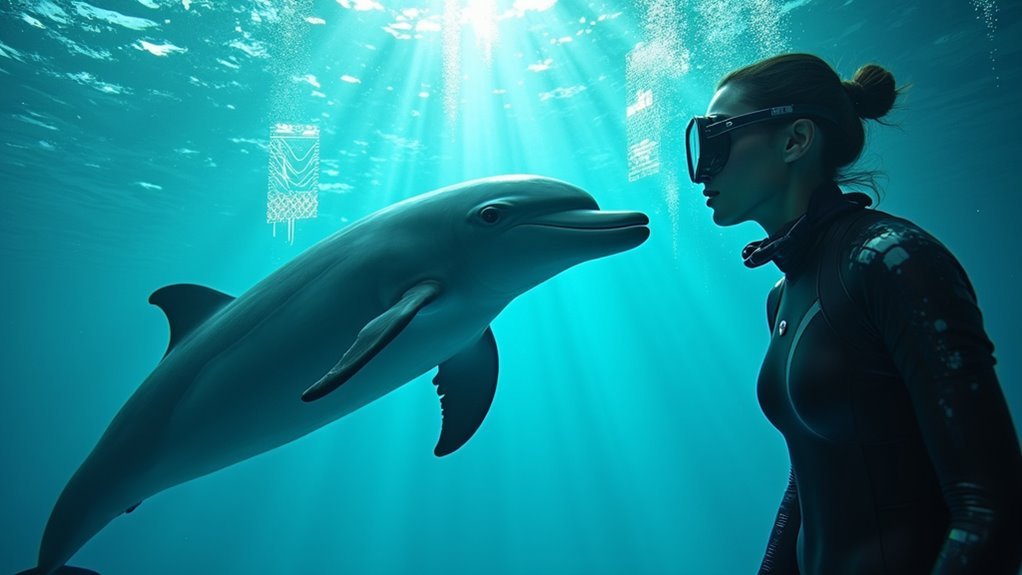
The most visible example of this new wave is DolphinGemma, a foundation model that Google built with collaborators at Georgia Tech and the Wild Dolphin Project. The team trained the system on roughly forty years of recordings from a long running study of wild bottlenose dolphins, focusing on so called signature whistles that function as individual identifiers within dolphin communities.
DolphinGemma learns the structure of dolphin vocalizations and can predict what whistle or click sequence is likely to come next, given previous sounds and context. In practice, that means the model builds an internal representation of dolphin acoustic space, where related whistles sit near each other and certain sequences become more probable based on social and environmental cues. The model can also generate synthetic dolphin like sounds, which allows controlled experiments on how wild dolphins respond to novel but realistic signals.
Researchers have demonstrated a prototype interaction system called Cetacean Hearing Augmentation Telemetry, or CHAT, that uses a smartphone interface connected to underwater speakers and sensors. In controlled settings, dolphins can select specific acoustic tokens that correspond to items or activities such as scarves or seagrass, and the system plays the associated sound back to humans as a simple message. This is closer to an AI mediated shared code than to fluent conversation, but it hints at what a narrow interspecies communication channel might look like.
Similar approaches are now being explored across many species. Reports describe breakthroughs in identifying distinct call types and vocal signatures in mice, birds, great apes, whales and even cuttlefish, with machine learning models clustering sounds into patterns that appear tied to individual identity, alarm contexts or social interactions. Foundation models trained on large mixed datasets can sometimes transfer what they learn about one species to another, helping detect structure in previously understudied communication systems.
The promise and limits of decoding animal signals
It is tempting to describe these systems as universal translators, but that framing oversells what they currently achieve. Most models are excellent pattern detectors and statistical predictors. They infer that sound A often precedes behavior B in situation C, and that sequence X tends to be used by individual Y toward individual Z.
From a scientific standpoint, this is enormously valuable. It allows researchers to test hypotheses about whether certain calls function like names, requests or warnings, and to do so across thousands of hours of data rather than small samples. For conservation work, better understanding of communication can help detect stress, habitat disruption and the impact of human activities such as shipping or tourism on animal social life.
However, ethical and philosophical analyses highlight serious limitations. Even highly sophisticated AI systems may misinterpret signals, attribute emotions that are not present or confound different contexts that sound similar but carry different meaning. Errors can have direct welfare consequences. A playback designed as a friendly contact call might be heard as a threat, or a warning signal could unintentionally habituate animals to real danger.
Ethologists argue that any translation attempt must be grounded in careful observation of species specific behavior and ecology, not just in acoustic patterns. Ethical frameworks such as ARRIVE guidelines, FELASA standards and Responsible Research and Innovation principles emphasize transparency, contextual judgment and the idea that AI should extend traditional ethology rather than replace it.
Consent, disturbance and control in wild lives
The more these systems begin to feel like translation tools, the sharper the ethical questions become. Animals cannot give informed consent to being recorded continuously, having their signals modeled or being drawn into interactive experiments with humans. This does not mean such work should stop, but it means researchers and funders carry a duty to minimize intrusiveness and prioritize welfare over curiosity or commercial opportunity.
Several ethicists describe a cluster of risks that are amplified by AI mediated communication. There is the danger of anthropomorphism, where human expectations about conversation and emotion shape how signals are interpreted and described to the public. There is the risk of surveillance, in which passive monitoring systems built for research or conservation are repurposed to track animals for tourism, resource exploitation or military applications. There is also the possibility of instrumentalisation, where animals become perceived as controllable assets once their signals are partially decoded.
New proposals such as the PEPP framework, developed by researchers at the More than Human Life Program and the Cetacean Translation Initiative, aim to set practical ground rules. The framework calls on teams to prepare by assessing potential impacts, engage with local communities and multidisciplinary experts, prevent foreseeable harm through conservative experimental design and protect animals by default rather than treating them as test subjects. Even routine recording and playback can cause stress, so the burden falls on humans to prove that studies are justified and responsibly run.
Implications for technology and business
From a technology perspective, animal communication research is becoming a test bed for foundation models that operate on sound rather than text. The same architectures that power speech recognition and music analysis in consumer products are being adapted to recognize individual animals, follow group dynamics and detect unusual events in massive acoustic datasets. Companies and laboratories that master these techniques gain capabilities that can transfer to fields such as robotics, environmental monitoring and multimodal AI that integrates sound, vision and movement.
There are clear business incentives. Tourism operators may be interested in using decoded signals to attract or direct wild animals, promising more reliable encounters to paying customers. Defense and security organizations could see strategic value in monitoring ocean life as part of broader sensing systems, or in using sound to influence animal behavior around infrastructure. Conservation groups hope to use these tools to identify distress and intervene earlier when habitats degrade or noise pollution rises.
Each of these applications carries different risk profiles. Commercial uses that aim to manipulate animal behavior for profit are particularly troubling, because they reward control rather than understanding. Conservation uses can be beneficial, but only if developed with transparent governance, independent oversight and ongoing input from local communities and animal welfare experts.
For technology builders, this field is an opportunity to demonstrate responsible AI in a concrete way. That means publishing limitations, resisting inflated claims about translation, disclosing data sources and ensuring that animal welfare experts and ethicists have real authority in project decisions. It also means acknowledging uncertainty. Even when models show statistically strong predictions, the underlying meaning for the animals may still be contested or unknown.
How to read claims of talking with animals
As media coverage accelerates, it becomes important for readers to develop a critical lens. Headlines that say scientists have cracked the secret language of animals usually compress nuanced work into a narrative that sounds more dramatic and final than the data support. Behind those headlines are teams measuring probabilities, testing correlations between sounds and behaviors, and trying to rule out simpler explanations.
A practical way to evaluate new claims is to ask a few questions. What exactly is being predicted or generated by the model, and how often does it succeed compared with chance? How closely are predictions tied to careful observation of behavior, not just to audio clusters? What safeguards exist to prevent distress or manipulation of the animals involved? Are ethicists, welfare scientists and local stakeholders part of the governance structure, or is the work driven mainly by technical curiosity or commercial promise?
When answers to these questions are clear and documented, trust becomes easier. When they are vague or absent, skepticism is appropriate. Responsible scientists and journalists can help by avoiding metaphors that imply fluent dialogue where only narrow signal association has been shown. That does not diminish the importance of the work. It simply keeps expectations aligned with reality and protects animals from the unintended consequences of human enthusiasm.
Looking ahead
The research on decoding dolphin whistles and other animal signals marks a cautious but genuine beginning to interspecies dialogue built on data rather than fantasy. The technical trajectory is familiar. Models will scale, representations will become richer and multimodal systems that tie sound to video and movement will reveal patterns humans have never noticed. At the same time, ethical frameworks will need to mature quickly to keep pace with the ability to listen to and influence wild lives.
The most constructive path forward treats animals not as problems to solve or tools to control, but as communication partners whose signals can teach humans about social complexity, resilience and vulnerability in shared ecosystems. That requires humility from technologists, patience from funders and a commitment to interdisciplinary collaboration that respects both scientific rigor and moral responsibility.
If these systems evolve under that kind of governance, the next generations may inherit not a fantasy of talking with animals, but a practical, carefully bounded capability for listening more closely and disturbing less. Understanding animals then becomes a shared technical, moral and ecological responsibility rather than a spectacle, a responsibility that will be tested every time a new model claims to have found a voice in the sounds of the living world. reddit