Self evolving AI is moving from concept paper to factory floor, and that shift deserves close attention right now. Over the past two years, researchers and companies have started deploying robots that do more than execute a fixed program; they continuously study their own mistakes, update their internal models, and quietly change how they move through the world. For robotics and automation, this is not just a performance tweak; it is the beginning of robots that treat every rollout as a learning opportunity rather than a risk to be minimized. This evolution underscores the necessity of structured governance to mitigate risks associated with AI deployment.
From programmed robots to self improving machines
For most of the history of industrial robotics, controllers were tuned offline and then treated as essentially static. Engineers would program trajectories and safety envelopes, validate them on test rigs, and only revisit the configuration when something broke or a new task was added. This approach produced reliable assembly lines but offered little room for robots to adapt on their own when conditions changed on the shop floor.
The first serious attempts to let robots learn from experience came with reinforcement learning, where an algorithm explores actions and receives rewards for good outcomes and penalties for bad ones. In practice, early real world deployments ran into a hard constraint. Robots needed humans to reset the environment, correct bad states, and intervene when the learning process put hardware at risk. A Stanford line of work, including systems like MEDAL and MEDAL plus plus, showed that robots could become more autonomous by learning not only how to do a task but also how to undo it and infer reward functions directly from a small set of expert demonstrations. Even then, these systems were episodic. They improved within a training window and then froze once deployed.
The newer paradigm of self evolving embodied AI goes further. Instead of treating learning as a one time pre deployment phase, it treats the entire life of the robot as a continuous feedback loop where memory, tasks, models, and even embodiment are open to adaptation. Surveys of self evolving agents underline the same shift for software systems that operate in changing environments. Static language models and controllers are giving way to agents that continuously curate new data, reflect on failures, and revise their own strategies based on real world trajectories and feedback signals.
The core loop of self evolving embodied AI
At the heart of self evolving embodied AI is the idea that the agent and its environment form a single adaptive system. The agent does not only change its policy; it also updates how it remembers past events, how it predicts future states, which tasks it prioritizes, and how its body interacts with the world. One influential formulation describes five intertwined processes: memory self updating, task self switching, environment self prediction, embodiment self adaptation, and model self evolution.
In practice, this looks like a closed loop. During interaction, the robot executes a skill and logs detailed traces of what happened in terms of sensor streams, actuator commands, and outcomes. In the evaluation phase, those traces are compared against goals and safety constraints; for example, whether the robot completed a pick and place task within a time budget, avoided collisions, and respected human safety zones. Diagnosis then identifies root causes for deviations, distinguishing between noisy sensors, flawed planning, or an outdated world model.
Update is where self evolution really occurs. Instead of waiting for engineers to patch the system, the robot can choose to refine its motion primitive, adjust its world model, rewrite parts of its decision logic, or modify how it stores and retrieves memories. Consolidation and validation ensure that successful changes become part of the stable skill set while harmful or redundant modifications are rolled back. When this loop runs in the background during normal operation, the result is a machine that is slightly better after every rollout, without requiring explicit human retuning for each incremental change.
World models that let robots imagine before they act
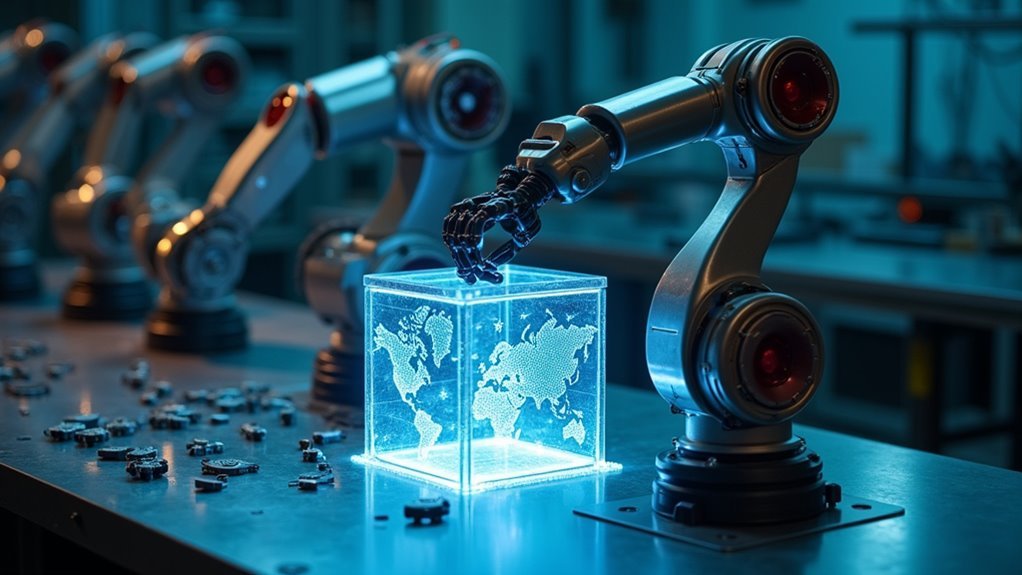
A crucial ingredient in recent self evolving systems is the use of rich world models that combine physical simulation with multimodal perception. China has pushed this idea into the spotlight with the World Omniscient World Model, often abbreviated WoW, described as the first self evolving multimodal world model system built specifically for humanoid robots. WoW combines a physics based model with a vision and language model so that robots can imagine, verify, and self correct their actions before committing to them in reality.
In concrete terms, a robot with such a world model can predict future contact forces, joint states, and visual scenes for candidate actions and entire trajectories. It can simulate lifting a payload, walking across a cluttered factory aisle, or handing an object to a human, and estimate where collisions, slips, or near misses are likely to occur. If the simulated outcome violates safety constraints, the controller can adjust the trajectory or strategy in simulation, test alternatives, and only execute those that pass both performance and safety checks. In China, systems like WoW—the first self-evolving world model for robots—are already being paired with affordable humanoids such as Boomi to explore these capabilities in home and educational environments.
Discrepancies between predicted and observed outcomes become powerful learning signals. When the world model expects a smooth handover but the object gets dropped or contacts a human arm, that error is logged and fed back into memory, task selection, and embodiment parameters. Over time, the robot refines its internal sense of physics and social interaction so that its expectations are better aligned with actual experience, leading to more robust navigation, manipulation, and recovery behaviors even in environments that were not part of its original training distribution.
What self evolving AI looks like on a factory floor
On a production line, the value of self evolution is measured in concrete metrics. Collision rates, task completion times, near miss events, emergency stops, and dropped payloads are all tracked as performance signals. These signals feed into evaluation layers that compare different controller variants and world model configurations, gradually selecting strategies that reduce risk and increase throughput.
Early trials of self evolving robotics frameworks built on continual reinforcement learning report notable safety gains. By turning every incident into a training signal, robots learn not only to avoid repeating the same mistake but also to generalize lessons across similar situations. Some industrial experiments describe critical failure rates falling by significant margins, including fewer emergency stops and unsafe contacts, as controllers and world models are updated continuously rather than during scheduled maintenance windows.
Importantly, the evolution process runs largely as a background computation. Factory operators see robots that keep doing their jobs while their internal architectures and policies are quietly revised in response to logged data. For production managers, this means less downtime for retuning and a gradual increase in reliability that can be tracked through historical trends in failure and near miss statistics. For safety teams, it introduces new responsibilities. They must oversee not just the initial controller design but also the ongoing evolutionary process, including guardrails that prevent unsafe updates from being deployed.
How these systems actually change themselves
Technically, self evolving AI architectures tend to combine several families of methods. Meta learning gives models the ability to learn how to learn, by optimizing the way they adapt from new experience so that each update is more efficient and better targeted. Neural architecture search explores alternative network structures, such as different sensor fusion modules or control hierarchies, and selects designs that perform better on the current distribution of tasks and environments.
Evolutionary optimization borrows ideas from biological evolution, generating variant controllers and world models, evaluating them against performance and safety criteria, and retaining those that produce superior outcomes. The result is a controller stack and world model that are not fixed. Policies, prompts, decision rules, tool use patterns, and memory structures are treated as editable objects instead of constants.
Frameworks for self evolved agents emphasize that feedback can take many forms, from explicit human ratings and structured rewards to implicit signals like task duration, energy consumption, and error rates. The core strategy is often formalized as a transformation that maps the current system state to an improved state, conditioned on the trajectories the agent has generated and the feedback it has received.
In robotics, this transformation is constrained by embodiment and safety. A robot cannot simply try arbitrary architectures or motion plans on real hardware if they risk damaging equipment or harming people. As a result, most self evolving systems maintain a clear separation between exploratory updates tested in simulation or sand boxed environments and validated policies that control actuators in production settings. World models and safety filters play a central role in this separation, screening candidate changes before they are granted influence over physical behavior.
Opportunities for technology and business
For technology teams, self evolving AI offers a way to bridge the gap between static benchmarks and messy reality. Instead of repeatedly retraining models offline when performance drifts, engineers can design systems that treat distribution shift as a first class signal. Surveys of self evolving agents argue that this kind of continual adaptation is essential for AI systems that operate in open environments, whether those environments are factory floors, warehouses, social media platforms, or enterprise workflows.
Businesses see immediate upside in three areas. Reliability improves as robots learn to avoid repeat failures and optimize their strategies for local conditions, which can be very different from the data used during initial training. Safety gains come from the ability to detect, interpret, and respond to near misses, not only accidents, leading to a form of proactive risk management embedded in the control stack. Flexibility increases because self evolving systems can adapt to new tasks and layouts without requiring a full redevelopment of controllers or world models every time a production line is reconfigured.
For research, self evolving embodied AI is a fertile ground to study long term autonomy and open ended learning. Conceptual frameworks like the Self Evolving Machine imagine systems that continuously evolve both cognitive architectures and physical bodies, drawing on modular robotics and even self healing materials. Recent robotic ecosystems that allow both controllers and morphologies to evolve online hint at what might be possible when robots can, in effect, redesign themselves to better fit their roles. These ideas are still experimental, but they push the field toward a future where robotics and AI do not simply scale up but also self organize.
Risks, open questions, and needed guardrails
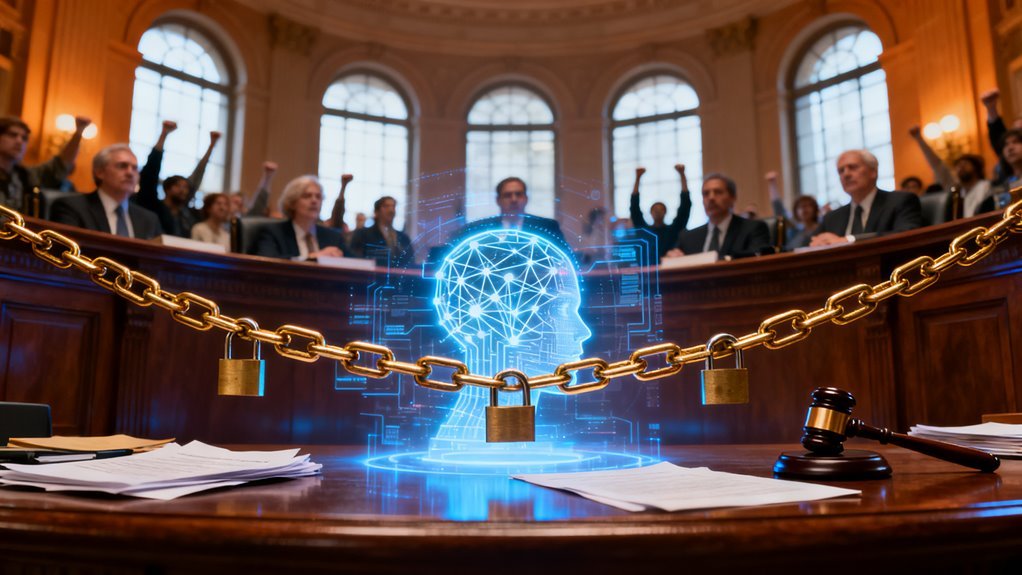
The same qualities that make self evolving AI exciting also introduce new risks. Continuous self modification raises the possibility of unintended behaviors if the feedback signals are misaligned or incomplete. Surveys caution that self evolving agents need carefully designed reward structures, monitoring, and governance to prevent harmful drift in their objectives or strategies.
In embodied systems, the stakes are higher because errors are expressed through physical actions. A misaligned update can translate into unsafe motion, inefficient energy use, or subtle violations of human comfort and trust. There are also questions about verification and accountability. Traditional robotics controllers can be certified against a fixed specification. Self evolving systems change over time, which complicates both compliance and incident analysis.
If a robot makes a mistake after hundreds of internal updates, pinning down which evolutionary step introduced the problem is non trivial. Conceptual work on self evolving machines suggests that traceability and interpretability should be baked into the design, so that every transformation of the system state is logged and can be audited.
Finally, there is a broader societal concern about autonomy. Self evolving AI shifts some decision making from human designers to machine processes that operate at scale and speed. While the feedback loops are grounded in data, they can encode biases or blind spots from the environments in which they run. Balanced perspectives in recent surveys emphasize the need for human oversight, diverse evaluation metrics, and explicit constraints that ensure self evolution produces systems that are not only more capable but also aligned with human values and norms.
Practical takeaways and the road ahead
For practitioners, the most important takeaway is that self evolving AI is no longer just a theoretical construct. There are real systems in labs and early deployments where robots and agents update their own models, controllers, and memories based on continuous streams of interaction data. These systems combine meta learning, architecture search, evolutionary optimization, and rich world models to turn experience into structured improvement rather than ad hoc patching.
At the same time, self evolution is not a magic fix. It requires careful design of feedback signals, robust simulation and safety layers, and a culture of monitoring and governance that treats updates as part of the system lifecycle, not as invisible background noise. The organizations that benefit most will likely be those that pair technical sophistication with thoughtful oversight, using self evolving AI to create safer, more flexible, and more resilient robotic ecosystems while maintaining clear human responsibility for outcomes.
Over the next few years, expect more factory lines, warehouses, and service environments to adopt self evolving embodied AI frameworks, especially as world models and continual learning methods become more mature and cost effective. As that happens, the robots around us will increasingly behave as agent environment wholes, with perception, cognition, and interaction co adapting to preserve performance under shifting conditions. The question is not whether these systems will evolve, but how well we guide that evolution toward futures that are safer, more productive, and genuinely trustworthy.
Conclusion
A new wave of self evolving AI for robots is quietly changing what reliability means in automation. Instead of treating breakdowns as expensive surprises these systems turn every failure into a learning event and early results showing more than fifty percent fewer failures in controlled tests hint at a different future for how machines improve over time.
From fragile robots to self improving machines
For most of the history of robotics reliability has been hand crafted. Engineers wrote control code by hand tuned parameters until the robot behaved acceptably and then froze the design. When something went wrong the fix arrived through a new software release or a hardware redesign usually after careful forensic analysis and often after painful downtime for whoever depended on those robots.
Machine learning began to change that picture by allowing robots to learn policies from data instead of explicit rules. Reinforcement learning in particular gave software agents a way to trial and error their way toward better behavior by receiving rewards and penalties for actions and gradually improving their strategy through feedback loops. That approach works well in simulations or tightly controlled labs but in messy environments a robot still hit hard limits. When it failed there was no guarantee it would actually learn the right lesson.
Researchers responded with techniques that explicitly reframe failure. OpenAI introduced Hindsight Experience Replay in 2018 which lets an agent re interpret unsuccessful attempts as successful experiences toward alternative goals drastically increasing learning efficiency in robotic manipulation tasks. More recently work on reflection based agents has explored the idea of making systems write their own postmortems after each attempt and consult those lessons before the next one so that the agent does not repeat the same mistake blindly.
At the same time groups such as DeepMind have pushed self correction methods for large language and code models that enable them to critique their own output and refine it without needing a separate external verifier for every step. Together these strands have set the stage for robots that not only execute policies but also own the process of understanding and fixing their own failures.
How the self evolving AI actually works
The self evolving system behind the reported drop in robot failures builds directly on these ideas but pushes them closer to real world autonomy. Conceptually you can think of it as two layers that work together.
The first layer is the control policy. This is the part of the AI that generates actions for the robot based on sensor data and goals. It might be a reinforcement learning policy trained in simulation or a model that has been fine tuned on past trajectories of real robots. On its own this policy can perform tasks but it does not reason explicitly about its own mistakes.
The second layer is the meta learner that watches what happens when the robot acts. Every time the system encounters something unexpected an object that slips mid grasp a strange sensor reading a navigation error it logs the entire context of the failure. That log includes what the robot saw what it decided to do what actually happened and any discrepancy between expected and observed outcomes. In some implementations this resembles a digital diary of failures which the AI curates and revisits rather than discarding.
Once a failure is recorded the meta learner analyzes it. Here the system uses ideas from Hindsight Experience Replay and reflection agents. It may reframe the failure as an example of the system pursuing the wrong implicit goal or miscalculating risk and then generate alternative strategies that would have avoided that outcome. In effect the AI is not just updating a score in a reinforcement learning loop it is writing a structured lesson for itself.
Those lessons flow back into the control policy. Depending on the architecture the system can update its parameters online or batch multiple failures and retrain periodically. Modern tooling makes this more practical. Web grounded models such as Perplexity Sonar can ingest new information and recent context to refine reasoning and factual accuracy over time without a complete retraining cycle. The same design pattern applies to robotics where the core model must keep improving without shutting down the system for major upgrades.
When you stitch these pieces together you get an iterative loop. The robot acts in the world errors are captured and analyzed those analyses produce modifications to its behavior and those modifications reduce future failures. Over many cycles the reliability curve begins to bend upward.
What a fifty percent failure reduction really means
The headline figure of more than fifty percent fewer robot failures sounds dramatic but it needs context. In most studies failures are measured as task level breakdowns a dropped object in a warehouse a navigation error that forces a reset or a software exception that halts a workflow. Cutting those events by half can translate directly into less downtime and fewer human interventions but the impact depends heavily on the starting baseline.
In environments where robots already perform relatively simple structured tasks a fifty percent reduction might be the difference between annoying disruptions and genuinely smooth operations. In more complex settings with clutter variable lighting and unpredictable human behavior that same reduction could mean a robot is finally usable without constant babysitting.
It is also important to separate cosmetic improvements from safety critical ones. A robot that drops fewer boxes is helpful for efficiency. A robot that more reliably avoids collisions with people is essential for trust. Many self evolving systems focus first on operational failures because they are easier to detect and log automatically while safety mechanisms often retain explicit hand crafted safeguards and external monitoring.
From an engineering perspective such a reduction suggests that the failure analysis loop is actually finding non trivial patterns in errors. If the system were just tweaking thresholds or overfitting to a narrow subset of conditions the improvement would likely plateau quickly. Sustained reductions over long runs hint that the AI is gradually building a richer internal model of the environment and its own limitations.
Implications for technology business and society
For technology teams the most immediate implication is a shift in how robotics software is developed and maintained. Instead of long cycles of manual debugging and static releases they can design systems where part of the intelligence is devoted to understanding and correcting its own failures. That does not remove the need for human engineers but it changes their focus toward designing the failure logging and interpretation mechanisms and verifying that automatic updates stay within safe bounds.
Businesses that depend on robots for logistics manufacturing or service work gain flexibility. If robots can improve through real experience they can be deployed faster in new environments with fewer handcrafted rules. Over time this could reduce integration costs and make robotics viable for smaller organizations that cannot afford large engineering teams.
At the same time autonomy brings new responsibilities. Self evolving systems blur the line between tested software and experimental behavior. When a robot rewrites parts of its own decision process the organization that operates it must know what has changed and why. Governance becomes as important as raw performance.
Societally the idea of machines learning from their own mistakes without continuous human supervision can be both reassuring and unsettling. On one hand it mirrors how people learn through feedback. On the other it raises questions about accountability and control. If a robot makes a decision based on a self learned rule derived from prior failures who certifies that rule as safe. How do regulators and insurers audit a system that is constantly updating itself.
There is also a broader AI ecosystem angle. Platforms like Perplexity Sonar are built to combine live information from the web with models that remain grounded in verifiable sources and clear citations. That philosophy emphasizes transparency and traceability. As robotics systems adopt similar self improving architectures they will need to carry that emphasis into physical environments where the consequences of mistakes can be far more concrete.
Limitations risks and open questions
Despite the promising numbers self evolving AI is not a magic solution. The most obvious limitation is data quality. If the system logs failures incorrectly or misses subtle near misses it may learn the wrong lessons. Bias in what gets recorded can lead to blind spots where the robot is overconfident in domains it has not truly mastered.
Security is another concern. Work on reflection agents and self play shows that powerful self improving systems can become easier to exploit if attackers learn how to influence the feedback loop. In robotics that could mean adversarial inputs that trigger specific failure patterns or manipulate sensors to push the system toward unsafe updates. Robust verification and sandboxed learning environments are essential.
There is also the stability question. Continuous learning can battle distribution drift as environments change but it can also introduce non obvious interactions between new behaviors and old assumptions. Engineers must design guardrails so that critical safety constraints remain immutable even as the rest of the policy evolves.
From a research standpoint key open questions include how best to represent failure knowledge so that it is both expressive and interpretable. Some teams favor natural language explanations written by the model itself which humans can read and audit. Others focus on compact mathematical summaries that plug directly into reinforcement learning updates. The choice affects not only performance but also how easily regulators and operators can understand why a robot changed its behavior.
Finally there is the human factor. If operators come to expect that robots will simply figure things out on their own they may pay less attention to early warning signs. Training and operational culture need to keep pace with technical capability so people stay engaged enough to notice patterns the systems themselves might miss.
The road ahead
Taken together the self evolving AI movement suggests a quiet but meaningful shift in how machines learn and fail. Instead of treating breakdowns as endpoints robots begin to see them as data points in a continuing story of improvement. By systematically analyzing their own mistakes and updating their behavior they can reduce failures significantly turning each incident into information rather than a setback.
In practical terms this means robotic reliability is likely to become less about painstaking hand tuning and more about designing robust learning loops that operate safely over long periods. As these loops mature autonomy will expand from simple execution of preset tasks to sustained self improvement where systems refine themselves continuously within clear constraints. The organizations that benefit most will be the ones that pair this technical progress with strong governance transparent monitoring and a realistic appreciation of both the opportunities and the risks.
If that balance is struck the next generation of robots will not just work better in the moment they will carry their own evolving understanding of where they tend to fail and what they should do differently next time which is arguably the closest thing machines have to experience reddit