AI Is Learning to Write the Language of Life, and the Implications Go Far Beyond Drug Discovery
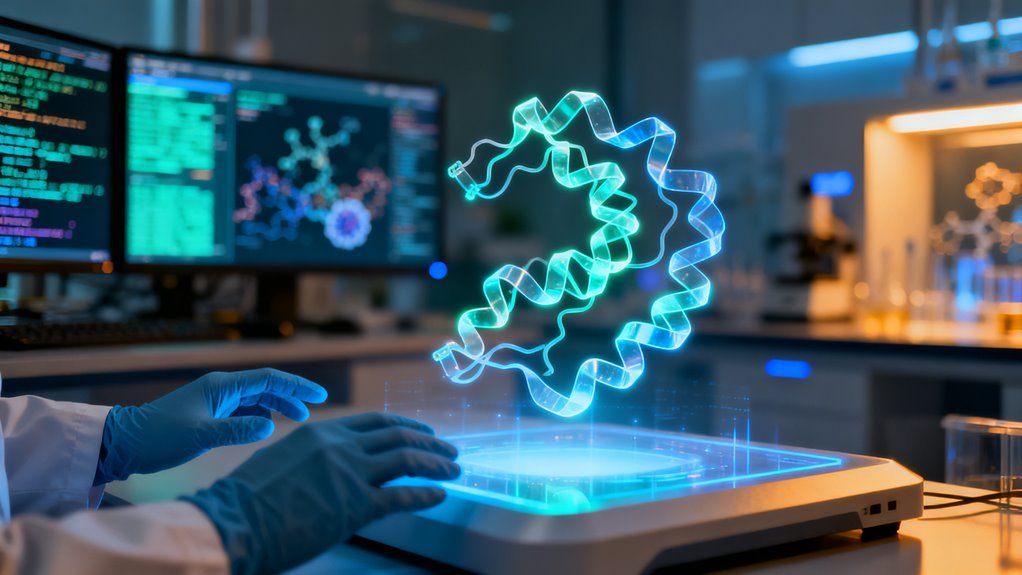
For billions of years, evolution has been the only force capable of designing functional proteins. That era is effectively over. A new generation of AI systems can now generate protein sequences from scratch, predict how they will fold in three dimensions, and verify that the resulting molecules perform specific biochemical tasks. The speed and scale at which this is happening should command attention well beyond the biotech sector, because what we are witnessing is not an incremental improvement in drug discovery tooling. It is the emergence of a programmable layer between human intent and molecular reality.
AI has given us a programmable layer between human intent and molecular reality — biology is now something we write.
The Problem That Kept Biology Bottlenecked
To appreciate why this matters, consider the math. A typical protein consists of a chain of amino acids drawn from an alphabet of 20. A modestly sized protein of 100 residues produces a combinatorial search space of 20 to the power of 100 possible sequences. That number dwarfs the estimated atoms in the observable universe by dozens of orders of magnitude.
Traditional protein engineering relied on directed evolution, a process where researchers mutate existing proteins, screen thousands or millions of variants, and hope to stumble onto something better. It works, and Frances Arnold won a Nobel Prize for pioneering it, but it is slow, expensive, and fundamentally limited by the tiny fraction of sequence space any lab can physically explore.
Natural evolution faces the same constraint at a grander scale. Every protein that exists in every organism on Earth represents an infinitesimally thin thread through that vast space of possibilities. Entire continents of functional protein design remain unexplored simply because no lineage ever wandered there.
AI changes the equation by replacing random exploration with directed navigation.
How the New Generation of Protein Design Models Actually Works
The toolchain that now makes this possible has matured remarkably fast. Structure prediction models like AlphaFold2, RoseTTAFold, and ESMFold learned to predict how a single protein chain folds into its three-dimensional shape, often matching the accuracy of experimental techniques like X-ray crystallography.
Newer systems including AlphaFold3, Chai 1, and Boltz 1 extend this capability to multi-chain complexes, predicting how proteins interact with other proteins, nucleic acids, and small molecules.
But prediction alone does not create new proteins. That requires generative models, and the field has produced several powerful ones in quick succession. RFDiffusion, developed at the Institute for Protein Design, applies denoising diffusion (the same mathematical framework behind image generators like Stable Diffusion and DALL E) to three-dimensional molecular structures. It starts from a cloud of random atomic coordinates and iteratively refines them into physically plausible protein backbones. The process takes seconds on modern GPUs.
Once you have a backbone, you need a sequence that will actually fold into it. ProteinMPNN handles this inverse folding problem, optimizing amino acid identities so that the resulting chain is thermodynamically driven to adopt the desired structure. Transformer-based language models like ProtGPT2 take a different approach, generating sequences directly while respecting biophysical constraints. The foundational architecture underlying these language models traces back to the introduction of the Transformer model in 2017, which catalyzed deep learning breakthroughs across domains before being adapted for protein design.
Newer systems like ESM3, developed by EvolutionaryScale, unify sequence and structure generation into a single model, collapsing what used to be a multi-step pipeline into one pass.
The practical result: researchers can now specify high-level functional requirements (a binding affinity threshold, a catalytic geometry, a thermal stability target) and have AI systems produce ranked lists of candidate proteins optimized against computed metrics like free energy, packing density, and solvent accessible surface area. Design cycles that once consumed months of directed evolution now complete in hours of computation.
The Numbers That Should Make People Pay Attention
Raw capability claims in AI often collapse under scrutiny, so the experimental validation numbers here deserve emphasis. When researchers at the Institute for Protein Design synthesized proteins generated by RFDiffusion and ProteinMPNN, more than 50 percent of the designs folded into their predicted structures.
For context, previous computational protein design methods often had success rates in the single digits. A tenfold improvement in hit rate, combined with the ability to generate thousands of candidates per run, fundamentally changes the economics of the field.
AlphaFold2 based filtering adds another layer of quality control before any molecule enters a lab. Candidates are triaged by predicted local distance difference test scores, a metric that quantifies confidence in structural predictions. Filtering for scores above 90 enriches candidate pools for structurally viable constructs, reducing wasted synthesis costs and accelerating the path from computation to confirmed function.
This is not a theoretical exercise. These proteins are being made, purified, and characterized. The models are generalizing beyond their training data, which consisted entirely of proteins shaped by natural evolution, to produce sequences and folds that no organism has ever encoded.
Why This Is Happening Now
Several converging factors explain the timing. The most obvious is the maturation of foundation models for biology, a trajectory that accelerated sharply after DeepMind released AlphaFold2 in late 2020.
That breakthrough demonstrated that deep learning could solve protein structure prediction, a problem that had resisted computational approaches for 50 years. It also created an enormous amount of structural data (AlphaFold’s public database now contains predicted structures for over 200 million proteins) that downstream generative models could train on.
Hardware advances matter too. Diffusion models for protein design are computationally intensive, and the same GPU scaling driven by the large language model boom has made these workloads tractable. NVIDIA’s dominance in this space is not coincidental; the same A100 and H100 clusters training chatbots are generating novel protein backbones.
There is also an infrastructure story. Platforms like OpenProtein.AI and the Institute for Protein Design’s software suite now offer cloud-hosted inference and no-code interfaces, removing the requirement that users possess deep machine learning expertise.
A biochemist at a midsize pharma company, or even a graduate student at a small university, can now deploy foundation models for custom protein engineering without writing training loops from scratch. Foldit extends participation further, letting citizen scientists contribute to protein design challenges through interactive environments.
This democratization mirrors a pattern we have seen repeatedly in the broader AI industry. Capability starts concentrated among a handful of well-funded research labs, then diffuses rapidly through open-source models, APIs, and user-friendly platforms. The same dynamic that brought large language models from a few organizations to millions of developers is now playing out in computational biology.
Who Benefits and Who Should Be Worried
The most immediate beneficiaries are drug developers. Designing therapeutic proteins (antibodies, enzymes, cytokines) has historically been one of the most expensive and failure-prone activities in pharmaceutical R&D.
If AI can reliably generate candidates that fold correctly and bind their targets with designed affinity, the cost and timeline of biologics development could compress dramatically. Companies like Generate Biomedicines, Cradle, and Profluent Bio are already building businesses around this premise.
Industrial biotechnology stands to gain as well. Custom enzymes for chemical manufacturing, agriculture, bioremediation, and food production represent a massive market that has been constrained by the difficulty of engineering proteins for non-natural functions.
AI-generated enzymes optimized for specific industrial conditions (high temperature, extreme pH, novel substrates) could unlock applications that were previously uneconomical.
Materials science is another frontier. Designed proteins can self-assemble into fibers, films, hydrogels, and other biomaterials with properties tunable at the molecular level. The ability to computationally specify material properties and then generate proteins that produce them opens a design space that materials engineers have barely begun to explore.
The incumbents who should pay closest attention are contract research organizations and companies whose business models depend on the slow, iterative nature of traditional protein engineering.
If computational design reduces the number of experimental screening rounds needed by an order of magnitude, the volume of wet lab services required per project drops accordingly. This does not eliminate the need for experimental validation, but it shifts value upstream toward computational design and downstream toward manufacturing and clinical development.
What People Are Overlooking
Much of the coverage around AI protein design focuses on structure prediction accuracy and the novelty of generated folds. Both matter, but the more consequential development is the closing of the loop between design and function.
Predicting that a protein will fold correctly is necessary but not sufficient. The real test is whether it does what you designed it to do: catalyze a reaction, bind a target, assemble into a material.
This functional validation gap remains the field’s most important bottleneck. Experimental confirmation of function is slower and more expensive than structural characterization, and the models’ ability to optimize for function (as opposed to foldability) is still catching up.
The next major milestone will not be a better structure predictor. It will be a system that reliably designs proteins with specified activity levels, not just specified shapes.
There is also a biosecurity dimension that deserves more candid discussion. The same tools that design therapeutic proteins can, in principle, design toxic ones. The dual-use potential of generative protein design models is not hypothetical, and the field has not yet converged on governance frameworks adequate to the capability.
Screening synthesized DNA sequences for dangerous constructs is an existing safeguard, but it was designed for an era when novel protein design was rare and difficult. As AI makes it routine and accessible, those safeguards will need to scale and adapt.
The Regulatory Landscape Is Not Ready
Current regulatory frameworks for biologics were built around the assumption that protein therapeutics are derived from or closely related to natural proteins. AI-designed proteins that occupy entirely novel regions of sequence space challenge this assumption.
Regulators at the FDA and EMA will eventually need to develop evaluation frameworks specifically for computationally designed biologics, addressing questions about how to characterize safety and efficacy when there is no natural analog to compare against.
This is not an immediate crisis. The first wave of AI-designed proteins entering clinical development will likely be close enough to existing protein classes that current regulatory pathways apply.
But as the technology matures and designs become more exotic, the gap between regulatory frameworks and technical capability will widen.
What Comes Next
The trajectory here is clear, even if the timeline is uncertain. Within the next two to three years, expect to see AI-designed proteins enter clinical trials in meaningful numbers, particularly in areas like oncology and autoimmune disease where novel binding proteins offer therapeutic advantages.
Industrial enzyme design will likely move faster, since the regulatory bar is lower and the feedback loops are shorter.
Longer term, the convergence of protein design AI with other computational biology tools (genomics, metabolic modeling, cell simulation) points toward something more ambitious: the ability to design entire biological systems from the bottom up.
Engineered metabolic pathways, synthetic cellular circuits, novel organisms. Each of these is further out and faces additional technical and regulatory hurdles, but the protein design layer is a necessary foundation for all of them.
The comparison to software is tempting and partially apt. What we are seeing is the emergence of a kind of molecular programming, where proteins serve as the functional units and AI systems serve as the compiler translating human specifications into molecular code.
The analogy breaks down because biology is messier than silicon, and the gap between in silico prediction and in vivo function remains significant. But the direction of travel is unmistakable.
For decades, biology was something we observed, cataloged, and occasionally nudged. The tools now emerging allow us to write it. The question is no longer whether AI can design functional proteins. It is whether our institutions, markets, and governance structures can keep pace with a technology that is rewriting the boundary between the natural and the engineered.



