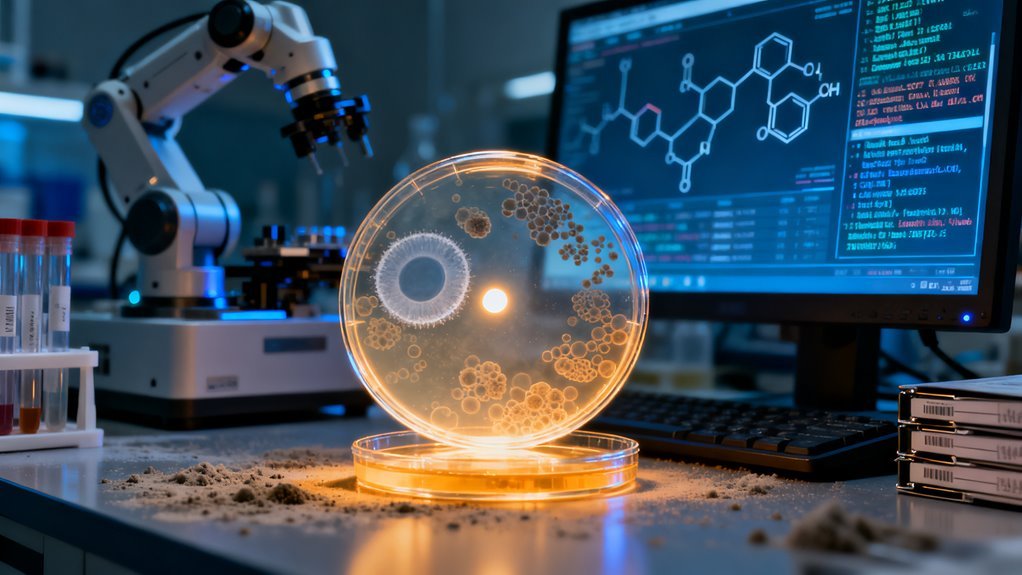

A compound shelved years ago as a failed diabetes treatment turned out to be one of the most promising antibiotics discovered in decades. No human researcher flagged it. A deep learning model did, after chewing through thousands of molecular structures in a process that took days rather than years. The discovery of halicin in 2020 did not just produce a new drug candidate. It forced the pharmaceutical industry to confront an uncomfortable question: how many other breakthroughs are sitting in plain sight, buried in chemical databases that nobody has the time or resources to properly search?
What Actually Happened
Researchers at MIT trained a neural network on roughly 2,500 molecules whose antibacterial properties were already known. The model learned to predict which molecular structures would inhibit the growth of *Escherichia coli*, but with a critical twist: it was specifically tuned to favor compounds that looked nothing like existing antibiotics. The team wanted structural novelty, not incremental variations on drugs bacteria had already learned to resist.
The model wasn’t built to find better versions of old drugs. It was built to find something entirely different.
They tested the model first on the Drug Repurposing Hub, a curated library of about 6,000 molecules that had been developed for various therapeutic purposes. Halicin ranked near the top. Originally explored as a treatment for metabolic disease, it had attracted zero attention from infectious disease researchers. Nobody had thought to test it against bacteria because there was no obvious reason to.
Then the team scaled up. The model screened approximately 107 million molecules drawn from commercial chemical databases. The entire process took roughly three days. For context, traditional high throughput screening methods would need years and tens of millions of dollars to cover a fraction of that chemical space with physical experiments.
Why This Discovery Matters Beyond the Headline
The antibiotics pipeline has been broken for decades. Major pharmaceutical companies largely abandoned the field starting in the 1990s because the economics were terrible: antibiotics are taken for short courses, resistance develops quickly, and hospitals reserve new drugs as last resort options, meaning sales volume stays low. The result is a dangerous mismatch between accelerating resistance and decelerating drug development. The World Health Organization has repeatedly warned that antimicrobial resistance could cause 10 million deaths annually by 2050 if current trends hold.
Against that backdrop, halicin’s significance extends well beyond its specific antibacterial properties. The compound works by disrupting the electrochemical gradient across bacterial cell membranes, which impairs ATP synthesis. This mechanism differs fundamentally from every major class of antibiotics in clinical use. That distinction is not academic. Because the mechanism is unfamiliar to bacteria, existing resistance pathways offer little protection.
Lab testing confirmed activity against Gram positive and Gram negative organisms, including *Mycobacterium tuberculosis*, carbapenem resistant Enterobacteriaceae, and multiple clinical isolates that shrug off frontline treatments.
But the deeper lesson is methodological. The pharmaceutical industry has accumulated enormous commercial chemical repositories containing billions of compounds. The overwhelming majority have never been experimentally tested for antibacterial effects. Not because testing them is impossible, but because physical screening at that scale has always been prohibitively expensive and slow. AI changed the math entirely by replacing wet lab experiments with computational predictions, compressing what would be decades of work into a long weekend.
The Strategic Implications for Drug Discovery
What happened with halicin is a template, not an isolated event. The two-phase approach the MIT team used, validating on a small curated library before deploying against massive external databases, has since become a standard methodology in AI driven drug discovery. Companies like Insilico Medicine, Recursion Pharmaceuticals, and Isomorphic Labs (DeepMind’s drug discovery spinoff) are all running variations of this playbook across therapeutic areas far beyond antibiotics.
The competitive dynamics here are worth watching closely. Traditional pharma companies spent decades building value through proprietary compound libraries and clinical trial expertise. AI screening partially commoditizes the first advantage. If a startup with a good model can search 1.5 billion compounds digitally, the strategic moat of owning a large physical library shrinks considerably.
What remains valuable is clinical development capability, regulatory expertise, and manufacturing scale. This suggests a future where AI native discovery companies partner with or get acquired by established pharma firms that control the later stages of the pipeline.
Investors have noticed. Funding for AI driven drug discovery topped $5 billion in 2023, and the halicin paper is frequently cited as a proof point that these investments can yield genuinely novel candidates rather than just marginal improvements on known drugs.
What People Are Overlooking
There is a broader asymmetry that the halicin case exposes and that deserves more attention: compounds abandoned for one therapeutic indication may harbor untapped efficacy in completely different clinical contexts. Drug repurposing is not a new idea, but systematic, algorithm driven reanalysis of existing databases at massive scale is.
The sheer number of molecules that have been synthesized, partially characterized, and then shelved represents an enormous latent resource. Most of these compounds were evaluated against a narrow set of targets relevant to whatever disease the original research team cared about. Nobody went back to ask what else they might do.
This creates an interesting opportunity that extends beyond antibiotics. Cancer, neurodegenerative disease, rare genetic disorders: all of these fields could benefit from the same approach of training predictive models and unleashing them on neglected chemical space. The bottleneck is no longer computational. Modern hardware and cloud infrastructure can handle the screening. The bottleneck is high quality training data, specifically well characterized molecules with reliable biological activity measurements.
What Comes Next
Several trends are converging to accelerate this space. Foundation models for chemistry, analogous to large language models for text, are maturing rapidly. Google DeepMind’s AlphaFold already transformed protein structure prediction.
The next frontier is predicting how small molecules interact with those proteins, which is precisely the kind of problem that halicin’s discovery foreshadowed. Generative chemistry models can now propose entirely new molecular structures optimized for specific properties, moving beyond screening existing compounds toward designing novel ones from scratch. A recent example is ApexGO, developed at the University of Pennsylvania, which uses Bayesian optimization to iteratively improve antibiotic peptide candidates and achieved an 85% success rate in halting bacterial growth during lab tests.
Regulatory frameworks are starting to adapt as well, though slowly. The FDA has signaled openness to AI generated evidence in drug development submissions, and several AI discovered compounds have entered clinical trials since 2020. None have reached approval yet, which remains the critical milestone the field needs to achieve for full credibility.
The antibiotics crisis is not going to wait for regulatory frameworks to catch up. Resistance is evolving faster than traditional discovery pipelines can respond. What the halicin story demonstrated is that the tools to fight back exist and that the limiting factor was never the molecules themselves. They were always there, cataloged in databases, waiting. The limiting factor was the inability to look at all of them at once and ask the right questions. AI removed that constraint. The pharmaceutical industry now has to decide how aggressively to act on the opening.