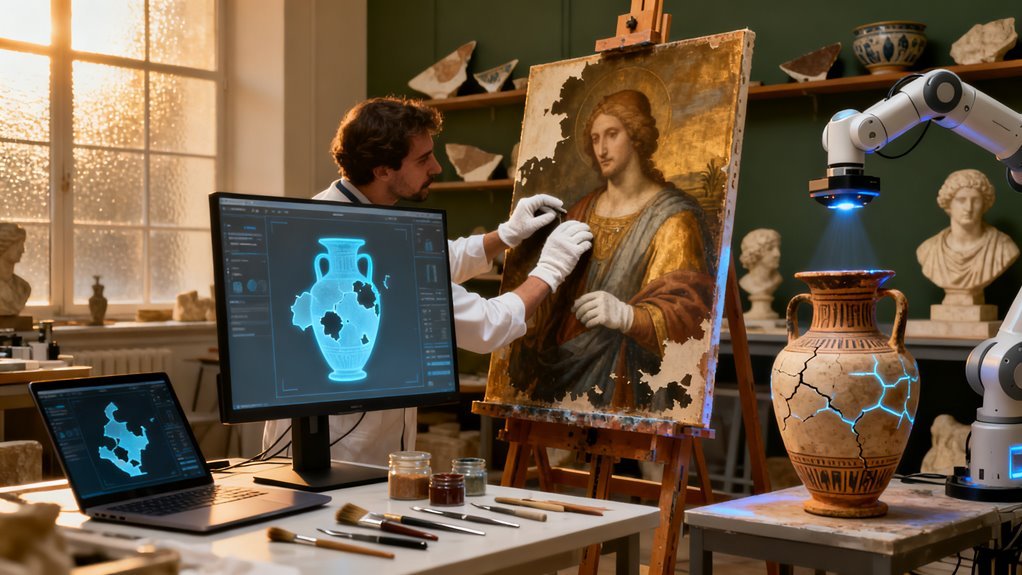

The restoration of a damaged 14th century mural used to begin with a conservator leaning over the surface under fluorescent light, armed with decades of training, a steady hand, and informed guesswork about what the original artist intended. That process still happens. But increasingly, the first step takes place on a screen, where machine learning models trained on millions of visual patterns propose reconstructions that no human eye could have assembled from the remaining fragments alone.
What’s unfolding across conservation labs worldwide isn’t just an incremental tool upgrade. It represents a fundamental shift in how cultural institutions think about preservation, access, and the very definition of an “original” work.
AI conservation isn’t just fixing what’s broken — it’s redefining what preservation, originality, and access mean for cultural institutions.
The Technical Foundation Is More Sophisticated Than It Appears
Museum conservation might seem like an unusual proving ground for cutting edge AI, but the technical challenges involved mirror some of the hardest problems in computer vision and generative modeling. Restoring a damaged artifact digitally requires a system to understand context, infer missing information from partial data, and produce results that are both visually coherent and historically plausible.
These are precisely the capabilities that have driven the last several years of progress in generative AI. Google Gemini AI enhances the ability to read damaged artifacts while contextualizing historical significance, providing an invaluable tool for conservators.
The current state of the art in digital artifact restoration draws from several converging technical streams. Hybrid frameworks combining transfer learning with transformer based generative adversarial networks have achieved remarkable fidelity on mural datasets, with peak signal to noise ratios exceeding 64 dB and structural similarity indices above 0.94.
To put that in practical terms: the AI generated reconstructions are nearly indistinguishable from high quality photographs of intact surfaces when evaluated by standard image quality metrics. That level of performance was essentially unthinkable five years ago.
The jump from 2D image restoration to full 3D reconstruction represents another order of complexity. Pipelines incorporating stable diffusion and neural radiance fields can now take a broken ceramic vessel, analyze its surviving geometry and surface decoration, and generate a volumetric digital surrogate that fills in what’s missing.
Integrated approaches using SIFT feature detection and Poisson based surface reconstruction have pushed model accuracy roughly 12% beyond traditional methods, with structural similarity values approaching 0.9964 for restored images. These aren’t rough approximations. They’re detailed, manipulable 3D models suitable for scholarly study, public exhibition, and archival documentation.
Why This Matters Now
Several factors explain why AI driven conservation is accelerating at this particular moment.
First, the foundation model revolution has created architectural building blocks that transfer surprisingly well to niche domains. The same diffusion models powering consumer image generators turn out to be remarkably effective at inferring what a damaged fresco might have looked like, precisely because they’ve internalized vast amounts of visual knowledge about color relationships, texture patterns, and compositional logic.
Conservation AI teams don’t need to build from scratch. They fine tune existing capabilities on domain specific datasets.
Second, high resolution 3D scanning has become dramatically cheaper and more accessible. A decade ago, capturing a museum quality volumetric scan of a fragile artifact required expensive equipment and significant expertise.
Today, photogrammetry pipelines running on consumer hardware can produce results that serve as viable inputs for AI restoration workflows. The scanning bottleneck has largely dissolved, which means the reconstruction algorithms finally have enough data to work with.
Third, and perhaps most importantly, museums are under mounting pressure to digitize collections at scale. Climate change threatens coastal and flood prone cultural sites. Armed conflict continues to destroy irreplaceable heritage.
The COVID pandemic demonstrated that institutions without robust digital collections effectively disappeared from public consciousness when their doors closed. AI powered conservation tools address all three of these pressures simultaneously by enabling faster, more comprehensive, and more consistent digitization.
The Strategic Landscape
It would be a mistake to view this purely through a conservation lens. What’s emerging is a new category of AI application that sits at the intersection of cultural heritage, generative media, and institutional data management.
Consider the downstream implications. Museums building extensive AI restored digital collections are simultaneously creating proprietary training datasets of enormous value. A comprehensive, high fidelity 3D archive of a major institution’s holdings could serve as the foundation for virtual exhibitions, educational platforms, commercial licensing, and research partnerships.
The British Museum, the Smithsonian, the Louvre, and their peers are sitting on cultural data assets that become exponentially more valuable once they’re digitized at sufficient quality. AI restoration tools are the key that unlocks that value.
Text to 3D models now enable geometric, structural, textural, and semantic consistent reconstruction from natural language descriptions. A researcher can describe a lost sculpture based on historical accounts, and generative systems will produce a plausible visual reconstruction.
Large scale scene reconstruction can recreate entire heritage sites, placing restored artifacts back into their original architectural and spatial contexts. The implications for education alone are staggering. Instead of studying a Roman villa through photographs and floor plans, students could walk through a spatially accurate virtual reconstruction populated with AI restored artifacts in their original positions.
The commercial technology ecosystem has noticed. Google’s work on cultural heritage through its Arts and Culture platform, NVIDIA’s interest in digital twins and spatial computing, and Meta’s investments in VR and 3D content creation all converge on this space.
None of these companies have made conservation their primary focus, but the underlying technologies they’re developing directly enable it. The museum sector benefits from billions of dollars in R&D investment it never had to fund.
Who Benefits and Who Should Be Concerned
The most obvious beneficiaries are institutions with large, underdocumented, or physically degraded collections. Many museums display only a fraction of their holdings, with the rest languishing in storage, sometimes in poor condition.
AI tools that can assess damage automatically across thousands of objects, prioritize conservation interventions based on objective metrics, and generate digital surrogates of items too fragile to exhibit fundamentally change what’s possible for these institutions.
Smaller museums and collections in developing nations, which have historically lacked the resources for extensive manual conservation, stand to gain disproportionately if these tools become widely accessible. Access to these platforms may also vary depending on institutional affiliations, which can determine the level of remote digital infrastructure and database connectivity available to conservation teams.
Computer vision models automating damage detection and condition analysis represent a particularly significant capability shift. Traditionally, condition assessments required trained conservators to physically examine each object, a process so labor intensive that many collections haven’t been comprehensively surveyed in decades.
AI systems analyzing high resolution scans can flag deterioration patterns consistently across tens of thousands of items, generating actionable data that helps institutions allocate limited conservation budgets more effectively.
But legitimate concerns deserve attention. Professional conservators rightly worry about the epistemological status of AI reconstructions. When an algorithm fills in a missing section of a painting, who decides whether the result is historically accurate?
The metrics look impressive on paper, but a high structural similarity score doesn’t necessarily mean the reconstruction reflects the original artist’s intent. It means the reconstruction is statistically consistent with the surrounding visual data. Those are different things, and the distinction matters enormously for scholarship.
There’s also a transparency question. If museums display AI restored digital versions of damaged artifacts without clearly communicating what’s original and what’s algorithmically generated, they risk misleading visitors.
The line between “digital restoration” and “digital fabrication” can blur quickly, especially as generative models become more capable. Conservation ethics have always emphasized reversibility and documentation of interventions. The AI equivalent would be comprehensive metadata tracking exactly which portions of a digital model are based on physical evidence and which are inferred.
What People Are Overlooking
The conversation around AI in conservation has focused heavily on visual fidelity, the technical achievement of making damaged things look whole again.
What’s received less attention is how these tools change the social and political dynamics of cultural heritage.
Digital repatriation is one emerging application with profound implications. Artifacts removed from their countries of origin during colonial periods remain a source of international tension.
Physical repatriation is often complicated by legal disputes, conservation concerns, and institutional resistance. AI generated high fidelity 3D replicas don’t resolve those disputes, but they create new possibilities. An institution could retain physical custody of an object while providing the source community with a detailed digital surrogate, or vice versa.
Whether that constitutes meaningful restitution is a political and ethical question, not a technical one, but the technology makes it a question worth debating.
Another underappreciated dimension is the relationship between AI restoration and insurance and valuation. As digital surrogates become increasingly detailed and accurate, they raise novel questions about what happens when an artifact is destroyed.
If a comprehensive AI model of an object exists, capturing its geometry, surface detail, and material properties at submillimeter resolution, does the loss of the physical original carry the same institutional and financial consequences? Insurance models for cultural property haven’t caught up with this reality.
What Comes Next
The trajectory here points toward increasingly autonomous conservation workflows. Near term, expect tighter integration between scanning hardware and AI analysis software, reducing the time from physical examination to digital restoration from weeks to hours.
Medium term, foundation models specifically trained on cultural heritage data will emerge, likely backed by consortia of major museums pooling their digital archives. The Cultural Heritage Imaging community has already laid groundwork for standardized capture protocols.
Adding AI reconstruction on top of those standards is a natural next step.
Longer term, the distinction between “conservation” and “creation” will become a central debate. As generative AI becomes capable of producing entire artifacts that never existed but are stylistically and materially consistent with a specific culture, period, or artist, the field will need new frameworks for authenticity, attribution, and scholarly use.
These are not hypothetical concerns. Text to 3D reconstruction of lost works based on written descriptions is already technically feasible.
Museums have always been institutions that mediate between past and present, deciding what survives, how it’s interpreted, and who gets to see it. AI doesn’t change that fundamental role.
But it dramatically expands the toolkit available, along with the stakes of getting it right. The institutions that move thoughtfully, investing in these capabilities while maintaining rigorous standards for transparency and scholarly integrity, will define what cultural preservation means in the coming decades.
Those that treat AI as merely a faster way to fix broken things will miss the larger transformation entirely.