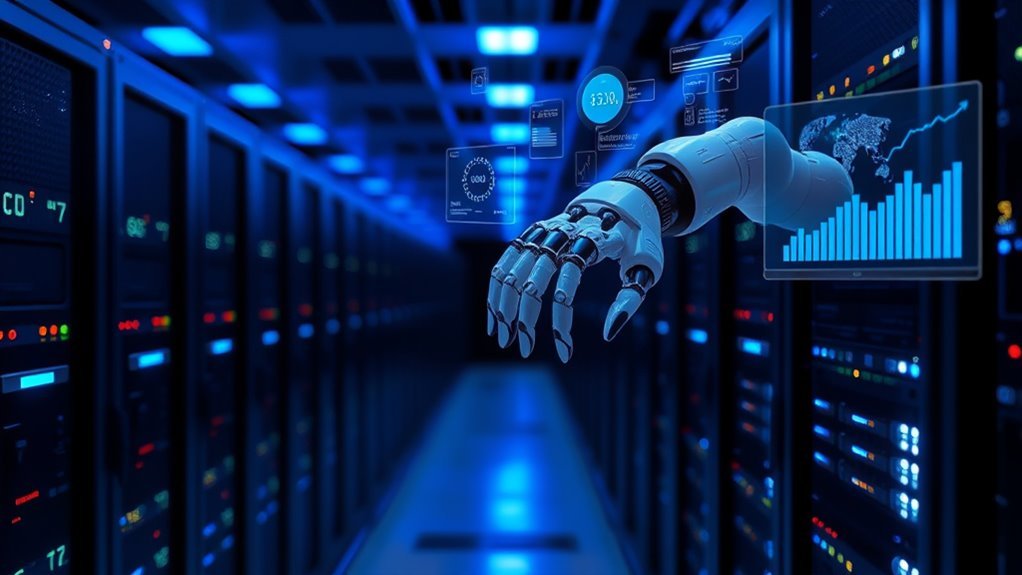

Autonomous AI in IT operations represents a convergence of AIOps, machine learning, and agentic AI that transforms traditional infrastructure management into a predictive, self-healing ecosystem. This model follows a structured pipeline of visibility, correlation, prediction, and action, where AI agents close the loop from detection to remediation without manual intervention. Rather than stopping at alerting, autonomous systems independently initiate workflows that address network and system health directly, extending their reach into proactive capacity planning, performance optimization, and risk mitigation.
Adoption metrics indicate the technology has crossed from experimentation into production. By 2026, 84% of organizations will have explored or piloted AI in observability, while 56% already deploy it broadly across multiple IT workflows or at business-critical scale. Agentic AI specifically has reached 72% adoption across IT operations and DevOps, with significant penetration in software engineering at 56% and customer support at 51%. IT organizations expect AI to automate nearly 46% of operational tasks within 18 months, and more than 50% of enterprises are projected to use AIOps platforms to automate major portions of their operations, marking a clear shift toward mainstream adoption.
Agentic AI has reached 72% adoption across IT operations and DevOps, signaling a clear shift toward mainstream deployment.
The practical capabilities driving this adoption span incident response, endpoint management, and service delivery. Autonomous AI detects incidents, identifies root causes, and executes remediation actions including restarting services, scaling resources, clearing queues, rolling back deployments, and rerouting traffic away from unhealthy regions.
Within endpoint management, the most common use cases include anomaly detection at 57%, device vulnerability identification at 55%, and patch prioritization at 47%. In IT service management, AI powers virtual agents and chatbot support at 58%, ticket classification and routing at 56%, and automated ticket resolution at 51%.
AI agents are concentrated where volume and repetition are highest. Level 1 support leads adoption at 61%, followed by network and infrastructure operations at 59%, with Level 2 support and endpoint operations each at 57%. These deployment patterns reflect a deliberate prioritization of functions where automation delivers the most immediate throughput gains and reduces dependency on human triage cycles.
The operational impact is measurable. Autonomous AI reduces mean time to resolution through automated triage, faster root-cause analysis, and proactive incident management. Organizations automating IT workflows report improvements across MTTR, cost savings, and overall ROI. Leading AIOps platforms have demonstrated 30-70% reductions in MTTR across production deployments, reinforcing the case for autonomous systems as a core operational investment.
AI-driven observability also reduces alert noise by correlating signals across logs, metrics, and traces, allowing engineering teams to focus on higher-order problems rather than filtering through undifferentiated event streams.
Gartner’s projection that autonomous AI will handle 25% of IT operations work by 2030 reflects the trajectory already visible in current adoption data. The combination of expanding agentic capabilities, increasing production deployments, and demonstrable ROI positions autonomous AI not as an emerging concept but as an operational standard taking shape across enterprise infrastructure.