
Google DeepMind’s Genie 3 is a general-purpose AI world model that turns simple text or image prompts into photorealistic, explorable 3D environments in real time. Rather than producing static images or pre-rendered video, it functions as a simulation engine that predicts the next state of a world in response to player actions and past frames. The model generates diverse settings, from corridors and rooms to streets and open spaces, using an autoregressive pipeline that reconstructs each frame conditioned on the previously rendered history. Within this framework, Genie 3 aims to demonstrate how an AI system can both build and understand complete worlds, anticipating how geometry, lighting, and objects should evolve as interaction continues.
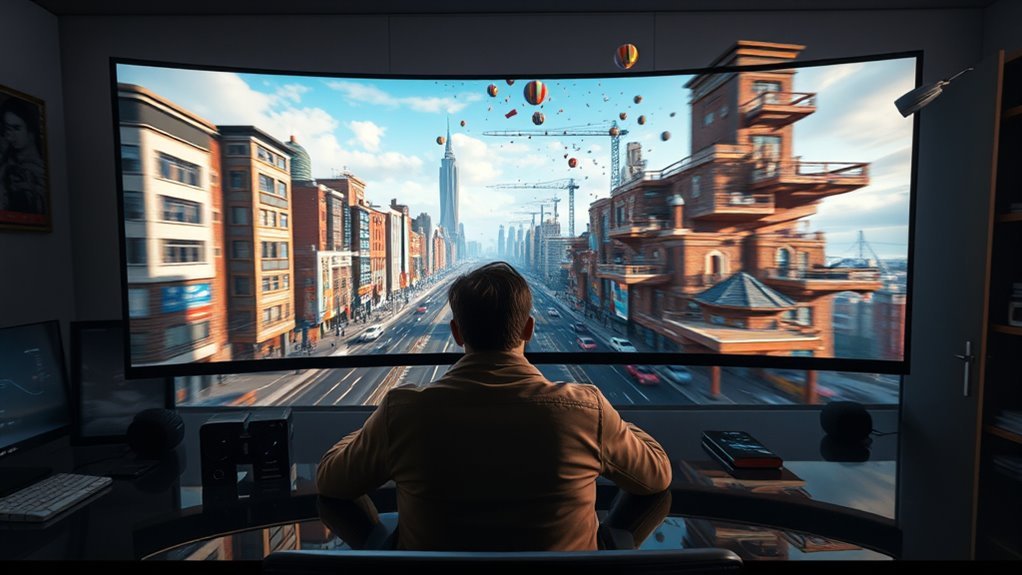
Genie 3 places emphasis on real-time, controllable exploration that resembles traversing a traditional game level. Worlds can be generated from minimal input, such as a brief text description or a single concept image, and then moved through using standard movement and camera controls. The system supports continuous motion through hallways, multi-room interiors, urban streets, and open landscapes, with the environment extending dynamically as the player advances. An integration with Google Street View enables the model to synthesize street-like scenes aligned with real-world layouts, providing coherent urban exploration experiences without relying on a conventional game engine.
Real-time, controllable exploration turns brief prompts into dynamically extending, street-aligned worlds you traverse like game levels.
Visually, Genie 3 operates at 720p resolution and roughly 24 frames per second, balancing fidelity with responsiveness for consumer hardware. Each frame is generated from scratch, conditioned on the accumulated sequence of previous frames and user inputs, supporting temporal coherence without explicit handcrafted physics code. Lighting, shadows, reflections, and camera motion emerge from the learned world dynamics, producing scenes that generally match the requested style, setting, and mood of the initial prompt or image. This focus on high-definition, style-consistent imagery distinguishes Genie 3 from earlier world models that prioritized narrow environments or short clips over rich, continuously explorable spaces. In Project Genie, this visual and interactive fidelity underpins user-created infinitely diverse worlds that remain coherent while being generated in real time from simple prompts.
Genie 3’s main limitation is its relatively short effective memory, which caps how long worlds stay precisely consistent. The model maintains detailed information about objects, textures, and local geometry for around one minute of interaction, extending Genie 2’s 10 to 20 seconds but still far below traditional game engines. Within this window, layouts, physics behavior, and visual attributes usually remain stable as players revisit areas or repeat actions, but beyond it demonstrations show gradual drift in small details, altered textures, and unreliable fine-grained markings.
Over extended sessions, these minor changes accumulate, so game worlds feel less firmly anchored even when large-scale structure appears intact. As a result, Genie 3 currently suits short, level-style experiences or focused training scenarios more than extended, story-driven games that demand hour-long persistence. Designers are encouraged to structure interactions around brief missions, constrained spaces, or episodic exploration, working within the roughly one-minute consistency horizon the model can reliably sustain. Long-form stability remains unresolved today.