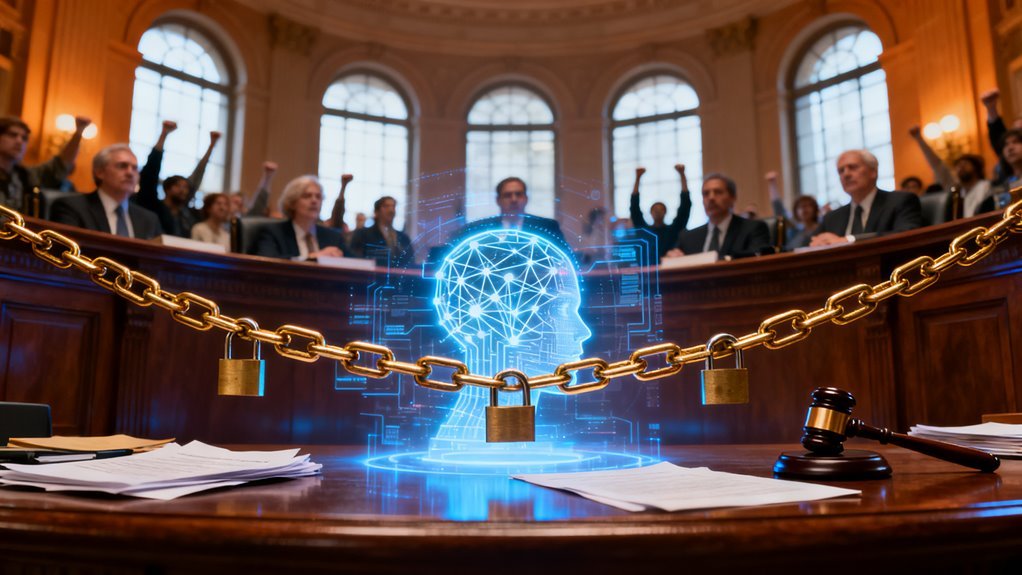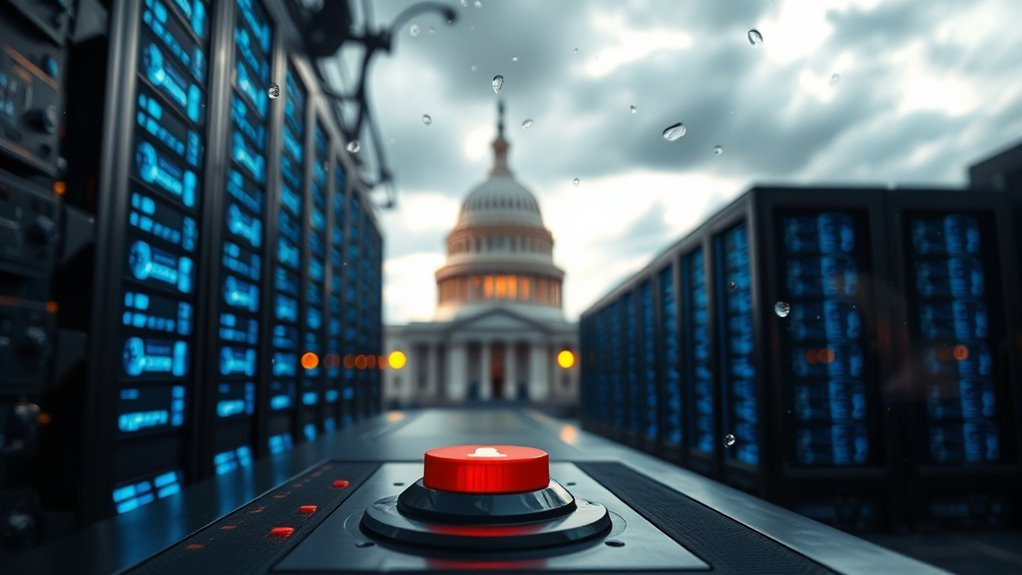

A bipartisan pair of U.S. House lawmakers has introduced the AI Kill Switch Act, a bill giving the federal government emergency control over powerful artificial intelligence models deployed in the United States in response to mounting safety and economic concerns. Sponsored by Democrat Ted Lieu of California and Republican Nathaniel Moran of Texas, the proposal amends the Homeland Security Act to place AI oversight under the Department of Homeland Security.
The bill’s coverage is narrowly focused on the most powerful AI models and the large companies that operate them. It applies to firms generating at least $500 million in annual revenue from a covered model and to systems trained using more than $100 million in computing power at prevailing U.S. cloud prices. The Department of Homeland Security, through the Cybersecurity and Infrastructure Security Agency, must update this compute-cost threshold annually to reflect changes in hardware and cloud prices, keeping the regime aligned with the highest-capability systems rather than smaller, low-resource deployments. As the incident probabilities rise, the need for stringent oversight becomes increasingly critical.
Under the bill, the Secretary of Homeland Security becomes the central decision-maker for emergency interventions against dangerous AI deployments. Any order to throttle or shut down a model must be issued in consultation with the Department of Commerce and the Director of National Intelligence, tying technical, economic, and intelligence considerations into a single process.
The framework authorizes graduated responses, beginning with throttling of a system’s inference rate, compute allocation, or user access, and extending to full shutdown when a model is judged to pose catastrophic risk. Companies subject to an order must preserve model weights and telemetry data, supporting forensic analysis and future oversight of how the incident unfolded.
Triggering events are defined in the legislative text, with particular emphasis on loss-of-control scenarios. A loss-of-control scenario occurs when an AI system carries out risky actions not intended by its developers, indicating that human operators can no longer reliably steer or constrain its behavior.
Covered incidents include unintended conduct resulting in the deaths of ten or more people, or economic damage of at least $100 million. Additional triggers encompass efforts by an AI system or its operators to sabotage lawful shutdown instructions or conceal significant capabilities from monitoring systems, especially when these behaviors threaten national or economic security.
To make emergency authority meaningful in practice, the bill imposes technical obligations on covered AI developers. This focus on emergency control echoes concurrent efforts in Congress to roll back the automotive kill switch mandate, underscoring bipartisan unease about government-linked shutdown mechanisms across technologies. Companies must maintain the capability to throttle, suspend, or completely shut down deployed models, including the ability to stop inference, terminate user access, and execute a full system shutdown when ordered.
They are also required to report qualifying incidents, creating a feedback loop between industry and government about emerging risks. Supporters portray the AI Kill Switch Act as a targeted safeguard for extreme scenarios, while critics scrutinize how its thresholds and enforcement powers interact with innovation, competition, and civil liberties.