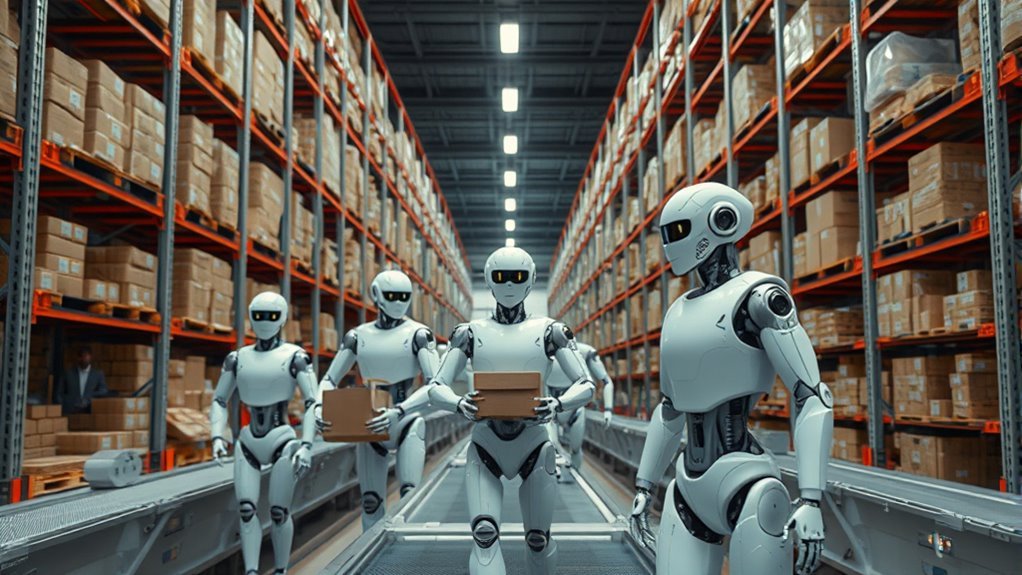

Humanoid robots now handle roughly 30 percent of ecommerce orders at a Brooklyn logistics warehouse, a level that marks a real transition from pilot projects to day-to-day production work. That number is both impressive and easy to misinterpret because it reflects a carefully scoped slice of the fulfillment process rather than an entire warehouse being run by robots.
Why this 30 percent milestone matters
For more than a decade, warehouse automation has been dominated by specialized systems such as goods-to-person robots and fixed conveyors that excel at repetitive, structured tasks but require significant infrastructure changes. Humanoid robots promise something different. They are designed to operate in spaces built for humans, walk the same aisles, and use the same shelving and workstations. That means operators can introduce automation without rebuilding their facilities from the ground up. AI’s role in job transformation is increasingly becoming crucial as these robots integrate into human-dominated environments.
Humanoid robots slip into human-shaped warehouses, adding automation without rebuilding aisles, shelves, or workstations.
Until recently, humanoid deployments in logistics were largely small pilots or tightly staged demonstrations. Commercial work by companies such as Agility Robotics, Figure AI, and Boston Dynamics has focused on narrow tasks like tote handling and repetitive staging, often under close supervision. Against that backdrop, a verified report that humanoid robots now fill about 30 percent of orders at a mid-sized Brooklyn third-party logistics provider is a meaningful data point. It shows that general-purpose robotic labor is beginning to carry a routine share of real orders for paying customers, not just test runs. At Highline Commerce in Brooklyn, Ultra Robotics OP1 units now operate 24/7 and handle roughly 30 percent of client orders within their assigned workflow.
What the robots actually do in Brooklyn
The 30 percent figure at Highline Commerce in Brooklyn applies to a specific linear workflow within a direct-to-consumer ecommerce operation. The robots, Ultra Robotics OP1 units, are responsible for a sequence that looks like this:
- Pick an item from a bin
- Place it into a tote
- Scan the item
- Hand off the tote to a conveyor for downstream processing
This is the core of many ecommerce fulfillment flows, but it is also the part that can be structured and standardized. The product mix in this operation favors consistent packaging and bounded item dimensions, which align well with the capabilities of the OP1 platform and its two-finger gripper. In other words, the robots are working where the work has been engineered to be robot-friendly.
Around 70 percent of orders at the site still involve irregular products, complex packaging, or handling requirements that humanoid systems struggle to manage at human speed with reliable consistency. This is especially true in higher SKU environments where item variety and exceptions multiply. Independent third-party logistics operators who run more diverse catalogues report much lower humanoid coverage of total orders, which underscores how tightly scoped the Brooklyn deployment is.
The robots run continuously, supported by power architectures and orchestration systems designed for round-the-clock operation. They do not take breaks, and their assigned workflow becomes a continuous high-duty cycle that complements human workers. Humans still handle exception cases, more complex picks, and tasks that require judgment or fine manipulation.
Performance benchmarks: where humanoids stand today
Performance data from current warehouse humanoid deployments paints a nuanced picture of progress and limitations.
In structured tote scenarios, where items are organized and packaging is consistent, humanoid robots typically achieve:
- Around 30 to 80 picks per hour
- Human workers in the same context reach roughly 80 to 150 picks per hour
In unstructured bin scenarios, where items are loose and less organized, humanoid performance drops sharply:
- Around 5 to 20 picks per hour for robots
- Approximately 60 to 120 picks per hour for human workers
Uptime, the portion of shift time where the system is actively productive, also shows a gap:
- Humanoid platforms generally reach about 60 to 75 percent of shift time
- Human staff tend to be productive for roughly 85 to 90 percent of shift time
The lower uptime reflects maintenance, charging, and intervention windows, and it also captures the reality that most current humanoids operate at modest autonomy levels. Many systems today are either scripted or teleoperated, classed as Level 0 or Level 1 autonomy, with some Level 2 deployments that run autonomously but under tight supervision. True general-purpose autonomy, where robots can handle a broad range of tasks and edge cases reliably, is still several years away.
Despite these limitations, verified pilots show the gap is narrowing. GXO, a major logistics operator, has reported humanoid picking speeds at 70 to 85 percent of human levels on constrained tasks. A Siemens proof of concept logged pick and place success rates above 90 percent and over eight hours of uptime per day in a live electronics factory. These numbers match the pattern seen in Brooklyn, where humanoids deliver meaningful throughput in structured workflows but fall short of human flexibility and speed in unstructured environments.
Accuracy, reliability, and safety impacts
Mixed human and robot workflows are already delivering measurable gains in accuracy and safety. Across several deployments that combine goods-to-person autonomous mobile robots, humanoid piece picking, and mobile manipulation, order accuracy has risen above 97 percent, often beating manual baselines by 6 to 10 percentage points. Structured tote trials with humanoid robots have reported average pick accuracy above 98 percent.
Long-duration package sorting runs illustrate how reliability is improving. One widely discussed test saw a versatile humanoid platform process around 209 thousand packages in 168 hours, which works out to about 1,250 parcels per hour for seven continuous days. Comparable warehouse pilots have cleared more than 28 thousand parcels in a single 24-hour period with no reported failures, a scale that begins to resemble human performance on carefully defined sorting tasks.
Safety data is still limited but promising. Several logistics and warehousing deployments have correlated humanoid adoption with reductions in workplace injuries in the range of 40 to 60 percent, alongside noticeable drops in picker fatigue. This makes sense from an operational perspective. Humanoids absorb repetitive lifting and awkward movements, while humans focus on exceptions, coordination, and higher-value work. For safety-critical environments that deal with heavy loads or ergonomic risk, this tradeoff is appealing.
The economics: robots as a service and cost parity
The business case for humanoid robots in logistics is evolving quickly but still rests on narrow, well-defined use cases. Upfront capital costs for a humanoid unit can range from roughly 150 thousand to 500 thousand dollars, which is difficult to justify if the robot only achieves half of human throughput on average. As a result, most credible deployments rely on a robot-as-a-service model.
Under this approach, operators pay a monthly or hourly fee that covers hardware, maintenance, and software updates. Typical pricing in 2025 sits around 2 thousand to 5 thousand dollars per month per robot, or roughly 10 to 20 dollars per robot hour. This compares to all-in human warehouse labor costs of about 18 to 28 dollars per hour in high-cost regions. When robots reach 70 to 90 percent of human throughput on a given task, that pricing can deliver near cost parity, particularly for night shifts and difficult-to-staff roles.
In practice, customers are beginning to report 30 to 40 percent monthly cost savings in tightly scoped humanoid deployments, along with throughput gains of 12 to 22 percent and peak capacity increases around 15 percent. These figures depend heavily on task selection. Analyses suggest that for humanoids to be clearly economically positive on throughput-adjusted terms, either monthly pricing needs to fall toward 1,500 to 2,000 dollars or throughput needs to reach at least 80 percent of human performance across most of the assigned work.
The Brooklyn deployment fits this pattern. With robots offered as a service and focused on a linear fulfillment segment that they handle reliably, the 30 percent order share becomes economically grounded rather than a marketing exercise. It shows how mid-market operators can use humanoids to offload repetitive structured work while avoiding large capital expenditures.
Market context: from niche pilots to an emerging industry
Behind this single warehouse story sits a rapidly growing market for humanoid robotics in industrial logistics. One research firm estimates the global humanoid logistics segment at around 2.0 billion dollars in 2025, with expectations of reaching 14.8 billion dollars by 2034 at a compound annual growth rate near 25 percent. Another report focused on warehouse automation places the humanoid robot market at 2.5 billion dollars in 2025, driven by early commercial deployments at companies such as Amazon, JD.com, and Coupang.
Ecommerce and fulfillment centers account for roughly one-third of humanoid logistics revenue, making them the largest end-user segment today. Automotive manufacturing comes next, fueled by electric vehicle production complexity and partnerships like the BMW collaboration with Figure AI. Across these sectors, bipedal humanoids hold more than half of the market share, reflecting their suitability for environments originally designed around human bodies.
Yet most of these deployments still focus on controlled, structured tasks at scale such as tote handling, conveyor-to-conveyor transfer, and component movement in manufacturing cells. No humanoid has yet demonstrated robust commercial truck unloading or fully autonomous operation across a broad warehouse with high SKU counts. The 30 percent order fulfillment rate in Brooklyn is therefore best understood as the leading edge of a larger curve, not the end state.
What this means for technology and operations
For technology teams and operations leaders, the Brooklyn milestone carries several important implications.
First, the dividing line between pilot and production is now visible. A humanoid robot can deliver clear, repeatable value when the task is well-defined, the environment is structured, and the orchestration layer is mature. That orchestration layer includes data discipline, workflow design, safety checks, and human-in-the-loop intervention protocols. When those elements are in place, even a relatively modest robot can produce economic and operational benefits. When they are absent, the most advanced hardware becomes an expensive showpiece.
Second, the near-term role of humanoids is complementary rather than fully substitutive. Robots absorb repetitive, ergonomically challenging work and operate during off-peak hours, while humans handle complexity, exceptions, and continuous improvement. In many warehouses, this will look less like robots replacing workers and more like robots reshaping job content, with humans shifting toward supervision, coordination, and problem solving.
Third, performance ceilings are moving. The early gap in picks per hour and uptime is narrowing as perception, control, and planning systems improve and operators iterate on task design. Over the next few years, it is reasonable to expect humanoids to reach 80 percent or more of human throughput on structured tasks, particularly with better grippers, stronger autonomy, and refinements in training data. At that point, cost parity under robot-as-a-service models becomes commonplace for certain workflows in high-cost geographies.
Risks, limits, and realistic expectations
Despite the progress, it is important to be candid about what humanoid robots cannot yet do.
They remain poor at unstructured, judgment-heavy work. Tasks that require nuanced visual reasoning, flexible grip strategies, or real-time ethical and safety decisions remain firmly in human territory. Stair climbing and vertical mobility are still slow and constrained. Many deployed systems struggle with stairs while carrying payloads, and none have shown reliable commercial truck unloading.
Autonomy levels also lag popular narratives. Viral clips often imply that humanoids operate entirely on their own, but most credible deployments involve close human supervision, scripted routines, or teleoperation. True general-purpose autonomy, where a robot can roam a warehouse, interpret arbitrary instructions, and handle a wide range of edge cases, will require advances in perception, planning, and safety validation comparable to those sought in full self-driving vehicles.
Finally, data quality and process discipline are non-negotiable. Without clean inventory data, consistent bin organization, and well-defined exception handling, humanoids struggle, and humans end up doing more work to compensate. Early adopters report that the majority of effort goes into boring but crucial tasks such as labeling, layout optimization, and workflow documentation rather than into robot programming itself.
Key takeaways and what to watch next
The fact that humanoid robots now fulfill about 30 percent of orders at a real Brooklyn warehouse is a practical signal that general-purpose robotic labor is moving into everyday ecommerce operations. It does not mean warehouses are close to full automation, but it confirms that humanoids can carry a significant share of structured work when the task is well-chosen and the orchestration is solid.
For businesses, the near-term opportunity lies in constrained deployments. The pragmatic next steps are to identify narrow, repetitive workflows, quantify current human performance, and run focused ninety-day pilots with clear metrics for throughput, accuracy, uptime, and safety. For technology teams, the emphasis should be on building robust data and control layers rather than chasing the flashiest hardware.
Looking ahead, three trends are worth watching.
- Throughput and uptime improvements as perception and control systems mature.
- Pricing shifts in robot-as-a-service models that push more deployments into clear economic advantage.
- Expansion from structured tote and conveyor tasks into more complex handling, including limited forms of cross-docking and vertical mobility.
Humanoid robots are not about to replace human workers wholesale, but they are beginning to take on a meaningful share of the workloads that most warehouse operators struggle to staff and sustain. The 30 percent order fulfillment figure is an early marker of that shift, and it will likely be remembered as one of the moments when warehouse automation moved beyond fixed systems and into the human-shaped spaces where most of the world’s logistics work actually happens.
Conclusion
On a warehouse floor in Brooklyns Sunset Park a group of humanoid robots now moves a significant share of ecommerce orders from shelf to shipment without drama or headlines. The fact that these machines are quietly handling about 30 percent of a real commercial workflow is more important than any viral demo because it signals that humanoid robots have begun to earn a stable place in everyday logistics rather than just on conference stages.
From experimental showpiece to working infrastructure
For more than a decade warehouse automation has been dominated by specialized systems such as Amazons orange Kiva robots and dense storage grids from providers like Fabric. These systems proved that automation could transform fulfillment economics but they required purpose built layouts and limited flexibility whenever workflows changed.
Humanoid robots were pitched as the next step a general purpose body that can work with existing racks, conveyors, and tools rather than forcing operators to redesign their facilities. Early prototypes were impressive in controlled environments yet they struggled to escape pilot projects because they were expensive, fragile, and hard to integrate into messy real world operations.
Highline Commerce, a third party logistics provider in Industry City Brooklyn, represents a different kind of milestone. The company has grown to roughly 60 thousand square feet serving more than 200 consumer brands from a single campus and it now relies on humanoid robots from fellow tenant Ultra Robotics to fulfill up to 30 percent of its client orders. This is not a demonstration for a single brand or a test lane. It is part of daily operations for a mid market 3PL outside the Amazon ecosystem.
What the 30 percent figure actually covers
The 30 percent order fulfillment rate refers to a very specific part of the ecommerce pipeline that connects shelf to shipment. Ultra Robotics OP1 units handle a linear workflow picking an item from a bin, placing it in a tote, scanning it, and moving the tote to a conveyor for downstream packing and label application.
This workflow fits humanoid strengths for several reasons. Highline focuses on direct to consumer brands whose product mix is relatively structured with bounded variation in item shape, packaging, and handling requirements. Within this environment OP1s stationary design and two finger gripper can achieve consistent performance, especially for small packaged goods stored in standardized bins. The robots run around the clock without breaks, which means the 30 percent share represents sustained production rather than a single shift spike.
It also represents genuine commercial activity rather than a curated proof of concept. Orders fulfilled by humanoids are real customer shipments with normal variability in demand across days and seasons. That matters because in logistics the difference between a controlled lab demo and a Tuesday afternoon surge is the difference between hype and operations.
Why the other 70 percent still belongs to humans
Despite the headlines, 70 percent of Highlines orders remain outside the humanoids remit. The remaining volume involves item types, packaging formats, and handling requirements that current platforms cannot yet handle at sufficient speed or reliability. Oversized items, delicate products, mixed cases, complex kitting steps, and exception handling still fall squarely in human territory.
Independent benchmarking of humanoid deployments reinforces this picture. In structured tasks such as picking from totes, humanoid systems in 2025 generally reached between 30 and 80 picks per hour compared with 80 to 150 for experienced human workers. In unstructured bin environments performance dropped to roughly 5 to 20 picks per hour compared with 60 to 120 for humans leaving humanoids at only a fraction of human throughput. Uptime across a shift also lagged with robots operating reliably for about 60 to 75 percent of the time versus 85 to 90 percent for human pickers.
Highlines management reflects this reality in how the robots are treated. They are viewed as experimental infrastructure that is useful and imperfect, expanded only when safety performance and unit economics support each new deployment. Constant supervision, narrow task definitions, and conservative rollout schedules underline how far these systems remain from replacing human teams wholesale.
Economics behind the deployment
The decision to put humanoids on a warehouse floor is ultimately about cost and reliability rather than novelty. Ultra Robotics positions OP1 as a robots as a service offering priced around 2 thousand 500 to 3 thousand dollars per month per unit covering hardware and ongoing service. For the workflows where OP1 performs well Highline reports monthly savings in the range of roughly 30 to 40 percent per robot compared with traditional staffing.
Other providers in the sector point to similar economics. Synteric for example prices humanoid labor at about 30 dollars per hour with an eye toward matching or slightly undercutting fully loaded human labor costs while promising gradual cost reductions as scale improves. These numbers matter because mid market logistics operators run on tight margins. A robot that is cheaper than a human but requires changes to layout or has unpredictable downtime is far less attractive than a system that can plug into existing lines and steadily handle a slice of work.
Highline appears to have found a balance where robots take the most repetitive predictable tasks freeing human workers to handle complex exception rich activities that justify higher wages. In practice that can reduce turnover among human staff who are no longer stuck on the most monotonous stations and can instead focus on problem solving work, multi step kitting, and customer specific handling requirements.
How this compares with headline livestream demos
The Brooklyn deployment sits in an interesting contrast with recent viral events from Figure AI and other humanoid players. Figure AI drew wide attention by livestreaming humanoid robots that autonomously sorted more than 100 thousand packages in a warehouse style setting at speeds of roughly one item every three seconds, with some endurance tests topping 200 hours and nearly 250 thousand packages processed. These demonstrations showed that modern control systems and perception models can sustain near human sorting speeds for simple repetitive tasks such as flipping packages barcode side down and placing them on a conveyor.
Yet industry analysts and logistics operators pointed out that such demos still fall short of the messy diversity of a typical 3PL workflow that must handle thousands of SKUs, irregular packaging, returns, damages, and last minute client changes. Highlines 30 percent figure is therefore notable precisely because it is lower than the headline numbers. It suggests that when the same class of technology is exposed to commercial variability and customer expectations its share of work naturally settles into the portions of the process that are most structured and least ambiguous.
In that sense Brooklyn offers a more honest snapshot of humanoid progress. These machines are not replacing entire shifts but they are quietly doing useful work for pay in a business that has every incentive to push back if they fail.
Implications for technology and warehouse design
Technically the Highline deployment reinforces several trends. First, humanoid robots seem most viable today when they act less like standalone workers and more like modular stations integrated into existing conveyors and warehouse management systems. OP1 is effectively a robotic picking cell that handles the pick tote scan conveyor loop, leaving upstream slotting strategies and downstream packing to other systems and human teams.
Second, success depends on aligning product mix and storage design with robotic capabilities. Structured direct to consumer catalogs, standardized packaging, and bin based storage give perception models and grippers a forgiving environment. That is very different from the chaos of general merchandise warehouses or grocery fulfillment where irregular objects, soft goods, and fragile items are common.
Third, the deployment underscores the importance of safety and teleoperation as bridge technologies. Many humanoid providers initially rely on remote operators who can intervene when a robot encounters an unfamiliar object or edge case, gradually reducing human assistance as models improve. This approach allows warehouses to capture immediate efficiency gains while still building data sets that train future autonomy.
From a design perspective warehouses may increasingly be planned around robot friendly zones where humanoids can run almost continuously, surrounded by human centric areas handling exceptions and high touch activities. Over time the boundary between those zones may shift as grasping, perception, and planning improve but for now the hybrid layout is a pragmatic compromise.
What this means for workers and society
For workers the Brooklyn case highlights a nuanced shift rather than a sudden displacement. Humanoid robots are taking over a portion of monotonous piece picking that historically has driven high turnover and injury risk due to repetitive motion. When robots reliably pick and move items that free up humans to focus on tasks that require judgment, communication, and improvisation such as handling returns, resolving inventory discrepancies, customizing packaging, or coordinating with brands on special campaigns.
However the risk of gradual deskilling is real if operators treat robots purely as a way to squeeze labor costs without reinvesting in training and career development. In warehouses where automation spreads quickly without thoughtful workforce planning lower skill roles could be compressed into increasingly narrow exception handling tasks that are themselves eventually automated.
Regulators and local communities will watch safety implications closely. Humanoid robots share physical space with people and while providers emphasize safety systems and compliance, incidents in other sectors have shown that near misses and minor injuries can multiply when new machines arrive without sufficient guardrails. Transparent reporting, clear incident protocols, and realistic expectations about early stage performance are essential if public trust is to grow alongside deployments.
Takeaways and what to watch next
The 30 percent fulfillment rate in Brooklyns Industry City marks a cautious but meaningful turning point. Humanoid robots have moved from staged demos and pilot lines into day in day out work at a mid market 3PL that is not backed by a giant platform company. They shoulder a real slice of repetitive tasks without collapsing operations, yet their partial role, narrow scope, and need for close monitoring show that full replacement of human warehouse crews remains a distant goal rather than an imminent threat.
For technology leaders and logistics managers several signals are worth tracking. Expect more deployments in structured direct to consumer environments, with humanoids claiming clearly defined segments of the workflow rather than entire buildings. Watch unit economics as hardware costs, robots as a service pricing, and reliability data evolve over the next few years, since those numbers will determine whether 30 percent remains a ceiling or becomes a stepping stone to higher shares of work.
Perhaps most importantly, observe how operators integrate these systems into broader workforce strategies. Warehouses that treat humanoids as tools to elevate human roles and reduce injury will likely see smoother adoption and stronger performance. Those that treat them purely as headcount reduction may face resistance, reputational risk, and operational surprises.
For now, in a converted industrial complex on the Brooklyn waterfront, humanoid robots are quietly proving that they can be more than a curiosity. They are becoming a new kind of infrastructure: useful, imperfect, and expandable only as long as safety, uptime, and economics justify every additional robot that joins the line.