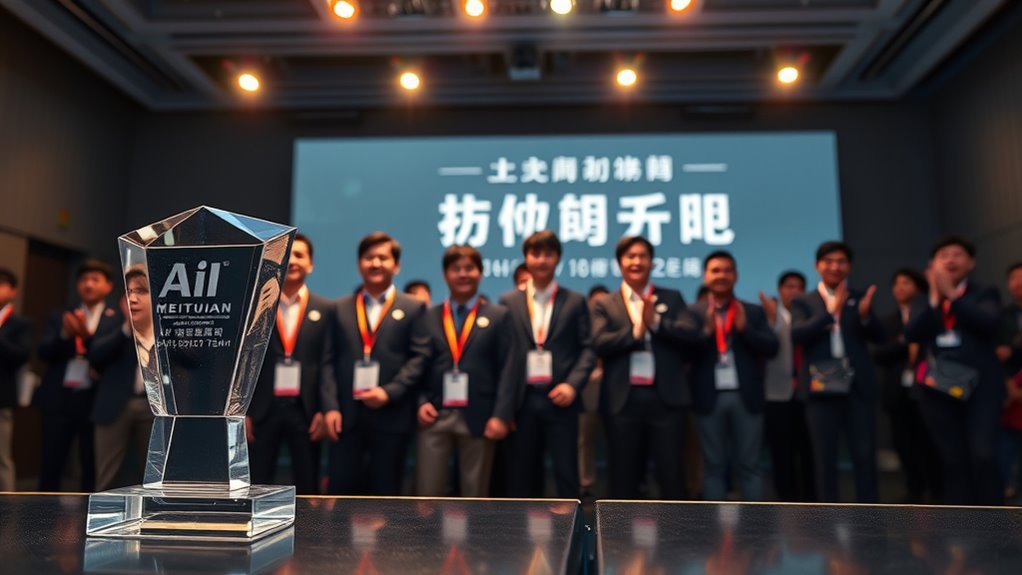

Meituan’s GeoRA research winning an ACL 2026 Outstanding Paper Award is a notable signal of where serious work on reasoning centric artificial intelligence is heading and who is now leading it. This recognition is not just about one clever algorithm. It reflects a broader shift toward reinforcement learning with verifiable rewards and the maturation of corporate research programs that aim to make large models reliable enough for real business decisions. It also crowns a year in which Meituan’s technical team curated 32 top-tier papers from leading AI conferences and shared their insights through five specialized live broadcast sessions. Additionally, this achievement illustrates the company’s commitment to enterprise AI sovereignty, emphasizing the need for control over the entire AI technology stack.
Reinforcement learning with verifiable rewards comes of age
For the past several years, most practical large language model tuning has relied on reinforcement learning from human feedback, where models are optimized against scores provided by human annotators or learned preference models. That approach helped align models with user expectations, but it struggled with consistency, scalability and objective correctness, especially in domains like mathematics and complex operations.
Reinforcement learning with verifiable rewards (RLVR) takes a different path by rewarding a model only when its output can be checked by a deterministic procedure such as a math solution checker, program executor or rule engine. Instead of asking humans or another model to judge outputs, RLVR uses external signals that can be audited and repeated, which makes it well suited for reasoning tasks where correctness can be automatically verified.
RLVR rewards models only when deterministic checkers verify correctness, enabling auditable, scalable reasoning
Recent work has shown that RLVR can be surprisingly efficient. For example, one study reported that one shot RLVR applied to a math specialized version of Qwen greatly improved performance on standard benchmarks with only a single verifiable example, and two examples performed even better. These results suggest that verifiable signals carry a high amount of useful information per training example compared with noisy preference scores.
At the same time, RLVR introduces new optimization challenges. Rewards are sparse and often binary, the update dynamics can be highly anisotropic, and naïve application of techniques designed for supervised fine tuning can lead to instability and catastrophic forgetting. This is the problem space in which GeoRA operates.
What GeoRA actually contributes
The GeoRA paper addresses a specific but critical question. How do you adapt large reasoning models with RLVR in a parameter efficient way without destroying the geometric structure that pretraining has already shaped in their representations?
Conventional low rank adapters such as PiSSA and MiLoRA were designed primarily for supervised fine tuning and do not account for the distinct optimization dynamics present in RLVR. When used directly in RLVR, these methods can cause spectral collapse, optimization instability and poor preservation of pretrained capabilities.
GeoRA proposes a geometry aware low rank adaptation mechanism explicitly tailored to RLVR update dynamics. Instead of treating low rank adapters as generic efficiency modules, it analyzes the RL update subspace, which tends to be compressible and anisotropic, and aligns the adapters with the principal directions discovered in that subspace.
In practice, GeoRA performs a singular value decomposition within a geometrically constrained mask over the weights, extracting the main directions of RL updates while freezing residual components that act as structural anchors for the pretrained model.
This design has two important consequences. First, it preserves the geometric structure that pretraining created, which reduces the risk of catastrophic forgetting and keeps the model’s existing skills intact. Second, it enables efficient dense computation on modern hardware, avoiding the performance penalties of highly sparse or irregular update patterns.
Experiments reported in the paper show that GeoRA consistently outperforms established low rank baselines on mathematical reasoning benchmarks for models such as Qwen and Llama, achieving state of the art results in several cases. The method also demonstrates improved training stability, stronger sample efficiency and better generalization to out of domain tasks, along with resilience to catastrophic forgetting. Those results justify why the work was singled out for an ACL Outstanding Paper Award.
The ACL 2026 portfolio behind the award
GeoRA is part of a larger ACL 2026 portfolio that highlights how Meituan is investing in reinforcement learning and complex reasoning for production scale systems. According to Meituan’s technical communications, the company has six accepted ACL 2026 papers spanning large model evaluation, nuanced reasoning, reinforcement learning optimization and generative recommendation applications.
Five of these papers come from the fulfillment AI team and form a coherent story about scaling large models to real world decision making.
- GeoRA focuses on RLVR specific low rank adaptation and training stability for reasoning models under verifiable rewards.
- CoT Flow models chain of thought reasoning as a continuous probabilistic flow, aiming to better capture long, structured business processes rather than treating intermediate steps as static text.
- UserLM R1 introduces a user simulator with explicit reasoning capabilities, which can be used to test and optimize recommendation and interaction policies before deployment to real users.
- Fine Mem proposes causal feedback aligned memory management, so that models can maintain and update long term context with attention to which information actually affects downstream outcomes.
- DuplexOmni explores full duplex multimodal interaction where systems can see, listen, speak and reason in parallel, with an emphasis on robustness and usability in operational environments.
This technical portfolio is complemented by SOP Maze, a benchmark designed to evaluate large language models on complicated standard operating procedures drawn from business contexts. SOP Maze targets a recurring pain point: many models can answer individual questions, but they struggle with multi step workflows that mix procedural rules, exceptions and temporal dependencies.
Beyond ACL, Meituan reports a total of 32 recent top tier publications across major AI conferences and collaborations with global partners, which signals a sustained and broad research investment rather than a one off effort. That track record strengthens the company’s authoritativeness in the intersection of reinforcement learning, large models and applied operations.
How low rank tuning is evolving for RL
Historically, low rank adaptation methods emerged as a way to fine tune large models without retraining all parameters, using small rank constrained matrices to capture task specific updates. Techniques such as LoRA, PiSSA and MiLoRA fit neatly into the supervised fine tuning setting, where gradients reflect dense token level losses and the geometry of updates is relatively well behaved.
RLVR breaks several of these assumptions. Rewards are often non differentiable and sparse, update directions can concentrate in narrow subspaces, and the effective signal is driven by verifiable outcomes rather than continuous token level losses. When standard low rank methods are used in this regime, they can misalign with the true update geometry, exaggerating certain directions while suppressing others and ultimately leading to spectral collapse or unstable training.
GeoRA can be viewed as part of the second generation of low rank RL techniques that explicitly model the geometry of RL updates rather than treating them as generic gradients. By masking weights according to spectral and Euclidean criteria, then performing decomposition within the masked subspace, GeoRA restricts adaptation to the truly compressible components while preserving the backbone of pretrained structure.
For practitioners, the lesson is straightforward. As reinforcement learning moves from small control problems to large reasoning models, parameter efficient tuning needs to become more aware of the underlying representation geometry. Methods that work well for supervised fine tuning may need substantial adaptation for RLVR. GeoRA is an early exemplar of that shift.
Implications for industry and Meituan’s strategy
Winning an ACL Outstanding Paper Award for work squarely focused on RLVR signals that high stakes reasoning with verifiable signals is moving from academic curiosity into the core of production oriented AI strategy. For Meituan, whose business depends on large scale fulfillment, logistics and recommendation, this alignment is not accidental.
GeoRA and the broader RLVR centered research portfolio are directly relevant to systems that must make decisions about delivery routes, rider assignments, restaurant recommendations and customer support with minimal error tolerance. Verifiable rewards fit naturally with many of these tasks. Delivery promises can be checked against actual arrival times, pricing decisions can be evaluated against revenue and fairness constraints, and compliance with standard operating procedures can be verified programmatically.
CoT Flow and Fine Mem point to an operational future where workflows like order dispatch, refunds or merchant onboarding are modeled as continuous reasoning processes with structured memory, rather than as isolated API calls. UserLM R1 and DuplexOmni suggest that user interaction will increasingly involve simulators and multimodal interfaces that can reason while communicating, making it possible to test policies extensively before exposing them to customers.
Meituan’s count of 32 recent top tier AI publications and its collaborations with leading universities, including institutions such as Peking University, strengthen its position as both an industrial player and an academic partner. For external researchers, this makes the company an attractive collaborator where theoretical ideas about RLVR and reasoning can be tested at real operational scale.
Opportunities and risks in the RLVR trajectory
The move toward RLVR and geometry aware methods like GeoRA offers clear benefits. Verifiable rewards increase transparency and auditability. Every training signal has an explicit checker, which makes it easier to debug failures, trace decisions and satisfy regulatory or corporate compliance requirements. When combined with parameter efficient adaptation, these signals allow large models to be sharpened for specific reasoning tasks without fully retraining them.
There are also meaningful risks. Verifiable rewards are only as good as the checkers behind them. If the checker encodes an incomplete or biased view of desired behavior, models will optimize toward that surrogate objective and may learn to exploit loopholes in the verification process. RLVRR, which extends RLVR to open ended generation by constructing reward chains that capture both content and style from reference responses, tries to mitigate some of this by using richer rule based verifiers. However, it still depends on the quality and coverage of those rules.
Moreover, RLVR makes the optimization landscape more brittle. Sparse rewards can create sharp cliffs in performance if models drift slightly away from the regions where verification succeeds. Geometry aware schemes help by constraining updates to stable subspaces, but they also add complexity and may require careful calibration when deployed across different domains.
From a societal perspective, the increased reliance on verifiable signals and corporate data raises questions about openness. Many of the most powerful reward functions for operations or finance are proprietary. As more reasoning capability is driven by closed verifiers, it may become harder for external observers to understand or audit how models are being trained.
What to watch next
Three trajectories are worth following over the next few years.
First, the expansion of RLVR beyond math and strictly checkable tasks into broader enterprise workflows. Work on RLVR and RLVRR suggests that verifiable reward structures can be built for open ended generation by deriving rule based chains from high quality references, opening the door to more general applications.
Second, the evolution of geometry aware adaptation techniques. GeoRA is an early example of low rank RL tuning that explicitly models update geometry, and its success will likely inspire variants that operate at different levels of the network, interact with memory modules or integrate with multi agent training setups.
Third, the way industrial research organizations like Meituan integrate these methods into production systems. The company’s ACL portfolio and broader publication record show a deliberate push to tie advanced reinforcement learning and reasoning research to concrete fulfillment and recommendation challenges. How well these ideas translate into measurable improvements in reliability, efficiency and user experience will determine whether RLVR and geometry aware adaptation become standard tools or remain specialized techniques.
Key takeaways
GeoRA’s ACL 2026 Outstanding Paper Award marks a turning point for reinforcement learning with verifiable rewards and for geometry aware low rank adaptation in large reasoning models. The method addresses real optimization pathologies that arise when standard parameter efficient tuning is naively applied to RLVR and demonstrates both state of the art performance and robust stability on demanding benchmarks.
Within Meituan’s broader portfolio, GeoRA is part of a coherent strategy that uses RLVR, chain of thought modeling, advanced memory management and multimodal interaction to push large models into the heart of operational decision making. For the wider AI ecosystem, the work underscores that future progress in reasoning will depend as much on careful geometry aware optimization and verifiable signals as on raw model scale.
Conclusion
Meituan’s ACL 2026 Outstanding Paper Award signals a real shift in how platform companies participate in serious artificial intelligence research, not just in applied engineering. It shows that a firm built around food delivery, local services and logistics can now stand alongside long established research institutions in core natural language processing work.
Why Meituan’s ACL Award Matters Now
In 2026 Meituan’s technical team reported that 32 of its papers had been accepted at major artificial intelligence conferences, including ACL, SIGIR, ICML and KDD. Among those, one ACL paper received the Outstanding Paper Award, a distinction that only a small group of submissions achieve each year and that is reserved for work seen as either theoretically significant or unusually effective in practice.
This matters for three reasons.
First, ACL is one of the central venues for natural language processing research, so an Outstanding Paper Award is a strong signal that Meituan is producing ideas that hold up under close academic scrutiny, not only incremental product improvements.
Second, Meituan is not a specialist research lab but a large consumer services company whose core business has historically been food delivery, local commerce and logistics. Its presence among the most cited contributions at ACL shows how deeply industry labs have moved into the core of academic artificial intelligence.
Third, the award arrives at the same time as a broader internal shift. In public comments Meituan leaders have framed artificial intelligence as central to the next stage of the company, with goals such as using artificial intelligence to reduce repetitive manual work and improve human efficiency and with an in house large language model named LongCat already deployed inside its ecosystem.
How Meituan Got Here: From Operations Platform to Research Contributor
For most of the previous decade Meituan was best known as a super app that stitched together food ordering, group buying, restaurant discovery and last mile logistics for Chinese consumers. Its early use of data and machine learning focused on recommendation, routing and demand forecasting inside its own operations.
Over time that operational focus evolved into a more systematic research strategy. Meituan built dedicated technical teams that publish in top venues and run open events to share findings with the community. The announcement that six Meituan papers were accepted at ACL 2026, covering topics such as large model evaluation, complex process reasoning, reinforcement learning optimization and generative recommendation, reflects this shift toward broad and deep research programs that extend beyond immediate product needs.
In parallel the company has articulated a clearer artificial intelligence playbook. Public reports describe three pillars. One is embedding artificial intelligence into daily workflows and operations. Another is creating artificial intelligence native products rather than simply adding models to existing services. The third is developing and running an internal large language model that can support these ambitions. This strategic framing gives context for the ACL award: the paper is not an isolated success but part of a coordinated attempt to move up the stack from applied optimization to fundamental methods.
Inside the ACL Outstanding Paper: Geometry Aware Adaptation
The awarded ACL 2026 paper comes from Meituan’s fulfillment technology team and focuses on what they call Geometry Aware Low Rank Adaptation for RLVR, a method that combines geometric insight with parameter efficient fine tuning for vision and language tasks. While the public summaries are relatively brief, they highlight a few key aspects.
The work addresses the challenge of adapting large multimodal models to new tasks without retraining the entire system, which is a practical concern for any firm that needs to deploy models at scale in high volume environments such as logistics or local commerce. Low rank adaptation techniques aim to modify only a small subset of parameters in a structured way, and the geometry aware approach suggests that the team has exploited the structure of the representation space to do this more effectively.
From an academic perspective this kind of contribution sits at the intersection of representation learning, efficient fine tuning and real world deployment constraints. The fact that it comes from a fulfillment group rather than a purely theoretical lab shows how deeply advanced methods have penetrated operational teams in industry.
A Larger 2026 Research Footprint
The Outstanding Paper is part of a broad research portfolio rather than a one off success. Meituan has highlighted a curated set of 32 high impact papers across the 2026 conference season and has organized a multi session livestream series to explain these works to the wider artificial intelligence community.
The accepted ACL papers cover several themes. One paper evaluates large language models on complicated business standard operating procedures, testing whether models can follow nuanced procedural rules rather than only respond to simple instructions. Another line of work looks at complex process reasoning and mathematical reasoning that is closer to competition level problem solving, which is relevant for both business planning and automated operations. Additional contributions explore reinforcement learning optimization and generative recommendation, both areas where Meituan’s real world datasets and traffic volumes provide fertile ground for experimentation.
This portfolio indicates that Meituan is deliberately mixing method oriented research with application focused studies. Some papers concentrate on evaluation, an area that is often underinvested but critical for trustworthy deployment. Others push on reasoning and optimization where improvements can have immediate business impact through better routing, pricing or personalization.
Implications for Technology and Business
For technology the main implication is that the boundary between corporate research and academic research continues to blur. When an operations focused company can win a leading award at ACL with a method that is both mathematically grounded and practically motivated, it reinforces a trend seen in other areas such as computer vision and reinforcement learning. Corporate labs are no longer just consumers of academic ideas but also originators of techniques that shape the broader field.
For businesses this award supports the view that investment in serious research can be a competitive advantage, not just a branding exercise. Meituan’s commitment to publishing in venues like ACL and ICML and sharing details through public technical blogs and livestreams signals openness and a desire for peer review. That tends to produce more robust methods and also makes recruitment of senior talent easier since researchers can maintain a public profile and contribute to the community.
There is also a practical operational angle. Meituan’s stated goal of using artificial intelligence to reduce repetitive manual work and raise efficiency only succeeds if the underlying models perform reliably across many edge cases. Geometry aware adaptation methods and rigorous evaluation of large language models on complex procedures are precisely the kinds of tools needed to reach that level of reliability.
At the same time there are risks. Heavy reliance on internal large language models and advanced adaptation techniques can create new failure modes that are harder to detect, especially when they interact with logistics or financial systems at scale. If models misinterpret procedures or if fine tuned parameters behave unexpectedly in rare scenarios, the impact on customers and partners can be significant. That is why the emphasis on evaluation and public scrutiny through conferences like ACL is not only academically valuable but also directly connected to safety and trust.
Societal and Ecosystem Effects
On the societal side this milestone highlights the growing role of platforms as research institutions. When a company that organizes urban services, delivery work and local commerce becomes a key contributor to natural language processing research, its choices in methodology and deployment influence millions of workers and users indirectly.
Meituan’s research agenda, which includes improving human efficiency by automating repetitive tasks, may reduce drudgery and open space for more skilled work. It may also pressure some roles to change or disappear, especially in areas where procedural knowledge can be codified into models. The balance between augmentation and replacement will depend on how the company designs its systems and training programs, topics that current public materials touch on only briefly.
For the artificial intelligence ecosystem the award reinforces a trend toward closer collaboration between industrial and academic communities. Meituan’s decision to explain its papers through open technical talks and livestreams, and to release detailed blog posts about its methods, helps researchers outside the company understand the assumptions and constraints driving the work. This transparency supports reproducibility and allows external teams to critique or build on these ideas rather than treat them as proprietary black boxes.
How This Compares With Earlier Corporate Artificial Intelligence Milestones
The trajectory mirrors earlier waves where companies like Google, Microsoft and others moved from applied engineering to best paper awards in areas such as machine translation, representation learning and reinforcement learning. The difference is that today’s industrial research is more tightly coupled to large scale platforms with dense logistics and service networks, which means direct feedback loops from deployment back into methodology.
Meituan’s mix of ACL level work on geometry aware model adaptation and practical research on business procedures and generative recommendation resembles the pattern where corporate labs first codify operational challenges as research problems and then progressively generalize the solutions. What makes the 2026 moment distinctive is the breadth of the portfolio and the explicit positioning of artificial intelligence as a central strategic pillar for the company rather than a supporting tool.
Looking Ahead: What To Watch Next
Meituan’s ACL 2026 Outstanding Paper Award marks a pivotal stage in its evolution from service platform to influential artificial intelligence research institution. The recognition reflects sustained investment in experimentation, interdisciplinary teams and rigorous evaluation rather than superficial demonstrations. As its breakthrough models move from academic studies into real world applications, the company’s trajectory suggests continued contributions that may shape industry practice, deepen collaboration with the wider research community and raise expectations for the impact of corporate artificial intelligence innovation in the coming years.
The most important questions now are less about whether Meituan can produce high quality research and more about how it will govern deployment. How will the company measure and communicate the effects of these models on workers, merchants and customers. How will it share benchmarks and evaluation tools so that external groups can verify performance and robustness.
If Meituan continues to pair strong academic results with transparent evaluation and careful integration into its platform, this ACL award could be remembered as the moment when its artificial intelligence ambitions moved from promise to practice. If that balance slips, the same research power that won the award could create new sources of opacity and risk. The next few years of publications, product launches and governance decisions will reveal which path it follows.