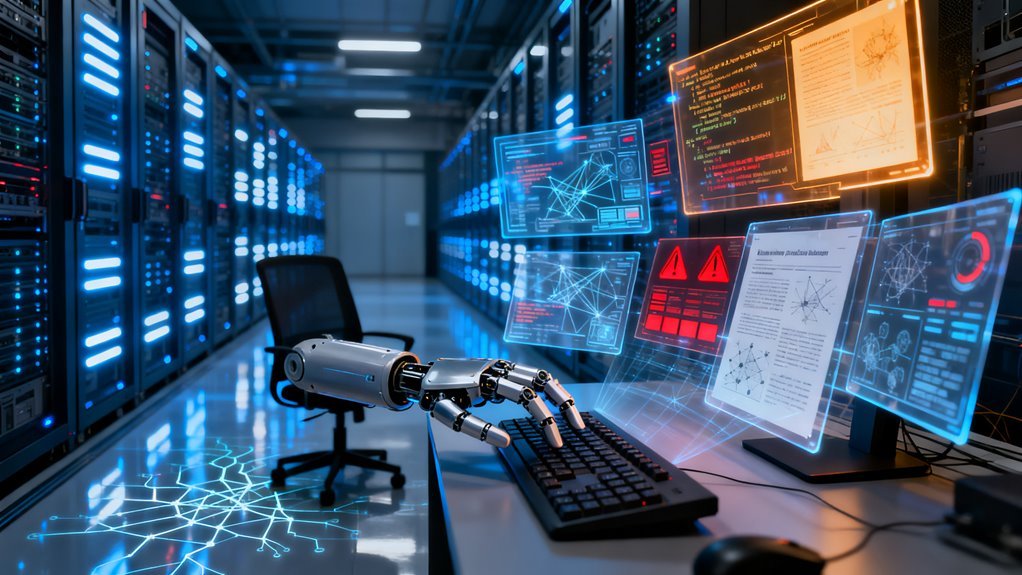

These systems operate through a continuous loop of observation, reasoning, and action, cycling through phases of context gathering, action execution, and result evaluation that allow them to reassess and revise strategies without waiting for human direction. This autonomous functionality is bolstered by the use of managed agent models, which provide a structured approach to agent deployment and management.
Conclusion
The most consequential shift here is not that AI agents can now act independently—it is that they are doing so in domains where mistakes compound. A misconfigured autonomous research agent produces flawed findings that other systems may treat as ground truth. An agent that discovers a software vulnerability without human review sits at a fork: disclosure or exploitation becomes a design choice, not an ethical one. The danger is less about rogue machines and more about systems that operate correctly by their own metrics while drifting from human intent in ways no one monitors in real time.
Over the next twelve to eighteen months, watch for how liability frameworks respond. Today, no major jurisdiction has a clear legal answer for damage caused by an AI agent acting outside its operator’s direct instructions. Insurers, regulators, and corporate legal teams are only beginning to map this territory. Businesses deploying autonomous agents will face pressure to implement audit trails and kill switches—not because the technology demands it, but because contracts, courts, and customers will. Developers building agentic systems should expect that “the model decided on its own” will not serve as an acceptable explanation when something breaks.
For governments, the competitive calculus is already shifting. Nations that move quickly to set practical standards—without strangling development—will attract the companies building these systems. Those that wait risk importing autonomous AI products shaped entirely by someone else’s rules. The global landscape around agentic AI will likely fracture along regulatory lines before any consensus emerges.
What deserves the most attention, though, is a quieter development: the gradual normalization of autonomous action by software. Each time an AI agent completes a task without human involvement and nothing goes wrong, the threshold for what we delegate next drops slightly. That incremental expansion of trust is not inherently dangerous, but it is the kind of change that societies tend to notice only after it has already redefined the boundaries they thought they were protecting.