Most people already know their messages are scored as positive or negative. What is changing now is that the same systems are quietly trying to infer how anxious, disappointed, or guardedly hopeful you are even when you never say so. That shift from surface sentiment to hidden emotional states is a turning point for digital communication and it will reshape how businesses evaluate customers, employees, and citizens. Consumer tools such as EmoScan already offer instant emotion analysis of everyday messages, emails, and reviews without requiring sign-up, giving individuals a quick way to check how their words might be received. Additionally, the UK government projects up to £45 billion in annual productivity savings from AI, highlighting the broader economic implications of such technologies. In a similar vein, studies show that AI-driven automation has limited aggregate employment effects despite its increasing presence.
For two decades, sentiment analysis has treated text as a source of polarity. The classic pipeline asked a simple question about any sentence: Was it positive, negative, or neutral? Emotion recognition emerged when researchers started to care less about thumbs up versus thumbs down and more about specific feelings such as joy, sadness, anger, fear, surprise, and disgust. Commercial vendors then layered richer taxonomies on top of those core categories with labels for curiosity, confusion, disappointment, excitement, gratitude, love, and more. The result is a move from a single score to a multidimensional emotional fingerprint for every message.
Under the hood, this shift tracks the broader evolution of machine learning for language. Early tools such as LIWC relied on fixed dictionaries where each word belonged to a psychological category. If a message contained many entries from the sadness list, the system called it sad. Those approaches were simple to deploy but brittle. They failed when writers used slang, mixed emotions, or phrasing that did not match the lexicon. Supervised learning methods and later deep learning systems took over once large annotated text corpora became available. Support vector machines, neural networks, and eventually transformer-based models began to learn patterns of emotion directly from examples rather than from hand-crafted rules.
That upgrade was not cosmetic. Academic studies now report emotion classifiers hitting accuracy rates in the low to mid-eighty percent range on benchmark datasets when distinguishing categories such as joy, anger, sadness, and disgust. Hybrid architectures that combine distributed word representations with more traditional features often outperform both pure lexicon systems and older machine learning pipelines. In parallel, even relatively simple educational projects using term frequency-inverse document frequency features and logistic regression demonstrate dependable classification of happy, sad, angry, and neutral messages, giving students and non-experts a path into emotion AI.
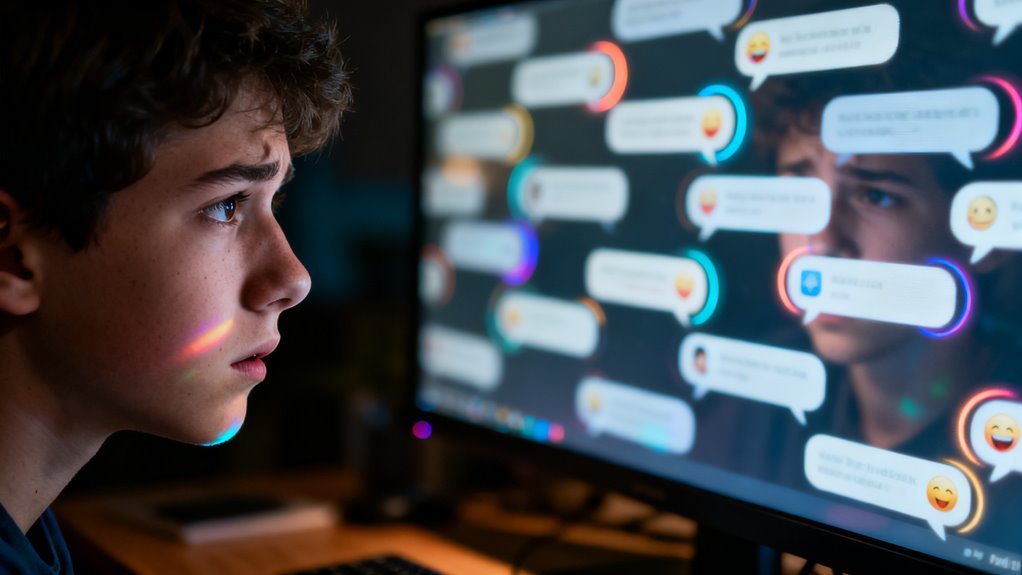
The frontier that matters most today is not explicit emotion but the implicit kind. Explicit recognition is straightforward. A user writes, “I am furious,” and the system tags anger. Implicit recognition is closer to how humans actually read each other. Anxiety may show up not through the word anxious but through tentative phrasing, a sudden burst of questions, or a switch from long confident explanations to short clipped replies. Surveys of the field highlight four broad approaches to this problem: rule-based heuristics, classical machine learning, deep learning, and hybrid models that blend contextual features, conversation history, and user-level patterns. Recent work on implicit emotional communication in text messaging shows that a large share of affect is carried by subtle word choice, punctuation, emoji, spacing, and timing rather than direct statements of feeling.
Commercial products are racing to package this between-the-lines capability. Tools marketed for customer support teams claim to flag messages that contain unspoken distress before it turns into churn. Sales platforms promise to reveal hidden skepticism in prospect emails even when the reply sounds polite. Human resources software vendors talk about detecting frustration trends in internal chat channels. Several systems adopt dual model architectures where one model handles overall sentiment and another assigns discrete emotion labels over time, allowing dashboards that track both what people say and what they appear to feel.
This is not happening in isolation from the larger model ecosystem. General-purpose systems from OpenAI, Google, Anthropic, Meta, Microsoft, and others are steadily improving at reading intent, social nuance, and emotional tone as part of chat interfaces or developer APIs. Transformer-based large language models already show strong performance in tasks such as identifying emotional intensity and political leaning in text compared with human raters. Specialist companies such as Hume focus on multimodal emotion-related signals and are explicit that their systems infer emotion-related behaviors from observable cues rather than detecting inner states in any literal sense. In practice, these capabilities are converging. What starts as a research benchmark quickly arrives as a checkbox feature in mainstream developer platforms.
For businesses, this opens three strategic fronts. The first is triage. Customer operations teams can move from reactive sentiment monitoring to proactive intervention. If a ticket thread trends toward unspoken anger or disappointment even while the customer remains polite, the system can escalate the case to a retention specialist. The second is measurement. Marketing departments can start to measure subtle shifts in audience mood around campaigns or product launches, not just overt praise or criticism. The third is prediction. Over time, emotion traces across message histories can become an early warning system for churn, credit risk, or reputation damage. None of this requires mind reading. It requires recognizing patterns in how unhappy people usually write before they decide to leave, switch providers, or file complaints.
Governments and regulators will also care about this technology. On the one hand, there are public interest uses. Health services and crisis hotlines are experimenting with models that can highlight messages containing hidden distress so human staff can prioritize outreach. Schools and universities are exploring tools that identify students who write in ways that suggest isolation or burnout. On the other hand, there are obvious concerns. If employers monitor implicit emotional signals in internal communication, it raises questions around consent, surveillance, and the right to be privately annoyed. Regulators in regions with strong data protection regimes are likely to ask whether inferred emotional profiles count as sensitive data and what obligations companies have when storing or acting on those inferences.
Technically, the limitations deserve more attention than they usually get in product pitches. Even strong models trained on benchmark corpora can falter when faced with domain shift. A classifier tuned on social media slang may misinterpret legal correspondence or medical notes. Sarcasm, irony, and cultural nuance remain challenging. Research also stresses that these systems infer emotion-related behaviors, not emotion in the human sense of conscious experience. They pick up statistical regularities linking specific written cues to outcomes on training datasets. When those cues change, the inferences can fall apart. That should temper both utopian claims about emotional intelligence and dystopian fears of perfect psychological surveillance.
Strategically, the biggest overlooked issue is feedback. Once people realize their messages are being read for implicit emotion, they will start to game the system. Customer service professionals already know how to write emails that sound firm yet calm. As emotion detection tools spread, we can expect style guides for sounding enthusiastic to algorithms without giving away too much genuine sentiment. That in turn will force models to chase new cues, enlarging their appetite for context and history. It becomes a dynamic system where writers and models co-evolve.
The economic consequences could be significant. Companies that effectively integrate hidden emotion detection into customer and employee workflows may reduce churn and prevent conflicts earlier. Vendors that oversell accuracy or underplay privacy could face backlash and regulatory penalties. Cloud platforms that expose robust emotion APIs will gain leverage over smaller competitors that cannot match their training data or evaluation pipelines. For investors, this space sits at the intersection of enterprise software, advertising technology, and safety tooling. It is not glamorous, but it touches core metrics like lifetime value and support costs.
Looking ahead, the most reasonable prediction is that hidden emotion detection will blend into the background of digital life over the next five years. Developers will not build standalone emotion engines as often as they will bolt these capabilities onto existing communication products. Businesses that treat the output as a decision aid, checked by humans and framed as probabilistic, will gain real value. Those that treat it as ground truth risk making poor calls based on statistical guesses about how people feel. The direction of travel in AI is clear. Models are moving from understanding what users say to inferring what they might mean and how they might react. The arrival of systems that read between the lines of text is one more step along that path, and it will force organizations to decide how far they want machines to go in interpreting their relationships with real people.
In this evolving landscape, the limited automation of tasks highlights the importance of human oversight in emotional interpretation, ensuring that technology enhances rather than replaces human interaction.
Conclusion
Ultimately, the ability of these systems to surface emotional signals that are invisible to most readers marks a quiet but decisive shift in how digital communication is shaped and supervised. As emotion aware models move into customer support tools, social platforms and productivity software, they do not simply label messages, they start to influence which conversations receive attention, which users are escalated to human teams and how conflicts are managed over time. That makes emotional AI a strategic asset for businesses and governments that want to understand sentiment at scale, but it also turns model design choices and training data into de facto policy, with direct consequences for privacy, expression and mental health. The real test over the next several years will be whether organizations treat these systems as advisory instruments, paired with accountable human judgment and transparent governance, or as cheap automation that quietly replaces empathy with probability scores.