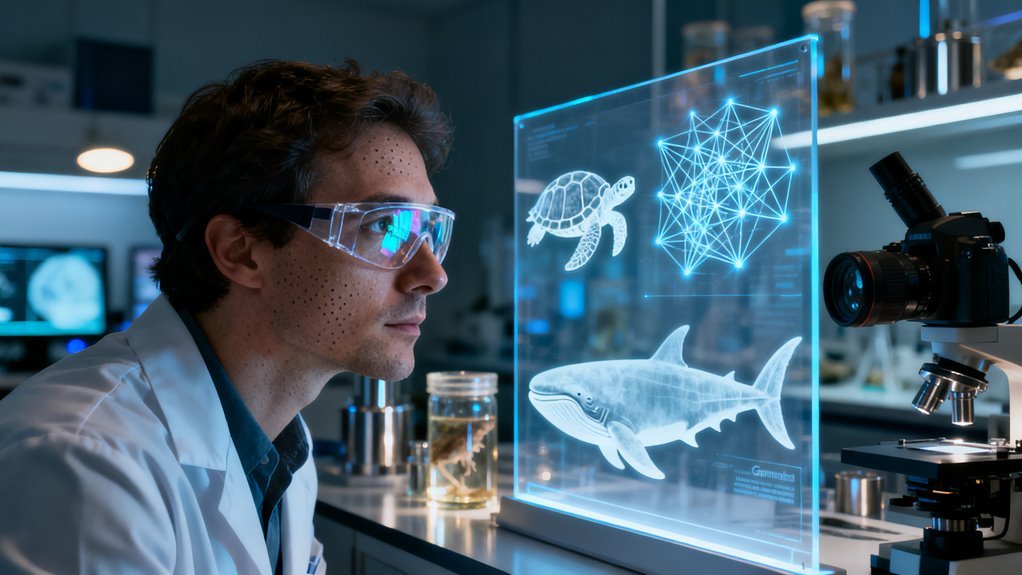
Aging used to be something biologists observed. With animals it meant tallying lifespans and cataloguing oddities like whales that live for centuries or rodents that almost never get cancer. Now those same animals are being treated as data sources for a new kind of intelligence system that treats longevity as a parameter that can be modeled, probed and ultimately optimized. That shift matters because it turns the biology of aging from a descriptive science into an engineering problem with direct implications for drug discovery, insurance, agriculture and even how cloud platforms position their next generation of AI models. In this context, AI safety becomes vital as researchers navigate the complexities of biological data. The potential for £45 billion in annual productivity savings from AI adoption in various sectors underscores the urgency of these advancements.
The turning point has been the fusion of multiomics with modern machine learning. Over the past decade researchers have gone from single gene studies to full genomic, transcriptomic, epigenomic, proteomic and metabolomic profiles for dozens of mammalian species at different ages. Those datasets are large enough and messy enough that traditional statistics struggle. Deep learning models and graph based inference step in to compress these measurements into representations that capture how damage accumulates, how repair mechanisms respond and which pathways stay stable in animals that remain healthy far longer than expected. In other words, AI is starting to learn what long life looks like in molecular terms.
The celebrity cast in this story is familiar. Bowhead whales, naked mole rats, certain bats and Greenland sharks all defy standard lifespan predictions and show unusual resistance to cancer, neurodegeneration and metabolic disease. Historically they were curiosities. Today they anchor multi species databases like AnAge and related longevity resources that provide high quality lifespan, body size and life history data for hundreds of animals. When those curated traits are linked with multiomics and fed into neural networks, the models uncover recurring signatures in DNA repair, stress response and epigenetic stability that correlate with exceptional longevity across distant branches of the mammalian tree. The key point is that AI does not just spot one off quirks in single species. It surfaces conserved patterns that look more like reusable design principles.
Longevity researchers have started to formalize this with what some call Longevity Intelligence frameworks. These pipelines ingest standardized multiomics from many species and use deep learning, causal networks and simulation to infer likely longevity pathways and rank them as potential drug targets or intervention points. The process is iterative. Models propose mechanisms, experiments validate or refute them, results feed back into training and the cycle repeats. Over time this builds an evolving map of aging biology that is both mechanistic and predictive rather than purely observational. From a technology perspective, this looks a lot like the reinforcement learning loops used to refine large language models, except the reward signal here is survival and healthspan instead of next token accuracy.
One of the most striking outcomes of this approach is the emergence of aging clocks. These models ingest biological signals from laboratory animals and output either an estimate of biological age or a forecast of remaining lifespan. In mice, unsupervised learning applied to serial blood tests has produced dynamic frailty indices that rise in a roughly exponential fashion with age and respond in measurable ways to diet, exercise and geroprotective compounds. Related clocks such as FRIGHT and AFRAID combine clinical features, lab values and behavioral data to capture apparent age and survival probability in animals more accurately than conventional frailty scales. Researchers use these tools to screen interventions in silico, prioritize which compounds move into expensive in vivo trials and adjust dosing strategies well before the first human volunteer is recruited. This is aging rendered as a numeric score that can be shifted, nudged and tracked with each experimental decision.
Organ specific clocks push the idea further. Brain age models built from MRI and other imaging modalities in rodents infer the pace of neural deterioration and can pick up subtle slowing of brain aging under different diets or activity regimes. Cardiovascular and metabolic clocks are following the same pattern. Each creates a standardized index that makes it possible to compare the biological condition of organs across individuals and species without relying on crude chronological age. For developers and data scientists, these are essentially domain specific foundation models that translate raw physiological signals into clinically relevant longevity metrics.
Perhaps the most provocative line of work takes the idea of an aging clock and scales it across the entire mammalian class. Epigenetic and transcriptomic clocks trained on thousands of samples from many species can now predict maximum lifespan, gestation time and age at sexual maturity from a handful of molecular features. A recent study showed that patterns of CpG density in selected gene promoters serve as robust biomarkers of lifespan across vertebrates and can be used to estimate lifespan for species with little observational data. Another group has built epigenetic predictors that track life history traits such as pace of development and reproductive timing in mammals with impressive accuracy. These are zero shot longevity estimators. Feed in molecular data from an understudied animal and the model returns a plausible aging trajectory without the need to monitor that species for decades.
It is tempting to see all this as a niche within biogerontology. That would be a mistake. What is happening in animal longevity research echoes a much larger trend in AI. Large language models from OpenAI, Google, Anthropic and others turned unstructured text into a searchable, generative substrate. Similar architectures and training philosophies are now being applied to biological and ecological data, with longevity as one of the most visible proving grounds. Nvidia, Microsoft and Amazon are investing heavily in cloud platforms tuned for multiomics analytics, high throughput simulation and AI workloads that demand both massive memory bandwidth and specialized accelerators. As these systems mature, the line between a biological experiment and a data pipeline will blur further. Labs that can stream their animal data directly into such platforms will outpace those that still depend on hand crafted analyses.
For businesses, the implications are immediate. Longevity biotechnology firms are already positioning AI driven aging clocks and cross species models as key assets in their pipelines for drug discovery, companion animal health and agricultural productivity. Pharmaceutical companies gain tools to de risk early stage programs by running intervention scenarios in animal models that are tightly linked to human biology through conserved aging pathways. Pet insurers and veterinary networks can imagine products priced around data driven healthspan forecasts for dogs and cats. In agriculture, breeders may use molecular aging predictors to select livestock lines that remain productive longer, smoothing supply chains and shifting economic assumptions around herd replacement. These are not abstract opportunities. They impact margins, valuations and the strategic calculus of investors who now need to understand longevity AI as well as they understand generative models for text and images.
Governments and regulators will not be able to ignore this wave. Multi species longevity databanks require standardized collection, ethical oversight and FAIR data principles to be usable across institutions. When animal aging data becomes a strategic resource, questions about access, sharing and national advantage follow. Countries that control unique long living species or large companion animal populations may find themselves with valuable training data that foreign biotech firms want to tap. Regulators will need to decide how to treat AI models that predict lifespan for domestic animals and potentially for humans, balancing innovation against the risk of misuse in areas such as insurance discrimination or unproven anti aging therapies. There is also a quieter animal welfare dimension. As AI increases the efficiency of aging research, it could reduce the number of animals required for certain studies, but it might also incentivize more intensive longitudinal monitoring. That tradeoff deserves explicit debate rather than being buried in technical documentation.
Ethically, the field sits at an uneasy intersection of curiosity, commerce and control. On one hand, learning from whales and rodents to extend healthy human life feels like a natural extension of comparative biology. On the other, once AI systems can suggest interventions that materially alter lifespan in animals, we step into territory where long term ecological and evolutionary consequences are hard to predict. Changing the aging trajectory of a keystone species could ripple through entire ecosystems. Even at the level of companion animals there are social questions about who gets access to longevity enhancing interventions and what extended lifespans mean for human attachment, grief and cost of care. None of these concerns argue for halting research, but they do underline the need for humility and transparent risk assessment as models grow more powerful.
What people often overlook is how quickly the tooling is likely to democratize. Much as open source language and vision models lowered the barrier for startups to build products on top of cutting edge AI, similar patterns are likely in longevity. Once generalized aging clocks are trained on broad animal datasets, lighter versions can be shared or licensed to smaller labs and companies that lack the budget for massive experiments but can contribute niche data back into the ecosystem. That feedback loop could accelerate discovery and expand the geographic footprint of longevity innovation, particularly in regions with rich biodiversity but limited research infrastructure.
Taken together, AI and animal longevity research point to a future in which aging is no longer treated as an immutable backdrop but as a variable that can be measured, simulated and eventually controlled. For AI itself, this is a test of whether the field can move beyond synthetic benchmarks and user engagement metrics toward deep integration with complex scientific domains. For businesses it signals new markets, new risks and new competitive fronts that cross traditional boundaries between tech and life sciences. For everyone else, it raises a simple but profound question. If intelligence systems can learn the rules of long life from animals, how do we choose to use that knowledge?
In addition, ongoing partnerships between public health agencies and tech firms aim to ensure federal safety evaluations are integrated into AI applications aimed at longevity research. Importantly, task reconfiguration around AI assistance in knowledge work highlights the need for adaptive strategies in this rapidly evolving field.
Conclusion
As the study of exceptionally long lived animals matures, artificial intelligence is turning into more than a fancy microscope for biologists. It is becoming the infrastructure that lets researchers pull signal from chaotic genomic, physiological and ecological data and compare species on genuinely equal terms. Instead of chasing one gene or pathway at a time, AI systems can scan across whales, tortoises, deep sea fish and short lived lab models to surface shared patterns of DNA repair, protein homeostasis, immune control and metabolic slowdown that correlate with extreme lifespan. Those models do not hand anyone a recipe for immortality, and they should not be treated as such. Their real value is in generating concrete, testable hypotheses about which mechanisms of resilience are conserved, which are species specific and which might be pharmacologically tractable. That in turn reshapes how drug discovery teams prioritize targets, how regulators think about aging interventions and how investors assess longevity platforms. The more comparative data AI ingests, the clearer the boundaries of biology become, and the more realistic the field’s next decade looks: not endless life, but a steadily sharper playbook for stretching healthy years while staying within the hard limits of animal physiology.



