
Artificial intelligence is starting to read the part of human life that people rarely show a product manager or a therapist. Not search history. Not chat logs. Dreams. As labs and startups begin to run modern language models over tens of thousands of dream reports, they are turning one of psychology’s most elusive topics into something measurable, comparable and in some cases commercially usable. This shift is essential as it aligns with increasing regulatory scrutiny on data usage, reflecting a growing need for responsible data governance.
That shift matters because dream content has long been treated as a mix of art, myth and subjective impression. Analysts would listen to a handful of reports, then build an interpretation around vivid symbols and personal associations. Interesting, but hard to test, hard to scale and almost impossible to compare across people or cultures. Once you feed those same reports into machine readers, patterns start to crystallize, and the conversation changes from anecdotes to distributions. This transformation parallels how AI literacy is reshaping various job roles across industries, highlighting the critical need for task reconfiguration in knowledge work.
At the research end of the spectrum, teams are now training content analysis systems on corpora of more than thirty-five thousand dream narratives. Instead of a human scorer ticking boxes, the system assigns probabilistic scores across dozens of recurring themes derived from classic coding frameworks like Hall and Van de Castle, Domhoff and Bulkeley. Each dream is not just a story about losing your teeth or missing a flight. It becomes a point in a high-dimensional space where aggression, misfortune, sexuality, success and other motifs are quantified with consistent rules. This method reflects the growing interest in public-private partnerships to explore innovative applications of AI.
The interesting part is how this is implemented. Rather than a single monolithic classifier, many groups use collections of specialized agents that crawl through each text, armed with theme-specific keyword templates and linguistic cues. One agent looks for conflict and pursuit, another for social support, another for money and work. None of this is especially glamorous on its own. The impact lies in what you can do once every dream in a dataset has the same structured annotation.
Those annotations turn vague impressions into prevalence maps. You can compare how often themes of threat or humiliation appear in one population versus another or track how financial anxiety in dreams shifts before and after an economic shock. What used to require years of manual coding by graduate students now becomes a query and a visualization. For sleep labs, this changes the scale of what is possible. For technology companies, it hints at entirely new forms of longitudinal mood tracking that cannot be gathered from social media alone.
Outside academic settings, consumer-focused tools are starting to apply similar ideas to personal dream journals. Some of these systems interpret dreams through three psychological layers that blend psychological analysis, symbolic motifs, and personal reflection to give users more structured insight into recurring themes. Many sleep and wellness apps already prompt users to log dreams. Add natural language processing and pattern tracking on top of those entries, and you move from a private notebook to a time series dataset. The system can surface your most frequent locations, recurring characters and repeated scenarios, then highlight which ones are intensifying or fading.
From a product perspective, this is a shift from treating each dream as an isolated anecdote to treating the whole archive as a dynamic signal. Comparative analysis across weeks or months can show how themes like pursuit, isolation or financial strain evolve and how their emotional tone changes. Instead of scrolling through dozens of notes, a user might receive a monthly report that says, in effect, your dreams about being chased are less frequent but more emotionally intense, while dreams about work deadlines have become more mundane and less disturbing.
For mental health providers, there is obvious appeal. A therapist could look not just at what a client remembers this week, but at how particular scenarios reappear and mutate over time. Companies will see opportunities to wrap this into coaching products, resilience training and even pre-clinical mental health screening. That in turn raises familiar questions about consent, data governance and the risk of overreach. Who owns the corpus of your dreams if you log them in a commercial app for five years? Which third parties get to run analytics on that data? Those policy conversations have barely started.
Another front is emotional and psychological pattern mapping. Modern systems do not stop at tagging themes. They attach affective labels to each dream and then analyze how emotions cluster around specific figures, places and storylines. Fear might concentrate around crowded public spaces, anger around a particular family member, longing around former partners or past homes. When you aggregate at scale, you begin to see that certain archetypal patterns are not the rare poetic events older theories suggested, but recurring statistical structures.
This is where long-standing schools of thought reenter the scene. Jungian-oriented engines cross-reference extensive symbol libraries to detect configurations that match ideas like the shadow, the anima or animus and heroic struggles. Freudian-inspired settings emphasize conflict, wish fulfillment and defensive disguises. The crucial difference is that instead of relying on an analyst’s intuition, these systems link symbolic motifs to measurable variables such as dream frequency, reported intensity on waking and association with current life stressors.
Integrate those narrative features with self-reported data on relationships, work, health and money, and you get something new. The system can suggest, with some level of confidence, that a recurring dream of failing an exam correlates more with current performance anxiety in a job than with unresolved memories from school. It can show that dreams about physical collapse spike weeks before a user reports burnout. Viewed responsibly, this becomes a tool to highlight where inner tensions remain unresolved and where intervention might help.
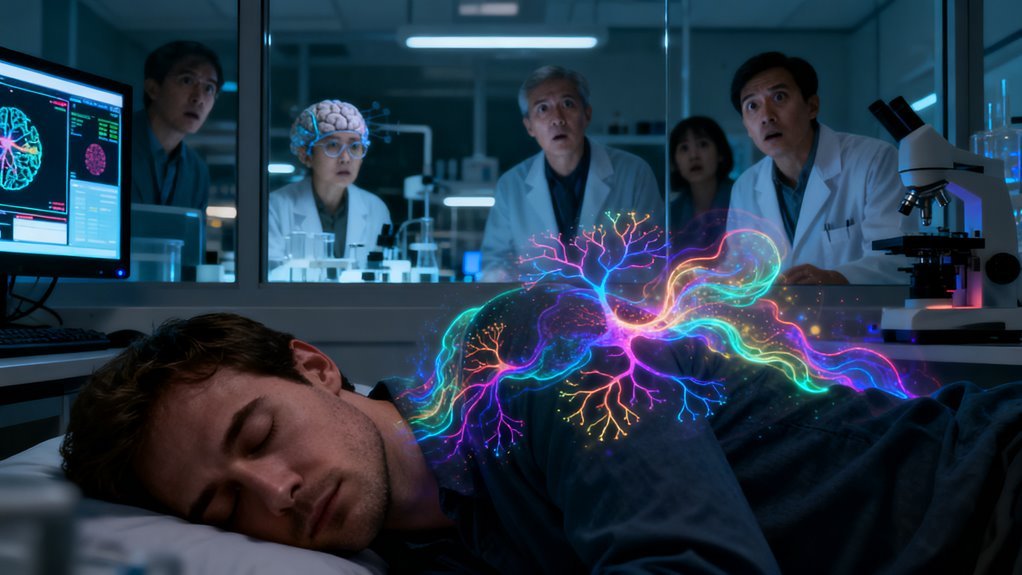
The most futuristic work goes in a different direction and tries to decode dreams directly from brain activity. Experiments that map patterns in higher visual cortex to probabilities over broad scene or object categories are still rough. Nobody is reconstructing perfect dream movies. What researchers are seeing instead is semantic regularity. Certain clusters of neural activity are more likely when the sleeper later reports an indoor scene, a face, a landscape, a written word. That is enough to tie subjective reports back to neural signatures and to test theories about how the brain generates dreams in the first place.
Why does any of this matter now? The answer has as much to do with market dynamics as with neuroscience. Large language models have made it trivial to parse free-form text at scale, and GPU infrastructure has made it practical to run these models over millions of words of dream material. Cloud platforms and vector databases handle storage and retrieval. What would have been exotic research infrastructure a decade ago now sits inside standard observability stacks and data pipelines.
At the same time, the consumer wellness economy keeps searching for differentiation. Meditation apps, sleep trackers and therapy platforms all claim to help users understand their minds. Dream analysis backed by machine learning offers a new narrative and potentially higher engagement. An app that not only records sleep duration but also tells you how your subconscious storylines are trending can be marketed as more insightful than a generic tracker, regardless of whether the underlying science truly supports strong claims.
For investors and founders, the opportunity is real but subtle. The obvious play is a direct-to-consumer dream analytics product that offers reports, coaching and perhaps integration with teletherapy. A more strategic angle is infrastructure. The same pipelines that extract themes and emotions from dreams can be applied to journals, support transcripts, even customer feedback. A company that perfects tools for extracting structured psychological signals from messy narrative data will have options far beyond sleep.
The risks should not be understated. Dream reports often contain extremely sensitive material about sexuality, violence, trauma and deeply held fears. If this content is stored insecurely, misused for ad targeting or pushed into poorly designed recommendation systems, the backlash will be swift. There is also the danger of overinterpretation. People already tend to treat dream symbolism as meaningful even when it may be stochastic noise. Add confident model outputs and sleek dashboards, and users may assign unwarranted significance to what are essentially statistical regularities.
Regulators are not yet focused on this niche, but the trend intersects with broader debates around biometric and mental health data. Dreams blur the line between medical information and personal expression. That will test existing privacy frameworks. Expect pressure for clear disclosure on how dream data are processed, which models touch them, whether they are used for training and what happens when a user deletes an account.
Looking ahead, AI-assisted dream analysis offers a small but telling preview of where the field is heading. The same set of technologies that turned internet text into training data is now being aimed at our most intimate narratives. Researchers gain powerful new tools to test theories of mind. Clinicians gain new signals for assessment and intervention. Product teams gain a new hook for engagement. The common thread is that qualitative inner life is being repackaged as quantitative features.
That raises a final strategic question for anyone building in this space. Are you helping people see patterns that genuinely support insight and healthier choices, or are you simply extracting another behavioral signal for engagement and monetization? The tools emerging around dream content make that distinction unavoidable. Over the next several years, how companies answer it will say as much about the direction of artificial intelligence as any new model announcement from a major lab.
Conclusion
Seen together, these findings recast AI as a new analytic lens on the dreaming mind, bringing into focus patterns of emotion, memory and desire that clinicians long suspected but could rarely measure at scale. As systems become more attuned to cultural context and a person’s lived history, dream traces start to look less like curiosities and more like longitudinal data that could influence clinical practice, early mental health screening and even how employers think about stress in their workforce. At the same time, the very act of quantifying the unconscious forces researchers, regulators and product builders to confront hard questions about consent, privacy, autonomy and whether anyone should be able to turn the most intimate layers of inner life into another source of behavioral insight.