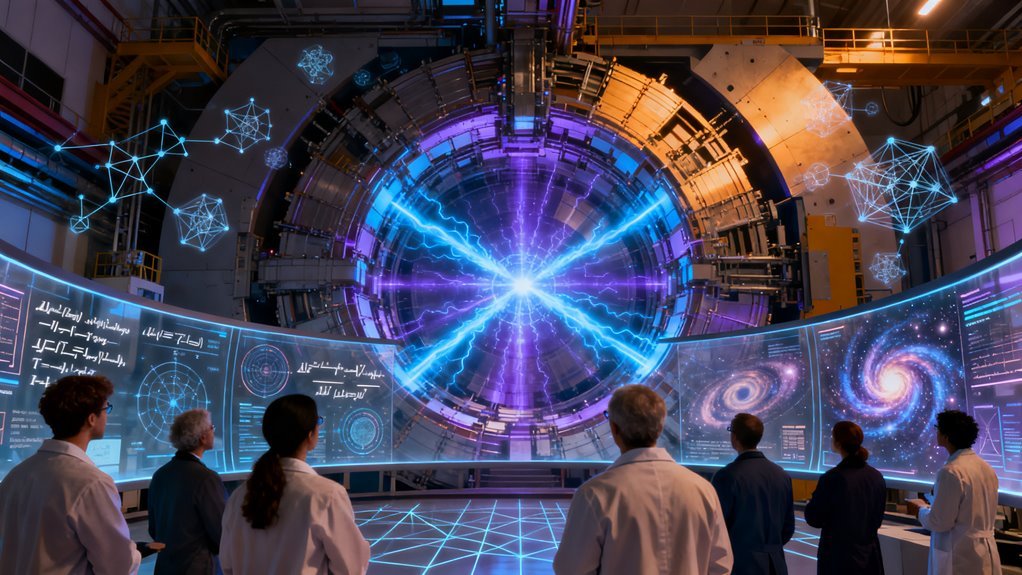
For decades, artificial intelligence played a supporting role in physics. It ran simulations faster. It processed data from particle colliders and telescopes. It optimized parameters. Useful, yes, but fundamentally a tool that operated within boundaries humans defined. That arrangement is now shifting in ways that deserve serious attention from anyone tracking the trajectory of AI capabilities.
A cluster of recent studies, spanning plasma physics, turbulence modeling, condensed matter, and multi-domain scientific foundations, points toward something qualitatively different. AI systems are not just fitting curves to experimental data anymore. They are extracting interpretable physical laws, identifying forces that humans missed entirely, and mapping regions of phase space that no theorist had charted. The transition from passive computation to active scientific discovery is no longer hypothetical. It is happening across multiple subfields simultaneously, and the implications reach far beyond academia.
AI is no longer crunching data for physicists — it is surfacing laws of nature they never knew existed.
Discovering Forces That Physicists Overlooked
Consider what happened with dusty plasma. A team published results in *PNAS* showing that a custom neural network, applied to a many-body plasma system, identified non-reciprocal interaction forces between particles with accuracy exceeding 99 percent. That alone would be noteworthy.
What makes it genuinely significant is that these forces contradicted assumptions the plasma physics community had held for years about how particles interact in complex plasmas. This was not a case of AI confirming what physicists already suspected. The system surfaced dynamics that were effectively invisible to conventional analytical methods.
And critically, the framework was built for interpretability. The discovered laws were not locked inside a black box. Scientists could read them, scrutinize them, and test them against physical intuition. The team behind the work positioned the framework as transferable to other many-body systems, which means the same architecture could potentially reveal unknown governing equations in biological swarms, active matter, or granular materials. This approach is reminiscent of how AI tools like AlphaFold2 have increased research capabilities by predicting previously unknown protein structures.
The interpretability piece matters enormously here. One of the persistent criticisms of deep learning in scientific contexts has been that neural networks can achieve impressive predictive accuracy while offering zero insight into underlying mechanisms. A model that predicts particle trajectories perfectly but cannot explain why is of limited scientific value.
This study threads that needle by producing both accuracy and transparency, a combination that was widely considered difficult to achieve in complex physical systems.
Turbulence Finally Gets an Analytical Model
Turbulence closure has been one of fluid dynamics’ most stubborn problems for over a century. The core challenge is deceptively simple to state: when simulating turbulent flows at practical resolutions, you cannot resolve every eddy. Small scale motions influence large scale behavior, and you need some mathematical relationship to capture that coupling without simulating every microscopic detail.
Traditional approaches rely on parameterizations that are either too simple to be accurate or too computationally expensive to be practical. An AI-driven equation discovery method recently produced a subgrid-scale closure model for geophysical turbulence that manages to be analytical, stable, and accurate enough to reproduce extreme events like strong cyclones.
This is not a neural network surrogate that approximates the answer. It is an actual equation, discovered by AI, that scientists can implement in climate models and fluid simulations. The practical consequences are significant. Climate modeling is one of the most computationally demanding tasks in science.
Global climate models running on the largest supercomputers still struggle with resolution limitations, and turbulence parameterization is a major source of uncertainty in long-range climate projections. An analytically derived closure model that reduces computational cost while maintaining fidelity could meaningfully improve the quality of climate predictions. For governments and institutions making trillion dollar infrastructure and policy decisions based on climate projections, better turbulence models translate directly into better information. In a related advance, the Spherical DYffusion model has already demonstrated the power of AI-driven climate science by projecting 100 years of climate patterns in just 25 hours.
What stands out about this work is the hybrid approach. The AI was not operating in isolation. Domain knowledge from fluid dynamics was integrated into the discovery process, constraining the search space so the resulting equations respected known physical principles like energy conservation.
Pure data-driven discovery tends to produce equations that work on training data but break down under new conditions. Combining physics constraints with machine learning addresses that fragility.
Mapping Unknown Phases of Matter
Condensed matter physics has its own version of the discovery problem. Identifying phases of matter and mapping phase diagrams traditionally requires either extensive experimental measurements or detailed theoretical calculations, both of which become prohibitively expensive when exploring novel materials or exotic quantum systems.
A physics-informed generative framework now offers an alternative by autonomously mapping phase boundaries without requiring large labeled datasets. The approach embeds physical constraints directly into the generative model, which prevents the system from proposing phases that violate fundamental laws.
This is a subtle but important design choice. Generative models without physical guardrails can hallucinate plausible-looking but physically impossible states. By building consistency with known physics into the architecture, the framework maintains scientific rigor while dramatically accelerating the exploration of parameter space.
For materials science and quantum computing, the implications are direct. Discovering new phases of matter is not purely an academic exercise. Exotic quantum phases underpin proposals for topological quantum computing. Novel magnetic phases could lead to new types of memory and storage devices.
Accelerating the mapping of phase diagrams means accelerating the pipeline from theoretical possibility to technological application.
Foundation Models Come to Physics
Perhaps the most ambitious development involves foundation models designed specifically for the physical sciences. The Polymathic AI collaboration has introduced models called Walrus and AION-1, trained on massive datasets that span astrophysics, biology, and fluid dynamics.
The core premise is that physical systems across vastly different domains share mathematical structure, and a model trained on sufficient diversity of physical data can learn those shared patterns and transfer them to new problems. This mirrors what happened with large language models in natural language processing.
GPT and its successors demonstrated that training on diverse text data produces representations useful across many downstream tasks. The Polymathic AI team is betting that the same principle holds for physical systems: a model that has seen supernova dynamics, bacterial motion, and turbulent flows might develop internal representations of conservation laws, symmetries, and scale relationships that transfer to problems it has never encountered.
The potential upside is enormous. Scientific computing today relies heavily on bespoke simulators, purpose-built codes that model specific physical systems. Building these simulators requires deep domain expertise and enormous development effort.
A foundation model that provides reasonable starting points across domains could reduce the barrier to entry for computational science and compress timelines for new research directions. But there are real questions about whether this vision will pan out at scale. Language has a relatively unified structure. Physics does not.
The equations governing quantum mechanics, general relativity, and fluid dynamics share certain mathematical properties but differ in fundamental ways. Whether a single foundation model can meaningfully capture all of these remains an open empirical question. Early results showing cross-domain generalization are promising, but promising early results in AI have not always survived contact with harder benchmarks.
What This Means for the Broader AI Landscape
These developments sit at an interesting intersection with the larger story of AI capabilities. The dominant narrative in AI right now centers on large language models and their applications in software, content, and business automation.
But the physics discoveries suggest something potentially more consequential: AI systems that expand the boundary of human knowledge itself, not just human productivity. There is a meaningful distinction between AI that helps you write code faster and AI that reveals physical laws you did not know existed.
The first is an efficiency tool. The second is a discovery engine. Both are valuable, but the discovery use case carries implications that are harder to price into market valuations because the downstream effects are unpredictable by nature. A newly discovered physical law could be commercially irrelevant or could unlock an entirely new technology category.
That uncertainty makes the space simultaneously harder to invest in and potentially far more transformative than the current enterprise AI market. For companies like Google DeepMind, which has already demonstrated AI’s potential for scientific discovery with AlphaFold, the physics applications represent natural territory for expansion.
Meta’s FAIR lab, which has published extensively on AI for science, is also positioned here. The question is whether scientific discovery AI follows the same scaling dynamics as language models, where massive investment in compute and data drives consistent capability improvements, or whether progress depends more on clever architectural choices and domain-specific design decisions.
The recent studies suggest the latter may be more important. The dusty plasma work succeeded because of interpretability-focused architecture. The turbulence closure worked because of integrated domain constraints. Brute force scaling alone would not have produced these results.
What People Are Overlooking
The most underappreciated aspect of this wave is the interpretability dimension. In commercial AI, the push for interpretability is primarily about trust and regulation. In scientific AI, interpretability is the entire point.
A black box prediction of a physical system has limited scientific value regardless of its accuracy. The fact that multiple groups are independently developing AI systems that produce human-readable laws rather than opaque predictions suggests this is becoming a design principle, not just a nice-to-have feature.
This has implications for the broader AI safety and alignment conversation. If interpretable scientific AI continues to advance, it provides concrete evidence that building transparent systems does not require sacrificing performance. That evidence could influence how regulators think about transparency requirements for AI systems in other domains.
Another underappreciated point: these tools lower the effective barrier to doing frontier physics. Graduate students and researchers at institutions without access to massive supercomputer allocations may find that AI-derived analytical models and foundation model starting points allow them to tackle problems that previously required elite computational resources.
The democratization of scientific computing could shift the geography of discovery in ways that are hard to predict but historically significant.
Looking Ahead
The next two to three years will likely determine whether AI-driven physics discovery scales beyond individual impressive demonstrations into a standard part of the scientific workflow. The key indicators to watch are reproducibility, whether other groups can apply these frameworks to new systems and get similarly strong results, and adoption, whether working physicists actually integrate these tools into their research pipelines or treat them as interesting curiosities.
If the pattern holds, expect to see major scientific funding agencies restructure grant programs around AI-augmented discovery. Expect to see physics departments hire machine learning specialists not as service providers but as co-investigators.
And expect to see the line between theoretical physics and machine learning research continue to blur until it becomes difficult to say where one ends and the other begins. The machines are not replacing physicists. But they are becoming something more interesting than tools.
They are becoming collaborators that see things humans cannot, and then explain what they found in terms humans can understand. That combination is new. And its consequences are just beginning to unfold.