Autonomous delivery robots were supposed to fade into the background of city life, quietly shuttling snacks and takeout while humans focused on more interesting work. Instead, a growing number of injury claims are forcing courts to answer a hard question: when a robot hurts someone in a very ordinary place, who should pay, and what does that say about how we manage AI in public spaces?
The emerging lawsuits in Arizona and New Jersey matter because they turn abstract debates about AI safety into concrete tests of duty of care, insurance, and accountability. They also highlight something that has been underappreciated for years: the people most exposed to experimental automation are often older workers, low wage staff, and cyclists, not tech insiders. Over-scoped permissions can exacerbate these risks, allowing for broader exposure to vulnerabilities.
How delivery robots became the next AI liability test
Over the past decade, most legal attention in automated mobility has focused on self-driving cars and robo-taxis. High profile incidents such as the fatal Uber test vehicle crash in Tempe in 2018 and subsequent investigations into safety practices created a template for asking whether companies did enough to foresee and prevent harm during trials.
Delivery robots slipped in under that umbrella but with fewer headlines, especially smaller sidewalk bots that universities and cities embraced as symbols of innovation. These systems typically combine computer vision, maps, remote network connections, and human oversight. They are marketed as low risk because they move slowly and carry groceries instead of passengers.
The cases now emerging show that even slow robots can cause serious harm if design, monitoring, or procedures fail, especially in complex environments like parking structures or dense city streets.
The Arizona case: a campus test meets a seventy-three-year-old worker
In Tempe, Arizona, seventy-three-year-old parking attendant Trudy Perez has sued Starship Technologies after an incident inside an Arizona State University parking structure in September 2023. According to the lawsuit and police reports, she was working in an ASU garage when a Starship food delivery robot that had been moving in front of her suddenly reversed, struck her, and knocked her to the ground.
The ASU police report and subsequent coverage describe the robot reversing more than once while Perez was already on the pavement, with investigators later reviewing both CCTV and robot video footage to reconstruct what happened. First responders documented an approximately four-inch laceration near her left elbow along with back pain and difficulty walking. Perez was later diagnosed with a spinal fracture and is described as having permanent or lifelong mobility impairment.
Her lawsuit in Maricopa County Superior Court accuses Starship of negligence and product defects and emphasizes that the robot was still in a testing phase inside the structured parking environment. The claim is not that a freak accident occurred but that the robot should never have been operating in a way that allowed repeated contact with a pedestrian who had no meaningful choice about sharing that space.
Starship, for its part, has argued in court filings that Perez’s injuries were caused in part by her own negligence, preexisting conditions, or a third party, and has declined public comment on the ongoing litigation. The case is currently scheduled for a jury trial early next year, with preserved footage from the robot and the police report expected to be central evidence.
Remote operators under the microscope
One of the most important aspects of the Arizona lawsuit is the role of the off-site human operator. Like many delivery robot systems, Starship’s devices are not entirely left to their own AI. They run autonomously most of the time but can be monitored and controlled by human staff who can intervene when the robot encounters unusual situations.
Perez’s complaint alleges that an assigned Starship employee failed to exercise control before the robot reversed into her, even though the system was in a constrained, predictable setting with vulnerable workers present. Reporting indicates that the lawsuit frames this as a failure of both design and operations: the robot’s behavior was unsafe, and the human backup did not step in quickly enough.
This dual structure makes the case especially important for AI governance. It forces courts to consider at least three layers of responsibility at once.
The system design, including how the robot senses obstacles, decides to reverse, and handles close contact with humans in tight spaces.
The real-time monitoring, including staffing levels, training, and protocols for intervention by remote operators.
The deployment context, including whether a campus testing program adequately protected employees who had no real ability to opt out of sharing space with experimental machines.
Arizona law already recognizes personal delivery devices and requires minimum liability coverage and compliance with specific operational rules, which in practice push companies to carry insurance and address foreseeable risks of collisions with pedestrians. Under Arizona statutes, operators of these devices must carry general liability insurance of up to $100,000, tying robot deployment directly to financial responsibility for injuries in public spaces. The Perez case will test whether meeting basic statutory requirements is enough or whether juries expect higher standards when older workers and tight structures are involved.
New Jersey: city residents as unwilling test subjects
Across the country in Jersey City, a separate dispute has drawn attention to similar themes in a very different environment. A cyclist collided with a self-driving delivery robot reportedly manufactured by Avride and operating in connection with Uber’s services, suffering a broken shoulder and head injury in the crash.
Coverage in international media describes the rider, a man in his thirties, as having both concussion and fractures after falling when the robot crossed his path. Following the incident, the robot allegedly continued attempting to move, leading some observers and commentators to characterize the event as a kind of robotic hit and run and to question whether current failsafe systems do enough to stop motion after a collision.
The injured cyclist has retained counsel and is preparing legal action against the manufacturer, arguing that the experiment effectively turned public streets into a test track without meaningful notice or consent for local residents. Online discussions have amplified concerns that urban pilots of delivery robots can quietly turn ordinary riders and pedestrians into crash test subjects. Those concerns align with a long-running pattern in tech deployment, where the people who bear the risk of early failures are often those with the least power to negotiate protections.
What these cases reveal about AI responsibility in human spaces
Taken together, the Arizona and New Jersey matters expose a set of recurring fault lines in how AI systems are introduced into everyday environments.
First, they challenge the narrative that low-speed delivery robots are inherently low risk. The Tempe incident shows that a relatively small device can still cause serious injuries to an older worker when something goes wrong, especially in confined spaces like parking structures where people have limited room to step away.
Second, they highlight how difficult it is to tell where human responsibility ends and machine responsibility begins. In both scenarios, the robots combine automated navigation with remote oversight. The Perez lawsuit foregrounds an alleged failure by a human operator, while also arguing that the robot’s autonomous behavior was defective. Any New Jersey litigation is likely to explore similar questions about design choices and monitoring practices in dense city traffic.
Third, they underscore the importance of deployment context. A campus garage with seventy-three-year-old staff is not the same as a wide-open sidewalk. A busy Jersey City street full of cyclists and delivery riders is not equivalent to a controlled warehouse. Yet much of the current regulatory framework for delivery robots treats them largely as a single category, with general rules about insurance, permissions, and operating conditions.
Finally, they show how documentation and logging are becoming central to AI accountability. In the Arizona case, preserved CCTV and robot video from the incident will be crucial evidence for the jury. Companies are learning that when something goes wrong, the data trail from sensors, logs, and operator consoles is no longer just useful for debugging. It is also discovery material in court.
Historical signals: lessons from self-driving cars
The questions being raised here echo earlier controversies around autonomous vehicles. Investigations into the fatal Uber crash in Tempe, for example, found that system design choices, sensor interpretation, and human backup driver attention all contributed to the tragedy. Regulators and researchers later emphasized the need for robust safety cases, scenario testing, and clear handoffs between automation and human control.
Delivery robots are now running the same gauntlet, but in a more fragmented regulatory landscape. Instead of national safety standards, companies deal with a patchwork of state statutes, city permits, and campus agreements. That can create incentives to move quickly in jurisdictions that are enthusiastic and relatively permissive, which is exactly where the most instructive failures tend to occur.
There is also a social pattern that repeats. First come small pilots and friendly coverage about convenience. Then an incident brings injured people into the picture. Only then do broader communities fully engage with questions like who signed off on this test, what risks were modeled, and how transparent the operators were with public stakeholders.
Implications for companies, universities, and cities
For technology companies building delivery robots, these cases are a warning that product liability law will treat autonomous systems much like any other consumer product once they operate in public. Claims of novelty or experimentation will not erase duties to foresee common failure modes such as reversing into a person in a garage or stopping safely after a collision.
Practically, that points toward several internal priorities. Safety engineering needs to be treated as a first-class feature, including conservative behaviors near humans, strict speed management, and strong post-impact safeguards like immediate emergency braking and remote shutdown.
Operator training and staffing need to be documented and auditable, with clear thresholds for when operators must take manual control. Incident reporting pipelines need to ensure that any near miss or minor impact triggers review, not silence.
For platforms like Uber that partner with hardware providers, the message is that brand and legal exposure will not be limited to software or logistics. Courts and regulators are likely to see platform companies as integrated actors in the deployment, especially if the robots are tied into ride-hail or delivery apps that manage routes and customer communication.
Universities and cities face a different kind of reckoning. They are often eager to showcase innovation, but they also have nondelegable obligations to protect workers, students, and residents. Campus administrations that greenlight robotic pilots in garages and sidewalks must be ready to explain what risk assessments they performed, what training they offered to staff like parking attendants, and how they communicated the experimental nature of these systems to the community.
What better AI safety practice would look like on the ground
Beyond the courtroom, the incidents in Arizona and New Jersey point toward a more mature model of AI deployment in public spaces.
Stronger pre-deployment safety cases that explicitly analyze vulnerable users such as older workers, wheelchair users, and cyclists, rather than assuming average able-bodied pedestrians.
Mandatory slow phases and geofencing in constrained environments like garages, loading docks, and narrow sidewalks, with aggressive stop behavior when any human is nearby.
Independent audits or spot checks of remote operator performance, including log review to confirm timely intervention when robots behave oddly.
Transparent labeling on the robots and in apps indicating that the system is under active testing, not fully proven, along with clear channels for reporting problems.
Involvement of worker representatives and local community groups in pilot design, so that the perspectives of people most at risk are incorporated before deployment rather than after an injury.
None of these steps are exotic. They mirror practices in aviation, medical devices, and industrial automation, where high reliability and clear incident learning loops are treated as non-negotiable.
Looking ahead: why these cases are bellwethers
The Perez trial in Arizona is on track for a jury hearing in the coming year, and its outcome will likely influence both settlement negotiations and safety investments across the delivery robot industry. Even if the case resolves before a verdict, the discovery process and any public evidence about operator behavior and robot logs will give lawyers, regulators, and engineers a clearer picture of what actually happened in that garage.
Any formal case that emerges from the Jersey City collision will further clarify how courts view injuries to cyclists caused by small autonomous devices sharing urban rights of way. Together, these disputes will shape expectations about the standard of care for robots that move through human spaces, and about whether it is acceptable to treat city residents and campus workers as involuntary participants in live AI trials.
The deeper lesson is straightforward but easy to forget. AI may be sold as a software upgrade to everyday life, yet the moment robots share physical space with people, abstract safety principles have to hold up against very concrete harms. The law is now starting to test those principles, one garage and one city street at a time, and the results will guide how society negotiates the next wave of everyday automation, from warehouse bots to sidewalk couriers to future machines that have not yet left the lab, and that conversation is already unfolding on reddit.
Conclusion
The lawsuit over an Arizona campus delivery robot is a small case on paper, yet it captures a much larger tension in how societies are trying to live with everyday artificial intelligence in public spaces. It forces a practical question that can no longer be kicked down the road How do we assign responsibility when AI powered machines share sidewalks and parking structures with people and something goes badly wrong
A delivery robot meets the legal system
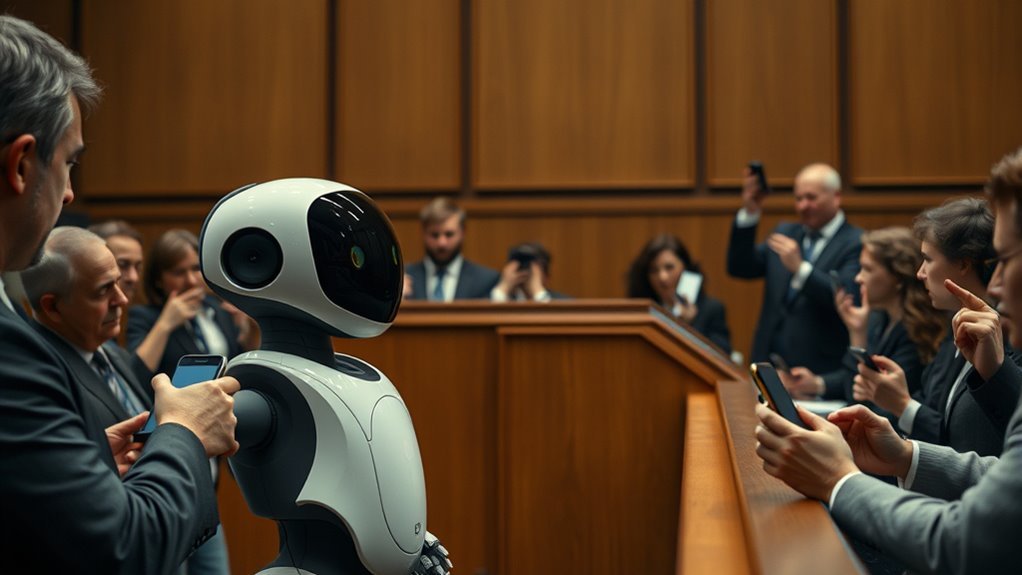
The case centers on Trudy Perez a seventy three year old parking attendant who worked at an Arizona State University parking structure in Tempe in late twenty twenty three. Perez alleges that a delivery robot operated by Starship Technologies collided with her in the garage knocked her to the ground and then moved toward her again while she was still down.
According to filings and statements from her attorneys she suffered a spinal fracture along with other injuries that led to lasting physical impairment and reduced mobility. Perez is seeking compensatory damages for medical costs pain and suffering and lost wages. The case is scheduled to go before a jury in early twenty twenty seven which means it could become one of the first widely watched jury trials about harm caused by a routine sidewalk delivery robot rather than a more dramatic autonomous vehicle crash.
Arizona already has rules for these machines. State regulations require that businesses using autonomous delivery devices maintain at least one hundred thousand dollars in liability insurance for every robot and ensure that each unit is monitored in real time by a human operator with reasonable safety precautions for pedestrians. Perez’s suit argues that Starship failed to operate the device safely and that the human operator did not adequately exercise control over the robot as the incident unfolded.
Whether the jury ultimately agrees matters beyond this one campus. If the case results in a substantial judgment or a clear finding of negligence it will signal to robot delivery firms and their investors that safety duties are not abstract ethics talking points but concrete legal obligations with financial consequences.
How we got here The slow evolution of AI accountability
Courts and lawmakers have been grappling with AI liability for more than a decade but most work so far has involved higher profile systems such as automated decision tools or autonomous vehicles rather than small delivery robots weaving between pedestrians. Legal scholars have focused on adapting familiar doctrines negligence product liability and vicarious liability to make sure there is always a human or corporate actor who can be held responsible when autonomous systems cause harm.
The European Union has moved furthest in turning these debates into structured law. The EU AI Act which entered into force in twenty twenty four uses a risk based approach that classifies AI systems from minimal to unacceptable risk and imposes stricter obligations on high risk systems. To handle the question of damages the EU has adopted an AI Liability Directive and a revised Product Liability Directive which together bring software and AI firmly within the existing product liability regime and introduce presumptions to help injured parties prove defect and causation.
The AI Liability Directive is particularly relevant as a contrast to the Arizona situation. It allows courts to order disclosure of evidence related to a specific high risk AI system and eases the burden of proof on claimants who need to show that an AI system caused harm and that the operator failed to comply with legal obligations. Under this framework deployers that is the businesses using AI in commercial activity carry the primary responsibility though developers and manufacturers can also be liable especially when their own noncompliance contributes to the damage.
Several European and international initiatives have explicitly rejected the idea of AI systems as independent legal persons and instead insist that responsibility trace back to human or corporate agents. The Council of Europe Framework Convention on Artificial Intelligence and Human Rights Democracy and the Rule of Law stresses that existing procedural safeguards and human rights protections must remain effective in AI contexts rather than being treated as optional or secondary.
In other words the law in many jurisdictions is converging on a simple baseline. AI does not go to court people and companies do. The core challenge is to clarify which people and which companies in each scenario and what evidence victims will need to make their case.
Safety standards and the gap on the sidewalk
Technical safety standards have not fully caught up with this reality. For mobile robots operating in public spaces one key standard is EN ISO thirteen four eighty two twenty fourteen which addresses safety requirements for personal care robots and related systems. Researchers examining the standard have pointed out that it largely fails to protect pedestrians and bystanders and does not address many real world scenarios where robots share crowded spaces with non expert users.
In the standard pedestrians and bystanders including animals are mostly ignored except when collisions occur at which point they are treated simply as safety related objects rather than as vulnerable people who may respond unpredictably to moving machines. Recommendations such as covering robots with soft materials in areas where collisions might occur show that designers are thinking about impact reduction but the overall framework still leaves large discretion to manufacturers and operators.
Workplaces that adopt autonomous mobile robots are facing a parallel issue. Legal analyses from jurisdictions such as Germany note that employers must ensure these robots have sufficient safety functions to prevent accidents and that operations respect both road traffic regulations and occupational safety rules when robots move through quasi public areas such as factory yards or campus roads. The Perez case sits right at this intersection a robot operating in a mixed environment that feels both like a workplace and a public space.
Why this single lawsuit matters for cities and businesses
From a business perspective delivery robots promise lower operating costs new data driven services and an ability to run nearly continuous logistics in environments such as university campuses dense neighborhoods and retail centers. Yet every incident that results in serious harm threatens to reset the economic calculus by making insurers regulators and city governments more cautious.
Legal experts following the Arizona case have already suggested that suits like this will push companies to invest more in safety features and monitoring because the cost of failing to do so will start to show up clearly in jury verdicts and settlements. When each robot must have a human supervisor liability insurance and robust logs that can be demanded during litigation the operating model begins to resemble conventional transportation businesses where safety compliance is not optional but central to staying in business.
For city planners and public officials the case highlights a set of practical questions
How many delivery robots can safely operate in dense pedestrian areas at once
What rules should govern priority between humans and robots when paths are narrow or visibility is limited
Which entity should be the primary point of contact for complaints and incident reports the campus the robot operator or the manufacturer
Existing frameworks such as the EU AI Act the AI Liability Directive and the Council of Europe convention offer one conceptual answer treat robots as part of broader AI infrastructure subject to clear obligations transparency and human oversight. However most local regulations in the United States still treat these devices at a more basic level as specialized vehicles or delivery devices with limited sets of specific rules. The Perez lawsuit exposes the gap between these narrow rules and the richer accountability models emerging elsewhere.
Beyond this case The future of everyday AI accountability
Several broader implications flow from this dispute.
First the case reminds both technologists and policymakers that everyday AI is now embodied and kinetic. When AI systems move through physical space sharing it with vulnerable people traditional safety engineering and human centered design cannot be optional extras but must be built into both hardware and software from the start.
Second legal doctrines around negligence and product defect are starting to absorb the distinctive features of AI such as learning behavior opaque decision paths and remote operators. That means companies cannot rely on the novelty of their technology as a defense. If they deploy autonomous systems they are expected to understand their failure modes and to put in place reasonable safeguards.
Third there is an emerging recognition that accountability needs to be layered. Deployers that run fleets of robots developers that build their navigation and decision systems platform providers that handle remote control and data collection and even employers that host robots in workspaces will all need clearly defined responsibilities. When harm occurs courts are increasingly willing to look up the chain rather than focus only on the entity closest to the victim.
Finally the Perez lawsuit underscores the importance of evidence. The EU AI Liability Directive explicitly empowers claimants by easing access to information and creating presumptions that help bridge the asymmetry between individuals and sophisticated AI operators. Similar ideas are likely to surface in other jurisdictions as more people seek compensation for harm involving autonomous systems. Logs video feeds incident reports and operator actions will all become central pieces of the story rather than technical details left in the background.
What to watch next
In the short term the Perez case will be watched for what the jury concludes about negligence the adequacy of human monitoring and the sufficiency of the existing Arizona rules on insurance and operator responsibility. Even a modest verdict could prompt delivery robot companies to tighten supervision and slow deployment plans in environments that look similar to the ASU campus.
In the medium term lawmakers and regulators are likely to revisit their frameworks as more incidents come to light. Expect debates about mandatory safety standards for public space robots clearer definitions of high risk AI and stronger requirements to notify people when they are interacting with AI driven systems instead of humans building on international approaches such as the Council of Europe convention.
In the longer view the central question is whether legal technical and ethical safeguards can keep pace with the rapid rollout of AI powered infrastructure in ordinary settings. The answer will depend on whether cases like Perez’s lead to a culture in which companies treat safety logs transparency and human oversight as strategic assets rather than regulatory burdens. If that shift happens delivery robots and similar systems can continue to expand while genuinely earning public trust. If it does not more lawsuits and tighter crackdowns will follow. reddit