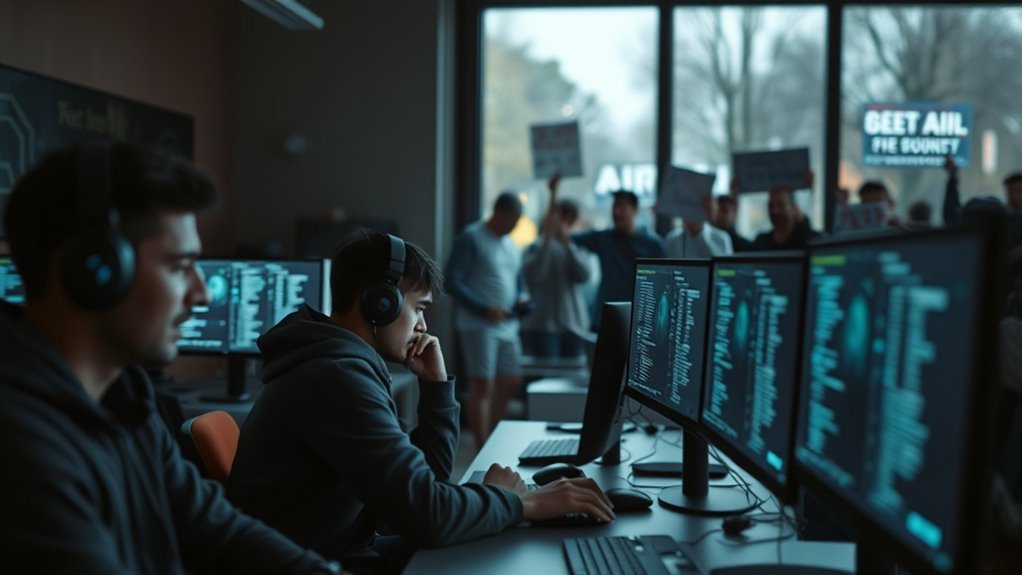

Accelerating workflows across the games industry, AI tools have quietly become standard components of modern development pipelines. Survey data from multiple regions shows that roughly nine in ten game developers already integrate some form of AI into their workflows, while about half of studios worldwide deploy AI in active development pipelines beyond limited experiments. Industry reports from platform providers similarly indicate that close to two‑thirds of developers now leverage AI tools during production, confirming that integration is no longer confined to experimental teams. At the same time, nearly all respondents in one multi‑country survey agree that generative AI is reshaping the games business, underscoring the scale of structural change underway.
Despite widespread workflow adoption, attitudes toward generative AI have grown sharply more negative, with around half of surveyed professionals now convinced the technology is harming the industry rather than helping it. Multiple annual surveys chart a brief rise in personal generative AI use between 2024 and 2025, followed by a decline in 2026 as skepticism, ethical concerns, and fatigue set in among practitioners. In one longitudinal panel, self‑reported use of generative AI tools among developers fell from 36% in 2025 to 29% in 2026, reinforcing this downturn in personal adoption. Recent figures suggest that only around a third of game industry professionals now use generative AI tools directly as part of their daily job functions, even as more than half report their companies adopting AI somewhere in the organization. This divergence between personal use and institutional integration reflects studios formalizing AI policies, centralizing experimentation, and limiting unsupervised tool use while still incorporating automation into core pipelines.
Studios embed AI into pipelines even as creators grow skeptical, centralizing experimentation and curbing unsupervised generative tool use.
Across studios that do employ AI, usage patterns are broadly consistent: most rely on large language models and other tools for research, ideation, and brainstorming rather than direct content creation or player‑facing features. Around four‑fifths of AI‑using developers report applying these systems to information gathering and concept exploration, while nearly half use them for code assistance, scripting support, and debugging tasks. This integration enhances workflow redesign and collaboration across teams, ensuring that AI capabilities align with evolving project needs.
Similar proportions turn to AI for administrative and communication work, including drafting emails and handling routine documentation, reinforcing the role of these tools as productivity layers rather than creative engines. Player‑facing generative features and automated asset production remain uncommon, with only modest shares of AI users reporting deployment of models for art generation, procedural content, or direct in‑game interaction. For most teams, the primary appeal lies in reducing repetitive tasks, shortening iteration cycles, and freeing developers to focus on higher‑level design and problem‑solving work.
These productivity‑oriented applications span the entire development pipeline, from early prototyping and rapid iteration on mechanics to testing, debugging, and selective asset creation for internal builds. Around a third of AI‑using developers report employing tools for prototyping tasks, while smaller but notable segments integrate automated systems into quality‑assurance workflows and asset pipelines.
Taken together, the data depicts an industry where AI has become infrastructural, embedded across studios and departments even as many individual creators reduce personal usage or resist deeper reliance.