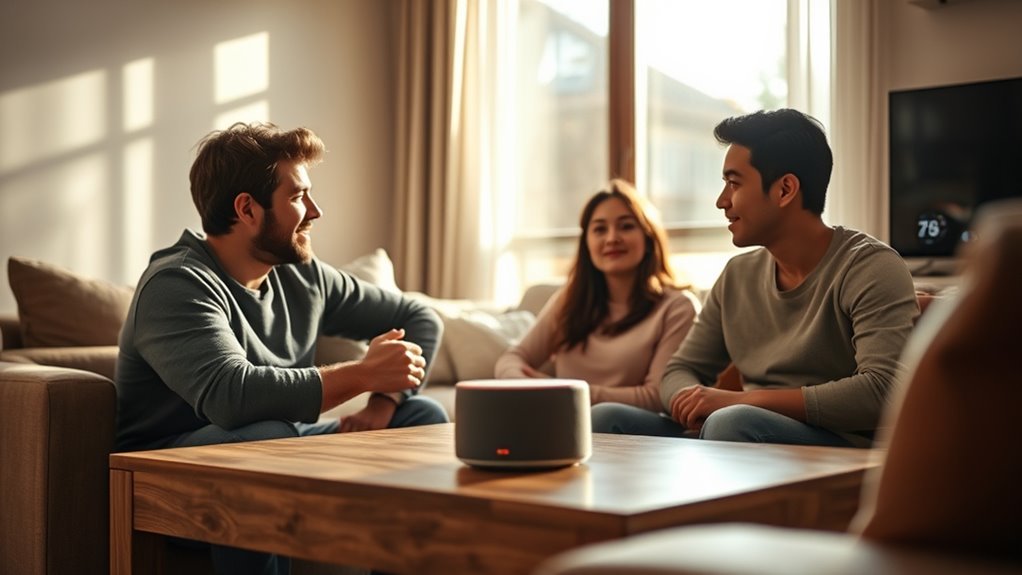

Smart home assistants are finally starting to remember more than a single command at a time. That shift matters because it moves the experience from talking to a voice remote toward having an actual conversation in the home, with all the convenience and new privacy questions that implies. Google’s latest update to Gemini for Home, including a fifteen minute conversational memory window and a revived Continued Conversation feature, is one of the clearest signs of that transition.
From wake words to conversations in the home
For nearly a decade, smart speakers from Google, Amazon and others have relied on a very simple interaction pattern. You say a wake phrase, issue a command, get a response, and the session ends. Each new request is treated as if the assistant knows nothing about the last one. That design kept systems simple and predictable, but it forced users to repeat themselves constantly and limited what assistants could do without manual setup.
Voice assistants long treated every command as isolated, forcing rigid, repetitive interactions in the home.
Google tried to soften that rigidity with the original Continued Conversation on Google Assistant, briefly keeping the microphone open for follow ups, but the depth of memory was minimal and context awareness was limited. When Gemini for Home started rolling out, many users noticed that this older convenience had disappeared or was tied to specific plans, which led to understandable frustration and support threads asking why the assistant suddenly felt less conversational. That backlash showed up clearly in Google forums, where a recent thread about these changes drew 424 votes in favor of its solutions and tips.
The new Gemini for Home update reverses that perception and goes further. Google now describes Gemini as having conversational context or short term memory on home devices, enabling genuine back and forth rather than isolated queries.
What the new fifteen minute memory actually does
The most concrete change is the introduction of a fifteen minute conversational memory window across Gemini for Home in Google Home. Within that window, the assistant can keep track of recent dialogue and device commands, and users can ask follow up questions that build on what was already said without restating all the details. This aligns with the role of middle managers in facilitating smoother interactions during AI rollouts.
If you discuss evening plans, ask for relaxing music and adjust the living room lights, Gemini can treat that as a single evolving conversation for fifteen minutes. You can then say something like “actually make it brighter in here” or “find a movie the kids might like” and the system can interpret those requests in light of the earlier context and preferences mentioned in that session.
After a longer pause, the session resets. That reset is important because it gives households a clear boundary for what the assistant treats as part of an ongoing conversation and what counts as a fresh request. It avoids the unsettling feeling that every remark is remembered indefinitely, while still leaving enough room for natural multiturn interactions during typical evening routines or weekend mornings.
This short term conversational state also changes how smart home control works. Instead of having to specify “turn off the kitchen lights” every time, you might say “turn off these lights” right after discussing the kitchen or adjusting a particular room, and Gemini can often resolve the reference based on what was just discussed. Sequential tasks like planning an evening, coordinating multiple device changes, or refining a media choice become more fluid because the assistant remembers what has already been decided in the preceding turns.
Continued Conversation returns with smarter context
Alongside the memory window, Google is rolling out an upgraded Continued Conversation feature for Gemini for Home early access users. Once enabled, you say “Hey Google” or your chosen wake phrase once, issue a request, and then the microphone stays active briefly after the response so you can naturally follow up without repeating the wake phrase. Pulsing lights on the speaker or display indicate that the assistant is listening for those followups.
Google emphasizes that this version of Continued Conversation is not just about keeping the microphone open. Gemini is now explicitly designed to remember the conversation thread for smoother followups, so the second or third question can rely on what was just discussed without needing you to reframe everything again.
Importantly for trust and usability, the updated feature is available globally across supported languages and regions, rather than being limited to a single market, and it works across speakers and displays for everyone in the household, including guests. That whole home access means the conversational rules are consistent whether someone is in the kitchen or the bedroom, and visitors do not have to learn a different interaction pattern on each device.
How to control what Gemini remembers
Controls for this expanded conversational memory are surfaced in the Google Home app. To enable Continued Conversation on Gemini for Home, households are instructed to go to Home Settings, select the Gemini for Home voice assistant, and turn on Continued Conversation, which keeps the microphone active briefly for followups. Those settings determine whether the assistant treats interactions as ongoing dialogues or isolated single turn commands, and therefore how much context it will carry over between requests.
Memory at the application level is also receiving more granular controls in the broader Gemini ecosystem. Separate from the fifteen minute home memory window, Gemini Advanced now lets the chatbot remember context across different conversations, including user preferences and details that are useful over time, with options to review and delete history or define how long information is retained. Users can manage this through Gemini Apps Activity, which acts as a central place to inspect and control past interactions.
Taken together, the device level toggles for Continued Conversation and the app level controls for personal memory give households fine grained oversight of what the assistant remembers, for how long, and in which situations. That mix aligns with a pattern across modern AI systems where short term interaction memory and longer term personalization are treated as separate layers, each with its own privacy and governance expectations.
Short term context versus model context
It is important to distinguish conversational memory in the home from the underlying model context window. Large language models like the ones that power Gemini process text in chunks, often measured in tokens, that define how much input the model can consider at once. Pro and Ultra tiers of Gemini advertise expanded context limits for complex tasks, documents, and projects, but everyday home conversations still rely on a more constrained short term memory that sits on top of that capability.
In practice, this means a few things.
First, your home devices are not loading your entire chat history into each response. They use the recent dialogue within the fifteen minute window plus selected personalization data when needed. The rest stays in storage governed by app level settings, rather than being streamed into every interaction.
Second, long term personalization is selective. With features like recalling past chats and remembering ongoing projects for Gemini Advanced, the system can bring in specific prior information when relevant, but this is different from a free form recall of every statement ever made. That distinction matters for both transparency and performance.
Historical context and what this tells us about Google’s strategy
Seen in context, the Gemini for Home memory changes fit into a broader history of Google’s voice assistant efforts. The original Google Assistant established the pattern of single turn commands with occasional limited followup. Continued Conversation appeared as a way to smooth things out, then partly disappeared or became inconsistent during the early Gemini transition, leading some users to feel that the new AI model was more powerful on paper but less friendly in everyday use.
Google’s recent set of updates, including global Continued Conversation for Gemini for Home, conversational context on the new Google Home speaker, and memory enhancements for Gemini Advanced, signal a clear strategy. The company wants one assistant that can span phones, web, and smart speakers, with a shared notion of context and memory that can be tuned by the user.
That approach also responds directly to competition. Amazon has been experimenting with more conversational versions of Alexa, and OpenAI has pushed the idea of chatbots that can remember preferences over time. By articulating distinct layers of memory and emphasizing user controls, Google is positioning Gemini as both capable and relatively safe for mainstream households. The fifteen minute window in the home is a simple, communicable boundary that makes it easier for nontechnical users to understand what is going on.
Opportunities and risks for households and businesses
On the opportunity side, richer conversational memory in the home can significantly reduce friction. Multi step tasks like planning an evening across media, lighting, and temperature, coordinating family routines, or making iterative adjustments to playlists become more natural when the assistant remembers context across several turns and devices. The assistant can start to feel more like a helpful household member and less like a voice interface bolted onto a speaker.
Businesses that build services on top of Google’s smart home ecosystem, from media providers to device makers, stand to benefit from this richer context as well. Recommendations can be more tailored to current mood and prior feedback, and automations can chain together multiple actions with fewer explicit commands. Those are tangible usability gains.
However, extended memory in the home raises familiar concerns. Keeping microphones active, even briefly, and retaining conversational context for fifteen minutes demands clear communication and trustworthy default settings. Google’s use of visual indicators like pulsing lights and explicit toggles in the Home app is a step in the right direction, but households still need to understand who can access these recordings, how long they are stored, and how they can be deleted or limited.
From a risk perspective, there are a few angles to watch.
One is inadvertent capture. Even with improved side talk detection that aims to ignore background chatter and focus on direct commands, there is always a chance that sensitive remarks get swept into the active context window.
Another is expectation creep. As assistants become more capable at remembering context, users may start assuming that they remember everything, which could lead to confusion or misplaced trust if the system does not recall a critical instruction or preference. Clear documentation and consistent behavior across devices are essential.
Finally, there is the question of how these home memory systems interact with broader user profiles. If data from home conversations influences recommendations or decisions in other Gemini surfaces, such as search or work tools, users will reasonably want transparency and controls that cover the whole stack, not just the smart speaker. The existence of Gemini Apps Activity and explicit memory controls for Gemini Advanced suggests Google is aware of this, but the real test will be how understandable these connections are in everyday practice.
Practical takeaways and what to watch next
A few concrete points emerge from this update.
Gemini for Home now tracks conversational context across a fifteen minute window, which directly improves how followups and multi step smart home interactions work.
The revived and upgraded Continued Conversation feature lets users speak more naturally without repeating the wake phrase while giving Gemini enough short term memory to handle evolving requests.
Users have meaningful control over these behaviors through the Google Home app and through broader Gemini memory settings, including Gemini Apps Activity and memory options for Advanced subscribers.
Looking ahead, the interesting questions are less about raw model capacity and more about design. How far will companies push conversational memory in shared spaces like the living room? Will households prefer strict time windows like fifteen minutes, or more flexible and personalized settings? How clearly will assistants show when they are in a remembered context versus treating a request as independent?
The direction is clear. Voice assistants are becoming context aware conversational partners rather than single shot command processors. Gemini for Home’s expanded memory is an incremental step, but it is also a visible milestone in that evolution, and it is happening in a space where ordinary households will feel both the benefits and the risks very directly.
Conclusion
Gemini for Home is moving the smart home from a world of barked commands to something closer to an ongoing household conversation. That shift matters because the assistant is no longer just turning lights on and off. It is starting to remember what is going on in your home and why you asked for something, and then using that context to coordinate tasks and devices with much less friction.
From command driven assistants to contextual home systems
Early smart speakers and home assistants were essentially voice driven remote controls. They could answer a question or trigger a single device, but each interaction was isolated. If you asked to turn on the living room lights and then said make it cozier, the system often had no idea that the second request referred to the same room or the same moment.
Google has been working for years to push beyond this one shot model, first with Google Assistant and now with Gemini for Home, which runs across Google Home speakers, Nest displays, and compatible cameras. These newer systems bring richer language understanding and the ability to maintain context across multiple turns so that follow up questions feel more like a dialogue than a series of unrelated commands.
The latest step in that evolution is expanded conversational memory inside Gemini for Home. It does not give the assistant perfect recall of everything that happens in your house. It does create a more reliable short term working memory that lets the system follow a thread, interpret ambiguous requests, and act more autonomously on your behalf.
What expanded context memory actually does
Google describes a conversational memory window of about fifteen minutes across the Gemini for Home experience. Within that window, the assistant can remember the topic and details of recent interactions, which makes it far better at understanding follow up questions or chained requests without needing you to repeat the setup every time.
This context memory is used in several specific ways. First, Gemini for Home keeps track of whether you are issuing a standalone command or continuing an existing conversation. It uses contextual cues to decide when a request is a follow up and when earlier speech can be ignored, which cuts down on unnecessary clarifying questions and misfires.
Second, the system combines conversational cues with device and location information from the Google Home app. That allows more accurate targeting when you say things like turn off the kitchen or turn off all the lights. Gemini now understands that turn off the kitchen should apply to lights rather than every plug and unassigned device and that turn off all the lights should affect only the home you are currently in, rather than multiple locations.
Third, context memory improves intent accuracy. Gemini can use clues from recent dialogue and your device setup to determine whether you are asking to control hardware, play media, or set timers and routines. This reduces the frustrating cases where a casual phrase triggers the wrong action or no action at all.
Finally, expanded context helps support more complex requests. Recent updates allow users to chain several actions into a single natural language instruction, such as lowering blinds, dimming lights, setting a timer, and starting a podcast in one turn, with Gemini understanding the shared context and sequencing those controls correctly.
In practical terms, all of this means you can speak more casually, stumble or pause, and still be understood. The assistant is better at holding onto what you meant over a short span of time instead of treating every sentence as if it came out of nowhere.
Memory plus perception: cameras, summaries and live search
Gemini for Home is not limited to spoken context. It also builds a richer picture of what is happening in your home by combining conversational memory with camera and sensor data.
Google describes three pillars here. Camera intelligence lets Nest devices with Gemini differentiate between specific events rather than just reporting that a person was detected. Notifications can include details such as a landscaper pruning roses or a rabbit eating garden carrots, which becomes part of the assistant’s understanding of who and what is moving through your space.
Ask Home allows you to query your household in natural language, including questions about camera history such as whether the dog chewed a shoe on the couch or who came to the door at a particular time. The system can search recorded video and sensor logs and return tailored answers or clips. Home Brief adds a daily summary of notable events, using knowledge of family members and household patterns to tell you, for example, that a specific person delivered flowers to someone upstairs while you were away.
Recent updates also introduce live search for cameras as a premium feature. Subscribers can ask questions like whether there is a car in the driveway and receive real time responses based on what Nest cameras see at that moment. This capability is offered through a paid tier at roughly ten dollars per month or one hundred dollars per year, and it extends the assistant’s memory from past events into continuous situational awareness.
All of these functions depend on the system maintaining short term context about who was seen, where, and when, and then relating that to your questions, your home layout, and your preferences.
How this changes daily smart home behavior
The practical effect of expanded context is a smart home that feels less like a collection of disconnected gadgets and more like a coherent environment managed by a single assistant.
A parent might say get the house ready for dinner and have Gemini dim the dining room lights, lower blinds, and start music, then follow up with set a timer for pasta without re stating which room or which activity they are talking about. The assistant can treat these as part of the same scenario, reusing the initial intent and location.
Later in the evening, a query such as what happened while I was out can trigger a Home Brief style summary that brings together camera events, deliveries, and security system status. If something looks off, a follow up question like was anyone near the back door can narrow the search within the same conversational context, rather than starting a new manual review of video feeds.
For busy households with multiple occupants, context memory can also help with personalization. The assistant is getting better at understanding who is speaking, which devices are nearby, and which home address should anchor queries about local news or weather. That reduces the confusion that arises when several family members use shared devices from different locations.
These may sound like incremental improvements, but they add up to a fundamental change in interaction style. Instead of micromanaging devices, users describe goals and rely on the assistant to translate that intent into coordinated actions, informed by recent events in the home.
Limitations and risks: short term memory and gated features
Despite the progress, Gemini for Home’s memory is still constrained. The conversational window remains relatively short, around fifteen minutes, and focused on one session. It does not maintain a deep long term narrative of your household over days or weeks, nor does it fully understand nuanced relationships and routines the way a person does.
That limited window is partly a safety measure. Persistent memory raises serious privacy concerns when it involves continuous audio and video capture inside homes. Google emphasizes memory policies and contextual logic that try to ignore irrelevant speech and limit retention to what is needed for the current dialogue and specific features such as summaries or live search.
Important capabilities are also gated behind subscriptions. Detailed camera summaries, live search and certain memory driven features are reported to be included in a Google Home Premium tier, which means the most powerful context aware functions are not available to every user and may create a divide between basic and advanced experiences.
Reliability is another concern. Greater reliance on context makes errors more noticeable when the system guesses wrong. If Gemini misinterprets a casual command, fails to distinguish between rooms, or misidentifies a device with a playful name, automation can behave in unexpected ways. Google has invested in device context and manufacturer data so that a whimsically named light can still be treated as lighting when you say turn on the lights, but these systems are not perfect.
For businesses that build hardware or services on top of Gemini for Home, this creates both opportunity and dependency. Deeper context allows richer automations, smarter notifications, and differentiated user experiences. At the same time, it ties those products closely to Google’s evolving policies on data handling, subscription models, and assistant behavior.
How this fits into the broader trajectory of context aware home AI
Research in smart home AI has been moving toward structured memory systems that store tasks, subtasks, and contexts in ways that can be reused and adapted. Work such as IoTGPT describes task memory graphs where high level goals like make the bedroom ready for sleep are broken into subtasks and personalized parameters based on past behavior, such as preferred temperature for sleeping.
Gemini for Home’s expanded context memory is a practical implementation of similar ideas in a consumer product. Rather than exposing graphs and models, it surfaces the benefits by letting people speak in goals and follow ups while the assistant infers device commands, scenes, and routines from what it has learned about the household.
In that sense, smart home AI is gradually shifting from simple voice control to adaptive systems that quietly orchestrate daily routines. Context memory is the connective tissue that lets these systems understand not just what you said, but what you meant in relation to your home, your schedule, and your environment.
Key takeaways and what to watch next
Gemini for Home’s expanded context memory is an important milestone, not because it gives the assistant perfect recall, but because it makes household conversations smoother, more reliable, and more capable of turning goals into concrete actions across devices.
The near term impact will be more natural multi step interactions, better camera based awareness, and smarter automations that feel less brittle. The longer term question is how far companies like Google are willing and allowed to go in building richer long term memories of home life, and under what privacy and business constraints those memories will operate.
For users and for the industry, the most important signals to watch are the evolution of memory policies, the line between free and premium features, and the way context is shared with third party devices and services. Those choices will determine whether the smart home becomes a genuinely trustworthy partner in daily life or remains an occasionally clever but ultimately limited collection of connected gadgets.