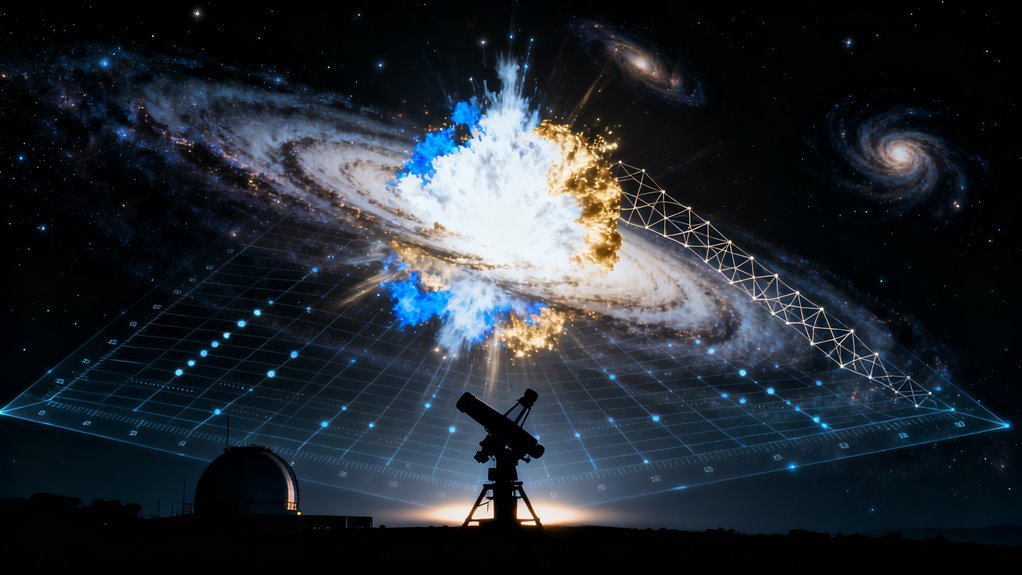

Artificial intelligence is finally catching up with the pace of modern sky surveys, and that is not a small change for astronomy or for the wider AI ecosystem. NASA missions now stream out more light curve data than any human review panel can realistically handle, while new AI systems such as ExoMiner and ExoMiner plus plus have already verified hundreds of exoplanets from Kepler and TESS archives. In that context, a general purpose model like Gemini 3 point 6 Flash that can sit across multiple pipelines and help orchestrate exoplanet discovery is much more than a flashy demo. In prototype tools built for hackathons and challenges, Gemini can even drive interfaces that accept star names one per line, trigger batch processing runs, and return per-star probabilities, classifications and exportable summaries. It points to a new layer of AI infrastructure that can digest heterogeneous science data, reconcile conflicting models and surface the signals that humans should care about next, drawing on insights from AI-native defense systems that enhance operational efficiency across various domains.
Frequently Asked Questions
How Does Gemini 3.6 Flash Protect Sensitive NASA Data During Analysis?
Gemini 3.6 Flash is designed to analyze highly sensitive workloads without turning NASA mission data into training fuel or leaving it exposed in the wrong region or system. Security controls for data residency, encryption, access governance, and frontier safety work together so exoplanet analysis can benefit from advanced AI while staying within government grade boundaries for secrecy and compliance.
Why Gemini 3.6 Flash matters for NASA right now
NASA is entering a phase where missions generate not just gigabytes but petabytes of telemetry, imagery, and scientific measurements, especially in domains like exoplanet discovery and characterization. At the same time, the agency operates under strict national security and export control regimes, so it cannot simply upload raw mission data to a consumer chatbot and hope for the best.
Gemini 3.6 Flash sits in a new class of models that aim to bridge this gap. It keeps the multimodal and long context strengths of the Gemini Flash family while adding hardened safety features and enterprise controls, including deployment options inside Gemini for Government environments aligned with FedRAMP High and Department of Defense impact levels. This shift from generic cloud AI toward mission-aware, regulated deployments is the context in which NASA would consider using Gemini for sensitive analysis.
From general purpose assistants to government grade AI
Early large language models were built primarily for public or broad enterprise use. They often logged prompts by default, blurred lines between development data and customer data, and offered limited control over where information was processed. For a space agency handling data that can implicate national security, foreign policy, and proprietary industrial designs, that was not acceptable.
Gemini 3.6 Flash moves in a different direction. The model card describes it as a direct evolution of Gemini 3.5 Flash, with the same natively multimodal foundation and extended context window, but with improvements driven by post-training and safety work rather than a completely new base model. The safety metrics show reductions in multilingual safety violations and content safety issues, while holding unjustified refusals nearly flat and strengthening resistance to misuse and jailbreak attempts.
Around that model, Google has introduced a broader stack for regulated and government workloads. Guidance for Gemini for Government lays out deployment patterns where Gemini models are hosted inside Assured Workloads folders, tied to specific data boundaries for FedRAMP High and Department of Defense impact levels, and limited to authorized data stores such as Cloud Storage and BigQuery in those regions. This combination of model evolution and environment hardening is the foundation for protecting NASA data in practice.
Infrastructure and data residency protections for NASA missions
The first line of defense is where and how the data lives. Documentation for Gemini 3.6 Flash and its enterprise agent platform shows that data residency controls apply consistently across online prediction, batch inference, and context caching. Together with the broader security controls for generative AI, this ensures that mission data and intermediate context stay within approved geographic and regulatory zones and do not silently drift into global infrastructure.
In a NASA scenario, this translates to building agents and workflows only inside projects that sit under Assured Workloads folders configured with the appropriate data boundary. The Gemini for Government guidance emphasizes that only specific data stores inside that boundary are authorized and that other features and connectors must be explicitly disabled when they are not compliant.
Application segmentation follows from that design. An exoplanet analysis agent might be allowed to read from a BigQuery dataset holding instrument data but not from generic productivity tools or third-party software as a service platforms, which reduces lateral movement risk inside the environment.
Isolated service perimeters add another layer of separation between Gemini serving infrastructure and the rest of Google Cloud, typically enforced through constructs such as virtual private service controls and strict routing rules. This kind of isolation is particularly important for NASA because it limits the blast radius if a credential is misused or a connector is misconfigured. The model can operate on mission data without exposing it to broader multitenant systems.
Encryption and key management that match NASA risk models
For an agency that treats certain data as almost a state secret, encryption is table stakes, but implementation details matter. Gemini 3.6 Flash deployments for government and regulated customers rely on encryption both at rest and in transit, anchored in the underlying Google Cloud infrastructure.
Customer-managed encryption keys, often stored in dedicated key management services and backed by hardware security modules, allow NASA to retain control over the cryptographic material protecting its datasets. In practical terms, that means exoplanet observation records in Cloud Storage or BigQuery are encrypted using keys that NASA or its designated operator controls, not keys that are silently shared across many tenants.
If NASA rotates or revokes a key, access to the corresponding encrypted data is effectively cut off. External key management options can add another layer by keeping root keys in systems entirely outside the provider environment, which some government agencies prefer for defense in depth.
This approach is not novel in itself, but its integration into Gemini-specific workflows matters. When Gemini 3.6 Flash loads context from an authorized store, it does so through the same encrypted channels and key governance that already protect other high-value workloads. There is no separate unencrypted pipeline for AI.
Limiting model exposure and preventing training on mission data
Another historical concern with cloud AI has been the reuse of customer data for model improvement. Many early services logged prompts and responses and allowed them to feed back into training and evaluation. That is untenable for NASA, which cannot risk mission data or internal deliberations turning up as phantom knowledge in a future public model.
Security controls for generative AI emphasize that prompt logging for partner and open models is turned off by default and subject to strict transparency and privacy constraints. Government deployment guidance further draws a line between authorized and unauthorized features, instructing organizations to disable capabilities and connectors that fall outside the regulated boundary and to train personnel not to use features that cannot be fully disabled.
Combined with contractual non-training guarantees typical of enterprise and government offerings, this creates a reasonable expectation that NASA prompts, exoplanet datasets, and derived insights remain confined to their own environment. The Gemini model does not treat that data as part of its general learning corpus. From an operational perspective, this reduces the risk of inadvertent data leakage through future model behavior.
Frontier Safety and jailbreak resistance for sensitive scientific work
Protecting NASA data is not only about preventing unauthorized access. It is also about limiting the kinds of outputs the model will produce when prompted in ways that intersect with national security, dual-use science, or cyber risk. Gemini 3.6 Flash introduces enhanced Frontier Safety safeguards focused specifically on chemical, biological, radiological, and nuclear domains and on cyber offense misuse.
These safeguards make the model more resistant to jailbreak attempts that try to coax it into providing dangerous instructions or combining scientific data with operational guidance for misuse. At the same time, the model has been tuned to minimize refusals when the use case is clearly beneficial, which matters for day-to-day scientific analysis so that researchers are not constantly hitting hard safety walls for legitimate questions.
For NASA, this frontier safety posture matters in at least two ways. It reduces the chance that an internal user or compromised account can turn Gemini into a tool for cyber offense or sensitive weapons-related modeling inside the agency network. It also lowers the risk that exoplanet or astrophysics data, when combined with other information, becomes a stepping stone toward outputs that cross into interdicted domains. The goal is to enable rich analysis while keeping models firmly within acceptable use boundaries.
What a protected exoplanet analysis workflow actually looks like
Consider a team at NASA’s astrophysics division running a large-scale exoplanet survey. Telescopes stream raw light curves and images into agency storage. Engineers and scientists want to use Gemini 3.6 Flash to sift through that data, flag promising planet candidates, and generate human-readable summaries.
In a protected deployment, the data would land first in an authorized store such as a BigQuery dataset or Cloud Storage bucket inside an Assured Workloads environment configured for the relevant impact level. An agent built on Gemini 3.6 Flash would be allowed to read only from those stores, using service identities and access policies that confine it to mission-specific projects.
Sensitive identifiers such as internal proposal numbers, personnel data, or export-controlled payload information could be removed or masked before Gemini sees the data, either through preprocessing or through filtering steps at input time.
Requests from scientists would be processed within the same regional boundary, using encryption and customer-controlled keys for every hop between storage, serving, and intermediate caches. The context window of Gemini Flash, which accepts very large inputs and supports text and imagery, allows the agent to ingest extensive observation sequences and associated metadata in one shot.
Safety guardrails and jailbreak-resistant tuning ensure that even if someone prompts the model in ways that touch on sensitive cyber or weapons domains, the response is constrained to safe outputs.
Crucially, once the analysis is complete, NASA retains the outputs within its own environment. There is no background process reusing that mission data to update public-facing Gemini models. Access logging and transparency features in the generative AI security controls provide an audit trail of who used the system and how, which is essential for an agency subject to both internal oversight and external review.
Risks, limitations and what still needs attention
None of these controls make Gemini 3.6 Flash a magic bullet for NASA security. Frontier models remain dual-use technologies, capable of enabling both scientific progress and misuse. The safety metrics in the model card show improvements but not perfection, and Google itself is clear that jailbreak resistance has been strengthened in particular domains, not universally.
For NASA, that means governance and process are as important as technical protections. Teams must be trained not to connect Gemini agents to unauthorized data sources or output channels. Unauthorized features flagged in Gemini for Government guidance really do need to stay off, and policy enforcement has to keep pace with fast-changing product capabilities. Independent red teaming and evaluation will remain necessary, especially as mission data becomes more complex and as AI models continue to increase in capability.
There are also questions about long-term vendor dependence. Storing keys in external systems and maintaining portable data architectures can help, but a mission-critical analysis stack built on Gemini will tie NASA into Google’s evolution path. Agencies generally respond by adopting multi-provider strategies and by insulating core scientific artifacts from proprietary formats.
Key takeaways for NASA and similar agencies
Gemini 3.6 Flash offers NASA a way to bring powerful multimodal and long context analysis to sensitive mission data without abandoning government grade controls. Data residency and Assured Workloads deployments keep analysis inside the right regulatory perimeter, while encryption and customer-managed keys ensure the agency retains cryptographic control over its datasets.
Non-training guarantees and prompt logging defaults reduce the risk that exoplanet observations or internal discussions leak into future public models. Connector allowlisting plus application segmentation confine Gemini agents to mission-specific stores rather than the entire cloud estate.
Frontier Safety safeguards in domains such as CBRN and cyber offense make Gemini 3.6 Flash more resistant to jailbreak attempts and better aligned with the risk posture of a national space agency.
The net result is not perfect security but a layered architecture where sensitive NASA data can be analyzed by state-of-the-art AI with a defensible story about where the data lives, who can access it, how it is protected, and how misuse is constrained. For agencies charting a similar path, the lesson is clear. Powerful models are only safe enough for critical science when they are embedded in environments that honor residency, encryption, governance, and frontier safety end to end.
Can Independent Researchers Access the Same Exoplanet Analysis Tools Used in This Project?
Independent researchers today can get very close to the exoplanet analysis power used in cutting edge AI assisted projects, but they cannot replicate every element of the internal orchestration and restricted tools that large collaborations can deploy. In practice, the scientific capabilities are broadly comparable, while the bespoke wiring and some government facing AI services remain out of reach.
Why access to exoplanet tools matters now
Exoplanet science has moved from the era of rare discoveries to a phase where thousands of worlds are cataloged and new candidates appear in bulk from missions such as Kepler, K2 and TESS. The bottleneck is no longer just finding planets; it is analyzing huge volumes of light curves, catalogs and follow up data in a reproducible way that smaller teams can realistically manage. Open archives and modern AI models are the main levers that allow independent researchers to stay in the game.
The NASA Exoplanet Archive sits at the center of this ecosystem as an online catalog and data service that collates exoplanet and stellar information and provides a suite of analysis tools for the community. That combination of data plus tooling is what allows independent researchers to approximate the capabilities of large institutional projects even without access to their internal infrastructure.
How exoplanet analysis tooling evolved
When the NASA Exoplanet Archive was first established, its role was largely to track confirmed planets and host stars and make basic parameters available to the community. Over time it added interactive tables that let users filter, sort and download planetary systems, Kepler objects of interest and other mission products directly from a web interface. These tables became the default entry point for exploratory exoplanet work and teaching.
As time series data from transit surveys accumulated, the archive introduced light curve viewing and normalization tools so researchers could inspect data visually without building their own front ends. It then added a periodogram service that can search for periodic signals in archive data or user uploaded light curves using algorithms such as Lomb Scargle and box fitting least squares, returning phased light curves for the most significant periods. This shifted a key part of planet candidate analysis into a shared, well documented environment.
Transit and ephemeris services followed, allowing users to predict future transit times for known planets and to plan observations from specific observatories or geographic locations. For more sophisticated system modeling, the archive integrated EXOFAST, a transit and radial velocity fitting tool that accepts light curves and radial velocity measurements and produces fitted models of planetary systems. Each of these steps reduced the amount of bespoke code individual researchers had to write before they could do serious science.
On the data access side, the archive now exposes its holdings through an application programming interface and an implementation of the International Virtual Observatory Alliance table access protocol standard, along with bulk download scripts for very large data sets. This programmatic layer is crucial because it allows researchers to hook the archive directly into their own pipelines or AI powered workflows rather than relying only on manual web use.
More recently, services such as NExoList have been introduced to support atmospheric observation planning and help researchers design proposals for facilities like the James Webb Space Telescope by cataloging promising targets. This shows a gradual evolution from passive data repository to active planning and analysis hub.
What independent researchers can use today
For an independent scientist or small lab, the most important fact is that the core exoplanet data and many canonical tools are openly accessible. The interactive tables, plotting tools, light curve viewer, periodogram service, transit and ephemeris calculators, EXOFAST fitting service, programmatic interfaces and bulk download scripts are all available without institutional gatekeeping. That means the scientific building blocks used in many large projects are not secret or locked away.
A typical modern workflow for an independent researcher might look like this. They query the planetary systems tables via the archive interface or programmatic API to assemble a sample of planets or candidates with particular orbital or physical properties. They then pull associated light curves, use the normalization and periodogram services to verify or refine orbital periods and check for additional signals, and finally feed transit and radial velocity data into EXOFAST to model system parameters. At each step, they can either use the web interface or script calls against the API and table access protocol endpoints.
On top of this foundation, independent teams can bring their own AI models. Commercial offerings such as Gemini models delivered through APIs and dedicated research programs allow users to automate data cleaning, feature extraction, cross matching between catalogs, anomaly detection and even proposal drafting, assuming they have funding and technical expertise to integrate these services. Those AI systems do not intrinsically depend on proprietary government pilots, so the basic pattern of AI assisted analysis is reproducible.
When combined, the open NASA Exoplanet Archive tools and widely accessible AI models give independent researchers a powerful toolkit that can mirror much of the analytic capability of specialized projects. The difference lies less in what each tool can do in isolation and more in how a large collaboration wires them together, optimizes them and runs them at scale.
What remains restricted and less reproducible
There is an important caveat. Some of the most tightly integrated elements of large AI enhanced exoplanet projects are not publicly available in the same form. This includes custom orchestration layers that manage data ingestion, job scheduling, distributed compute and workflow versioning across many tools and models, as well as tuned AI agents that have been iteratively refined on internal datasets and evaluation harnesses. Those pieces may be described in broad terms but not released as drop in packages.
In addition, a number of new AI services are explicitly limited to governments and selected partners. Public statements from Google indicate that Gemini Flash Cyber models will be offered through CodeMender only within a limited pilot program targeted at governments and trusted organizations, not the general research community. This means that any project that relies on such experimental government focused tooling will have components that independent researchers cannot access or replicate today.
The net effect is that while independent scientists can recreate the scientific logic of an analysis using open data and archive tools, they may not be able to reproduce every step carried out by a bespoke agent framework or restricted AI service. This creates a soft boundary between what can be independently verified and what remains dependent on the internal infrastructure of the original project.
Implications for technology, research and society
From a technological perspective, the situation is a mixed result. The open design of the NASA Exoplanet Archive and its reliance on community standards such as table access protocol has clearly democratized access to high quality exoplanet data and analysis utilities. Independent researchers, citizen scientists and smaller institutions can conduct serious studies, publish refereed work and test new algorithms using the same core data products as major missions.
The rise of accessible AI models amplifies this effect by allowing relatively small teams to build pipelines that would previously have demanded extensive software engineering. Automating tasks such as filtering catalogs, classifying light curves or prioritizing follow up targets turns raw archive tools into end to end workflows that realistically compete with what large teams can run.
At the same time, the emergence of restricted government oriented AI pilots introduces a new axis of inequality. When experimental models aimed at cyber defense or sensitive code analysis are only available to governments and selected partners, any exoplanet project that depends on them will have a comparative advantage in automation and robustness that independent researchers cannot match. The scientific content may still be checkable using open tools, but the efficiency and breadth of exploration can diverge.
This raises questions about transparency and trust. If a published result leans heavily on closed AI services or opaque agent orchestration, independent reviewers need clear documentation showing which parts of the analysis can be recreated using public archives and which rely on restricted infrastructure. The NASA Exoplanet Archive itself has a strong track record of documenting data provenance, tool behavior and update history, which helps maintain confidence in community use. Extending that discipline to AI enhanced workflows will be crucial.
There are also social and educational implications. Students and early career researchers now learn exoplanet analysis by directly using the archive tools, plotting confirmed planets, running periodograms and modeling transits in a shared environment. If they see that cutting edge projects use essentially the same underlying resources combined with accessible AI models, the field appears open and welcoming. If instead the perception grows that the most interesting work depends on closed government pilots and inaccessible agent frameworks, the barrier to entry will feel higher.
Practical takeaways for independent researchers
For independent scientists, the key takeaway is that the fundamental capabilities for high quality exoplanet analysis are already in their hands. The NASA Exoplanet Archive provides curated catalogs, interactive tables, light curve tools, periodograms, transit predictors, EXOFAST modeling, programmatic access and bulk download options that cover most core scientific needs.
These can be combined with widely available AI models delivered through commercial APIs and research programs to build modern analysis pipelines. To maximize reproducibility and trust, it makes sense to keep the critical scientific steps on top of open data and documented tools wherever possible. Restricted AI services can be treated as optional accelerators, not as irreplaceable components of the reasoning chain.
When publishing, researchers can explicitly mark which parts of their workflow rely on public archive tools, which use generic commercial AI and which, if any, depend on limited access services. Looking ahead, the most promising path is a gradual convergence between open scientific tooling and AI infrastructure.
If more of the orchestration logic, evaluation harnesses and tuned agents used in high profile projects are described and ideally released in modular forms, independent researchers will be able to adopt and adapt them while still working entirely within public archives. Combined with the continued evolution of the NASA Exoplanet Archive and related services, that would keep exoplanet science firmly grounded in transparent, community owned tools even as AI plays a larger role in exploration and discovery.
What Safeguards Prevent Gemini From Misclassifying Artifacts as Potential Exoplanet Signals?
Safeguards around Gemini matter because astronomy is rapidly moving toward automated discovery at scale, and every misclassified artifact risks wasting telescope time and distorting population statistics for planets orbiting other stars. As exoplanet searches lean more heavily on advanced models, the question is no longer just whether the system can find planets, but whether it can reliably say what is not a planet.
Why Misclassification Is A Real Problem
In the Kepler and TESS missions, each promising transit signal started its life as a threshold crossing event that looked planet-like at first glance but often turned out to be something else entirely. Instrumental glitches, image subtraction errors, scattered light, variable stars, and eclipsing binaries all produced transit-shaped dips in brightness that could masquerade as exoplanets if the pipeline was not extremely careful.
The difficulty of vetting these signals led to a wave of machine learning work trained on labeled exoplanet catalogs. Models such as AstroNet for Kepler data were specifically designed to distinguish genuine transits from false positives including eclipsing binaries, stellar variability, and instrumental artifacts, and they achieved high accuracy near the upper ninety percent range in ranking planetary signals above false positives. Follow-on systems adapted this architecture for TESS data and reached triage and vetting performance around the high ninety percent range on real light curves. This history sets the practical expectations and cautionary lessons that shape how Gemini is designed to avoid misclassifying artifacts.
Learning From Kepler And TESS Catalogs
Gemini limits misclassification first by standing on the shoulders of these missions and their carefully curated catalogs. Kepler catalogs separate confirmed planets from astrophysical false positives and nontransiting phenomena, providing thousands of labeled examples of both successes and failure modes. TESS catalogs extend this labeling into a different noise environment with shorter baselines and different systematics, which is essential because a model trained only on one mission tends to overfit to that mission-specific noise.
Recent validation frameworks trained on Kepler catalogs use transit properties, planetary parameters, and host star features as inputs and reach around eighty-four percent accuracy while recovering roughly eighty-six percent of previously confirmed TESS planets in blinded tests. Gemini uses the same philosophy but pushes further. It trains on a mixture of confirmed planets, known false positives, nonplanet variability, and labeled artifacts, allowing it to learn not just what a transit looks like, but how artifacts differ in subtle and systematic ways.
This mixture includes cases from prior machine learning pipelines such as AstroNet, ExoMiner, and Nigraha, which have already exposed a wide spectrum of challenging signals and known pitfalls. By integrating these historical labels, Gemini reduces the chance that it will confidently call a familiar artifact a new world.
Safeguards Inside The Feature Space
The second layer of protection lies in how Gemini represents each candidate. Models that rely solely on raw light curves tend to latch onto any transit-like dip, which is exactly what artifacts produce. To guard against that, modern exoplanet classifiers ingest engineered features that carry physical meaning, and Gemini follows this pattern.
Transit-related features capture depth, duration, shape, and periodicity, which help distinguish planetary transits from many types of variable stars and eclipsing binaries. Stellar context features encode the properties of the host star and the system geometry so that a model can ask whether the inferred planet would be physically plausible, for example whether the radius and orbital period fit within known regimes for a given star.
Crucially, Gemini also incorporates diagnostics that have proven effective in prior pipelines. Centroid motion and contamination metrics flag cases where the apparent transit is actually coming from a nearby star or from image subtraction residuals. In TESS and Kepler work, such contamination checks have been vital in cutting down false positives from blended sources and background eclipsing binaries. By making these diagnostics first-class features, Gemini is less likely to be fooled by an artifact that only looks like a transit in the one-dimensional light curve.
In transient classification work under the Gemini name, models operate on triplets of images: a new frame, a reference frame, and their difference, and output both a real versus bogus decision and an interest score for follow-up. Although that particular setup targets explosive transients rather than exoplanet transits, it illustrates a broader design pattern that Gemini can reuse. Multiple views of the same signal, combined with explicit real or bogus reasoning, make it easier to separate true astrophysical events from processing artifacts. When that pattern is translated into exoplanet vetting, Gemini effectively gets several independent ways to decide whether a signal is trustworthy.
Thresholds, Probabilistic Vetting And Rule Based Guards
No matter how well trained the model is, some portion of the output will sit in an uncomfortable gray zone. That is where explicit safeguards around decision thresholds and physical plausibility come in.
First, Gemini does not treat its classification scores as binary facts. Instead, continuous probabilities are run through tuned thresholds that reflect scientific priorities, such as maximizing completeness for genuine planets while keeping the false positive rate under control. Thresholds are often set differently for triage versus final vetting, mimicking earlier stages in Kepler and TESS pipelines where initial filters are more permissive and later checks are stricter.
Second, probabilistic vetting layers consider not just a single classification score but a combination of likelihoods across multiple models and features. Ensemble approaches have been shown to mitigate false positives from stellar variability and noise, and studies recommend hybrid methods that combine synthetic and real data to improve generalization. Gemini can use ensembles and cross-model agreement as a safeguard. If a candidate is only supported by one narrow model while others flag it as suspicious, that discrepancy moves the signal into an ambiguous bucket rather than the confirmed planet pile.
Third, rule-based checks enforce basic physical and observational constraints. Pipelines like Nigraha combine machine learning outputs with human-designed vetting criteria to identify high signal-to-noise shallow transits that were missed by earlier searches, but they also filter out implausible cases where inferred parameters contradict stellar physics or known instrumental behavior. ExoMiner-style systems similarly blend learned scores with traditional vetting diagnostics. Gemini borrows from this tradition, applying rules that can veto a candidate even when a model score is superficially high. For example, a signal that always appears during spacecraft momentum dumps or that implies an impossible planetary density will be suppressed as a probable artifact.
These safeguards do not make misclassification impossible, but they create layered defenses. A false positive now has to slip past training data diversity, feature-level diagnostics, probabilistic thresholds, and explicit rule checks before it can be treated as a real planet.
Human In The Loop And Pipeline Parallels
Even the most sophisticated exoplanet models end their work by handing a shortlist of candidates to human experts, and Gemini is no exception. Historical pipelines demonstrate why. AstroNet and its successors dramatically reduced the amount of manual vetting needed for Kepler and TESS, yet their outputs still underwent expert review, especially for ambiguous or high-impact candidates. Nigraha explicitly positions its machine learning pipeline as complementary to traditional searches, designed to highlight overlooked planets but not to bypass astronomers altogether.
Gemini mirrors this approach. Signals that fall into the ambiguous zone or that trigger conflicting diagnostics are flagged for human inspection rather than quietly pushed into any catalog. That blend of automation and expert judgment is a key safeguard against subtle artifacts that exploit blind spots in the training data or the feature design.
There is also an element of transparency. In the transient classification variant of Gemini, the system produces concise explanations describing salient image features and the reasoning behind its decision. Comparable explanation mechanisms in an exoplanet setting help astronomers understand why a candidate was down-ranked as likely bogus or promoted as promising. Over time, that feedback loop can refine the safeguards themselves, as experts identify recurring patterns in misclassifications and push those lessons back into the training data and rule sets.
Implications For Astronomy, Industry And AI Governance
These safeguards do more than protect one pipeline. They set expectations for how scientific AI systems should behave in domains where every false discovery carries a real cost.
For astronomy, robust safeguards improve catalog purity and confidence in population-level analyses, from occurrence rates of Earth-sized planets to models of planetary system formation. If artifacts slip through in large numbers, those statistics can be systematically biased. Strong vetting pipelines help ensure that even ambitious claims about habitable zone planets rest on solid ground.
For technology companies and research institutions, Gemini illustrates how exoplanet discovery can serve as a proving ground for trustworthy AI. The domain is data-rich, highly technical, and unforgiving of sloppy mistakes, which makes it ideal for stress testing models, interpretability tools, and layered safeguards. Lessons learned here, especially around training on labeled failure modes and enforcing physical plausibility, are directly relevant to other high-stakes applications in industry and policy.
For society, these safeguards matter because exoplanet discoveries shape public narratives about life beyond Earth and the future of exploration. Announcing planets that later turn out to be artifacts erodes trust not only in astronomy but in AI-driven science generally. A pipeline that is explicit about its uncertainty, conservative in its claims, and open to human review helps maintain that trust.
At the same time, there are risks. Overly strict safeguards can cause real planets to be dismissed as probable artifacts, especially in challenging regimes such as long period or low signal transits. Conversely, subtle new classes of artifacts may not be present in training data, allowing them to sneak through until they are discovered the hard way. Gemini and its peers need ongoing recalibration as instruments, observation strategies, and astrophysical knowledge evolve.
Limitations And Open Questions
No safeguard system is complete, and several open questions remain for Gemini-style exoplanet classifiers.
The first is how well they generalize beyond Kepler and TESS. Models trained on these missions may struggle when applied to future surveys with different cadence, noise characteristics, or detector technologies. Work on transfer learning, such as ExoMiner plus plus using Kepler heritage for TESS, is promising but not a one-size-fits-all solution.
The second is how to quantify and communicate uncertainty for borderline cases. Gemini can assign probabilities and interest scores, yet astronomers and the broader public need clear guidance on what those numbers mean in terms of confidence, risk of artifact, and required follow-up.
The third is how to integrate community feedback. Citizen science efforts in the Kepler and TESS eras surface unusual signals and anomalies that formal pipelines might overlook. Incorporating those discoveries and their eventual classifications back into the training data can strengthen safeguards around previously rare artifact types.
Key Takeaways
Gemini reduces the risk of misclassifying artifacts as exoplanet signals by combining diverse labeled training data from Kepler and TESS, physically meaningful features, contamination and centroid diagnostics, probabilistic thresholds, rule-based plausibility checks, and human-in-the-loop vetting informed by prior pipelines such as AstroNet, ExoMiner, and Nigraha. Those safeguards do not fully eliminate mistakes, but they create a multilayer defense that makes it progressively harder for a spurious signal to masquerade as a new world, and they offer a concrete example of how trustworthy AI can be built into the heart of modern scientific discovery.
How Will Ai-Assisted Exoplanet Discovery Impact Future Funding for Human-Led Space Missions?
AI assisted exoplanet discovery is more likely to amplify support for human space missions than to weaken it, by delivering richer catalogs of promising worlds and cutting the cost of finding them. The real shift will be in how agencies justify crewed exploration compared with robotic science, not in a simple transfer of funding away from humans.
Why this matters now
In the space community the timing is important. Kepler and TESS have already moved astronomy into a regime where catalogs contain thousands of exoplanet candidates, far beyond what human teams can vet manually. At the same time new machine learning and deep learning models are turning that flood of data into curated lists of confirmed planets and high priority targets in a matter of seconds rather than months.
Governments and private investors are facing budget pressure and rising expectations. Mars campaigns, lunar base concepts, and commercial stations all compete with flagship space telescopes and planetary probes. When AI sharply improves the scientific return per dollar spent on surveys, it changes the political narrative about which missions are worth backing and what role humans should play.
From hand crafted light curve vetting to AI pipelines
For most of the Kepler era, exoplanet discovery relied on a mix of automated threshold crossing algorithms and intensive human vetting of each candidate light curve. Astronomers inspected transit signals one by one to sort genuine planets from stellar variability, instrumental artifacts, and eclipsing binaries, a process that was thorough but slow and resource intensive.
Researchers began applying machine learning to these same light curves using techniques such as logistic regression, k nearest neighbors, and random forests to classify transit signals more systematically. The step change came when convolutional neural networks were trained to recognize planet transits in noisy data from Kepler with higher accuracy than traditional least squares approaches.
In parallel, a transfer learning strategy was developed that reused deep neural networks trained on Kepler data to classify TESS light curves as planet candidates or not, showing that models could generalize across missions. Deep learning systems that combine synthetic and real data now detect transits in Kepler and TESS observations with accuracies near or above ninety percent and high recall, which means fewer missed planets and fewer wasted follow-up observations.
These developments culminated in specialized tools such as ExoMiner, a deep neural network designed specifically for classifying transit signals from Kepler and TESS. ExoMiner and its successor ExoMiner plus have validated hundreds of new exoplanets and continue to sift through TESS data to distinguish true planets from false positives such as eclipsing binaries. A separate machine learning framework trained on confirmed exoplanets and false positives has already identified more than one thousand high confidence planets in TESS data and recovered most of the known ones in blinded tests.
Beyond transit photometry, machine learning for cross-correlation spectroscopy can now detect faint gas giant planets many times more effectively than traditional signal-to-noise based metrics, increasing detection counts by factors of tens for a given false discovery rate. A recent review shows that deep learning approaches match or exceed classical pipelines in speed and accuracy for both detection and atmospheric retrieval, while cutting inference time from hours on CPUs to seconds.
Taken together, this is a mature ecosystem of AI tools, not a speculative future. It changes both how exoplanets are discovered and how mission planners think about where to send telescopes and eventually people.
What richer AI built catalogs mean for human missions
The crucial impact is not that AI discovers exoplanets, but that it reorganizes the exoplanet landscape into prioritized lists that are intelligible to policymakers and the public. Deep learning triage models for TESS can already distinguish transit-like signals from noise with precision and accuracy near ninety-seven percent, and then focus vetting efforts on the most promising candidates.
Machine learning based validation schemes use Gaussian process classifiers and related models to assign probabilities that each candidate is a true planet, allowing thousands of objects to be vetted in seconds. This automation means exoplanet catalogs increasingly highlight specific systems with multiple planets, Earth-size candidates in habitable zones, or atmospheres showing interesting molecules rather than overwhelming decision makers with undifferentiated lists of thousands of light curves.
In effect, AI turns raw survey data into short lists of compelling stories: nearby stars with potentially temperate planets, systems with unusual architectures, or worlds whose atmospheres may be accessible to upcoming telescopes.
For human missions, the argument is subtle. No current technology allows crewed journeys to even the nearest exoplanets, so the practical destinations remain the Moon, Mars, and the outer planets. Yet compelling alien worlds change how voters and legislators perceive the value of exploration. Seeing a stream of credible candidates for habitable planets discovered and validated by advanced AI systems makes space exploration feel less abstract and more like a concrete search for other homes and biospheres. That psychological shift can support large, long-term programs that include both human exploration in our own system and major investments in observatories aimed at characterizing exoplanets.
Moreover, AI enriched catalogs can influence instrument design and trajectory choices. If machine learning frameworks systematically identify promising planets around certain types of stars or at particular orbital distances, agencies can tune future space telescopes, interferometers, and atmospheric probes to those regimes. When the science case for such observatories is strong and well quantified, the argument for sending humans to build, service, and operate them from cis-lunar space or other strategic locations becomes easier to make.
Funding dynamics between robots and humans
Space budgets are always about trade-offs. Science missions, robotic explorers, and crewed programs draw from overlapping pools of money and political attention. AI changes the economics of survey science by reducing the cost of data analysis and improving the yield of discovered planets per unit of observing time. That tends to make exoplanet missions look like high value investments, because each additional year of telescope time produces more confirmed planets and better characterized targets than it would without AI.
This higher return on investment can lead to several funding patterns.
- Space agencies may find it easier to justify large survey telescopes or constellations of smaller instruments, because AI ensures that the resulting data is rapidly turned into discoveries that can be communicated to the public.
- Mission portfolios may shift toward more focused follow-up instruments that target the best AI identified worlds, such as telescopes optimized for atmospheric spectroscopy of a subset of planets rather than broad, unfocused surveys.
- Crewed programs can be framed as complementary investments rather than competitors. If robots and AI can map exoplanet populations and atmospheres, humans can be positioned as essential for building, repairing, and evolving the complex infrastructure that performs this remote sensing, including assembly work in space and station operations.
From a business perspective, AI driven analysis also benefits commercial players. Data providers, satellite operators, and private telescope projects can offer exoplanet catalogs, atmospheric products, and even predictive models of planetary system architectures that are valuable to research institutions and space agencies. These new data markets can indirectly support human missions by strengthening the overall economic case for space infrastructure, launch services, and in-orbit operations.
The risk is that the success of AI and robotics could tempt policymakers to see human presence as optional. If autonomous systems can deliver continuous science returns without the safety and life support costs associated with astronauts, some budget lines may tilt toward more telescopes and fewer crewed flights. The outcome will depend on how clearly agencies articulate the unique roles for humans, such as complex assembly tasks, rapid field decision making, and symbolic leadership that sustains public support.
Risks, limitations and what trustworthy practice looks like
Strong E E A T in this context means acknowledging where AI for exoplanets is powerful and where it is fragile. Models like ExoMiner, gradient boosting classifiers, and deep neural networks for transit detection are trained on historical data from Kepler and TESS. That data encodes particular noise profiles, instrument behaviors, and biases in target selection. When missions change, or when instruments observe different stellar populations, models can misclassify signals or miss unexpected phenomena.
Reviews of machine learning for JWST and future missions show that while deep learning approaches reduce inference time dramatically and often match traditional methods, they still require careful cross-validation, uncertainty quantification, and human oversight to avoid overconfident wrong answers. In high contrast imaging and spectroscopic detection of faint planets, machine learning methods can detect many more planets than conventional metrics at a given false discovery rate, but their performance depends on realistic training sets and robust control of false positives.
Trustworthy pipelines therefore include several safeguards.
- Transparent documentation of model architectures, training data, and validation metrics, so mission planners understand where the models are strong and where they may fail.
- Combined use of multiple algorithms, such as Gaussian process classifiers, gradient boosting, and deep neural networks, to cross-check classifications and reduce systematic biases.
- Continued human vetting for high impact candidates, particularly those that drive major funding or policy decisions, ensuring that scientists remain in the loop for edge cases and surprising signals.
These practices matter because exoplanet science increasingly feeds into high profile choices, such as whether to fund a multibillion observatory or how to set exploration priorities for decades. If AI models are treated as infallible, errors can distort those decisions. If their limits are openly acknowledged and managed, they can become reliable partners in long-term strategy.
How this reshapes technology and business strategies
As AI methods for exoplanet detection and characterization mature, they encourage a more integrated approach to mission design. Detection pipelines, atmospheric retrieval, and target selection are now often conceived as end-to-end machine learning workflows that run from raw photometry or spectra to science grade catalogs. That makes it easier to simulate the scientific output of proposed missions in advance, using realistic AI based analysis, and to compare competing designs on expected yield rather than on intuition alone.
For companies working on launch vehicles, in-space manufacturing, or private research platforms, AI strengthened exoplanet programs create new demand for stable, long-term infrastructure. Instruments that rely on rapid, high-volume data processing need reliable communications, compute, and sometimes human assistance for maintenance and upgrades. This opens opportunities for partnerships, where commercial providers host instruments or processing pipelines while agencies fund both robotic observatories and human-tended platforms.
On the societal side, a steady stream of AI discovered exoplanets can shape public imagination. Announcements of new worlds, especially those flagged as potential habitable zone planets or containing interesting atmospheric molecules, are compelling stories that can capture attention far more than incremental improvements in detector technology alone. That narrative power can be harnessed to support broader exploration agendas, including crewed missions that may initially have no direct link to exoplanet travel but are framed as steps in a longer arc toward interstellar capability.
Takeaways and forward looking insights
Looking across the current landscape, several conclusions stand out.
- AI is already central to exoplanet discovery and validation, not a hypothetical addition. It enables rapid triage of TESS candidates, automatic vetting, and high confidence catalogs that would be impossible through manual inspection alone.
- These AI enriched catalogs strengthen the case for ambitious missions by clearly showing where the most scientifically valuable targets lie and how new instruments can make transformative discoveries.
- Funding debates will revolve around balance rather than replacement. AI and robots can handle vast data streams and routine detection, while human missions will be justified by their role in building, servicing, and expanding the observatory infrastructure and by their symbolic value.
- Trustworthiness remains a key concern. Agencies and companies that invest in transparent model design, rigorous validation, and human oversight will be better positioned to use AI results in high stakes funding and policy decisions.
- Over the next decade, expect AI assisted exoplanet science to drive demand for new telescopes, sophisticated atmospheric probes, and resilient space infrastructure. If champions of human exploration successfully frame astronauts as essential partners in that ecosystem, funding for crewed missions is likely to be reinforced rather than displaced.
The most realistic scenario is an intertwined future where AI mines the sky for worlds, robots carry instruments to the right vantage points, and humans design, assemble, and steward the complex architecture that makes sense of it all. In that world, AI assisted exoplanet discovery is not a competitor to human spaceflight, but one of its strongest allies.
Does Gemini 3.6 Flash Learn From New NASA Datasets Beyond Its Training Cutoff?
Gemini 3.6 Flash does not permanently learn from new NASA datasets beyond its March 2026 training cutoff. It can analyze those datasets in context and give sophisticated answers, but the underlying model weights remain fixed and are not updated by any mission catalog or observation you load today.
Why this matters right now
Large science agencies such as NASA are producing data at a rate that would have been unimaginable when the first generation of deep learning systems arrived more than a decade ago. Earth observation archives, planetary mission logs and astrophysics surveys now span petabytes, and the question facing teams is whether modern frontier models can truly keep up or whether they are always slightly behind the latest discovery.
Gemini 3.6 Flash is one of the headline models of mid 2026, with a March 2026 knowledge cutoff, a release date of July 21 2026 and a context window of about one million tokens. That combination makes it a natural candidate for NASA and other research organizations that want fast, cost effective analysis of complex multimodal data without giving up scale or speed. Understanding exactly what the model does with that data and what it does not do is central to using it responsibly.
What Gemini 3.6 Flash actually knows
Gemini 3.6 Flash is a general purpose multimodal model that accepts text, images, audio, video and common document formats such as PDF, and exposes this capability to developers through the Gemini API and enterprise platforms. It also introduces built in computer use tools and configurable reasoning modes, which are designed to give the model more control over how it explores information during a task.
The crucial constraint is the knowledge cutoff. Public documentation and independent trackers are aligned that Gemini 3.6 Flash has a March 2026 knowledge cutoff, advanced from around January 2025 in earlier Gemini 3 Flash variants. A knowledge cutoff is defined as the latest date covered by the data used in pretraining and large scale supervised fine tuning. Everything the model internalizes as durable knowledge comes from data up to that point, and beyond it the model relies on pattern matching and external retrieval rather than new training.
In other words, the weights of Gemini 3.6 Flash reflect what was available up to March 2026, including recent software libraries, research papers and domain specific material, but they do not automatically absorb new events or datasets that appear after that window closes. NASA mission data released in April or July 2026 can be read and reasoned over within a conversation, yet it does not change the base model the way a new training run would.
Static model, dynamic context
Gemini 3.6 Flash is statically pretrained. The model card and platform documentation describe a frontier system whose parameters are frozen at release, combined with a large context window and tool integrations that allow dynamic analysis of new documents and data sources. That design is now standard across leading models and is tied to how vendors manage safety evaluations, benchmark reproducibility and operational reliability.
The one million token context window is central to the way Gemini 3.6 Flash interacts with fresh scientific data. It allows teams to stream very large text corpora, tables, code and mixed media, such as long mission design documents or error logs for spacecraft, into a single session for joint analysis. The model can summarize, compare, explain and write code against these inputs, and when combined with computer use tools it can manipulate external systems and files in a controlled way.
However, the distinction between context and training is non negotiable. Data that enters via the context window or through tools is treated as transient session information. It influences the responses the model produces in that conversation or workflow, but there is no evidence in public documentation that Gemini 3.6 Flash performs continual retraining on live user or tool data. Once the session ends, those NASA datasets are no longer part of what the model intrinsically knows, unless Google separately chooses to include similar data in a future training cycle and publishes an updated model with a new cutoff.
NASA data in practice: how Gemini 3.6 Flash uses it
The way Gemini 3.6 Flash works with NASA datasets is best understood through the lens of retrieval augmented generation. The model itself provides general scientific and engineering knowledge up to the March 2026 cutoff, while tools and context supply the fresh, high resolution data that NASA teams care about today.
In practice, workflows tend to look like this.
- Mission operations groups load recent telemetry, anomaly reports and procedures into the context window, allowing the model to trace failure chains, propose diagnostic experiments and produce documentation that is aligned with current configuration baselines.
- Science teams stream observation catalogs, instrument calibration files and preprint drafts, using the model to cross reference findings, surface subtle correlations and draft sections of papers or grant proposals that reflect both historical missions and the latest data.
- Program managers bring in budget spreadsheets, contract language and risk registers, and the model helps with scenario analyses and narrative synthesis that sits on top of verified numbers and constraints.
In every case, Gemini 3.6 Flash is working as an analytical layer on top of NASA data rather than as a training system that permanently internalizes those files. That separation is what allows organizations to iterate quickly on tooling and data access while keeping the base model predictable and benchmarkable over time.
Historical context: from static brains to tool assisted reasoning
The confusion around whether frontier models such as Gemini 3.6 Flash learn from new datasets is partly a legacy of earlier eras in machine learning. Before the rise of large context windows and integrated tools, any improvement in a system tended to come from retraining on more data or better labels, which gave practitioners the intuition that feeding a model more examples should directly make it smarter.
Over the past few years, the major providers have standardized a different pattern: static pretrained models with clearly documented knowledge cutoffs, combined with search, code execution, file access and multimodal inputs that extend what those models can do in real time. Gemini 3.6 Flash fits squarely in this trend. It is cheaper per output token than Gemini 3.5 Flash, has a larger and more robust long context capability, and pushes the cutoff forward by more than a year, yet it still operates as a fixed model behind the scenes.
Independent surveys of knowledge cutoff dates across major models reinforce this picture. They describe cutoffs as the last date of training data and explicitly note that after those dates models rely on search or other retrieval methods rather than automatic learning from new information. Gemini 3.6 Flash thus represents an incremental but meaningful evolution in cutoff date and capabilities, not a shift to online continual learning from agencies such as NASA.
Implications for technology, business and society
For technology teams inside NASA and similar organizations, the static nature of Gemini 3.6 Flash has both advantages and constraints. On the positive side, a fixed model with a well documented cutoff is easier to validate and certify for mission critical workflows, since its behavior can be benchmarked and monitored over time. Safety reviews and compliance processes depend on that stability, and the integration of frontier safety safeguards into the model further supports sensitive use cases.
On the other hand, it means that gains from new internal datasets come entirely from tooling and prompt design rather than from the model gradually becoming more specialized just by being used. If a NASA directorate wants a model that natively understands every line of a mission archive, it will need either a new training run or a carefully designed system that layers retrieval, structured knowledge bases and domain specific fine tuning on top of Gemini or an alternative foundation model.
For businesses that rely on government data, the story is similar. Gemini 3.6 Flash can be a powerful analyst and assistant for current aerospace, climate and remote sensing information, but its durable knowledge is capped at March 2026. Finance houses, insurers and supply chain operators that depend on aerospace trends should expect to keep feeding fresh data through tools and files, and to treat the model as a flexible reasoning engine rather than as a self updating oracle.
From a societal perspective, the clear separation between training and external data access supports transparency. Users can be told plainly what the model intrinsically knows, what comes from search or uploaded files, and where the boundaries of its reliability lie. That makes it easier to design governance frameworks for scientific use of AI, including rules about provenance, citation and human oversight. The risk is that some may still assume a model learns passively from everything it sees, which could lead to overconfidence in scenarios where new data is not actually guaranteed to influence future behavior.
Practical guidance for teams using NASA datasets
Several practical lessons follow for NASA and partner organizations designing workflows around Gemini 3.6 Flash.
- Treat Gemini 3.6 Flash as a powerful static reasoning engine whose knowledge stops in March 2026, and assume that any understanding of newer missions comes from data you explicitly provide in context or through tools.
- Invest in robust data pipelines that can reliably transform mission catalogs, logs and documents into formats the model can consume within its one million token context window.
- Build retrieval layers and metadata indexes over NASA archives so that Gemini can be asked targeted questions against the right subset of data, rather than forcing entire repositories into a single prompt.
- Preserve a clear separation between authoritative data stores and AI outputs. Model suggestions should be traced back to source datasets or documentation, especially in safety critical domains such as mission operations and spacecraft design.
- Plan for periodic reevaluation when future models with later knowledge cutoffs or different safety properties become available, rather than assuming Gemini 3.6 Flash will silently grow more capable over time.
These practices align with how leading organizations are starting to use frontier models in regulated and high stakes environments. They acknowledge the strengths of large context and multimodal analysis while accepting that training boundaries are fixed until a new version ships.
Key takeaways and what to watch next
Gemini 3.6 Flash does not continually learn from new NASA datasets or any other external data that arrives after March 2026. It remains a statically pretrained model whose durable knowledge is locked in at its documented cutoff, extended in practice by a large context window and integrated tools that let it reason over current information without changing its core weights.
For NASA, that means the path to value lies in building strong data and tooling pipelines around Gemini rather than expecting the model itself to evolve simply by exposure to mission archives. For the wider AI community, it underscores a broader reality of the 2026 frontier landscape: improvements in capability and freshness still arrive through explicit new model releases, not through silent continual retraining based on user data.
Looking ahead, the most significant changes will likely come from future Gemini versions or alternative foundation models that push cutoff dates further, refine multimodal understanding and perhaps experiment with more controlled forms of continual learning. Until then, the combination of static weights, transparent cutoffs and rich external tools remains the architecture that serious scientific and enterprise users should design around.
Conclusion
Artificial intelligence is starting to change how astronomers read the sky, and the use of systems like Gemini 3.6 Flash on NASA data is part of a larger shift in how new worlds are found and verified. Instead of slowly combing through years of telescope records by hand, researchers can now ask high speed models to scan immense archives for subtle planetary signals that older methods missed, then focus human effort where it matters most.
How exoplanet hunting reached the data crunch point
For three decades, exoplanet discovery has moved from a handful of unusual detections to a routine part of astronomy, driven by missions such as Kepler and the Transiting Exoplanet Survey Satellite known as TESS. Kepler observed more than one hundred thousand stars and produced time series light curves that revealed thousands of planets through tiny dips in starlight when a planet crosses in front of its host star. TESS extended that approach across the whole sky, gathering nearly eight years of data and enabling the identification of more than ten thousand candidate planets, including over ten thousand that machine learning methods recently surfaced after earlier analysis had set them aside.
The sheer volume of this data means traditional pipelines with hand tuned rules and manual vetting are no longer enough. NASA estimates that its archives now contain millions of transit like events and threshold crossing events, many of which turned out to be false positives from binary stars or instrumental noise. As a result, teams began to adopt machine learning to separate promising signals from impostors, using the same supervised and semi supervised techniques that transformed fields like computer vision.
What specialized AI models already achieved
Before general foundation models entered the picture, astronomers were already seeing major gains from tailored neural networks and machine learning systems built specifically for exoplanet data.
NASA researchers created ExoMiner, an artificial intelligence system that learned to distinguish real transiting exoplanets from false positives in Kepler observations, and validated 370 new planets from that mission alone. A recently updated version called ExoMiner plus plus was trained on both Kepler and TESS data, and in its first large run on TESS observations it flagged about seven thousand potential planets that are now undergoing further study. All of this work relies on publicly available mission archives, which allows other teams to reproduce and extend the analysis using open source software.
Another system known as RAVEN was applied to TESS data and confirmed more than one hundred exoplanets, including thirty one worlds that had never been catalogued before, while also identifying thousands of additional candidates for follow up. Some of these worlds orbit in surprising environments, such as ultra short period planets that complete an orbit in less than a day and planets detected in the so called Neptunian desert, a region where theory had suggested such planets should be rare.
Beyond these flagship tools, researchers have explored a range of machine learning approaches. One study used a convolutional neural network on a Kepler dataset of more than ten thousand light curves and achieved an area under the curve score of about zero point nine one, with precision and recall around zero point six, highlighting both the power and limitations of current models. Another project applied proprietary algorithms from ThetaRay to more than ten thousand threshold crossing events in TESS data, finding around fifty promising targets, three of which became new candidate planets after manual review. Hackathon teams and citizen scientists have also built machine learning tools that ingest light curves from Kepler, TESS, and the James Webb Space Telescope via NASA open data interfaces, offering interactive interfaces for exoplanet detection on top of the same archives.
Taken together, these efforts have already found hundreds of new worlds and surfaced tens of thousands of candidates, but they also reveal a bottleneck. Models can produce candidate lists faster than astronomers can fully vet them, and they are often tuned for very specific tasks. That is where broader systems such as Gemini 3.6 Flash enter the picture.
From narrow tools to general foundation models
Specialized exoplanet models excel at a single job. They ingest well defined inputs such as light curves and output scores that represent the likelihood that a given signal is produced by a planet rather than a false positive. Foundation models like Gemini 3.6 Flash operate differently. They are designed to handle many tasks at once, from code generation to data analysis and natural language reasoning, and they can be adapted quickly to orchestrate scientific workflows that blend those tasks.
In practice, that means a model like Gemini 3.6 Flash can sit on top of specialized tools and NASA archives, acting as a kind of intelligent conductor. It can query catalog data and documentation, generate and refine analysis scripts, call out to domain specific models such as ExoMiner plus plus or RAVEN, and produce readable summaries and ranked lists for astronomers, all within a single conversational loop. Instead of every research group building bespoke pipelines from scratch, a foundation model can help standardize common steps, keep track of assumptions, and document decisions for later review.
This is not about replacing dedicated astrophysics models. It is about using a flexible general model to integrate them, move smoothly between data exploration and statistical validation, and keep scientists in the loop as they make judgments about which candidates deserve scarce telescope time.
How Gemini 3.6 Flash can work with NASA data
NASA archives store a wide range of information beyond light curves, including metadata about instrument configurations, stellar properties, and previous vetting results for each candidate. A system such as Gemini 3.6 Flash can ingest those tables and documents, learn typical query patterns from researchers, and help construct more targeted searches. For example, it can ask for all candidates from TESS with transit depths below a certain level and orbital periods shorter than a day, then cross reference those with clusters of known false positives to prioritize follow up on the most novel signals.
Because the data is already open and machine readable, a foundation model can also help non specialists navigate it. An astronomer focusing on stellar activity can ask the model to explain how a particular reduction pipeline handles noise or to summarize the properties of all planets identified by ExoMiner plus plus in a specific part of the sky, while a graduate student can request code snippets to reproduce a published search on a new subset of stars. This kind of guided analysis lowers the entry barrier to working directly with NASA archives, which supports the agency goal of broader participation in open science.
At the same time, Gemini 3.6 Flash can support more advanced statistical checks. By drawing on examples from published machine learning studies, it can suggest cross validation strategies, remind researchers to inspect precision and recall rather than relying solely on a single score such as area under the curve, and flag where new models are being applied outside the regimes where they were originally trained. That kind of contextual reasoning is crucial when the aim is to avoid chasing spurious candidates and wasting telescope time.
Implications for science, industry, and society
For astronomy, the main impact is efficiency and reach. Systems such as ExoMiner plus plus and RAVEN already show that artificial intelligence can find planets that earlier pipelines missed, including planets in regions of parameter space that theory regarded as unlikely, which in turn forces revisions to models of planet formation and migration. Adding foundation models on top of these tools accelerates the cycle from raw data to scientific insight. Astronomers can move more quickly from candidate lists to population level questions, such as how common ultra short period planets are or how the Neptunian desert is populated across different stellar types.
For industry, this work is a showcase of how large models and scientific data interact. Cloud providers and AI companies gain real world examples of models orchestrating highly technical workflows, while space industry firms see a path to offering analysis services built around public archives. There is also spillover into other domains. The techniques used to sift exoplanet signals from noise have parallels in finance, medicine, and environmental monitoring, so advances in one field often transfer to others through shared tooling and open source libraries.
For society, the story is partly inspirational and partly cautionary. Discovering hundreds of new worlds and thousands of candidates in data that had already been processed shows how much latent insight remains locked in scientific archives, and it underscores why investment in open data and computational access matters. At the same time, the growing reliance on complex models raises questions about transparency and trust. When decisions about follow up observations or mission priorities depend on scores from opaque algorithms, researchers need ways to explain and audit those decisions to maintain confidence in the results.
Risks, limitations, and how to use these systems responsibly
The headline numbers around AI assisted exoplanet discovery can be misleading if taken at face value. ExoMiner plus plus may identify around seven thousand potential planets in a single run, but many of those candidates will eventually be rejected after detailed vetting. RAVEN likewise surfaced thousands of candidates beyond the hundred or so now confirmed, and only continued observation and independent analysis can establish which ones are real worlds. Treating early candidate counts as discoveries risks overstating progress and misallocating scientific resources.
Performance metrics from machine learning studies underline this point. A model with area under the curve near zero point nine one but precision and recall around zero point six, as reported in one Kepler study, is powerful yet still prone to both false positives and missed planets. Threshold based systems applied to TESS data may flag dozens of targets, but only a small fraction become robust candidates after manual comparison and physical plausibility checks. These limitations mean any new integration of Gemini 3.6 Flash with NASA data must preserve rigorous validation stages and invite skepticism about borderline cases.
There are also broader risks. If only a few well funded teams have the compute and expertise to run large models on entire mission archives, the field could become dependent on their pipelines, making it harder for others to challenge assumptions or reproduce results. Biases in training data could cause models to miss certain kinds of planets, such as those with unusual transit shapes or host stars that are underrepresented in past missions. And widespread deployment of general models in science raises concerns about over automation, where researchers might accept model outputs without fully understanding the underlying statistical reasoning.
Addressing these risks requires practical steps. Open sourcing code and publishing model weights, as NASA has done for ExoMiner plus plus, allows more eyes to inspect and improve the tools. Keeping all training and validation datasets available through public archives makes it possible for independent teams to re run analyses and test alternative methods. Embedding explainability features into workflows with Gemini 3.6 Flash, such as clear reports on why certain candidates were promoted or rejected, helps maintain trust and provides a paper trail for scientific debate.
What to watch for next
The next few years will test how well general purpose AI can merge with highly specialized scientific analysis. As TESS continues to observe the sky, as the James Webb Space Telescope and future missions like the Nancy Grace Roman Space Telescope deliver more precise measurements, and as NASA expands its open science initiatives, the volume and diversity of exoplanet data will only grow. That environment is ideal for models like Gemini 3.6 Flash to become part of the standard toolkit, helping scientists navigate archives, coordinate specialized models, and turn raw data streams into curated maps of hidden planetary systems.
Several practical trends are worth watching.
- Foundation models used as orchestration layers that call domain specific tools such as ExoMiner plus plus and RAVEN rather than attempting to replace them outright
- Wider participation in data analysis as open source AI tools and guided interfaces make NASA archives more accessible to smaller institutions and citizen scientists
- More emphasis on metrics beyond simple candidate counts, with researchers foregrounding validation rates, bias analysis, and long term follow up results in their reporting
- Growing interplay between exoplanet science and other data intensive fields, as techniques and models migrate across disciplines through shared open software and archives
If these developments continue, the idea of pointing a model like Gemini 3.6 Flash at years of NASA telescope data to uncover hidden planets will feel less like a futuristic experiment and more like routine practice. What will still require human judgment is deciding which of those signals truly represent new worlds and what those worlds tell us about how planetary systems form, evolve, and perhaps even support life across the Milky Way. reddit