
The new data center partnership between Meta and BlackRock in El Paso is a clear signal of how expensive modern artificial intelligence has become and how central institutional capital is to building the compute behind it. It is not just another data center announcement. It is a blueprint for how big tech companies plan to finance the next wave of AI infrastructure without loading their own balance sheets with every dollar of concrete, steel, and power equipment. This venture combines a very large technology build, roughly fourteen billion dollars, with an ownership and financing structure that looks more like a core infrastructure asset than a traditional corporate capital project. For anyone following AI, cloud, and financial markets, it is an important moment in the evolution of how the industry pays for the machines that train and run large models, particularly as AI infrastructure is increasingly viewed as strategic national capital.
A financing blueprint for capital-intensive AI infrastructure, shifting gigawatt-scale compute onto institutional balance sheets
—
Background: AI Infrastructure Moves From Experiment to Core Asset Class
Over the past decade, data centers shifted from being a cost item in tech budgets to a distinct institutional asset class. Private equity, infrastructure funds, and pension investors now treat hyperscale campuses as long-lived cash flowing infrastructure, similar to fiber networks or renewable power plants.
At the same time, AI workloads have radically increased the capital intensity of these facilities. Training and serving large models demands dense racks of accelerators, extreme power and cooling capacity, and resilient connectivity. The price tag has risen accordingly.
Meta has already pursued a large joint venture structure for its twenty-seven billion dollar data center project in Louisiana with Blue Owl, relying on external capital to fund most of that build. The El Paso partnership with BlackRock continues that strategy and expands it.
BlackRock brings enormous scale and experience in infrastructure and private credit markets, with trillions of dollars under management and deep relationships with institutional investors. Meta brings the demand for compute, the technical design of AI optimized campuses, and a long-term need for capacity that can anchor leases over decades.
Against that backdrop, the El Paso venture is part of a broader trend. AI data centers are no longer just tech projects. They are becoming structured financial assets that sit at the intersection of cloud computing, real estate, energy, and credit markets.
—
Inside the El Paso Deal: Ownership, Financing and Governance
Ownership split and governance
Under the agreed structure, funds managed by BlackRock are expected to hold about eighty percent of the equity in the El Paso data center venture, while Meta retains twenty percent.
Meta will be both the primary user and the operator of the campus. It will enter long-term lease agreements for the full facility and will provide construction management, administrative, and property management services.
Governance is designed to match this division of roles. BlackRock, as the majority capital provider, controls the infrastructure financing and holds the dominant equity stake.
Meta, through its data center and AI infrastructure teams, maintains operational control over day-to-day campus performance, including how the compute is deployed for AI workloads. This separation is consistent with the way many infrastructure funds invest in assets where a specialist operator runs the facility while the fund focuses on capital structure and returns.
To align the eighty-twenty ownership split, Meta will receive a one-time distribution of about one billion dollars from the venture at closing. That payment effectively rebalances value between what Meta has already spent on the site and the new capital BlackRock is contributing.
Capital structure and funding
The total development cost for the campus is approximately fourteen billion dollars, covering buildings and long-lived power, cooling, and connectivity infrastructure.
The funding mix combines in-kind contributions from Meta, direct equity from BlackRock managed funds, and a large layer of debt financing.
Meta will contribute land and construction in progress assets for the El Paso site, valued at around two point three billion dollars at financial close. That is Meta’s equity stake, delivered in assets rather than new cash.
BlackRock managed funds will provide approximately four point nine billion dollars in cash equity. Together, those contributions anchor the equity portion of the capital structure.
A substantial share of BlackRock’s investment is funded with proceeds from a debt financing of about twelve point five billion dollars raised through its infrastructure and private credit platforms. This is a very large single project financing in data center markets and underscores how comfortable institutional investors have become with lending against long-term digital infrastructure.
This approach shifts much of the upfront capital burden away from Meta. Meta gains access to the underlying compute capacity through its leases and guarantees but does not need to book all fourteen billion dollars on its own balance sheet as direct capital expenditure.
For BlackRock and its clients, the venture offers exposure to a long-lived asset with committed occupancy from a major technology company.
Lease terms and residual value guarantees
Meta will enter into lease agreements with the venture for use of the entire data center campus. The leases have an initial term of four years, with four options to extend.
That structure gives Meta potential use of the facility for up to twenty years if it exercises all options.
To further support the financing, Meta also provides residual value guarantees. These have an aggregate threshold of roughly thirteen billion dollars that declines over time.
If certain conditions are met during the first sixteen years of the lease term, Meta’s maximum guarantee payment would equal any shortfall between the fair value at that point and the guarantee threshold for the covered property.
In practice, these guarantees function as a backstop for lenders and equity investors. They reduce the risk that the asset’s value falls sharply below expectations and help make the large debt financing more attractive to institutional investors in credit products.
—
Technical Ambition: A One Gigawatt AI Campus
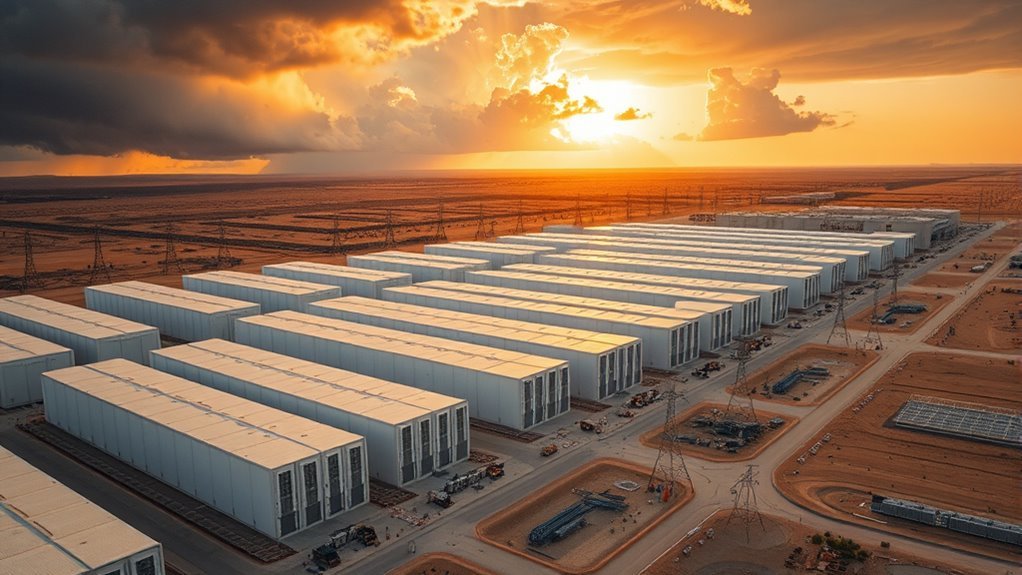
The El Paso campus is engineered to deliver around one gigawatt of compute capacity, dedicated largely to AI workloads across training and inference.
Meta has publicly committed that the site is expected to reach 1 gigawatt of capacity once fully built, matching the scale outlined in its development plans.
That figure is striking. Existing hyperscale data centers often operate at hundreds of megawatts. One gigawatt places El Paso among the most ambitious single-site cloud and AI facilities planned to date.
The design scales Meta’s AI optimized architecture, including dense deployment of accelerators, high-performance networks, and integrated storage systems.
This infrastructure will support large-scale models that power recommendation engines, content ranking, safety systems, and emerging generative AI services across Meta’s family of applications.
Concentrating so much capacity at a single campus allows Meta to standardize hardware and software stacks, streamline operations, and pursue aggressive energy and cooling efficiency tuned for AI demands.
It also creates a focal point risk. Any operational disruption at this campus would impact a significant share of Meta’s future AI compute.
From a regional perspective, Meta has indicated that the project will support up to four thousand construction jobs and around three hundred permanent operational roles once it is online, a meaningful economic impact for the El Paso area.
—
Strategic Implications for Meta
For Meta, the El Paso venture addresses several strategic challenges at once.
First, it supports Meta’s push to embed generative AI and recommendation-heavy models more deeply across Facebook, Instagram, WhatsApp, and other products.
Running these models at scale requires reliable access to very large compute resources. A dedicated gigawatt campus provides that backbone.
Second, the financing model helps Meta manage the optics and reality of heavy capital expenditure. Shareholders have become more sensitive to long-duration spending, particularly in a macro environment where rates are higher and AI returns are still evolving.
By bringing in BlackRock as the majority capital provider and leaning on project debt, Meta spreads the investment load across multiple balance sheets.
Third, the venture preserves operational control. Meta keeps authority over design, construction standards, facility operations, and AI workload deployment.
It is not simply a tenant in a third-party colocation facility. Instead, it shapes the architecture to its own needs while sharing ownership and financial risk.
Finally, the structure gives Meta flexibility. The lease options allow Meta to extend or eventually step back depending on how its AI strategy and compute requirements evolve over the next two decades.
The residual value guarantees ensure that if Meta does reduce usage, it still has clarity on its financial commitments.
There are risks. Meta remains exposed to the economic performance of the campus through its equity stake and guarantees.
If AI demand does not grow as expected, or if alternative compute architectures reduce the need for this scale of facility, the economics could be less attractive. Regulatory changes around data centers, energy use, or AI could also alter the risk profile.
—
What This Signals About BlackRock and Institutional Capital
For BlackRock, the El Paso venture is a high-profile example of how infrastructure and private credit platforms can meet rising demand for digital assets.
Leading a roughly twelve point five billion dollar debt package for a single AI campus shows confidence that institutional investors view these projects as durable and financeable.
This deal also mirrors the broader pattern of BlackRock and peers positioning themselves as key partners for big technology companies.
Instead of tech firms self-funding every facility, asset managers assemble capital from pension funds, insurers, and sovereign wealth funds looking for long-term yield.
From an investor perspective, the appeal is clear. Long leases with a major technology tenant, plus residual value protection, offer a combination of predictable cash flows and downside mitigation.
At the same time, these deals expose investors to technology-specific risks, including fast-changing hardware lifecycles and uncertainties around future AI regulation.
The scale of the El Paso financing will likely influence how future AI campuses are structured. Once a template exists, banks and funds can replicate it in other regions, gradually standardizing AI data center project finance similar to how renewable energy projects developed well-understood models over time.
—
Broader Implications: Energy, Policy and Market Structure
A one gigawatt AI campus raises wider questions beyond Meta and BlackRock.
On the energy side, securing reliable power at this scale is nontrivial. Data centers increasingly compete with other industrial and residential users for grid capacity.
This can trigger debates about local resource allocation, grid resilience, and the mix of generation technologies needed to support digital infrastructure.
While detailed power procurement plans for El Paso have not been publicly outlined in these releases, long-lived power infrastructure is explicitly part of the fourteen billion dollar development scope.
On the policy side, large AI facilities draw attention from regulators and communities. Issues include land use, water consumption for cooling, labor conditions during construction and operation, and broader environmental impact.
Meta’s job creation estimates suggest local economic benefits, but communities may also question the long-term tradeoffs.
In financial markets, spreading AI infrastructure across specialized ventures raises questions about concentration of risk. Many of these financings rely on a small number of major technology tenants and a handful of very large asset managers.
That can create systemic exposure if AI demand falls short of expectations or if credit conditions tighten.
Finally, there is a competitive dimension. Other hyperscale cloud providers and AI companies are watching how Meta structures these projects.
If this approach proves successful, we can expect more partnerships where technology firms contribute design and demand while external capital owns most of the physical infrastructure.
—
Key Takeaways and What To Watch Next
Several core points stand out from the Meta and BlackRock El Paso venture.
- The campus is a very large AI-oriented data center project, with about fourteen billion dollars in development costs and roughly one gigawatt of compute capacity focused on AI training and inference.
- Ownership is split with BlackRock managed funds holding around eighty percent and Meta twenty percent, reflecting a model where institutional capital finances most of the infrastructure while the technology company operates and uses it.
- The financing relies heavily on debt, with about twelve point five billion dollars raised through BlackRock’s infrastructure and private credit platforms, supported by Meta’s long-term leases and residual value guarantees.
- Strategically, this structure allows Meta to scale AI compute while moderating direct capital expenditure, and it positions BlackRock as a central player in digital infrastructure investing.
Looking ahead, several things are worth watching.
How quickly similar structures appear for other AI campuses, including follow-on projects by Meta and deals from rival platforms.
How regulators and communities respond to the energy and environmental footprint of gigawatt scale AI facilities.
How the balance of power evolves between technology companies that control AI workloads and financial institutions that increasingly own the physical infrastructure underneath them.
If the El Paso venture delivers stable returns and robust AI capacity, it may become a reference model for financing the next generation of compute.
If it encounters challenges, it will offer lessons on the limits of leveraging infrastructure finance techniques in such a fast-moving technological domain.
Conclusion
Meta and BlackRock are turning a single data center campus into a test case for how the next wave of artificial intelligence infrastructure will be financed and governed. Their 14 billion dollar venture in El Paso, Texas, is not just about adding another hyperscale site. It is about separating ownership of the physical compute backbone from the technology platforms that depend on it, and inviting institutional capital to underwrite the long term bet on AI.
Why this deal matters now
The El Paso campus is designed to deliver roughly 1 gigawatt of compute capacity for Meta’s AI systems and core advertising business, placing it among the largest single site facilities planned in the United States. A campus of that scale can support tens of thousands of high end AI accelerators and effectively becomes a critical piece of national digital infrastructure rather than just another corporate facility.
Meta has been ramping its commitment to this site over several years. In 2025 it announced a new AI optimized data center in El Paso, the company’s twenty ninth data center, with an initial investment of around 1.5 billion dollars and a design that could grow to a 1 gigawatt campus powered entirely by renewable energy and advanced liquid cooling. By early 2026 Meta had increased planned spending on the project to around 10 billion dollars as AI workloads and model ambitions expanded. The new venture with BlackRock effectively folds this partly built site into a financial structure that can carry the remaining investment while keeping most of it off Meta’s own balance sheet.
At the same time, institutional investors such as pension funds, insurance companies, and sovereign wealth funds have been searching for long duration, asset backed returns in sectors with structural demand growth. Data centers have increasingly become a core asset class for these investors, supported by long term leases and the rise of AI and cloud computing as essential services. The Meta BlackRock venture sits directly at that intersection.
How hyperscale AI infrastructure has been financed so far
Historically, hyperscale platforms such as Meta, Amazon, and Google built and owned much of their critical compute infrastructure directly, treating data centers as strategic assets rather than financial products. Equity and traditional corporate debt financed large portfolios of internally controlled facilities, while third party colocation and cloud providers focused on more diversified, multi tenant sites.
Over the past decade, that model has been evolving. Real estate investment trusts and specialist data center developers have used joint ventures, private funds, and securitized structures to build and own facilities that are then leased to hyperscalers on multi year agreements. In Europe, for example, Blackstone and Digital Realty have created a multibillion dollar joint venture where Blackstone funds hold an 80 percent interest and Digital Realty retains a 20 percent stake and operational control of hyperscale campuses in Frankfurt and Paris, illustrating the appeal of an owner operator split.
At the capital markets level, private credit funds and structured finance vehicles now supply a significant share of debt for data center projects. Institutional notes and project specific securities backed by data center cash flows have become an important part of the financing toolkit, especially for very large, energy intensive sites. Meta’s earlier Hyperion style transactions already showed that AI infrastructure could be financed through special purpose vehicles that sit outside the core corporate balance sheet while still delivering dedicated capacity to the platform.
Inside the El Paso venture
The El Paso AI campus is now being placed into a dedicated venture jointly owned by Meta and funds managed by BlackRock. BlackRock linked funds will own 80 percent of the equity in the venture, while Meta will retain a 20 percent interest and act as the sole tenant and operational manager once the campus is fully online. The parties have committed to fund their respective shares of about 14 billion dollars in development costs, covering the buildings and long term power, cooling, and network infrastructure.
At financial close, Meta will contribute the land and construction in progress assets it has already assembled for El Paso, valued at around 2.3 billion dollars. BlackRock will provide roughly 4.9 billion dollars in cash to the venture. The remaining capital requirement, estimated at around 12.5 billion dollars, is expected to be financed with debt raised against the project, rather than against Meta’s main balance sheet. That combination of equity from Meta and BlackRock and substantial project level debt is typical of large infrastructure projects in sectors such as energy and transportation, now being applied to AI compute.
Meta will lease the entire campus from the venture and provide construction management, administrative, and property services. The initial lease term runs for several years with multiple extension options that could stretch occupancy to roughly two decades, aligning long term access to compute with investor demand for predictable cash flows. The campus is scheduled to begin bringing capacity online in 2028, making it central to Meta’s roadmap for more advanced AI models over the coming decade.
A new template for funding hyperscale compute
What makes this venture notable is not only its size, but the way it codifies a division of labor between technology platforms and institutional capital. Meta will focus on designing the AI optimized architecture, tuning compute for its models, managing operations, and using the capacity, while BlackRock and its investors focus on owning the physical infrastructure and earning returns through rent and debt service.
This arrangement locks in long term access to durable computing power for Meta without requiring the firm to carry the full capital burden on its own books. The lease converts what might otherwise be capital expenditure into operating expenditure, smoothing financial optics and providing flexibility as AI hardware generations evolve. For BlackRock and the institutions behind its funds, the venture offers exposure to AI growth through a tangible asset with predictable cash flows, similar in profile to energy or utility infrastructure but tied to data rather than electrons.
The structure also echoes other owner operator splits emerging across the sector. In the Blackstone Digital Realty venture, Digital Realty keeps operational control and a minority equity stake, while Blackstone provides the bulk of patient capital, mirroring the 80 20 split seen in El Paso. In both cases, expertise in designing and running hyperscale environments remains with the technology or operating partner, while the balance sheet strength and long horizon capital come from institutional investors.
If this model scales, hyperscale data centers may increasingly resemble regulated infrastructure assets from a financing perspective, even when they support cutting edge AI research. Developers, REITs, and infrastructure funds could build and own compute campuses, while platforms sign long term leases that guarantee utilization and underpin debt and equity returns. Meta and BlackRock are effectively testing this thesis at gigawatt scale.
Implications for technology, business, and society
On the technology front, securing a gigawatt scale campus under long term lease gives Meta a stable foundation for training and serving the next generation of AI models. It reduces the risk that capital constraints or macro cycles force sudden cutbacks in compute investment, which is critical as models grow more demanding and as Meta pursues ambitions such as multimodal assistants and generative experiences across its platforms.
For Meta’s business, shifting a large portion of the El Paso spend into a project venture means less direct capital intensity, while still committing the company to use the facility through long dated leases. This can improve reported free cash flow in the near term while keeping AI infrastructure expansion on track, a balance that public market investors increasingly scrutinize. The deal also shows how a major platform can tap into infrastructure style capital pools without giving up operational control over its core compute stack.
For BlackRock and similar institutions, the venture offers a way to participate in AI growth without having to pick individual model winners or bet on specific applications. Returns come from owning the underlying land, buildings, and long lived electrical and cooling systems that any large AI deployment will require. If demand for AI compute remains robust, rents should be supported by Meta’s ongoing need to use the site, potentially extending across multiple hardware generations.
The local and societal impacts are more mixed. Meta has indicated that the El Paso project will support thousands of construction jobs and several hundred permanent roles once operational, bringing new employment and tax base to the region. The company has also committed to power the data center with renewable energy and use advanced closed loop liquid cooling systems that recycle water, addressing some concerns about emissions and resource use. At the same time, a gigawatt scale campus places substantial stress on regional grids and water systems, and communities will expect transparency about how those burdens are managed over time.
Risks and open questions
Despite the apparent elegance of the structure, several risks and uncertainties remain.
There is demand risk. AI workloads are growing quickly, but the trajectory is not guaranteed. If the pace of AI monetization slows or regulatory constraints tighten, Meta could find itself locked into long term leases for capacity that is underutilized, while investors face lower than expected cash flows. Structuring flexibility into lease terms and expansion phases can mitigate this but not eliminate it.
There is technology risk. Hardware generations change rapidly, and architectural shifts such as new types of accelerators or network fabrics can require different building layouts, power densities, and cooling strategies. Although the El Paso campus is designed for scale and adaptability, investors are ultimately betting that the physical plant will remain useful across multiple waves of hardware innovation.
There is legal and regulatory risk. Large AI data centers are increasingly targets for litigation and policy scrutiny, ranging from environmental impacts and labor practices to data security and algorithmic accountability. As more projects move into complex joint ventures and securitized structures, questions about who bears liability for operational failures or regulatory breaches become sharper. Clear allocations of responsibility among tenants, operators, and owners will be crucial.
Finally there is concentration risk. A small number of platforms account for most hyperscale demand, and a venture like this ties returns closely to the fortunes of a single tenant. If Meta’s strategy or financial position changes significantly, it could affect the economics of the campus as an investment even if the broader demand for compute remains strong.
What to watch next
The Meta BlackRock partnership is likely to serve as a reference point for future AI infrastructure deals. Other hyperscale platforms and data center operators will be watching to see how well this model performs in practice, both operationally and financially. Key signals will include how smoothly capacity ramps in 2028, how lease extensions are exercised, and whether similar ventures are announced in other regions.
On the investor side, the response from pensions, insurers, and sovereign funds to this type of asset will matter. If El Paso is seen as a successful template, more capital may flow into dedicated AI data center funds, REIT vehicles, and structured financings that replicate the 80 20 owner operator pattern. That could accelerate the buildout of AI infrastructure globally, but also tie a growing share of institutional portfolios to the long term trajectory of AI.
For policymakers and communities, the question will be how to balance the economic benefits of these campuses with their environmental and grid impacts. As AI infrastructure starts to look more like traditional utilities in scale and importance, pressure for clearer regulation, reporting, and oversight is likely to rise.
The Meta and BlackRock venture shows that AI infrastructure is becoming a distinct asset class, with its own financing norms and risk profile. The gigawatt in El Paso is not just a technical milestone. It is a sign that the capital markets are beginning to treat compute as critical infrastructure, and that the way that infrastructure is owned and financed will shape who benefits from the AI era and who bears its risks. reddit