
The timing of MAI Cyber 1 Flash is not accidental. Over the past few years, attackers have begun using large language models to generate exploit code, craft convincing phishing campaigns, and probe cloud configurations at scale. At the same time, defenders have struggled with noisy tools, overwhelmed teams, and rising infrastructure costs. The rise in AI agent security incidents has made this technology increasingly critical.
Microsoft is positioning MAI Cyber 1 Flash as its first security-focused model built in-house that runs inside MDASH, a multi-model agentic harness dedicated to vulnerability discovery and remediation. That combination of a specialized model plus an orchestrated agent system reflects an important shift in philosophy. Instead of throwing a single frontier-scale model at every problem, the company is trying to engineer a reliable workflow that can be measured, tuned, and paid for over time.
From static scanners to agentic AI
Traditional vulnerability management relied on static analysis tools and rule-based scanners that could find known bug patterns but often missed subtle logic flaws and produced large volumes of false positives. Early machine learning systems added anomaly detection and pattern recognition but still treated each scan as a mostly linear process.
MDASH moves away from that single-pass mentality. It is described as a multi-model agentic scanning harness in which more than one hundred specialized agents examine code, challenge each other, and validate findings through a staged pipeline. Some agents focus on scanning for potential issues, others debate whether a finding is truly exploitable, and a final group constructs proof of concept attacks to demonstrate that a bug can actually be triggered in practice.
This adversarial and collaborative structure is closer to how experienced security teams operate, but it is now encoded into an automated system.
Inside MDASH and MAI Cyber 1 Flash
MAI Cyber 1 Flash itself is a transformer-based model that uses self-attention and sparse Mixture of Experts layers, tuned specifically for security workloads. Public model documentation and independent write-ups indicate that it carries about one hundred thirty-seven billion total parameters, with roughly five billion active at inference time and a context window of around two hundred fifty-six thousand tokens.
In practical terms, that means the model can read and reason over very large codebases and long configuration files without losing track of cross-cutting relationships and attack paths. The lineage also matters for trust. Microsoft describes MAI Cyber 1 Flash as a compact, code-heavy security model derived from the MAI Thinking 1 family, fine-tuned on exploit and remediation records as well as curated code datasets. It is not a general conversational system repurposed for security. Instead, it has been shaped to read code, assess exploitability, and propose patches in ways that align with typical vulnerability management workflows.
Inside MDASH, MAI Cyber 1 Flash is the default workhorse. Multiple reports and technical briefings converge on the claim that it handles about ninety percent of vulnerability-related tasks end to end, including detection, patch suggestion, and validation, with only the hardest ten percent escalated to GPT 5.4 or related frontier models.
Microsoft and outside analysts emphasize that this distribution is by design. The cheaper specialized model does the bulk of the work, while the larger and more expensive GPT 5.4 is reserved for cases that genuinely need extra capacity and longer context.
The role of GPT 5.4 in the stack
GPT 5.4 sits in the architecture as a high-end fallback rather than a universal engine. It is described by Microsoft and several analysts as roughly ten times larger than MAI Cyber 1 Flash and optimized for complex reasoning across novel attack surfaces and unusual combinations of inputs.
When MDASH agents encounter a vulnerability that requires unusually deep context, chain of thought across many files, or creative synthesis of threat intelligence, they can route that specific query to GPT 5.4 while keeping routine work on the specialist model.
Previously, MDASH configurations leaned much more heavily on GPT 5.4, GPT 5.4 mini, and GPT 5.3 codex for most stages of the pipeline. That approach delivered strong CyberGym scores but at a high token and compute cost, which limited how broadly the system could be deployed across enterprise environments.
The new architecture, with MAI Cyber 1 Flash in front and GPT 5.4 behind it, reportedly cuts token and compute expenditure by about fifty percent compared with those earlier stacks while maintaining CyberGym performance at roughly the same ninety-six percent plateau. In Microsoft’s framing, those reductions amount to roughly 50% cost savings relative to existing MDASH offerings. That tradeoff between accuracy and cost is central for any defender operating at scale.
What a ninety-six percent CyberGym score really means
CyberGym is a benchmark focused on vulnerability discovery and remediation under test conditions. The ninety-six percent score for the MDASH system as a whole reflects how often the combined harness, agents, and models can find and patch flaws within the benchmark scenarios, not how safe a real enterprise will be over months or years of evolving threats.
It also attaches to the integrated MDASH stack rather than to MAI Cyber 1 Flash or GPT 5.4 in isolation.
In the competitive landscape, this score matters because it places MDASH above or close to other well-known systems on the same benchmark, including Anthropic Mythos, and signals that agentic workflows with specialized models can match or beat more monolithic frontier model approaches at least in structured tests.
However, experienced practitioners will recognize that benchmarks like CyberGym typically measure performance on curated scenarios, where the rules of engagement and ground truth are known. Real-world environments bring messy code, undocumented dependencies, legacy systems, and human behavior that may not be captured in a lab.
It is also important to remember that a benchmark optimized for vulnerability discovery does not directly address broader safety questions such as model misuse, insider threats, or social engineering campaigns. A system that scores well on CyberGym still needs governance, monitoring, and human oversight to be trustworthy in production.
Project Perception and agent teams beyond code scanning
The release of MAI Cyber 1 Flash is tied closely to a broader initiative called Project Perception, which aims to push MDASH-style agentic defense beyond pure software vulnerability scanning into live enterprise environments.
In Perception, Microsoft describes red agents that simulate attacker behavior and map potential attack paths, blue agents that triage signals and decide what represents genuine risk, and green agents that write and apply fixes or policy updates to harden defenses.
MAI Cyber 1 Flash sits at the core of this system for code and configuration analysis, while other models including GPT 5.4 provide extended reasoning and contextual understanding when needed.
This architecture gives enterprises a way to continuously probe their own systems with AI-driven teams rather than relying only on periodic penetration tests or static tooling. It also raises new questions about how far to push automation. Allowing green agents to execute corrective actions automatically can dramatically reduce response times, but it requires strong guardrails, change control, and visibility for human operators to avoid unintended outages or security regressions.
Implications for technology and business
From a technology standpoint, MDASH and MAI Cyber 1 Flash underscore a growing consensus that specialized models paired with agentic workflows can be more effective and economical than using a single massive general-purpose model everywhere.
The sparse Mixture of Experts approach in MAI Cyber 1 Flash provides a way to keep effective capacity high while limiting active parameters during inference, which helps with latency and cost. The long context window supports whole system reasoning, allowing the model to correlate vulnerabilities across services instead of treating each file as an isolated artifact.
For businesses, the move to a cost-aware stacked architecture is as significant as the raw score. Security leaders are already constrained by budgets, and many are wary of being locked into perpetual use of the largest and most expensive frontier models.
Microsoft executives have highlighted token cost as a primary constraint for defenders operating at scale and have framed intelligent routing across models as just as important as raw model capability. If MAI Cyber 1 Flash can truly cover most real workloads with GPT 5.4 reserved only for exceptional cases, that gives organizations a path to leverage advanced AI without unsustainable spending.
There is also a competitive angle. Cloud providers and security vendors are racing to offer convincing AI defense platforms. A credible claim of ninety-six percent benchmark performance combined with demonstrable cost savings and an agentic design that mirrors established security practices strengthens Microsoft’s position in that market.
At the same time, enterprises will judge the system not only on scores but on how it integrates into their existing workflows, how transparent its reasoning is to human analysts, and how well it copes with the messy realities of legacy infrastructure.
Risks, limitations and open questions
Despite the impressive architecture, several risks and uncertainties remain. Any model trained heavily on historical exploit and remediation data may inherit biases from past incident patterns. It could become very strong at certain classes of bugs while still missing novel vulnerability types that do not resemble its training set.
Agentic systems also introduce complexity. Coordination failures between scanning, debating, and proving agents can lead to subtle gaps where some issues are neither fully dismissed nor fully escalated.
There is also the question of adversarial use. Attackers will study public descriptions of MAI Cyber 1 Flash, MDASH, and Project Perception and may attempt to craft code or configurations that are adversarial to the models, aiming to slip past detection or cause misleading reasoning.
The presence of GPT 5.4 as a fallback helps by adding a second perspective with different training and capabilities, but it also adds a powerful component that must be protected from misuse.
Finally, benchmark scores can create a false sense of security. A ninety-six percent result on CyberGym is valuable as a comparative metric, yet it does not eliminate the need for human expertise, incident response playbooks, and layered defense in depth. The most realistic approach is to treat MDASH and MAI Cyber 1 Flash as force multipliers for security teams, not replacements.
Key takeaways and what to watch next
The introduction of MAI Cyber 1 Flash inside MDASH marks a clear step toward integrated, agentic AI defense that blends specialized security models with frontier reasoning from GPT 5.4.
The system shows that it is possible to achieve top-tier benchmark performance while cutting token and compute costs roughly in half compared with earlier, more frontier-heavy configurations. It also illustrates how multi-agent workflows can mirror human security processes and be encoded into repeatable pipelines.
For practitioners and leaders, the practical takeaway is to focus less on single model scores and more on architectures. How are models combined? How are tasks routed? When is a frontier system invoked and when is a compact specialist sufficient? Those architectural choices will determine not only effectiveness but affordability.
In the coming years, expect to see more security platforms that treat large general-purpose models as specialized engines called only when necessary, and more sector-specific models like MAI Cyber 1 Flash tuned for particular domains.
The organizations that succeed will likely be those that combine careful benchmark validation with rigorous real-world testing, transparent governance, and an honest assessment of where AI helps and where human judgment must remain in the loop.
Conclusion
In late July 2026 Microsoft quietly reset expectations for what AI can do in frontline cybersecurity by reporting that its MDASH security agent, running the new MAI Cyber 1 Flash model with GPT 5.4 as backup, reached about 96 percent on the CyberGym benchmark while cutting costs roughly in half compared with its earlier configuration. That combination does not end the defensive arms race, but it does mark a shift in how serious teams will think about using AI for real production defense rather than isolated experiments.
A new moment in AI powered defense
Cybersecurity has been waiting for this kind of result for more than a decade. Security vendors have promised AI driven protection since the early machine learning waves in endpoint detection and threat analytics, yet most systems still rely heavily on rules, signatures, and human analysts to stitch everything together. The CyberGym result matters because it shows a concrete, quantified jump in performance, and it ties that jump to a specific architecture that blends compact specialist models with a larger frontier model instead of relying on one giant system for everything.
For readers who have followed AI benchmarks over the years, a 96 percent score on any credible evaluation stands out. In this case CyberGym is described as a gold standard benchmark that measures how well AI agents can reason over large real world codebases and reproduce known vulnerabilities under controlled conditions. MDASH equipped with MAI Cyber 1 Flash and GPT 5.4 sits about twelve points ahead of Anthropic Mythos 5, and also ahead of security tuned systems built on other frontier models from OpenAI and Google, which cluster in the low to mid eighties on the same test.
How AI cybersecurity reached this point
To appreciate why this benchmark feels different, it helps to zoom out. Early AI security products focused on pattern recognition in logs and network traffic, often using relatively simple models to flag anomalies. Those systems helped reduce noise but rarely took decisive autonomous action, and they were easily overwhelmed by modern attack complexity.
The current generation of models is built to reason rather than simply classify. CyberGym, introduced in recent research, challenges agents to reproduce more than one thousand known vulnerabilities across nearly two hundred open source projects, scoring them on successful reproduction rather than mere detection. That is a much tougher task than matching patterns in log entries.
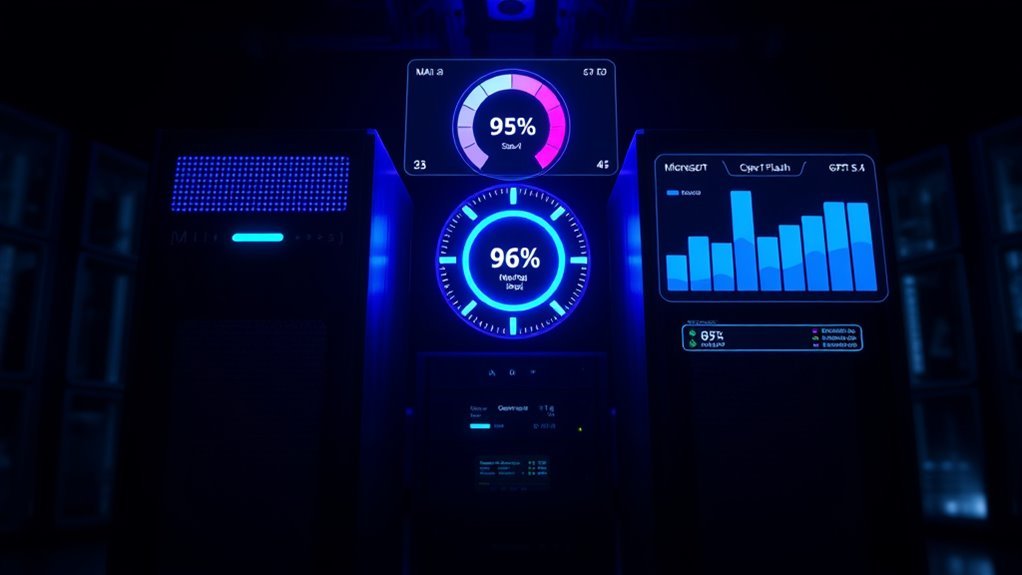
Microsoft has been iterating toward this moment with MDASH, its agent harness for security workflows. At Build 2026 the company reported a previous MDASH configuration scoring around 96.55 percent on CyberGym with a different model mix, before introducing MAI Cyber 1 Flash as its first branded cybersecurity specialist model. The latest numbers show MDASH with MAI Cyber 1 Flash and GPT 5.4 achieving around 95.95 percent on CyberGym, rounded to 96 percent in much of the public messaging.
What the CyberGym score actually measures
It is tempting to read a 96 percent score as a blanket guarantee of security, but that would be a mistake. CyberGym measures vulnerability discovery in a structured environment. Agents are judged on their ability to find and reproduce known flaws in code, not on how they prioritize fixes, coordinate remediation, or integrate into messy enterprise environments.
In practice this means the benchmark is strongest at telling us which systems are better at the narrow but crucial task of reasoning over code to uncover vulnerabilities. MAI Cyber 1 Flash inside MDASH appears significantly more effective at this task than rival configurations based on Mythos, Gemini, and specialized versions of GPT, at least according to the scores Microsoft and partner analyses have published. The benchmark does not directly say how these systems behave when feeds are noisy, infrastructure is misconfigured, or attackers deliberately try to mislead the AI.
There is another nuance that experienced practitioners will notice. The 96 percent figure belongs to the combined MDASH system, not the MAI Cyber 1 Flash model on its own. Microsoft and independent write ups are clear that the architecture uses MAI Cyber 1 Flash for the bulk of work while routing the hardest cases to GPT 5.4, which remains a much larger frontier model from OpenAI. The score is therefore about the ensemble, not a single self contained model.
Cost, architecture, and the rise of specialist models
The most interesting aspect of this announcement is not the raw score but the design behind it. Microsoft says that MAI Cyber 1 Flash now handles roughly ninety percent of MDASH security tasks, with only around ten percent of truly difficult cases escalated to GPT 5.4. That shift moves MDASH from an architecture dominated by expensive frontier models to one where a compact specialist model carries most of the load, and the larger model is reserved for edge cases that genuinely benefit from its broader capabilities.
According to Microsoft and several independent analyses, this change delivers about fifty percent cost savings compared with the previous frontier heavy MDASH setup, while simultaneously improving CyberGym performance from around 88.4 percent to close to 96 percent. In other words, the system gets both cheaper and better, at least on the benchmark it is optimized for.
This pattern fits a broader trend that Perplexity Sonar and other research efforts have been tracking across AI infrastructure. Rather than relying on one monolithic model, more teams are adopting router architectures that combine several smaller specialists with a few large generalists. The specialist handles routine work with lower latency and cost, while the generalist steps in for complex, ambiguous, or high impact tasks. The MDASH configuration with MAI Cyber 1 Flash and GPT 5.4 is one of the clearest security focused examples of that trend.
What this means for security teams and vendors
For security leaders, the headline is that AI is starting to cross from promising pilot to production ready tool in very specific areas. A system that can reliably find known vulnerabilities across diverse codebases is directly useful for continuous security testing, secure development pipelines, and red team style exercises. The CyberGym performance suggests that MDASH with MAI Cyber 1 Flash and GPT 5.4 could shoulder a large share of repetitive code analysis and vulnerability discovery work that currently consumes expensive human time.
If those capabilities hold up in real environments, the practical implications include more frequent and deeper testing of code before release, faster feedback loops for developers, and richer context for human analysts triaging issues. Organizations with large codebases and limited security staffing would benefit most, especially if the promised cost savings are real. Microsoft and several commentators position the roughly fifty percent cost reduction as a key reason this architecture is viable for broad deployment rather than niche use.
There are strategic implications for vendors as well. The clear gap over Mythos, Gemini, and other specialized security configurations on CyberGym gives Microsoft a strong claim to leadership in AI powered code security, at least as measured by this benchmark. That will pressure competitors to respond with their own specialist models and router based systems, accelerating an arms race in which benchmark scores and cost per evaluation become core marketing metrics.
Risks, limitations, and open questions
Despite the impressive numbers, a cautious reading is essential. Several analyses note that the 96 percent CyberGym score and the associated cost claims are vendor reported and have not yet been independently verified. CyberGym leaderboard entries are typically self reported by participating labs, and public write ups do not name an external auditor for the particular assessment Microsoft cites.
That lack of independent verification matters because benchmarks can be unintentionally or intentionally gamed. Systems can overfit to test distributions, learn quirks of particular datasets, or be configured in ways that perform well under evaluation but poorly under live fire conditions. CyberGym also focuses on vulnerability discovery rather than remediation quality, so a system that scores high might still suggest impractical fixes or miss the organizational realities of patching and change management.
Access is another constraint. MAI Cyber 1 Flash within MDASH is currently described as available in private preview, with no firm public timeline for wider availability. That means most organizations cannot yet test these claims directly in their own environments or compare MDASH against competing offerings under consistent conditions. Until real customers can run side by side evaluations, CyberGym scores will remain an important but partial signal.
Finally, there is the broader societal risk. As defensive AI improves, offensive actors are also learning how to use frontier models and specialized tools to design, customize, and automate attacks. Benchmarks like CyberGym push defenders forward, but they do not automatically close the gap between well resourced attackers and average organizations. Overconfidence in automated defenders could lead to underinvestment in human expertise, process rigor, and fundamental security hygiene, all of which remain non negotiable.
Takeaways and what to watch next
Taken together, these results mark a genuine inflection point for applied cybersecurity AI. The MDASH system demonstrates that compact, cost conscious specialist models, routed intelligently alongside larger frontier models, can shoulder most real defense workloads while reserving the heaviest reasoning for a smaller fraction of difficult cases.
The CyberGym score raises expectations rather than ending the arms race. Security leaders will increasingly demand stronger robustness against adversarial behavior, more transparent evaluation methods, and independent verification of vendor claims before trusting automated defenders with high stakes digital environments. Benchmarks will need to expand beyond vulnerability discovery to cover remediation quality, real world deployment constraints, and resilience under active attack.
In the near term, the most important moves to watch are independent replications of the CyberGym results, early customer case studies of MDASH in production, and competitor responses that push the specialist plus frontier pattern even further. If those elements converge, AI backed security may finally start to feel less like a marketing tagline and more like a dependable part of everyday defense. reddit