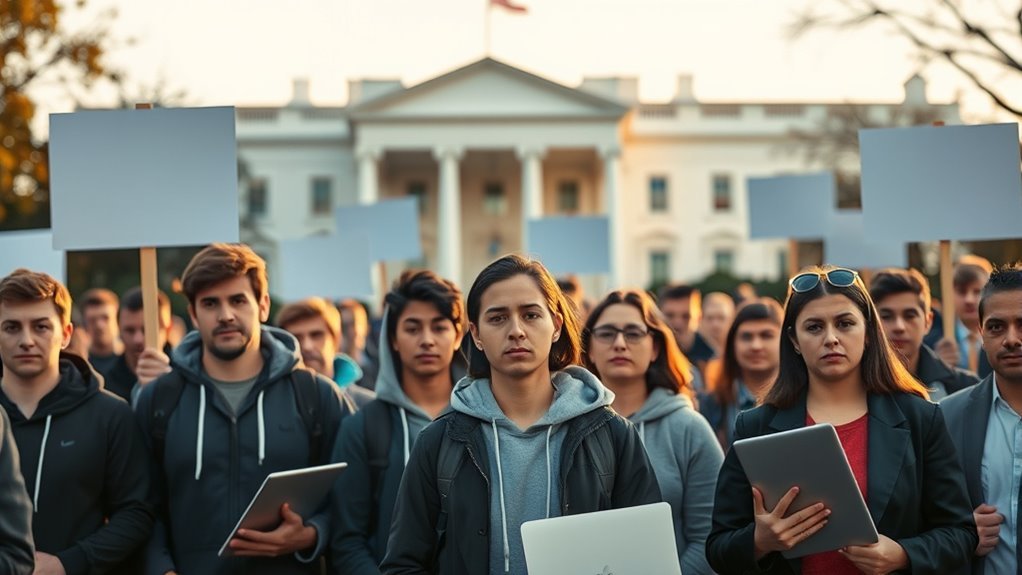

US startups push back as Washington considers a clampdown on Chinese AI
A coalition of nearly two hundred young US tech companies is quietly trying to stop one of the most sweeping artificial intelligence restrictions Washington has ever considered. They are warning the White House that treating advanced Chinese models as a blanket national security threat would not just hit Beijing. It would hit the US startup economy first and hardest, reshaping who can afford to innovate with frontier AI.
From an AI reporter’s perspective, this is one of those inflection point debates. It sits right at the intersection of national security, economic competition and the practical realities of how modern AI is actually built and used. Having watched similar fights over chip export controls, app bans and investment restrictions over the past decade, the arguments on both sides are sharper this time and the stakes are broader.
How we got here: the rise of Chinese frontier and open weight models
For years, US policymakers saw artificial intelligence as an area where American labs like OpenAI, Anthropic and Google clearly led the field. That gap has narrowed. Chinese groups including DeepSeek, Moonshot AI and Z.ai have released large models that now test competitively against Western systems in coding, reasoning and even cybersecurity tasks.
Moonshot AI’s Kimi K3, in particular, has become a symbol of that shift. It is an open weight model, meaning its trained parameters are made available so others can run or fine tune it on their own infrastructure. Similar offerings from DeepSeek and Z.ai follow the same pattern. In practice, this has allowed thousands of developers worldwide to build products without paying US style per token or per call fees to a centralized service.
US officials are watching this trend with increasing unease. Axios and other outlets have reported that the administration is weighing measures that would make it far harder for American companies to use Chinese AI systems, potentially through procurement rules or the Commerce Department’s Entity List. That would echo earlier moves to restrict Chinese access to advanced US chips, but flip the direction of control: instead of limiting what China can buy, it would limit what US firms can use.
At the same time, lawmakers have opened formal investigations into how often US companies rely on Chinese models in production systems. The House Committee on Homeland Security and the House Select Committee on China have already sent letters to firms like Cursor and Airbnb asking about their exposure to Chinese developed AI, signaling that the issue is moving beyond niche technical circles into mainstream policy oversight.
The startup coalition and its open letter
Against this backdrop, nearly two hundred US startups, many backed by Y Combinator, have organized under the banner of the Little Tech Association to oppose a sweeping crackdown. Their open letter to President Trump, Commerce Secretary Howard Lutnick and Office of Science and Technology Policy Director Michael Kratsios argues that an outright ban on Chinese open weight models would be a classic case of shooting the wrong target.
The startups make three core claims.
First, they argue that Chinese open weight models are already deeply woven into the US innovation ecosystem. Founders describe how models from Moonshot AI, DeepSeek and Z.ai power everything from developer tools to research prototypes and niche business software. Companies such as Particle and Proton depend on the affordable inference these systems provide. Cutting off access would not roll back their use abroad. It would simply push American firms to the sidelines.
Second, they stress the practical cost differential. Open weight models allow startups to host and fine tune systems on their own servers or cloud accounts, often at a fraction of the price of calling proprietary US hosted models via commercial APIs. Many young firms operate on razor thin budgets and cannot justify the ongoing licensing and compute costs of fully closed frontier systems. The letter warns that a sudden ban would force hundreds of companies to rearchitect products, renegotiate contracts and absorb dramatically higher costs, pushing some into crisis and others into fire sale acquisitions.
Third, they describe their campaign as the first broad, coordinated intervention by the wider US startup community in a major federal AI policy debate. That detail matters. In earlier rounds of AI regulation, the loudest voices tended to be large labs, established platforms or security agencies. Bringing small and midsize firms into the conversation highlights how deeply advanced models have penetrated the everyday tools and workflows of the US tech sector.
What Washington is considering
The policy options on the table are still evolving and, importantly, they are not limited to a single ban switch.
Several departments are exploring procurement based levers. One path would be to bar federal agencies and their contractors from using Chinese developed AI models in critical systems. Another would restrict government contracts with companies that rely heavily on such models anywhere in their stack, nudging the private sector away from Chinese systems without formally criminalizing their use.
Treasury officials are also examining whether any Chinese open source or open weight models were trained using intellectual property taken from US labs or companies. They have floated the idea of sanctions against firms that engaged in what some call distillation attacks, copying the behavior of US models in ways that violate licensing terms or export rules. That approach builds on recent outbound investment restrictions that already limit how US venture capital can fund cutting edge Chinese AI startups if their models exceed certain compute thresholds or are tied to military and intelligence use cases.
National security and cybersecurity agencies, meanwhile, have raised concerns that Chinese models might subtly encode Beijing aligned narratives, censor dissenting viewpoints or carry safety guardrails that reflect Chinese state priorities rather than US civil liberties. They also worry that powerful open weight systems that can automate stages of cyberattacks are becoming accessible to less sophisticated actors.
It is important to note that, according to reporting on internal White House discussions, a total blanket ban on all Chinese open weight models has not yet been seriously considered, even if some senior officials have floated the idea. More targeted measures remain more likely, at least in the near term.
Why startups say a ban would backfire
From the startup perspective, the most immediate risk is not abstract geopolitics. It is day to day operational reality.
Founders who have migrated to Chinese open weight models often do so because they offer frontier level performance at prices that make experimental prototyping and early user growth feasible. Replacing those systems with US proprietary models typically increases direct model costs and indirect engineering overhead. For teams building developer tools, research assistants or specialized enterprise workflows, that cost difference can easily determine whether a product exists at all.
The coalition’s letter argues that cutting off access would yield little leverage over Beijing. Chinese companies would still distribute their models globally, and actors outside the US would continue to use and refine them. Because the weights are already available on the internet, it is effectively impossible to stop their use entirely. The practical effect would be to make US hosted environments less attractive, pushing some future innovation and deployment to jurisdictions with looser rules.
They also highlight a nuance that has been missing from some political talking points. An open weight model does not automatically send data back to the original provider. Once the weights are downloaded and run locally or in a neutral cloud, the Chinese company has no direct visibility into what prompts or data the US user is processing. That does not eliminate all risk, but it undercuts the assumption that every query to a Chinese model is simultaneously a data exfiltration event.
From a broader AI ecosystem standpoint, their argument connects to a long running concern that aggressive national security framing of emerging technologies can lead to overbroad restrictions that freeze experimentation. When the Trump administration issued an executive order on promoting advanced AI innovation and security, it explicitly warned that excessive restraints could jeopardize US leadership by slowing domestic progress faster than they slow competitors abroad. That order created a voluntary review framework for frontier AI models and explicitly rejected mandatory federal licensing, reinforcing the administration’s light-touch approach. Treating every Chinese open weight model as a blanket threat would cut against that principle.
The security case and its limits
Security agencies and some lawmakers are not raising these concerns lightly. Recent work has shown that certain Chinese models can match leading US systems in vulnerability discovery and cybersecurity tasks, including scanning for weaknesses and suggesting exploit code. Combined with open weight distribution, that creates a scenario where off the shelf models could help automate cyber operations in ways that were previously the domain of well resourced state actors.
Officials also point to the information operations dimension. State Department spokespeople have argued that Chinese AI models are designed to advance Chinese government narratives and embed censorship into their responses. If those systems become default foundations for global digital infrastructure, they worry, the values encoded in everyday software could shift in subtle but important ways.
There is some technical and legal pushback here. Experts at think tanks like Brookings have noted that it is ultimately impossible to ban China’s open source AI models outright because their weights are freely accessible online. Attempting to block their distribution or possession raises serious First Amendment questions in the US, since model weights can be framed as a form of speech or publication. In practice, enforcement would rely on indirect controls such as procurement rules, investment screens and contractual standards rather than police action against developers who download weights.
Security professionals also differ on how to weigh risks that derive from where a model was built versus how it is deployed. A model trained in China might reflect certain local biases, but a US team that fine tunes it with independent datasets and runs it inside a secure enclave could mitigate some, though not all, of those concerns. As Hernan Kovetz and others in the cybersecurity industry have pointed out, the real danger often lies in what tasks a model is used for and what additional tooling it is connected to, not simply in its origin alone.
This is where grounded experience matters. Having covered AI safety and misuse debates since the early days of generative models, one pattern recurs. Risks are real and growing, yet they are also uneven and context dependent. Policies that treat all models from a particular country as identical threats tend to overestimate some dangers and underestimate others.
What this fight means for AI competition and policy
Beyond the particulars of Kimi K3 or DeepSeek, this emerging clash tells us several important things about where AI is heading.
First, the frontier is global. Chinese labs are now clearly capable of training systems that rival or surpass many US offerings on specific tasks. That reality forces US policymakers to think in terms of interconnected ecosystems rather than simple dominance. Restricting model use at home does not erase progress abroad. It may simply redistribute who benefits from it.
Second, open weight distribution is changing leverage. In the past, control over powerful models often tracked directly with control over central servers. If you could block traffic to a particular endpoint, you could effectively deny access. With open weight models, once the weights are out, they spread. Attempts to restrict them shift from direct technical controls to broader regulatory and economic pressure.
Third, the US is increasingly experimenting with more granular tools. Outbound investment restrictions keyed to compute thresholds, procurement rules aimed at specific risk categories and targeted sanctions for IP theft represent a more sophisticated, albeit more complex, approach than blanket technology bans. Done well, these tools can focus attention on genuinely sensitive applications while leaving room for innovation elsewhere. Done poorly, they can create confusing, overlapping requirements that only large incumbents can navigate.
Fourth, the debate highlights a tension between national security and startup friendly innovation policy. On one hand, Washington wants to stay ahead of China in AI and protect core infrastructure from foreign manipulation. On the other, it wants a vibrant domestic ecosystem of small firms experimenting with new ideas. If regulatory responses to foreign models raise fixed costs and compliance burdens, they will tend to favor large, well resourced companies over small ones.
From a practical standpoint, founders and policymakers will likely need to find middle ground. Certain use cases, especially in critical infrastructure, defense and core government systems, may warrant strict limits on foreign models. In many commercial and research contexts, however, open weight systems can be part of a competitive and healthy ecosystem, provided there is transparency about their training data, safety characteristics and governance.
Key takeaways and what to watch next
A few points stand out for technology leaders, investors and policymakers trying to make sense of this moment.
- Chinese AI labs now produce frontier level open weight models that are widely used inside US startups, academic projects and commercial tools.
- The US government is actively considering procurement limits, investment screens and sanctions related to Chinese models, but a total legal ban on their use is unlikely in the near term due to technical and constitutional constraints.
- A coalition of nearly two hundred US startups is arguing that sweeping restrictions would raise costs, destabilize the innovation economy and hand competitive advantage to firms outside the US who can still freely use these models.
- National security and cybersecurity officials remain deeply concerned about intellectual property theft, embedded censorship and the use of powerful open weight systems for cyberattacks, and they are unlikely to drop the issue.
- The core policy challenge is to distinguish between genuinely sensitive applications that require strong guardrails and broader commercial or research uses where overbroad controls could do more harm than good.
In the next phase of this debate, watch for three signals.
First, whether procurement rules harden into formal restrictions on contractors that rely on Chinese models.
Second, how Treasury and Commerce draw lines around IP theft and model training practices, and whether any firms are actually sanctioned.
Third, whether startups and mid sized companies can sustain their pushback and translate it into concrete adjustments in draft legislation.
Artificial intelligence has always been about more than algorithms. It is about who gets to use them, under what rules, and at what cost. The fight over Chinese open weight models is a revealing test of how the US plans to balance openness, security and competitiveness in the years ahead.
Conclusion
Nearly two hundred United States startup founders have just drawn a line in the sand for Washington on artificial intelligence, warning that a broad move to cut off Chinese open weight models could quietly reshape who gets to build the next generation of AI systems in America. The appeal matters because it forces policy makers to confront a core tension that has been building for years in United States AI policy: how to balance genuine security risks against the practical need for open, affordable access to powerful models that many young companies depend on.
What sparked the clash over Chinese AI models
The immediate trigger is a coordinated letter from the Little Tech Association, a newly formed group representing almost two hundred Silicon Valley companies and investors including Proton and Y Combinator. The signatories are urging the Trump administration not to restrict access to advanced Chinese open weight models such as systems released by Moonshot AI and Alibaba, which are already widely available to developers worldwide.
In their message to the White House, the Commerce Department and the Office of Science and Technology Policy, the founders argue that access to high quality open weight models is now a basic ingredient for startup innovation, not a luxury. They warn that a blanket ban on downloading or using Chinese open weight models would not meaningfully slow their global spread but would directly harm United States startups that rely on these models for affordable frontier level inference.
The core of their argument is straightforward. If Washington walls off Chinese open weight models without providing comparable domestic alternatives, young companies are pushed toward expensive closed systems from a small set of incumbents. The founders believe that outcome would entrench dominant labs, narrow the competitive field and ultimately weaken United States leadership in AI.
How United States AI policy got here
To understand this conflict, it helps to recall how quickly United States thinking about open models has evolved. In mid 2025 the White House released Americas AI Action Plan, explicitly framing open weight models as a strategic asset for innovation and even national security. The plan highlighted open models as a way to broaden access to advanced capabilities while also looking at tightening export controls on adversaries such as China in order to maintain an edge in the so called AI race.
Shortly after that plan, large labs such as OpenAI resumed limited open weight releases after years of prioritizing fully hosted products, signaling that open models were once again part of the mainstream policy conversation. Meanwhile, United States startups and academic labs increasingly committed to open weight development, betting that self hosted models would become a foundation for both commercial products and research.
At the same time, Congress and the national security community were growing more concerned about the rapid adoption of Chinese developed models inside United States companies. The House Committee on Homeland Security and the House Select Committee on China launched a joint investigation into the risks posed by AI systems built in the Peoples Republic of China and sent letters to firms such as Cursor, Anysphere and Airbnb seeking information about their use of Chinese models. That was one of the first visible signs that what had been mainly a technical debate about open source AI was turning into a matter of national security policy.
More recently, legal and regulatory work has started to move beyond chips and infrastructure toward rules aimed directly at models and access. Trade and export control specialists expect redesigned controls to emerge as interim rules that focus less on physical hardware and more on how and where models can be used and distributed by United States entities. The current startup letter lands right in the middle of that shift.
Why open weight models are so hard to regulate
The founders are not just objecting to the idea of restrictions. They are pointing at a technical reality that makes sweeping bans hard to enforce. Open weight models are systems whose trained parameters are publicly downloadable. Once a company has pulled those files and is running them locally, there is no straightforward mechanism for regulators to recall or delete them.
Experts who study United States China technology policy note that this creates a genuine enforcement dilemma. Chinese open source models are hosted on public platforms, mirrored across multiple repositories and shared informally among developers. Because the models are just large files, not services, they look more like digital speech or software than like a controlled export in the traditional sense.
Researchers such as Kyle Chan at the Brookings Institution have argued that trying to block access to those files entirely may be functionally impossible and could raise First Amendment issues, since the models can be framed as information rather than a physical product. Once a United States firm has downloaded a system such as GLM 5 point 2 or DeepSeek V4 Pro to its own servers, that company sits outside the reach of any future import restriction on that specific download. There is currently no clear legal mechanism to force removal of those models from private infrastructure at scale.
Policy specialists increasingly expect Washington to focus on the parts of the stack it can realistically control. That means procurement rules, compliance obligations and security audits for companies that do business with the federal government, plus targeted restrictions on routing live data through foreign hosted application programming interfaces where prompts and user information could flow into overseas infrastructure. The open letter from startups is effectively asking policy makers to lean into that more surgical approach rather than trying to police every file on every server.
What startups say is at stake
From the perspective of founders, open weight models have become the scaffolding on which a lot of innovation now rests. Many early stage companies lack the capital to train frontier scale systems from scratch or to pay for heavy usage of premium closed models on a per token basis. Instead, they fine tune and deploy open systems, often integrating both United States and Chinese models into their products.
Signatories to the Little Tech Association letter argue that these models are not just experimental tools. They are live components in production systems used by hundreds of companies for coding assistance, search, business automation and creative applications. Entrepreneurs warn that if access to Chinese open weight models is abruptly cut off without equivalent replacements, a significant number of startups could see their economics break, leaving them unable to compete with better funded incumbents that already have deep relationships with closed model providers.
The founders also connect this to broader competitiveness. They contend that American leadership in AI depends on two conditions. First, United States labs must continue to produce world class open weight models. Second, United States builders need the freedom to use high quality open systems from abroad that are already widely available, including those developed in China. Removing either pillar, they argue, risks narrowing the innovation base in the United States and ceding practical advantages to ecosystems that remain more open to mixing domestic and foreign models.
The national security and trust concerns
On the other side of the debate, lawmakers and security officials are focused on a different set of risks. Investigations launched by congressional committees have flagged concerns that Chinese developed models could embed vulnerabilities, be updated in ways that enable data exfiltration or be paired with services that route sensitive corporate or user information back to infrastructure in China. In this view, relying on foreign models at the heart of enterprise software is not just a technical choice but a potential vector for espionage and economic coercion.
There is some technical evidence to justify caution, though it remains limited. One widely discussed report from Booz Allen examined code generated by certain Chinese models and identified patterns consistent with insecure or flawed outputs, but the firm emphasized that it did not have proof of intentional backdoors. Independent researchers described the findings as credible but also noted that the evidence was not strong enough to generalize across all Chinese models or to prove deliberate sabotage.
Policy advisers have suggested that Washington could deploy procurement bans that discourage government agencies and their contractors from using Chinese models, along with heavier information sharing about known vulnerabilities so companies can make more informed choices. Such measures would not completely remove Chinese models from the United States market, but they would change the incentives for firms in sectors that depend heavily on federal contracts.
Trust also has a geopolitical dimension. Officials worry that Chinese labs could train their systems using distilled knowledge from United States models, potentially leveraging American intellectual property and safety work without equivalent reciprocity. Managing this give and take between global research collaboration and strategic competition is becoming a central question for both governments and labs.
Possible paths forward instead of a blanket ban
The letter from nearly two hundred startups implicitly sketches a different path from an outright prohibition. Their position does not deny that risks exist. Instead, they call for targeted safeguards that deal with specific threats while preserving the benefits of open access.
One likely direction is a focus on runtime conditions rather than model files themselves. Legal and technical analyses suggest that the United States can more easily restrict how government data and critical workloads are processed than it can police which open source files developers download. That could include rules that prevent contractors from sending sensitive prompts or user data through foreign hosted endpoints, combined with mandatory security reviews for any model used in high risk government systems.
Another track involves strengthening domestic open weight ecosystems so that United States startups have viable homegrown alternatives. The White House AI Action Plan already framed open models as part of the national interest, and trade experts expect forthcoming export controls to be tailored to protect that advantage while limiting dangerous flows to adversaries. If those policies are paired with investment in United States labs and clearer guidance on safe use of foreign models, the practical need for sweeping bans could diminish.
Finally, Washington can lean more heavily on transparency. Detailed vulnerability advisories, certification schemes for secure model deployment and clearer guidance on acceptable uses of foreign models may all reduce the pressure for blanket restrictions by allowing companies to differentiate between risky and lower risk scenarios. This is slower and more demanding than a simple prohibition, but it better matches the granular nature of AI risk.
What this fight means for the future of AI in the United States
The clash over Chinese open weight models is ultimately a test of how the United States will govern an AI ecosystem that is both deeply global and increasingly strategic. On one side is a startup community that has grown up in a world of open code, open research and mix and match tooling. On the other side is a security apparatus that sees frontier AI systems as dual use technologies with serious implications for defense, intelligence and economic resilience.
If policy makers opt for broad restrictions, the immediate effect would likely be to push more companies onto closed domestically hosted models, raising costs and concentrating power in a handful of large providers. Over time, that could slow experimentation at the edges and make it harder for new labs to emerge. If instead they pursue targeted safeguards and invest in domestic open ecosystems, the United States could maintain both a vibrant startup scene and a credible security posture, though it will require more nuanced regulation and constant reassessment as models evolve.
The letter from Little Tech Association is therefore not just a lobbying effort. It is a signal that the people building AI products day to day are worried that certain policy instincts could unintentionally drain energy from the very ecosystem that Washington says it wants to protect. How the White House responds will help set expectations for future debates about foreign models, open source releases and the acceptable boundaries of AI collaboration across rival blocs.
Key takeaways and what to watch next
Several practical lessons emerge from this episode. First, open weight models have moved from a niche technical concept to a central strategic issue for both startups and governments. Second, the technical nature of these models makes complete bans difficult to enforce and potentially fraught with constitutional questions, pushing regulators toward more targeted tools such as procurement rules, endpoint restrictions and security audits. Third, both sides acknowledge real risks, but they differ sharply on whether those risks justify sweeping prohibitions that could reshape the competitive landscape of United States AI.
In the coming months, watch for three signals. Any new guidance from the White House or Commerce Department on foreign AI models will indicate whether targeted safeguards are gaining favor over bans. Congressional investigations into Chinese AI and follow on hearings will show how hard security hawks push for stricter measures. And the response from large United States labs to startup concerns will reveal whether domestic open weight options expand enough to reduce reliance on Chinese models.
The decision the administration makes now will not only determine whether nearly two hundred startups keep using Chinese open weight models. It will also shape the rules of engagement for a global AI ecosystem where openness, security and competitiveness are permanently entangled.