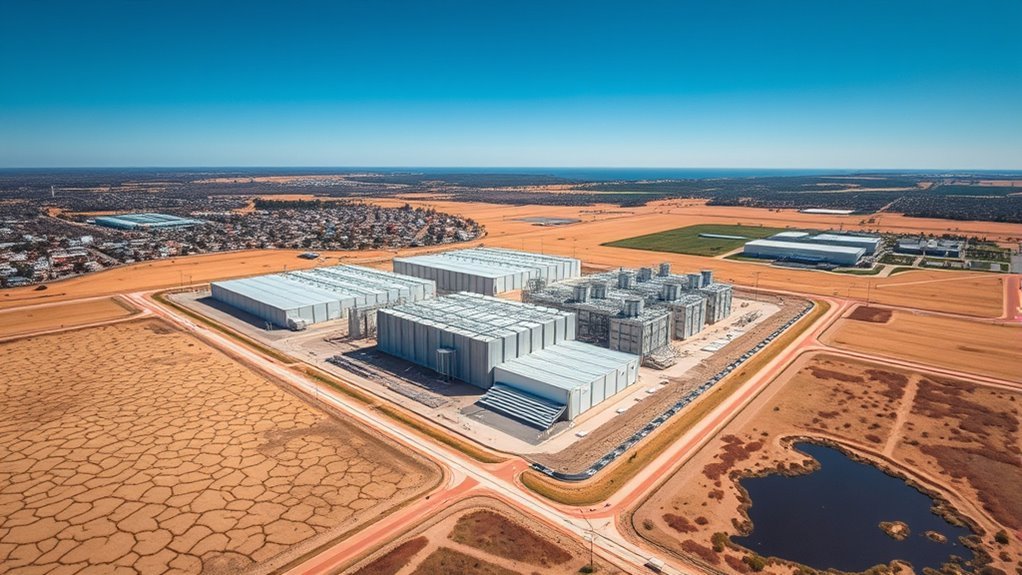

Amid Australia’s push to build sovereign AI infrastructure, OpenAI and local operator NEXTDC are advancing a A$7 billion hyperscale AI campus at the S7 site in Eastern Creek, western Sydney, positioned as a cornerstone of the “OpenAI for Australia” initiative and a primary compute hub for government and industry.
The project is framed as a sovereign AI compute facility, designed to host GPU superclusters capable of supporting advanced training and inference workloads for public and private sectors. Situated about 45 kilometres west of central Sydney on a 258,000 square metre parcel, the campus is planned to become one of the largest data centre complexes in the Southern Hemisphere, with a first phase targeted for operation in the second half of 2027, subject to regulatory approvals. This initiative aligns with global standards essential for safe governance of advanced AI systems.
NEXTDC has positioned the S7 “Stargate” campus as critical national infrastructure aligned with Australia’s security and critical systems frameworks, emphasizing its role in hosting sensitive workloads for government, defence, finance, healthcare, and research. OpenAI is expected to act as the foundational tenant, securing substantial compute capacity to underpin deployment of its models in Australia and across the broader Asia-Pacific region. To protect these sensitive workloads, operators may employ unusual activity detection and user verification measures to identify and block automated or unauthorized access attempts.
Anchoring Australia’s sovereign AI, S7 will host sensitive national workloads as OpenAI’s primary Asia-Pacific compute stronghold
The arrangement follows OpenAI’s decision to establish its first Australian office in Sydney, signalling a longer-term commitment to co-develop local AI capability and provide sovereign access to advanced GPU resources under the OpenAI for Australia program.
At full build-out, the S7 campus is designed to deliver between roughly 550 and 612 megawatts of IT and supporting load, a scale comparable to the electricity demand of about 780,000 Australian households. This concentration of high-density compute is engineered around large GPU clusters, with closed-loop liquid systems circulating coolant directly around chips to extract heat before it is expelled by fans.
The revised cooling strategy uses no ongoing water in operation but requires more energy, heightening scrutiny of the facility’s overall resource footprint even as developers highlight the absence of potable water consumption.
Initially, project designers had proposed using treated wastewater drawn from Sydney’s recycled-water network to cool the data centre, an approach intended to reduce strain on drinking water supplies and align with broader sustainability objectives.
Implementation depended on constructing a dedicated pipeline to transport recycled water to Eastern Creek, but planning authorities declined to grant the necessary approval. NEXTDC subsequently ended negotiations with utilities, removing the recycled-water option from the design and locking in the more energy-intensive liquid refrigerant approach as the primary cooling method for the OpenAI-associated campus.
The shift has intensified debate over how Australia’s rapidly expanding data centre sector manages electricity use, emissions, and water in a climate-constrained future. Local communities and policymakers are weighing the economic and strategic benefits of sovereign AI infrastructure against concerns about grid capacity, environmental impact, and the precedent set by abandoning a prominent recycled-water initiative at such a high-profile facility in Sydney.