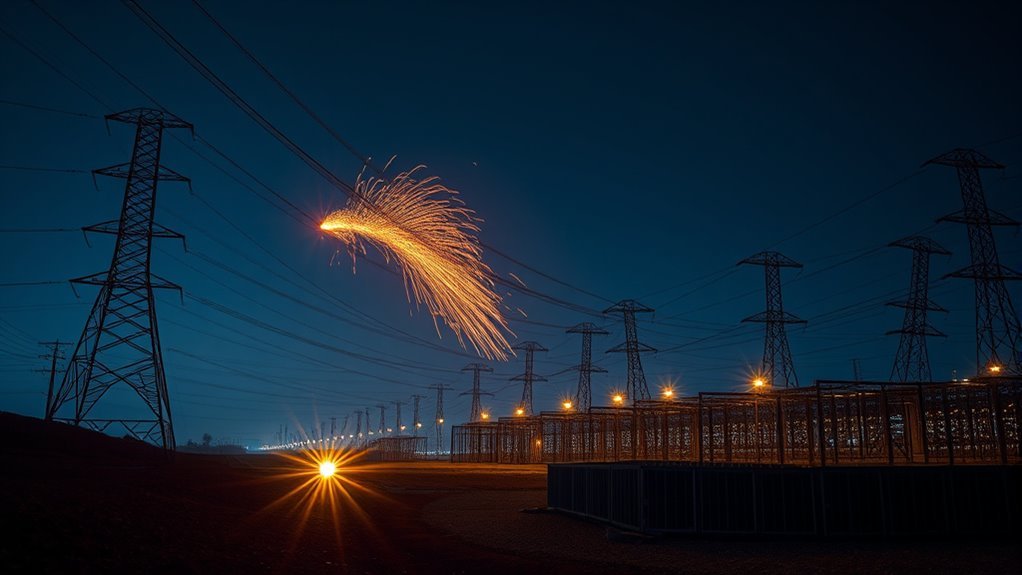

The Eastern United States grid just received a very twenty first century warning shot. A single fallen transmission line near Washington DC did not simply trip a few local customers. It triggered protective systems across clusters of artificial intelligence data centers that promptly removed more than three gigawatts of demand from the PJM Interconnection in under a minute. The lights merely flickered for most people. For grid engineers and AI operators, the incident exposed a deeper structural mismatch between hyperscale computing and legacy power systems that were never designed for this kind of behavior. Regulators now emphasize that such events expose growing grid stability risks as data center demand accelerates and large blocks of load can disappear without warning.
How one line fault turned into a three gigawatt shock
In July 2026 a transmission fault in Ashburn Virginia, the heart of the region known as Data Center Alley, set off a cascading but fully automatic response inside dozens of AI facilities. Sensors detected abnormal voltage and frequency conditions near the point where these campuses connect to the grid. Within seconds, uninterruptible power supplies and transfer switches shifted their internal loads away from utility power and onto onsite generators and battery backed systems.
The result was a sudden disappearance of more than three gigawatts of load from PJM, the largest grid operator in the United States, equivalent to roughly three percent of total demand at the time. Voltage rose perceptibly and frequency nudged upward across a wide area running from Northern Virginia toward the Midwest, enough that Ting Labs, a consumer device network that monitors electrical quality from wall outlets, recorded a clear system level disturbance.
What residents experienced as a brief flicker was in fact a large system imbalance. Every conventional generator in PJM was still producing power based on the pre fault demand forecast. When three percent of the load vanished, the grid was momentarily oversupplied. Protective mechanisms handled this particular event without serious consequences but regulators and reliability experts immediately flagged it as a preview of more complex problems to come.
This did not come out of nowhere
The July 2026 shock was not an isolated anomaly. It sits on top of a growing record of similar episodes in which clusters of data centers disconnect almost simultaneously, turning local faults into continent scale challenges.
Clusters of data centers now routinely disconnect in sync, turning minor grid faults into continent-scale shocks
North American reliability regulators have already cataloged multiple events in which more than one gigawatt of data center load dropped within moments of transmission disturbances in 2025. In at least one case documented by the North American Electric Reliability Corporation, hyperscale campuses initiated their own load reductions rather than being disconnected by utility equipment simply because internal protection systems could not ride through what grid operators considered a routine disturbance.
Earlier incidents in Northern Virginia likewise saw on the order of one and a half gigawatts and beyond fall off the grid in seconds as dozens of facilities reacted to voltage and frequency deviations and transferred to backup power. NERC responded in 2026 with one of its highest urgency alerts, explicitly naming gigawatt scale data center load drops as an emerging reliability threat. That alone is notable. The organization has issued only a handful of such alerts in its history, traditionally for events such as fuel shortages or extreme weather.
At the same time, PJM and other regional operators are dealing with record demand driven both by residential air conditioning and the rapid growth of AI workloads. During the late June and early July heatwave that covered more than thirty states, PJM requested and received emergency federal authority to force large data centers off the grid and onto diesel backup generation within fifteen minutes of an emergency signal to preserve capacity for homes and critical services. That sequence of orders under section 202 c of the Federal Power Act is a strong sign that authorities now view digital infrastructure as a front line reliability issue, not a niche concern.
Why AI data centers behave differently from traditional big loads
From the outside, a hyperscale AI campus looks like any other large industrial customer. On the inside, it behaves very differently.
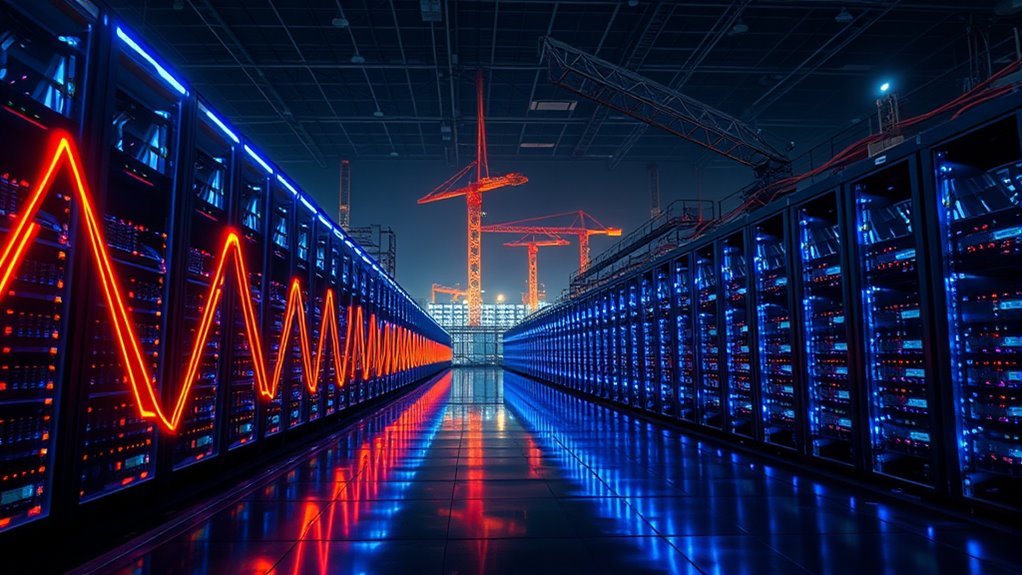
Traditional heavy industry tends to ramp loads slowly and maintain relatively steady demand. AI data centers instead aggregate tens of thousands of graphics processing units and other accelerators running tightly synchronized training cycles. That creates highly cyclical patterns. During each training batch many accelerators swing from idle to full power almost simultaneously, then drop back, producing waves of demand that roll across the grid within minutes. IEEE Spectrum reporting has described these facilities as high frequency cyclical consumers whose load profiles do not resemble conventional factories at all.
Moreover, the way they connect to the grid is mediated by layers of power electronics and sensitive computing hardware. The servers and accelerators at the core of AI workloads require extremely clean and stable voltage and frequency. Even brief sags or spikes at the point of interconnection can threaten equipment or corrupt computations. To protect against that, data centers deploy sophisticated uninterruptible power supply systems, transfer switches and internal microgrids that can isolate themselves from the broader system in fractions of a second.
When a fault occurs on nearby transmission lines, the data center does not simply ride through it like many traditional customers. Even if the bulk grid expects the disturbance to be cleared quickly by protection relays, internal logic inside the campus may decide that the safest response is to disconnect and rely on onsite generation and batteries. The computing workload continues but from the grid perspective the entire facility just disappeared. In the July 2026 Ashburn case, these protective actions by many campuses in the same geographic cluster compounded into a more than three gigawatt load drop.
A structural mismatch between grid design and AI risk management
This is where experience with both power systems and large scale computing becomes important. The problem is not that data center operators are behaving irrationally. It is that their risk models were built almost entirely around avoiding downtime and hardware damage inside the campus. Grid stability has often been treated as someone else’s problem.
From a grid operator’s perspective, a large data center is attractive under normal conditions because it provides nearly continuous demand that helps smooth out variations elsewhere. These campuses often run around the clock at high utilization. In planning studies, they behave as steady anchors for generation dispatch.
However, when those same loads withdraw in response to faults, the grid loses a stabilizing influence at precisely the moment it needs it most. NERC’s 2026 State of Reliability report emphasizes that as individual campuses approach gigawatt scale and cluster regionally, customer initiated load drops of hundreds of megawatts or more begin to threaten frequency and voltage stability across interconnections. If several clusters react in parallel, the total could exceed what existing reserves and automated controls were designed to handle.
PJM is already warning that generation capacity shortages could appear as early as the 2026 to 2027 delivery years because AI driven demand growth is outpacing additions of new resources and transmission lines. The International Energy Agency and other analysts estimate that more than two thousand five hundred gigawatts of projects including renewables storage and large loads such as data centers are stuck in grid interconnection queues globally, waiting for infrastructure that often takes a decade or more to build. In other words, the grids that AI relies on are not growing nearly as fast as the AI workloads themselves.
There is also a growing equipment bottleneck. Skyrocketing demand from AI campuses is aggravating shortages of transformers, switchgear and other critical components across the United States, driving up costs and stretching lead times. Utilities and developers are racing to lock in orders years in advance just to keep projects viable. That slows the ability to reinforce weak points and adapt protection schemes at the pace needed.
Business implications for AI operators
For AI companies and cloud providers, these developments have immediate strategic consequences.
First, power is no longer just an operating expense. It is becoming the binding constraint on new deployment. Reporting across multiple outlets now describes grid stability rather than semiconductor supply as the main bottleneck for frontier AI expansion in some regions. Large campuses that were once planned around proximity to customers or fiber routes are now being reevaluated based on the resilience of local transmission and the willingness of regional operators to accommodate their load profiles.
Second, regulators are beginning to treat hyperscale data centers as grid scale actors. In June 2026 the Federal Energy Regulatory Commission issued show cause orders to grid operators, requiring them to revisit the way they study and allocate costs for large loads above fifty megawatts, including co location arrangements and curtailment protocols. That kind of scrutiny signals that data centers will increasingly be expected to participate in reliability planning rather than simply purchasing capacity as consumers.
Third, emergency mandates like the recent Department of Energy orders place reputational and operational risk squarely on AI providers. When federal authorities direct data centers to switch to diesel backup within fifteen minutes during an emergency, local communities notice the noise and air quality impacts even if the lights stay on. Companies that have invested heavily in clean energy branding now face the optics of running large diesel fleets during heatwaves.
Forward looking operators are already responding by building their own islanded microgrids and self provisioned generation, including onsite renewables, batteries and sometimes conventional plants dedicated to their campuses. That approach can reduce reliance on stressed regional systems but it also introduces new coordination challenges. A campus that can separate completely from the bulk grid and operate as a private island during disturbances adds optionality. It also raises questions about how and when it reconnects without destabilizing the shared system.
Societal and environmental tradeoffs
From a societal perspective, the emerging pattern is nuanced. AI infrastructure has clear economic and technological benefits. It underpins advances in medicine, logistics, finance and software productivity. However, the way it interacts with power systems is making those benefits more complex to realize.
The most immediate concern is reliability for ordinary customers. During the recent heatwave, federal officials explicitly framed emergency orders as a choice between uninterrupted power for AI campuses and air conditioning for millions of households. That framing will accelerate public scrutiny. Communities that see local air quality worsen because data centers are running diesel fleets during emergencies while their own bills rise are likely to demand stronger constraints.
Environmental implications sit on top of that. When hyperscale campuses shift to onsite fossil generation during grid emergencies, the resulting emissions concentrate in specific localities even if overall blackout risk falls. On the other hand, there is genuine innovation in pairing AI facilities with renewables and storage. Some operators are exploring designs where training workloads flex in response to power availability, taking advantage of surplus wind or solar and backing off when grids are tight. That direction could turn AI from a reliability risk into a balancing asset if done properly, but it is early.
Transparency is important here. Many of the reported incidents so far have not caused blackouts. NERC and PJM both emphasize that while frequency and voltage deviations have been measurable, system protections have prevented serious harm. The United States grid has bent under AI related peaks but has not broken yet. Trustworthy communication needs to acknowledge that resilience while still making clear that safety margins are shrinking and that the current trajectory is not sustainable without changes.
What needs to change to make AI and grids coexist
Mitigating these risks will require more than incremental tweaks. Several threads are already visible in regulatory and industry responses.
1. New protection and ride through standards
NERC’s 2026 report explicitly calls for updated modeling and equipment standards so that large data centers can ride through normally cleared grid disturbances rather than instantly disconnecting. That means revisiting voltage and frequency tolerances at the point of interconnection, refining the logic in transfer switches and uninterruptible power supplies, and testing scenarios where onsite backup systems delay or stagger their response instead of acting all at once.
2. Coordinated reconnection protocols
A gigawatt scale campus that drops off the grid is one problem. A gigawatt scale campus that attempts to reconnect at the wrong moment can be worse. Operators and regulators are beginning to discuss staged reconnection, where large loads ramp back only after frequency and voltage are stable and reserves are adequate. That kind of choreography requires real time data sharing between campus operators and grid control centers, not just static interconnection agreements.
3. Better planning for large load clusters
FERC’s show cause orders and the growing body of reliability analysis point toward more stringent planning requirements for regions that host dense data center clusters. That includes ensuring sufficient reactive power support, short circuit strength and fast frequency response near campuses, as well as explicit limits on how much customer initiated load shedding is acceptable in a given area.
4. Aligning incentives
At present, the incentives inside the data center often reward zero downtime above all else. As long as computing continues smoothly, switching to backup generation during a disturbance looks like a success, even if it stresses the grid. A more balanced design would reward facilities for staying online through minor faults, participating in demand response, and offering controllable load that can help absorb variability from renewables. That shift will likely require new market products and tariffs, not just moral appeals.
Key takeaways and what to watch next
The fallen line near Washington DC was a small physical event that exposed a large systemic issue. AI data centers have quietly become gigawatt scale actors on critical power grids. Their protective systems are designed to think in milliseconds about server safety but not necessarily about interconnection wide stability. When dozens of campuses make the same decision at once, that gap in perspective turns into a macro level shock.
Several trends are converging. AI workloads are growing faster than grids can be reinforced. Equipment and interconnection queues are delaying upgrades. Regulators are starting to treat data centers as major grid participants, not passive customers. Communities are becoming more aware that their local air quality and reliability can be directly affected by the choices AI companies make about backup power and risk management.
The near term outlook is mixed but not hopeless. The United States grid has shown that it can bend under these new stresses, and emergency tools like federal orders and curtailment protocols have so far prevented widespread failures. At the same time, NERC’s unusual alerts and PJM’s warnings about shrinking capacity margins are clear signals that the present approach cannot scale indefinitely.
For readers and decision makers the practical lesson is straightforward. Power planning has become a central part of AI strategy, not a back office detail. Companies that treat grid integration as seriously as model architecture will be better positioned. Regulators that bring AI operators into reliability planning early will reduce the odds of unpleasant surprises. The next few years will determine whether hyperscale computing and legacy grids evolve into a stable partnership or continue to collide in ways that turn small physical faults into multi gigawatt shocks.
Conclusion
Viewed up close, one fallen power line has turned into a revealing stress test for how an increasingly AI powered economy interacts with an aging electric grid. It matters right now because data center construction and AI workloads are surging faster than grid planning processes can adapt, which means routine faults can suddenly threaten both AI businesses and the communities that share the same wires.
A single fault that nearly cascaded
In recent years, high voltage line failures have triggered abrupt load drops as clusters of data centers disconnect from the grid almost simultaneously and switch to backup systems. In Virginia, a lightning arrestor failure on a 230 kilovolt transmission line caused about 60 data centers to drop off the grid, removing roughly 1 500 megawatts of demand in just 82 seconds. That was enough load to power well over one million homes, shed almost instantly from the system.
Grid operators were forced to respond quickly to keep frequency and voltage within safe bounds, and regulators later acknowledged that concentrated data center disconnections have become a new vulnerability for the United States grid. The routine protection devices that isolated the fault worked as designed for the transmission line, yet the collective reaction of large data centers transformed a localized issue into a system wide near miss.
A more recent incident on the same regional grid saw more than 3 gigawatts of data centers stop drawing power in a matter of minutes, again compelling operators to scramble to rebalance the system. Experts now expect events where data centers suddenly disconnect or reconnect to become more frequent as larger AI campuses come online on already stressed networks.
How AI data centers changed the grid
Historically, grid planners worried most about large power plants tripping offline and about predictable demand from homes, industry and commercial buildings. Big loads tended to ramp more slowly, and data centers were important but not dominant consumers of electricity in most regions. That picture has changed considerably with AI workloads, which concentrate massive computing clusters in relatively small geographic areas and run them near continuous duty cycles.
Studies of modern AI training systems show synchronized patterns in power use as computations and communications alternate, creating rapid variations in demand at time scales that traditional dispatch models do not fully capture. Utilities now report that data centers supporting AI workloads are among the most energy intensive customers they serve, with demand rising faster than legacy forecasting tools assumed. Data centers running large AI clusters can ramp from low consumption to full load in seconds, generating multi megawatt swings that ripple through local substations and transmission corridors.
The primary constraint in many regions is no longer generation capacity but the ability to secure reliable grid connections at the right locations and timeframes. Grid connectivity has effectively become a strategic bottleneck for AI expansion, with interconnection queues lengthening, permitting becoming more complex and utilities tightening technical requirements for large loads. These conditions push developers toward on site or dedicated power resources and create tensions between reliability, affordability and decarbonization goals.
Why sudden disconnections are uniquely risky
At a technical level, modern data centers rely heavily on power electronics and protection schemes that are designed to disconnect quickly during faults to protect equipment and maintain internal stability. When a transmission line experiences a fault, these protection systems can trigger many facilities to cease drawing power nearly at once, which appears to the grid as a massive and abrupt decrease in demand. Grid controls can handle small fluctuations, but large step changes stress frequency control, reserve deployment and local infrastructure in ways that were not common when demand was more diffuse.
For AI businesses, the risk is not just physical but financial and operational. Power interruptions can corrupt long and expensive AI training runs, forcing teams to restart computations and consume additional time and energy to reach the same result. Outages or unstable power conditions can lead to direct revenue losses, breach service level agreements and increase costs when operations must be rescheduled or rebalanced across regions. This low tolerance for interruptibility raises the stakes for grid reliability near major AI campuses and creates a tight coupling between energy resilience and the AI business model.
Communities feel the impact as well. Large clusters of AI data centers can amplify local congestion and drive higher power prices during stressed conditions, even when the broader grid appears adequate at a system level. Sudden disconnections or reconnections can create localized reliability challenges that are not visible in simple aggregate demand charts, as substations and transmission corridors near AI hubs experience fast changing flows that push equipment close to operating limits. If operators misjudge these dynamics, the result can be forced curtailments for other customers or emergency actions that affect entire regions, not just the data centers that triggered the event.
Lessons from recent near misses
The Virginia events and similar incidents have prompted reliability organizations and regulators to study how data centers can precipitate cascading issues when they disconnect without coordination. Investigations highlight that traditional models often assume that loads change gradually and that protective actions are scattered rather than synchronized across many facilities. In reality, AI campuses may react almost in unison to a disturbance because they share common grid connections and similar equipment configurations.
Reliability assessments now warn that the grid was not designed to withstand the sudden loss of large blocks of data center demand at once, particularly as individual campuses approach 1 500 megawatts or more. Analysts argue that the behavior of data centers under stress conditions must be treated as a potential initiator of cascading failures, not merely a passive response to upstream faults. Research on grid resilience under ever increasing AI demand emphasizes that overlapping disruptions and elevated data center loads can compound stress on system operations, especially when combined with variable renewable generation and transmission constraints.
At the same time, some operators and vendors are experimenting with smarter controls. In one case, a system was deployed that allows data centers to modulate computing workloads, including AI training jobs, so that power use can ramp up or down without abrupt shocks to the grid. Solutions such as fast energy storage, advanced load management and improved fault ride through capabilities for data center equipment are being explored as ways to buffer the grid from sudden demand changes.
Building resilient AI campuses and grids
The emerging consensus is that protecting both AI infrastructure and surrounding communities will require treating power strategy as a central part of risk management, not an afterthought reserved for facilities teams. Developers are being advised to integrate grid constraints into site selection, capacity planning and financial modeling from the earliest stages, rather than assuming that utilities can always deliver whatever power levels the campus might eventually require.
Several practical approaches are gaining traction. First, large AI campuses are pursuing diversified power sources, including dedicated renewable projects paired with storage and sometimes on site generation, to reduce reliance on single transmission corridors or substations. Second, data centers are investing in more flexible internal infrastructure such as advanced uninterruptible power supplies, modern protection schemes and control systems capable of smoothing demand at the point of interconnection. Third, some operators are exploring the use of workload aware scheduling, where AI training and inference are staggered or adapted to grid conditions, transforming data centers from volatile loads into resources that can help absorb variability and support resilience.
On the policy and regulatory side, utilities are tightening grid codes and seeking more visibility into how large loads behave under faults and disturbances. Connection agreements increasingly include provisions for controlled reconnection after an event, so that thousands of megawatts of demand do not surge back at once and trigger secondary problems. States and regulators are also discussing how to align AI industry growth with broader energy goals, including emissions reduction and equitable access to reliable power, recognizing that unchecked expansion could otherwise crowd out other priorities.
What needs to happen next
Viewed from a distance, that fallen power line is less an isolated mishap than a preview of how tightly the future of AI is intertwined with the physical realities of the grid. It shows that protection systems, rising demand and aging infrastructure can turn routine faults into systemic risks when many data centers react in the same way at the same moment. The incident also underscores a basic truth for AI leaders and grid operators alike. Reliability is no longer just about keeping plants online. It is about understanding how massive, synchronized loads behave under stress and designing both facilities and grids so that those behaviors do not tip the system over the edge.
Over the next few years, three shifts will be decisive.
- Planning for disconnection as a first class scenario. Grid models and business plans must explicitly consider sudden data center disconnections and reconnections, not only peak demand forecasts or average utilization curves.
- Making smarter coordination the norm. AI campuses and utilities need shared monitoring, control and communication frameworks so that protective actions at one site do not unintentionally threaten stability for an entire region.
- Treating resilience as part of AI strategy. Boards and executives should view energy resilience, grid connectivity and local community impacts as core components of AI deployment strategies alongside models, chips and capital.
If those changes take hold, the next time a power line fails it will remain the routine fault that engineers expect rather than a trigger for a major crisis. In an increasingly electrified AI dependent world, the difference between those two outcomes will be determined not just by hardware and algorithms, but by whether the industry acknowledges that experience and history now show the grid itself has become one of AI’s most critical dependencies.






1 comment
Comments are closed.