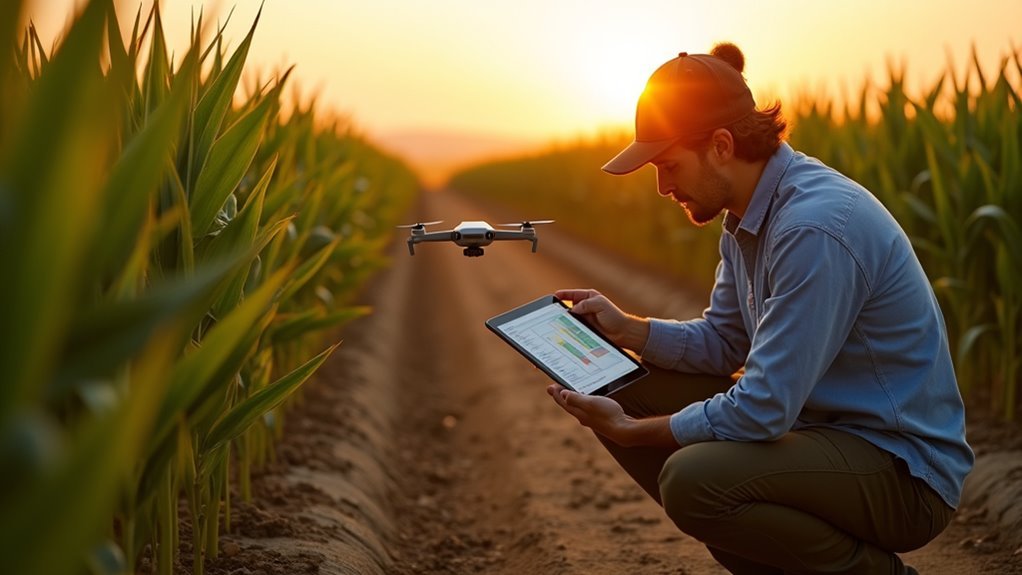

Artificial intelligence is quietly changing how corn is grown, turning fields into data-rich systems where decisions about water, fertilizer, and seed are guided by continuous streams of data rather than gut feel alone. For growers facing rising input costs, tightening water supplies, and increasingly volatile weather, these tools are shifting from experimental pilots to practical instruments for protecting yield and profitability while shrinking environmental impact. By combining drones, in-field sensors, and variable-rate systems, AI brings precision agriculture principles directly into everyday corn management, helping farmers match water and fertilizer to the needs of each part of a field. Furthermore, the ongoing global semiconductor shortage exacerbates the challenge of scaling these AI technologies, making access to necessary hardware more critical than ever.
Why AI for corn farmers matters now
Modern corn production has always been a balancing act. Farmers push for higher yields with fertilizer and irrigation, then try to avoid the economic and environmental costs of using too much. Historically, most decisions followed rules of thumb. Nitrogen was often applied at uniform rates across whole fields, and irrigation schedules were set by calendar or simple soil checks.
Corn farming has long balanced yield ambitions against the hidden costs of overusing inputs
That approach made sense when data were scarce and tools were simple, but it left a lot of money and efficiency on the table. Studies of conventional irrigation, for example, show that typical practices can require around 6000 cubic meters of water per hectare in a season, with AI-assisted scheduling cutting that by about 15 percent while keeping yields stable.
Reviews of smart irrigation systems find that sensor and AI-guided scheduling commonly reduces water application by roughly 15 percent to 40 percent compared with traditional methods, especially when farms shift away from flood or furrow irrigation. Meta-analyses that pool many trials report even larger savings, with AI-driven irrigation systems achieving around 30 percent to 50 percent reductions in water use and 20 percent to 30 percent gains in crop productivity relative to conventional approaches.
Corn growers are also under pressure from regulators and consumers to cut nitrogen losses to air and water. That is where AI-based nitrogen management and predictive analytics are becoming especially relevant.
From blanket nitrogen rates to responsive management
Nitrogen has long been managed as a blunt instrument. Many farms set a target rate per acre and apply it uniformly, regardless of how soils differ or how plants are actually responding. Recent work in AI-powered nitrogen management shows how much room there is to improve on that tradition.
One doctoral study on AI-powered nitrogen use efficiency used soil electrical conductivity to delineate management zones and then established nitrogen-rich strips within each zone as living biosensors. Drones and satellites collected imagery throughout the season, and machine learning models quantified how different parts of the field responded to applied nitrogen. By combining those aerial data with historical records, the researchers built a dynamic nitrogen prescription that adjusted rates by zone rather than relying on a single blanket recommendation.
The results are instructive. In wheat, the AI-based strategy increased yield by roughly 12 percent while cutting nitrogen application by about 16 percent compared with conventional practice. In corn, the same methodology delivered a potential yield increase of around 5 percent alongside a reduction of about 10 percent in nitrogen application. That combination of slightly higher yield with meaningfully lower nitrogen use is exactly the kind of efficiency gain that matters when fertilizer prices are high and environmental scrutiny is intense.
Other efforts push the idea further by putting AI models directly on robotic platforms. The AIR N system, for example, integrates cloud-based artificial intelligence with an autonomous field robot that traverses corn fields, gathers sensor data in real time, and adjusts nitrogen application on the move. Instead of treating the field as a uniform canvas, the robot applies fertilizer only where models and sensors indicate a measurable response, inch by inch.
Complementary projects focus on diagnosing plant status directly. One proof of concept system uses deep learning on images of corn leaves to detect nitrogen deficiency and then recommends targeted fertilizer application based on actual plant needs. Another system tracks the crop’s dynamic nitrogen uptake across growth stages and uses weather forecasts to recommend both timing and dosage of fertilization during critical periods such as stem elongation.
These tools turn nitrogen management into a continuous feedback loop rather than a series of one-time decisions. Taken together, the evidence suggests that AI-supported nitrogen strategies can trim application rates by around 10 percent in corn while holding or slightly increasing yields, at least under the conditions studied so far. The exact numbers will vary by region and system, but the direction of change is consistent: less nitrogen per bushel harvested and better alignment between applied fertilizer and crop demand.
Smart irrigation that actually learns
Water management is another area where AI has moved from concept to practice. The basic idea is simple. Sensors measure soil moisture and sometimes plant status, weather services provide local forecasts, and machine learning algorithms decide when and how much to irrigate. In practice, there are several generations of technology emerging.
Controlled studies of AI-based smart irrigation show that relatively simple machine learning models, fed with data on soil moisture, precipitation, and temperature, can recommend seasonal water volumes that are about 15 percent lower than conventional irrigation while maintaining stable yields. Comprehensive reviews of smart irrigation systems across open field crops, orchards, and greenhouse operations find that sensor or AI-guided irrigation typically reduces water application by roughly 15 percent to 40 percent, with larger savings in systems that previously relied on flood or furrow methods.
When farms also transition to pressurized systems such as drip or micro sprinkler, total water savings can reach roughly 25 percent to 60 percent, depending on crop and climate. Meta-analytical work that aggregates many smart irrigation trials underlines those findings. Across diverse crops and regions, AI-driven irrigation systems consistently outperform traditional scheduling by delivering about 30 percent to 50 percent savings in water use while raising crop productivity by roughly 20 percent to 30 percent.
More experimental setups report dramatic headline numbers. One study of AI-supported autonomous irrigation documented water consumption reductions of more than 75 percent in an initial planting and nearly complete elimination of irrigation water in a second planting phase, with an overall average reduction approaching 88 percent compared with manual methods. Those results come from highly controlled conditions, but they demonstrate what is technically possible when irrigation is fully automated and tightly optimized.
For corn producers, the practical takeaway is that smart irrigation can move them away from overwatering, which wastes energy and leaches nutrients, toward a regime where each irrigation event is justified by data. That is not just about saving water. By keeping soil moisture in the optimal range, these systems help stabilize yields and improve nutrient use efficiency, since plants are less likely to suffer stress that limits uptake.
Predicting yields before harvest
The third pillar of AI for corn farmers is prediction. Accurate yield forecasts were once mainly a concern for national agencies and commodity analysts. Today, field-scale yield prediction is increasingly a management tool. If a farmer can forecast yield for each part of a field with reasonable confidence, they can adjust fertilizer, seed populations, and irrigation to match realistic potential.
Several waves of research show how rapidly yield prediction has improved. Work on county-level corn and soybean yield prediction has used multispectral satellite data, particularly infrared and temperature bands collected during the growing season, to feed neural networks that distinguish between crop types and estimate yields before harvest.
Early studies using moderate resolution satellite imagery found that images taken between May and October, combined with vegetation indices such as the normalized difference vegetation index, were among the most informative for predicting corn yield. More recent efforts move from county averages down to field scale and plot scale predictions. One study used Sentinel 2 satellite imagery and environmental data to predict corn yields at the field level, testing different ways of organizing the time series data.
Resampling the annual time series based on thermal time instead of calendar days, and using biophysical parameter estimates, increased the coefficient of determination by roughly 0.25 to 0.42 when predicting yields in years outside the training sample. Another project leveraged reconstructed daily, cloud-free Sentinel 2 imagery, showing that higher temporal resolution improves accuracy because more frequent images capture rapid changes in crop growth that coarser datasets miss.
At finer scales, researchers have applied compositional autoencoders to high-resolution plot-level satellite imagery, explicitly separating genotype and environment features. Those models improved early-stage yield prediction accuracy by up to about 10 percent compared with traditional autoencoders and outperformed vegetation index-based approaches by roughly 9 percent across growth stages.
There is also work on national scale yield and price predictions using satellite-derived products such as gross primary production, combined with machine and deep learning methods, to forecast corn yield and price variation across regions in advance of harvest. Public and private initiatives are now blending satellite, drone, and ground sensor data into spatial spectral temporal neural networks that give farmers increasingly reliable forecasts under variable weather and soil conditions.
The practical implication is that yield prediction is no longer a black box locked inside government crop reports. It is becoming an operational tool for individual farms. If a model indicates that parts of a field are unlikely to respond to additional nitrogen or denser planting, farmers can avoid overinvesting there and redirect resources to zones with higher potential. That is where the connection between prediction and input efficiency becomes real.
Opportunities and risks for farmers and the food system
From a technology and business perspective, the convergence of AI, robotics, remote sensing, and agronomy is reshaping the input markets around corn. Fertilizer and irrigation providers are increasingly offering data layers and decision support services, not just products. Equipment manufacturers are embedding AI capacities in machinery, from autonomous nitrogen robots to sensor-rich pivot systems.
Data platforms are emerging that aggregate imagery and field records to train models that many farms can use, rather than every farm having to build its own. For society, the upside is clear. More precise nitrogen management reduces the risk of nitrate contamination in groundwater and lowers nitrous oxide emissions, an important greenhouse gas. Smarter irrigation can ease pressure on aquifers and rivers, which is crucial in regions already facing water scarcity. Better yield prediction can smooth supply planning and help avoid surprises in food and feed markets.
There are risks and uncertainties as well. Many of the most impressive results come from controlled experiments or early adopter farms with good connectivity and strong technical support. Performance in smallholder settings or in regions with limited data infrastructure may be more modest. Yield prediction models trained in one climate and soil context can perform poorly when transferred elsewhere, especially under extreme weather that differs from historical patterns.
AI-based systems also introduce new dependencies on data providers and software vendors, raising questions about data ownership, long-term costs, and resilience if services change or fail. From a trustworthiness standpoint, the most credible deployments are those that combine AI outputs with agronomic expertise rather than replacing human judgment. Farmers need transparent models, clear documentation of how recommendations are generated, and conservative default settings that avoid pushing inputs to risky extremes.
Robust validation across multiple years and environments, plus ongoing monitoring, is essential to ensure that efficiency gains are real and not just artifacts of short-term trials.
Takeaways and what to watch next
For corn growers, the signal in all this noise is straightforward. AI is becoming a practical tool to produce more with fewer inputs, by aligning nitrogen and water more closely with the crop’s actual needs and by using better yield prediction to guide where and when to invest. The technologies are not magic and they do not remove uncertainty from farming, but they do move decisions from intuition alone toward measurable evidence.
The next few years will likely determine how widely and equitably these tools spread. Key questions include whether small and medium-sized farms gain access to usable versions of these systems, how data and models are governed, and whether environmental gains are translated into policies and markets that reward farmers for efficiency rather than just volume.
What is clear already is that AI for farmers is moving from pilot plots to the mainstream, and the choices made now will shape how resilient and sustainable corn production can be for decades to come.
Conclusion
Corn farmers are starting to get something they have never really had before: a continuously learning system that watches every part of the field and quietly suggests how to grow more grain while using less fertilizer and less water. This matters now because the pressure to produce more food under tighter climate and environmental constraints is no longer abstract; it is showing up as volatile yields, higher input costs and stricter regulations across the global corn belt.
Why AI In Corn Fields Is A Timely Shift
Corn sits at the heart of modern agriculture, feeding livestock, fueling bioethanol and anchoring many rural economies. As climate patterns grow less predictable and fertilizer and water prices swing, the traditional playbook of fixed seeding rates, blanket nitrogen programs and rigid irrigation schedules is reaching its limits.
Over the past two decades, research has shown that smarter data use can narrow this gap. Early work with neural networks for corn and soybean yield prediction demonstrated that machine learning could capture complex interactions between weather, soil and management better than classical statistical models. Recent studies that couple crop models such as APSIM with modern machine learning have further improved prediction accuracy, cutting error measures by roughly 7 to 20 percent in the United States corn belt.
This new generation of systems moves beyond prediction and into real time decision support. The practical question is no longer simply “what will my yield be” but “exactly how should I plant, fertilize and irrigate every part of this field today.”
How We Got Here: From Experimental Models To Field Scale Tools
The first wave of agricultural AI focused on yield prediction. Neural network models trained on historical corn and soybean data could detect non linear relationships between temperature, rainfall, soil texture and management. As computing and satellite imagery improved, researchers began to combine physical crop models with machine learning, feeding simulated soil water status and drought stress indicators into AI algorithms to sharpen yield forecasts.
At the same time, sensor costs fell and drones moved from research plots into commercial services. Integrated systems that linked drones, soil sensors, Internet connected devices and geographic information platforms opened the door to truly granular field maps. They could show, for example, where soil organic matter dips, where plants are under stress mid season and where past fertilizer applications have left residual nutrients.
AI systems now sit on top of these data streams. Instead of treating the field as one uniform unit, they divide it into many micro zones and learn how different combinations of seeding rate, nitrogen rate and irrigation timing interact with local soil and weather conditions. In effect, they encode and extend the kind of mental map that experienced growers build over years of walking their fields, but with more precise numbers and continuous updates.
What The New Corn Systems Actually Do
The newest AI guided tools for corn focus on a set of very practical decisions.
* Planting rate and pattern
Modern tools analyze historical yields, soil maps and satellite or drone imagery to recommend variable planting rates across the field. Trials with intelligent seeding have reported measurable gains in corn yield, including a documented 6.2 percent increase compared with uniform seeding when machine learning guided spacing and density. In commercial services, agronomists describe using AI to help farmers choose the right planting rate for different parts of the field, aiming for lower costs and more consistent results.
* Fertilizer placement and timing
Precision nutrient systems use AI to predict the nutrient status of each zone, taking into account soil tests, crop stage and forecast weather. A synthesis of field studies shows that AI driven precision nutrient management can lift yields by up to 17 percent while cutting fertilizer use by about 23 percent, compared with traditional uniform application. Other work reports roughly 20 percent reductions in total fertilizer use without sacrificing yields when AI guides how and where nutrients are applied.
* Irrigation scheduling and water use
Intelligent irrigation platforms combine soil moisture sensors, weather data and crop growth models, then use AI to decide when and how much water to apply. Quantitative analyses show that these systems can reduce water use by around 15 percent compared with conventional scheduling, with no yield penalty. The most advanced setups in high value crops demonstrate possible water savings of up to 50 percent, though those numbers represent best case scenarios in well instrumented settings. Climate smart irrigation and fertilization programs driven by AI have recorded combined savings of roughly 22 percent in water use, 28 percent in fertilizer and 35 percent in nitrogen leakage.
* Integrated control systems
Commercial platforms such as ZeRo.agri illustrate how these capabilities come together. This AI based system automatically manages irrigation and fertilization to keep soil moisture within optimal ranges while trimming input use. Reported benefits include reduced stress on crops, more stable yields and lower water and fertilizer consumption, along with reduced nitrate pollution and lower greenhouse gas emissions from soils.
Evidence So Far: More Corn With Less Input
The central claim behind these tools is attractive: grow more corn, or at least the same amount, with less fertilizer and less water. The emerging data, while not uniform, increasingly supports that direction.
Field evaluations of AI cropping systems in corn have found that recommended programs can apply between 19 and 223 percent less nitrogen fertilizer than typical local practice, while maintaining similar profits. In some trials the potential for clear yield increases is less certain, underscoring that input savings are often more reliable than big yield jumps in the short term.
When multiple technologies are combined the signal is stronger. Studies that integrate AI, drones, Internet connected sensors and geographic information systems report concurrent gains in productivity and resource efficiency. Precision nutrient management has delivered yield increases up to 17 percent along with a 23 percent cut in fertilizer use. Intelligent irrigation designs have achieved water consumption savings of 15 to 50 percent in different settings while preserving or improving yields.
Drone and AI analytics specifically in corn have shown large improvements in nitrogen efficiency. One study from the University of Nebraska Lincoln found that targeted nitrogen applications guided by drones and AI reduced nitrogen use by about half and still increased corn yields by roughly 10 to 12 percent. Work from the University of Illinois reported yield gains in corn on the order of 10 to 20 percent with AI supported drone imagery guiding interventions.
A broader review of AI in agriculture concludes that across crops, AI supported management can boost productivity between about 20 and 150 percent depending on the baseline and context, while enabling water conservation and better climate resilience. Importantly, these are ranges drawn from many studies, not guarantees for any given farm.
Business And Rural Impacts
For growers and agribusinesses, the appeal of AI guided systems often starts with the balance sheet. Fertilizer, water, pesticides and energy are major variable costs, and even modest percentage reductions can matter more than headline yield gains. Analyses of AI applications to cut input waste highlight four major streams: fertilizer loss through over application, water oversupply when plants are not under stress, pesticide spraying outside actual pest pressure and energy waste from inefficient pumping and drying.
In many operations, achieving just 3 to 8 percent savings in each of these categories can support higher profit and more resilient cash flow, especially when commodity prices are volatile. Corn focused AI tools that refine planting rates, adjust nitrogen by zone and optimize irrigation schedules are essentially targeting these same waste streams in a practical way.
For rural communities the picture is nuanced. On one hand, better margins and more stable yields can support local jobs and keep farms solvent through tough seasons. On the other, the capital requirement for sensors, connectivity and analytics can deepen divides between larger operations and smaller farms that struggle to invest in advanced infrastructure.
Service models are beginning to bridge that gap, with cooperatives, agronomy firms and equipment dealers offering AI backed advisory services rather than requiring every farm to build its own system. The long term effect on rural autonomy will depend on how data ownership and decision control are handled: whether farmers remain in charge of both their data and the final choices, or gradually cede critical decisions to external platforms.
Risks, Limitations And Open Questions
Despite promising numbers, these systems are not magic solutions. Several limitations and risks stand out.
* Data quality and representativeness
AI systems learn from historical data. If that data covers only certain soil types, climate regimes or management styles, recommendations may be less reliable elsewhere. Unusual weather events or new disease pressures can push conditions outside the range the models have seen, leading to poorer guidance.
* Overconfidence in model outputs
Controlled trials show attractive input reductions and yield gains, but one Wisconsin evaluation of a corn AI tool noted that the potential for consistent yield increases was not yet clear, even when profitability was acceptable. Treating model outputs as definitive instructions rather than well informed suggestions can create new risks, especially where local experience would recommend caution.
* Environmental and regulatory dynamics
Precision fertilization that cuts nitrogen and reduces runoff is clearly positive for water quality and climate goals. Yet there is a risk that efficiency gains could encourage some operations to intensify production further on sensitive land, which might offset environmental benefits if not governed carefully. Regulatory frameworks around nutrient management, data privacy and digital advisory services are still evolving.
* Equity and access
High quality implementation requires connectivity, hardware and trusted advisory support. Regions with weak rural broadband or limited capital may benefit less from AI advances, potentially widening existing gaps in agricultural productivity and income.
These factors point to a simple reality: AI systems in corn fields perform best as disciplined tools inside a broader agronomic strategy, not as replacements for farmer judgment. The strongest results so far come from setups that combine AI recommendations with manual overrides and regular human review.
Forward Looking Takeaways
A few practical conclusions emerge from the current evidence and experience.
* AI for corn is moving from prediction to prescription
The trajectory from early neural network yield forecasts to modern systems that actively recommend planting, fertilization and irrigation strategies is clear. This shift turns AI into an operational tool, not just a forecasting aid.
* Input efficiency is a more reliable win than dramatic yield jumps
Across studies, fertilizer and water savings in the range of 15 to 30 percent with stable yields appear more consistent than very large yield increases on every farm. Growers and businesses should evaluate systems primarily on cost savings, risk reduction and environmental compliance, then treat extra yield as a bonus.
* Human expertise remains central
The most promising deployments treat AI as an amplifier for agronomic experience, not a substitute. Systems such as ZeRo.agri demonstrate impressive control over soil moisture and nutrient delivery, yet they are most effective when farmers understand how and why recommendations are generated. Efforts in explainable AI for agriculture aim to keep this human understanding front and center.
* Policy and market design will shape who benefits
Incentives for reduced nutrient runoff, water conservation and carbon friendly practices can align AI recommended management with public goals. At the same time, support for digital infrastructure, open standards and farmer controlled data will influence whether small and medium farms can access and trust these tools.
Looking ahead, the question is less whether AI will be present in corn production and more how deeply it will be woven into daily decisions and long term planning. If the current pattern holds, farmers will gain increasingly precise visibility into their fields, from plant stress to micro level nutrient needs, and will use that visibility to trim waste without sacrificing yields. The systems described today are first iterations, and their real test will come as they pass through more seasons, more geographies and more hands on adjustments by experienced growers.
Future updates on these systems will reveal whether they truly deliver resilient agriculture at scale. reddit