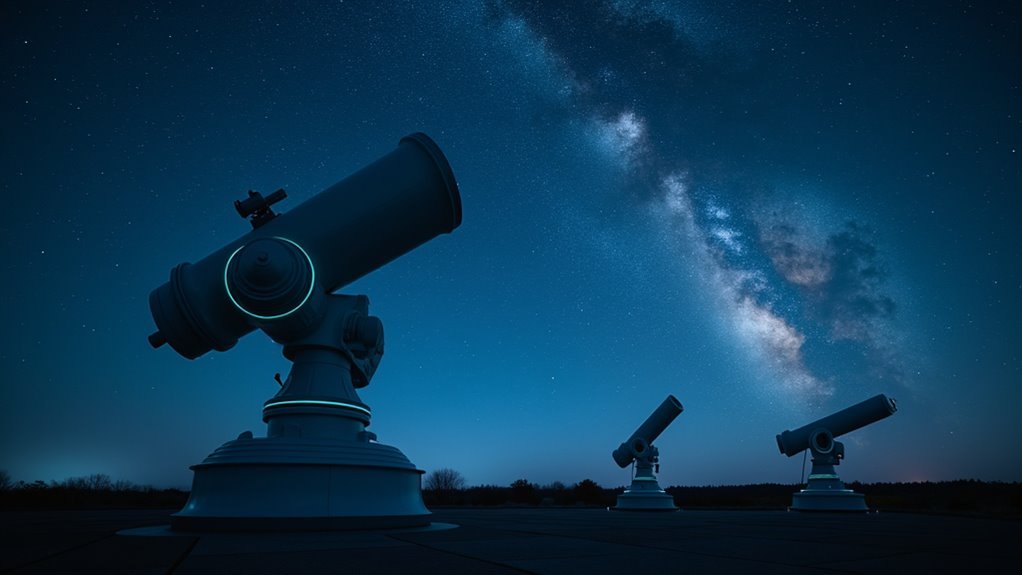

On a mountain in northern Chile, an old idea about astronomy quietly expired. For decades, large telescopes were instruments that astronomers drove by hand, one exposure at a time. Now an artificial intelligence system is deciding on its own where to look, when to move, and how to react to changing skies. That shift from human operator to autonomous planner is not just a convenience for tired observers. It is a preview of how AI will take control of scientific infrastructure across many fields, from climate monitoring to drug discovery.
At the Cerro Tololo Inter American Observatory, the Dark Energy Camera on the Blanco four meter telescope has begun running under an AI scheduler that plans the night, revises the plan as conditions change, and keeps the instrument as productive as possible. This is being billed as the first truly AI directed telescope rather than a simple robotic system, and that distinction matters. Robotic telescopes can execute a script. They can follow a queue. They can respond when a human tells them to repoint. Autonomous AI observatories decide for themselves what to do next within broad scientific constraints.
From robotic telescopes to AI observatories
To understand why this matters, it helps to recall how telescope operations evolved. In the era of film and small detectors, each night was allocated to a principal investigator. Observers travelled to the site, drew up paper plans, and adjusted them by gut instinct as clouds and wind rolled in. Later, queue scheduling allowed observatories to mix programs and adjust on the fly, often guided by sophisticated but static software that tried to match seeing conditions, instrument setups, and priority scores.
Robotic telescopes emerged as internet connectivity and off the shelf control systems made it feasible to operate smaller instruments without staff on site. These systems removed the need for an observer at the controls, but they did not fundamentally change who made the decisions about what to observe. A human still produced a schedule. A human still decided on target lists and exposure strategies.
The new AI scheduler at Cerro Tololo effectively moves the line that separates human decision making from machine decision making. Scientists still set scientific priorities and constraints, but the AI now makes thousands of micro decisions throughout the night. It chooses targets, orders them, adjusts exposure times, and decides when to pivot to backup programs. It learns from past nights about which choices lead to better data under particular conditions. Human expertise is shifted up a level, closer to strategy and farther from tactical control.
In historical context, this is similar to the transition in finance when algorithmic trading took over intraday decisions. Portfolio managers continued to define objectives and risk appetite, but algorithms handled the details of execution. In astronomy, AI is about to do for photons what automated trading did for stocks.
How the scheduler actually thinks
Behind the scenes, systems like the Blanco scheduler treat telescope operations as a sequential decision problem under uncertainty. Every exposure is a choice. Point here or there. Choose longer or shorter integration. Stay with the current field or move to a followup target. Each choice has consequences for the rest of the night.
Researchers formalize this as a Markov decision process. At any moment the system has a state that includes seeing quality, weather, instrument health, sky brightness, current position, and queue of potential targets. The AI chooses an action that transitions the telescope to a new state. A reward function encodes scientific value, such as completing a set of exposures on a supernova field or reaching the desired depth for a wide survey tile.
To learn a good strategy, teams train reinforcement learning agents on historical survey data and realistic simulations. Methods such as Proximal Policy Optimization, deep Q learning, and evolutionary strategies are well suited to this setting because they can cope with noisy rewards and complex constraints. Plain English version: the system plays many simulated nights, tries different scheduling tactics, and gradually discovers patterns that produce more usable science per hour of dark time.
What is new compared to earlier rule based schedulers is the ability to adapt gracefully when conditions deviate from expectations. If cloud layers move in, the AI does not simply mark a block as lost. It recomputes the plan, downgrades precision demanding programs, and fills gaps with less sensitive observations. If the seeing improves, it may bring forward high priority fields. In practice, this almost becomes an operating system for the night sky, where the algorithm is constantly balancing real time telemetry against the long term goals of multiple teams.
The technical implications are subtle but powerful. Better scheduling means less idle time, fewer half finished programs, and more consistent data quality. That in turn improves downstream machine learning pipelines that rely on homogeneous training sets. AI at the top of the stack makes AI in the data center more effective.
Agents that link many telescopes
The Blanco experiment is not happening in isolation. The StarWhisper Telescope framework pushes the same idea across networks of telescopes run by both professionals and amateurs. Instead of a single scheduler tied to one instrument, StarWhisper uses multiple AI agents, including large language models with function calling, to orchestrate end to end observations for time sensitive surveys such as the Nearby Galaxy Supernovae Survey. In recent deployments, the StarWhisper Telescope has already automated the full observation cycle from planning and telescope control to real-time data processing and transient alerts.
In practice this means that an AI system can generate site specific target lists for different locations, dispatch imaging sequences, analyze incoming images in real time, and automatically submit proposals or alerts when a transient event is detected. Some agents handle natural language interaction with astronomers. Others manage telescope control APIs. Others run image reduction and classification. The framework acts as a conductor for a distributed orchestra of hardware and software.
This agentic model matters because astronomy is inherently distributed. No single facility can watch the whole sky with the cadence and coverage modern surveys require. Lightweight telescopes, including those owned by universities or serious amateurs, can contribute valuable data if they can be plugged into a coherent AI managed workflow. StarWhisper demonstrates how such coordination is possible without human schedulers sitting in the middle of every decision.
There is also a clear line from StarWhisper to broader AI trends in software engineering. Large language models with function calling capabilities already act as operators that can read documentation, compose API calls, and respond to events across complex systems. Here, those capabilities are being pointed at the sky. The same techniques that route customer support requests or manage cloud resources are now routing telescope time.
Who gains, who risks losing control
The obvious beneficiaries are large survey projects and the institutions that host them. Instruments such as the Dark Energy Camera and upcoming facilities like the Vera Rubin Observatory produce enormous volumes of data and operate on tight schedules that demand efficient use of every hour of dark time. AI schedulers can squeeze more science out of fixed infrastructure, which is attractive in an era of constrained public funding. Additionally, the AI safety measures are critical as these systems become integral to scientific operations.
Smaller observatories stand to gain as well. By adopting frameworks similar to StarWhisper, universities and consortia can pool telescopes into virtual networks that behave like a single agile facility. This can increase the value of mid range instruments that might otherwise struggle to compete with flagship projects.
On the other side of the ledger, traditional roles in observatory operations are being redefined. Night assistants and staff astronomers still play critical roles in safety, calibration, and troubleshooting, but their direct control over what the telescope does in minute by minute terms is being reduced. Some will welcome the change as it frees them to focus on higher level problems. Others may feel a loss of craft and autonomy.
There is also a governance question. When an AI system handles scheduling for multiple programs, its reward function effectively encodes institutional priorities. Choices about how to weigh different science goals, which teams receive more responsive followup, and how to treat risky experimental projects are now partially delegated to machine learning agents. If those choices are not transparent, teams may feel that a black box is quietly reshaping the scientific agenda.
The issue is familiar from other sectors. Recommendation systems decide which news articles or videos people see. Ad targeting algorithms decide which campaigns are rewarded. As AI enters the control room of science, similar concerns about bias, equity, and long term incentives will follow.
Signals for the wider AI economy
What is happening on Cerro Tololo and inside frameworks like StarWhisper says as much about AI strategy as it does about astronomy. In recent years, major AI labs have focused on foundation models and chat interfaces. OpenAI, Google, Anthropic, Meta, Microsoft, Amazon, NVIDIA, and new entrants like xAI have raced to release ever larger language and multimodal models. The conversation has been dominated by benchmarks, context windows, and reasoning capabilities.
The telescope story reflects a different but equally important trend. AI is quietly moving from screen based experiences into the management of physical systems. Scheduling an observatory is not conceptually far from scheduling a fleet of delivery vehicles, a network of industrial robots, or a grid of power assets. Once the algorithms are proven in one domain, they are highly portable.
For businesses, this points toward a future in which AI led resource planners become standard. Manufacturing plants, data centers, logistics hubs, and even office buildings will likely be run by agents that continuously optimize actions against evolving constraints. Models that today route API calls for a survey pipeline could tomorrow route jobs in a warehouse.
There are clear economic consequences. Organizations that own expensive infrastructure will be under pressure to adopt AI schedulers simply to remain competitive. Investors will scrutinize how efficiently capital intensive assets are used, and scheduling algorithms will become part of that performance story. Vendors that can supply robust, auditable AI operations platforms will find a receptive market.
At the same time, regulators will pay attention. In astronomy, bad decisions mostly waste time and money, although safety risks exist when large moving structures are involved. In energy, transportation, or healthcare, similar AI decision makers could have life and death consequences. The path from telescope scheduling to critical infrastructure scheduling will raise questions about certification, oversight, and liability.
What happens next
Right now, the AI telescope narrative is still emerging. The Blanco scheduler has completed initial observing runs and shown that an AI system can plan and adapt a night of observations without constant human intervention. StarWhisper has demonstrated that AI agents can coordinate multiple telescopes and automate the entire observational workflow from target selection to data analysis. Other projects at facilities such as the Canada France Hawaii Telescope and Rubin Observatory are exploring related applications of AI for condition monitoring and dynamic scheduling.
The next several years will likely bring a few clear developments.
First, AI schedulers will become standard for large survey instruments. Once early adopters demonstrate tangible gains in data quality and throughput, peer facilities will find it hard to justify staying with manual or static scheduling.
Second, the agent based approach seen in StarWhisper will spread beyond astronomy. Remote sensing satellites, climate sensor networks, autonomous marine vehicles, and industrial IoT deployments all face similar challenges of distributed, uncertain, resource constrained planning. AI agents that can coordinate diverse hardware without constant human orchestration will be very attractive.
Third, the relationship between scientists and their instruments will change. Instead of thinking in terms of nights at the telescope, researchers will think in terms of campaigns described to an AI operator. They will specify constraints, priorities, and desired outcomes, while the AI translates those into thousands of low level actions. That shift will require new skills for scientists and new transparency tools for AI systems.
Finally, the telescope case will inform broader debates about AI governance. It offers a contained environment where autonomous decision making can be tested with clear metrics and limited risk. Lessons learned about reward design, interpretability, failure modes, and human oversight will be valuable as similar systems are deployed in more sensitive arenas.
The main point is simple. If AI can learn to run telescopes in harsh environments, juggling weather, hardware quirks, and conflicting human demands, it can learn to run many other complex systems. What is being pioneered on a Chilean mountaintop is not just a smarter way to take pictures of distant galaxies. It is an early example of AI taking the wheel of real world infrastructure, one exposure at a time.
Conclusion
As this self directed telescope settles into its routine, it quietly signals that autonomy in astronomy has moved from lab demos to operational reality. Time allocation on major facilities has always been dictated by committees and human schedulers; handing those choices to an algorithm means the act of discovery is starting to be shaped by machine judgement as much as human intent. The system now absorbs changing weather, instrument performance and scientific priorities, then selects targets that maximize scientific yield, turning the night sky into a dynamic optimization problem instead of a static script. For industry and research alike, this style of machine led observation hints at a near future where AI does not simply accelerate data analysis but decides which data exists in the first place, a shift that will force astronomers, funding agencies and technology builders to think much harder about transparency, oversight and who ultimately defines what is worth looking at.