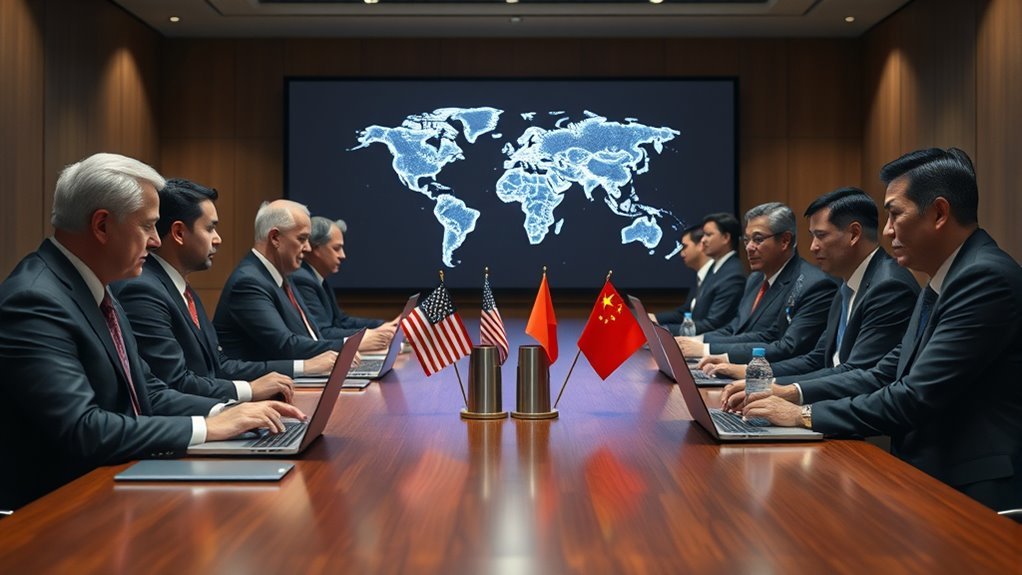

How did a discreet technical dialogue on artificial intelligence between the United States and China become a high‑stakes security channel at the heart of their strategic rivalry? The answer lies in a series of meetings in Geneva that gradually evolved from exploratory talks into a forum for managing threats from advanced AI systems.
On May 14, 2024, the two governments convened the first intergovernmental AI dialogue in Geneva to implement understandings reached at the Biden–Xi summit in San Francisco six months earlier. That opening session set a pattern of closed‑door, technically focused conversations on AI risks, governance approaches, and the security implications of increasingly capable models.
In Geneva, U.S. officials from the White House, State Department, and Commerce Department engaged counterparts from China’s Foreign Ministry and the National Development and Reform Commission, signaling that both sides viewed AI as a whole‑of‑government concern rather than a narrow technical issue. The dialogue was described as candid and professional, even as broader relations were marked by strategic mistrust and competition. This dialogue aligns with the global standards essential for safe governance of general-purpose and frontier AI systems.
American delegates were led by National Security Council official Tarun Chhabra and State Department acting envoy for critical and emerging technology Seth Center, underscoring Washington’s decision to frame AI as a national security and foreign‑policy challenge.
Subsequent sessions in 2024 continued in relative secrecy, deepening a habit of using Geneva as a venue for exchanges on frontier AI risks, cyber threats, and potential military applications. Rather than negotiating formal deliverables, both governments used the channel to clarify how they assessed advanced systems, to share domestic approaches to AI governance, and to probe each other’s thinking about safety requirements for powerful models.
U.S. officials stressed throughout that export controls, sanctions, and broader technology‑protection measures were not on the table, drawing a clear boundary between dialogue on risk and negotiation over competitive advantage.
By 2026, the AI channel had become prominent, and Trump–Xi talks in Beijing included agreement to launch a formal intergovernmental dialogue under the new U.S. administration, with a fresh round of security‑focused meetings. The first official AI security talks of the Trump presidency are scheduled for September 2026, framed as high‑stakes discussions that will precede Xi Jinping’s planned visit to the United States on September 24.
Treasury Secretary Scott Bessent is expected to lead the U.S. delegation, a choice that reflects the administration’s view of AI as central to economic power and national security.
The September agenda is to focus on defining frontier AI systems, examining cyber and military uses, and exploring how both sides can reduce the risk that powerful models are misused by criminals, terrorists, or other non‑state actors. U.S. officials have also raised concerns about China’s potential misuse of AI, including scenarios where advanced systems exacerbate disinformation or enable intrusive surveillance. Washington’s priority is to prevent capable systems from proliferating beyond state control, while Beijing has indicated a preference for in‑depth technical exchanges about how such systems function and fail, rather than broad political debates over ideology.