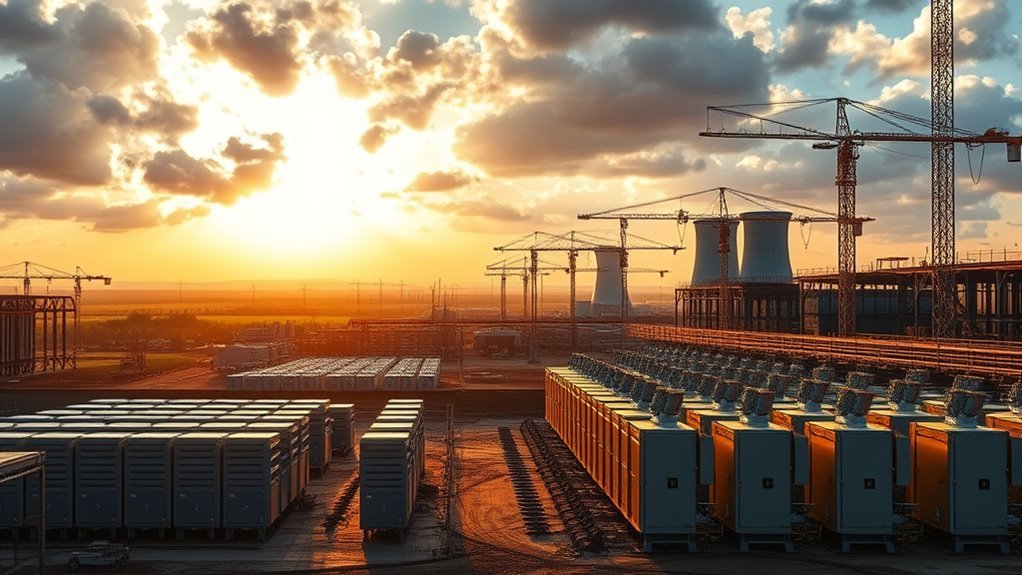

Nvidia’s reported plan to guarantee as much as 250 billion dollars of financing for OpenAI’s proposed Ohio campus signals a new phase in how the world will fund and build artificial intelligence infrastructure at planetary scale. The campus itself is planned to ultimately draw on 10-gigawatt capacity, underscoring the unprecedented scale of compute and power concentration under discussion. If even a substantial fraction of this project moves forward as described, it would reshape the economics of cloud computing, power markets, and national industrial strategy around frontier AI. Additionally, this initiative positions Ohio as a potential AI infrastructure hub, reflecting a broader trend in leveraging corporate partnerships for national technological advancement.
Nvidia’s $250B backstop turns OpenAI’s Ohio campus into a testbed for planetary-scale compute, power markets, and industrial strategy
What is actually being proposed in southern Ohio
OpenAI is in negotiations to lease a massive data center complex in southern Ohio with an eventual power capacity of around ten gigawatts, built on a mix of United States Department of Energy land and nearby private property. The site centers on the former Portsmouth Gaseous Diffusion Plant in Pike County, a decommissioned uranium enrichment facility that the Department of Energy is redeveloping as a technology campus.
SoftBank’s energy focused subsidiary SB Energy is slated to develop the campus and associated power infrastructure. The plan envisions the site as a multi phase build, with an initial stage of roughly eight hundred megawatts of capacity targeted for around 2028 and additional phases ramping toward the full ten gigawatt target over multiple years.
Cost estimates underscore how extreme this build would be. Reports based on briefings to investors and officials suggest total spending well above five hundred billion dollars once computing hardware, construction, labor, power generation, transmission, and supporting facilities are included. Some analyses separate the real estate and power piece from the chips themselves, with the campus and energy infrastructure alone potentially exceeding five hundred billion dollars and a further several hundred billion dollars required to buy accelerators and servers over the life of the project. These numbers are not final commitments but early projections of what it would take to sustain frontier scale AI training and inference at this single site.
The role Nvidia is being asked to play
Nvidia is reported to be in advanced discussions to provide a financial backstop of roughly 250 billion dollars that would guarantee portions of the lease and debt tied to the Ohio campus. Instead of writing a single check, Nvidia would effectively stand behind SB Energy and OpenAI, helping lenders and investors feel comfortable financing a build that is many times larger than conventional data center projects.
In parallel, separate conversations are said to cover financing for the AI chips that would populate the site, which could reach hundreds of billions of dollars over time if OpenAI pushes toward the upper end of projected compute demand. Taken together, these structures would deeply intertwine Nvidia’s balance sheet with OpenAI’s long term infrastructure plan, moving beyond traditional vendor credit lines into something closer to integrated capital planning for a national scale utility of compute.
Crucially, all of this remains subject to negotiation. Multiple reports stress that there is no signed agreement yet and that terms could change or the deal could collapse. For a project this large, it is normal for financing packages and counterparties to evolve over months or years.
How this fits into the history of AI infrastructure
A decade ago, hyperscale cloud buildouts by companies such as Amazon, Microsoft, and Google defined the cutting edge of computing infrastructure, with capital spending in the tens of billions of dollars per year and data centers sized at tens or low hundreds of megawatts. As deep learning workloads grew and accelerator based training became central, spending shifted toward high density clusters designed around GPUs and custom chips, but the basic pattern remained many data centers distributed across regions, each within familiar size and cost ranges.
The Ohio proposal effectively jumps a few generations ahead on both size and concentration. Ten gigawatts of capacity at a single campus would be more than half the current operating capacity of all United States data centers combined according to project documents for the PORTS Technology Campus. A first phase of eight hundred megawatts would itself be one of the largest individual AI infrastructure deployments ever attempted.
This is not happening in isolation. OpenAI, Oracle, and SoftBank have previously outlined a broader Stargate style plan to build multiple AI data centers with combined budgets in the hundreds of billions of dollars, and the Ohio site appears to be a cornerstone of that effort. Other major AI developers including Anthropic, Microsoft, and Google have reportedly evaluated the same region for high capacity power and dedicated compute campuses, reflecting a wider shift away from renting slices of generic cloud toward controlling entire physical estates tuned for frontier models.
Energy, geopolitics, and the choice of a former nuclear site
Building ten gigawatts of data center capacity requires more than racks and chillers. It demands a power system that rivals those serving large metropolitan areas or industrial belts. Documents related to the PORTS campus describe plans for an onsite natural gas generation complex of roughly 9.2 gigawatts, backed by about 33.3 billion dollars of Japanese investment under a United States Japan strategic trade and investment agreement. New transmission infrastructure, including billions of dollars of upgrades by regional utilities, would move that power into the computing halls.
This arrangement makes the project as much about geopolitics as about technology. United States authorities would retain significant control over the allocation of the ten gigawatts of federally backed power, while Japanese partners shoulder a large share of the upfront capital for generation under the trade framework. For both countries, the campus becomes a symbol of strategic alignment on AI and energy security.
Locally, Pike County and surrounding areas are poised to experience dramatic change if multiple phases go forward. Early materials describe thousands of construction jobs and several hundred permanent operations roles in the first stage alone. For a region that has spent decades managing the legacy of nuclear industry and decommissioning, a pivot toward high technology infrastructure brings both opportunity and pressure. There will be debates over environmental impacts of a massive gas plant, questions about water use and grid resilience, and concerns about how benefits are distributed across communities.
Why the financing structure matters beyond this single deal
From a business and financial perspective, the reported 250 billion dollar guarantee is significant because it extends vendor backed infrastructure financing to a scale that starts to resemble sovereign support. Historically, chip suppliers have offered credit or structured deals to help customers buy hardware, but rarely have they guaranteed decades of lease payments for facilities they do not own.
If Nvidia ultimately commits, it is effectively expressing a strong belief that demand for its accelerators will remain robust enough for OpenAI and the campus developer to satisfy their obligations over perhaps twenty years. The arrangement also reinforces Nvidia’s position as the central node in the AI value chain, tying its fortunes not only to chip sales but to the financing of power, land, and buildings around those chips.
For OpenAI, a dedicated campus of this size would reduce dependence on cloud providers and give it more direct control over the environment in which frontier models are trained and deployed. That could enable more aggressive experimentation with larger model sizes, longer training runs, or new architectures that require unusual interconnect topologies difficult to realize within general purpose clouds. At the same time, it would introduce utility like responsibilities for reliability, security, and compliance across a vast physical footprint.
Technological and societal implications
On the technology side, a ten gigawatt campus unlocks the possibility of treating compute as a continuous resource at unprecedented scale. Instead of planning individual training runs on clusters measured in tens of thousands of GPUs, engineers could think in terms of persistent multi million GPU fabrics logically carved up among experiments and products. That does not automatically produce better models, but it makes ambitious ideas more practical to try.
It also accelerates a trend where leading AI labs operate with orders of magnitude more compute than most of the field. Even if this campus ultimately hosts workloads from multiple companies, the concentration of capacity in the hands of a small set of firms risks widening the gap between frontier research and the rest of the ecosystem. Policymakers and funders will need to consider how to support broader access, through shared national facilities, academic carve outs, or new funding models for open research.
For society, the project raises classic questions about concentration of power and the resilience of critical infrastructure. A single campus of this size becomes a potential point of failure or target, whether for cyberattacks, physical sabotage, or regulatory decisions. Energy consumption and emissions will be scrutinized, especially if most power comes from gas rather than renewables. Communities near the site will have to balance economic gains against environmental and social costs.
At the same time, there are real upside scenarios. If governed well, the campus could be used not only for commercial products but for large scale public interest initiatives: climate modeling, biomedical research, disaster response, and foundational open models designed to be widely shared. The presence of a strategic facility could attract ancillary investment in education, housing, and regional infrastructure.
Uncertainties and what to watch next
Even with detailed reporting, this project remains in flux. None of the parties have publicly committed to final terms, and estimates for total spending and capacity could change as technologies evolve or as regulators weigh in. Interest rate movements, energy market dynamics, and shifts in AI demand over the next several years will all influence whether financiers are comfortable underwriting hundreds of billions of dollars tied to a single concept of future compute use.
There are also open design questions. How much of the power will be reserved for a single tenant versus shared across multiple firms? How aggressively will operators pursue energy efficiency measures such as advanced cooling, workload scheduling, and local renewable integration? How will national security and export control authorities treat a site that aggregates world class AI compute under complex international financing arrangements?
From an industry perspective, one of the most important signals will be whether other chip makers and AI labs follow suit. If this style of vendor guaranteed mega campus becomes a template rather than an exception, infrastructure planning for digital industries could start to look more like planning for liquefied natural gas terminals or national rail networks: long timelines, heavy regulatory oversight, and deep entanglement with geopolitics.
Takeaways and the road ahead
The proposed Ohio campus and Nvidia’s potential 250 billion dollar guarantee illustrate how quickly AI has moved from being primarily a software story to being a story about concrete, turbines, power lines, and multi decade financial commitments. The project magnifies every major tension in AI today: between openness and concentration, between innovation and environmental impact, between private capital and public oversight.
Over the next few years, watching this project will be a way to track whether the world is truly willing to build physical infrastructure on the scale implied by the most aggressive AI roadmaps. Success would mean a new benchmark for what is possible when technology companies, governments, and global investors align around compute as a strategic resource. Failure or retrenchment would be an equally important data point about the limits of current enthusiasm and the need for more incremental paths.
Either way, the Ohio plans and Nvidia’s reported role mark a turning point. Frontier AI is no longer just code and models running in abstract clouds. It is becoming a physical system with a footprint and a balance sheet that rival the largest industrial projects in history, and the choices made now will shape how that system serves or undermines broader societal goals in the decades ahead.
Conclusion
Nvidia’s exploration of a 250 billion dollar guarantee for OpenAI’s planned Ohio AI campus marks a turning point in how artificial intelligence infrastructure is financed, not just how it is built. If it comes together in anything like the form being discussed, this project would fuse a chip supplier, an AI lab, and an energy developer into one of the most capital intensive technology bets ever attempted. The scale is so large that it starts to look less like a data center project and more like a new layer of national infrastructure.
What Nvidia is actually considering
Reports from multiple outlets describe Nvidia in advanced talks to provide roughly 250 billion dollars of financial guarantees that would help OpenAI lease a planned 10 gigawatt data center campus in southern Ohio. The site is being developed by SB Energy, an energy focused subsidiary of SoftBank, with OpenAI expected to be the anchor tenant.
Crucially, this is framed as a guarantee or backstop, not a simple cash transfer. Nvidia would be standing behind OpenAI’s lease and related project financing, reassuring lenders who might otherwise hesitate to fund such a large project for a company without an investment grade credit rating. That kind of support can significantly improve borrowing terms and unlock larger pools of capital than OpenAI could access on its own.
The reported Ohio campus would have capacity of around 10 gigawatts, placing it in a different league from even the largest existing hyperscale data centers. Estimates put the cost of the overall effort at more than 500 billion dollars once hardware is included. Coverage of the negotiations also notes that the 250 billion dollar guarantee would cover the real estate and construction side of the project rather than Nvidia’s chips, which would require a separate financing package that could be even larger.
It is important to keep the status of this deal in perspective. Public reporting describes ongoing negotiations, not a signed contract. Details such as the legal structure of the guarantee, its duration, the collateral involved, and the conditions that could trigger Nvidia’s obligations have not been disclosed. Until those become clear, the 250 billion dollar figure is best understood as the potential scale of exposure, not as a committed cash outlay.
How we got here: from data centers to AI power plants
To understand why this is happening, it helps to look at the evolution of AI infrastructure over the past few years.
OpenAI and Nvidia already have a deep commercial relationship. In September 2025, Nvidia announced a strategic partnership to deploy at least 10 gigawatts of Nvidia systems for OpenAI’s infrastructure, tied to an intention to invest up to 100 billion dollars in OpenAI as each gigawatt of capacity comes online. That arrangement effectively bound Nvidia’s capital commitments to OpenAI’s ramp up of AI computing power.
By mid 2026, reports described OpenAI in talks to lease a 10 gigawatt data center campus on federal land in Ohio, under a partnership that involves the United States Department of Energy. The site would span thousands of acres and is intended to support OpenAI’s Stargate project, a multi generation plan to train and deploy much larger models than today’s systems. SB Energy would handle power generation and site infrastructure, while OpenAI would lease the capacity and Nvidia would supply the hardware.
Earlier coverage suggested that the total cost of the Ohio initiative, including hardware, could reach or exceed 500 billion dollars. Within that context, the newer reports about a 250 billion dollar guarantee look less like a leap into unknown territory and more like an escalation of a strategy that was already being assembled: vendor financed AI megaprojects anchored by a few powerful firms.
Why a chip company is acting like a financier
Vendor financing is common in capital intensive industries such as telecom equipment and aviation, but the magnitude here is unusual. The logic is straightforward. OpenAI wants to consume enormous quantities of Nvidia hardware. SB Energy wants to build the underlying energy and data center infrastructure. Lenders want assurances that the tenant will actually pay for all this over decades.
Nvidia sits at the intersection of those interests. Because it is both a crucial supplier and one of the most valuable companies in the world, its guarantee can substitute for the kind of balance sheet that OpenAI does not yet have. According to reporting, Nvidia’s backing would allow the developer to secure debt on more favorable terms and at greater scale, by directly addressing lender concerns about OpenAI’s credit quality.
The proposed structure, as described publicly, separates real estate and construction risk from hardware purchases. The 250 billion dollar guarantee would focus on lease and construction financing. A separate financing arrangement for OpenAI’s chip purchases, which some reports suggest could total around 350 billion dollars, is being discussed as well. If both elements materialize, Nvidia would not only be supplying the picks and shovels of the AI gold rush but also underwriting the mines.
This shift reflects the way AI has become a long duration infrastructure story rather than just a software trend. Data center campuses of this scale are more like power plants or industrial complexes than traditional computing facilities. It is not surprising that the capital stack is starting to resemble project finance more than venture capital.
Technical and infrastructure implications
A 10 gigawatt AI campus is staggering from an engineering perspective. Many existing hyperscale data centers operate in the hundreds of megawatts rather than multiple gigawatts. A single nuclear reactor is typically on the order of a gigawatt of capacity. A campus targeting ten times that figure would rank among the most power hungry computing sites on the planet.
Reports indicate that the Ohio site would be built on federal land leased from the Department of Energy, with SB Energy responsible for power generation and site infrastructure. This likely reflects the need for dedicated energy resources rather than drawing all power from existing grids. The project sits at the intersection of energy policy, regional economic development, and national digital infrastructure.
Nvidia’s role would extend beyond providing chips. The company has already announced its Vera Rubin platform for large scale AI systems, and the first gigawatt of capacity for the broader 10 gigawatt deployment was targeted for the second half of 2026 under the existing partnership with OpenAI. The Ohio campus could become a flagship deployment site for such architectures, potentially influencing reference designs for future AI facilities worldwide.
There is also a resilience angle. Concentrating so much compute and energy demand in a single campus creates operational and security risks. Outages, physical disruptions, or cyberattacks would have outsized impact on AI workloads that might be central to many downstream services and businesses. The Ohio plans are therefore part of a wider question about whether AI infrastructure is best built as a few giant hubs or a more distributed network of sites.
Economic and competitive consequences
For OpenAI, the reported arrangement is an attempt to secure long term access to massive compute resources without shouldering all the upfront capital costs. Leasing a campus with third party project finance, supported by a supplier’s guarantee, lets the company scale fast while keeping its balance sheet relatively light. It also deepens its dependence on Nvidia at a time when many large tech companies are trying to diversify their silicon suppliers.
For Nvidia, this move would lock in a dominant position in the most advanced AI workloads. Tying financing, hardware supply, and long term infrastructure planning together makes it harder for rivals to displace Nvidia in OpenAI’s stack. It signals confidence in continued AI demand for many years, since the company would be willing to put a significant contingent obligation behind it.
At the same time, the pattern may worry competitors and regulators. If major AI labs can only access the largest scale infrastructure through vertically entangled deals with a small number of dominant chipmakers, the barrier to entry for new players will rise. Smaller startups and even many established firms will not be able to replicate this kind of financing at comparable terms.
The Ohio project also competes indirectly with cloud hyperscalers that have historically led data center development. Companies such as Amazon, Microsoft, and Google have invested heavily in their own AI facilities. Here, OpenAI is anchoring a dedicated campus with an energy developer and a chip supplier as its critical partners, potentially reshaping the traditional roles in the cloud value chain. Even if OpenAI ultimately continues to use cloud providers for distribution, the economics of who owns and finances the core compute may shift.
Risks, concentration, and unanswered questions
The headline numbers are attention grabbing, but the real story for policymakers and investors is concentration of risk.
A guarantee of up to 250 billion dollars would directly tie Nvidia’s fortunes to the performance of one tenant, in one region, for a specific class of infrastructure. If AI demand grows more slowly than expected, or if OpenAI faces business or regulatory setbacks that affect its ability to utilize the campus, Nvidia could find itself exposed to obligations that do not align with actual hardware sales.
There is also counterparty risk. Many details remain unspecified in public reporting, including how much of the guarantee would be senior versus subordinated, how losses would be shared among lenders, and what triggers would force Nvidia to step in. Without that information, it is difficult to assess whether this backstop resembles an insurance policy, a partial guarantee of cash flows, or something closer to a full take or pay commitment.
From a systemic perspective, this kind of deal blurs the lines between technology vendor, financial institution, and critical infrastructure provider. If similar structures spread across the industry, the AI ecosystem could accumulate hidden leverage and interconnected credit exposures. In that scenario, a shock to one major AI player could ripple through suppliers and infrastructure developers in ways that are not yet fully mapped.
Regulators are likely to pay attention. The Ohio campus sits on federal land and involves the Department of Energy, a large foreign backed energy developer, a leading AI lab, and one of the world’s most valuable public companies. The project raises questions about long term oversight, national security implications, and who ultimately bears the risk if anything goes wrong.
What this means for the future of AI infrastructure
Despite the uncertainties, the direction of travel is clear. AI infrastructure is moving into a phase where the biggest projects are financed more like power grids and less like server rooms. The Nvidia OpenAI Ohio discussions show that the gravitational center of this ecosystem is shifting toward a small group of firms willing and able to combine technical leadership with extraordinarily large balance sheet commitments.
For technology and business leaders, the takeaways are straightforward. Compute scarcity will increasingly be decided by access to capital and strategic partnerships, not just by engineering skill. Energy and data center location choices will be as important as model architecture decisions. Vendor relationships will feel more like long term alliances than arms length procurement.
For society and policymakers, the challenge is to ensure that this new layer of AI infrastructure remains resilient, contestable, and aligned with broader public interests. That will require transparency about arrangements like the Ohio guarantees, careful monitoring of concentration risks, and a willingness to revisit regulatory frameworks that were built for a very different computing era.
The Ohio campus may or may not ultimately match the current plans in every detail. Even if the terms change, the signal is unmistakable. AI is entering an era of trillion dollar infrastructure arcs, and the institutions that shape and finance those arcs will wield significant power over how the technology evolves and who benefits from it. reddit