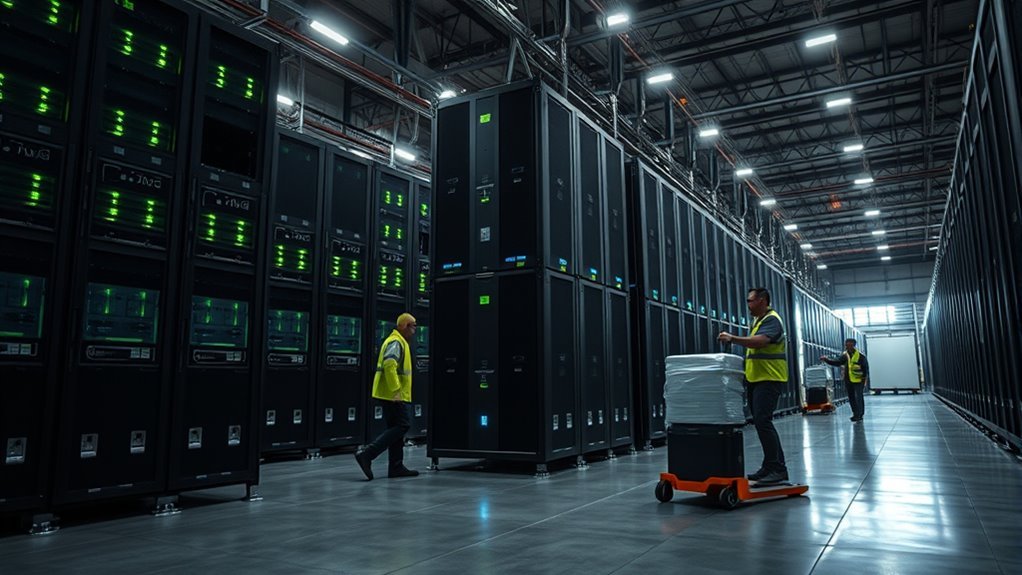

Investors are discovering in real time that even a powerful multiyear AI story does not exempt semiconductor stocks from corrections and sentiment swings. The latest selloff in global chip markets matters because it is the first serious test of whether the enormous capital being deployed into AI infrastructure can sustain both current valuations and the next leg of technological progress.
From AI euphoria to a global semiconductor reset
Over the past year, AI exposed chipmakers to an unusually concentrated wave of optimism. High performance processors and memory became the picks and shovels of the AI gold rush, and markets priced in years of uninterrupted demand growth. For a while, that optimism looked justified. Global semiconductor sales reached 791.7 billion dollars in 2025, an increase of 25.6 percent from 630.5 billion dollars in 2024 according to data from the Semiconductor Industry Association based on World Semiconductor Trade Statistics.
Industry forecasts now call for roughly 975 billion dollars in sales in 2026, which would move the sector toward the one trillion dollar mark. At the same time, AI chips are projected to drive roughly half of that revenue while accounting for less than 0.2 percent of total unit volume.
Against that backdrop, equity markets pushed many semiconductor names to record highs. The Philadelphia Semiconductor Index staged an extraordinary rally helped by enthusiasm around AI chips before suffering an eight percent drop in a single week as traders questioned how long that pace could last. That kind of swing is not unusual in cyclical tech sectors but it is jarring after months of one way gains.
The Morningstar Global Semiconductors Index, which had soared year to date, has also given back a meaningful portion of its advance as momentum money exits and more value-focused investors insist on verifying the growth assumptions baked into prices.
The correction is clearly global rather than localized. South Korea’s Kospi has seen sharp moves led by memory specialists that are most exposed to AI data center demand. In Europe, names such as BE Semiconductor and STMicroelectronics have come under pressure as investors lock in gains from earlier runs.
In the United States, large liquid names including Micron Technology, Intel, and other memory and storage players have seen intraday swings that would usually be associated with company-specific problems rather than sector-wide re-rating. What stands out today is that extended valuations rather than deteriorating fundamentals are driving the new caution.
Historical context: this is not the first semiconductor boom
Anyone who has watched chips for more than one cycle will recognize the pattern. The industry has always grown in powerful waves tied to specific compute eras. In the personal computer boom, unit volumes and margins exploded and then normalized once the market matured.
Smartphones did something similar in the 2010s, driving enormous scale in application processors, radio frequency components, and storage before growth slowed and inventories built up. The crypto mining craze around 2017 created a spike in demand for graphics processors that ended abruptly when token prices fell and mining economics changed.
The pandemic era surge in laptops, webcams, and game consoles created another demand spike followed by a painful inventory digestion.
The current AI wave is different in magnitude but not in its basic structure. Instead of consumer devices, the focus is on data centers, cloud platforms, and enterprise workloads. Rather than millions of individual gadgets, demand is concentrated in very large clusters operated by a relatively small number of hyperscale cloud providers and large enterprises.
The pattern is still familiar though. Expectations run ahead of what customers can practically deploy, capital spending ramps aggressively, and equity markets eventually pause to ask whether the returns will justify the upfront investment.
The data behind the downturn
The present correction is best understood as a valuation check rather than a sudden collapse in demand. The revenue numbers are robust. Multiple industry sources converge on global semiconductor sales of roughly 792 billion dollars in 2025 and growth rates in the low to mid-twenties, with SIA citing 25.6 percent year on year and Gartner estimating 21 percent based on its methodology.
WSTS data suggest the market could reach about 975 billion dollars in 2026, implying another year of strong double-digit growth. These are extraordinary figures for a sector that was a little above 500 billion dollars only a few years ago.
At the same time, valuations in leading AI-exposed names have climbed faster than even these strong fundamentals. When a company like Taiwan Semiconductor reports solid results yet sees its share price decline by several percentage points, that usually signals that investors had already priced in more than the reported numbers or that they are worried about future cycles rather than the current quarter.
Micron’s experience is similar. It surged dramatically in a short period, powered by optimism about high bandwidth memory and AI servers, then pulled back as traders took profit and more cautious investors highlighted the volatility of memory pricing.
Indices tell a similar story. The Philadelphia Semiconductor Index, for example, moved up more than eighty percent over a rapid period before dropping about eight percent in a single week as market participants asked when the AI party might cool down.
Moves of that scale across a broad benchmark communicate a change in narrative from pure enthusiasm to verification. Market participants are no longer willing to pay any price for exposure to AI. They now want to see evidence that the capital spending binge will translate into durable earnings and cash flow.
Concentrated demand and the rise of chipflation
One of the reasons this correction feels uncomfortable is that AI demand is highly concentrated in a few critical components. High bandwidth memory, advanced accelerators, and AI-specific networking silicon sit at the center of modern AI systems.
As foundries and memory manufacturers prioritize these products, capacity for other categories can tighten. That has contributed to shortages in certain types of DRAM and high bandwidth memory and to elevated pricing in some areas of the supply chain.
When input costs rise across the stack while end customers are still experimenting with business models, it raises awkward questions. Cloud providers and enterprises are investing heavily in AI infrastructure, yet many AI applications have not fully proved their monetization potential.
If chip prices and margins are propped up largely by scarcity rather than long-term value creation, there is a risk that some of those margins will compress once capacity catches up or when customers demand lower prices to preserve their own economics. This emerging dynamic, often labeled chipflation, is uncomfortable for both buyers and investors because it is hard to know how long it will persist.
Why the revenue surge still matters
Despite the selloff, it is critical not to lose sight of the secular story. The move from roughly 630 billion dollars in sales in 2024 to about 791.7 billion dollars in 2025 means the industry added more than 160 billion dollars of annual revenue in a single year.
That jump is powered not only by generative AI but also by edge computing, automotive electronics, industrial automation, and ongoing growth in traditional cloud and storage. AI is the catalyst that highlights the trend, yet the underlying structural shift is the steady embedding of silicon into virtually every part of the economy.
Projections toward 975 billion dollars and potentially one trillion dollars of annual semiconductor revenue around 2026 underscore just how central chips have become to digital and physical infrastructure. That scale implies that the industry is no longer just a cyclical appendage of consumer electronics.
It is now core infrastructure for national competitiveness, security, and industrial strategy. Governments see this and are pushing for domestic capacity, resilient supply chains, and support for advanced manufacturing, which in turn affects how investors think about risk and return.
Implications for technology, businesses, and society
For technology builders, the correction is a reminder to focus on sustainable use cases rather than short-term hardware chasing. Startups and large enterprises that rushed to reserve GPU clusters simply to avoid being left out may now face tougher internal questions about return on investment.
The cost of compute remains high, and the pressure to align spending with revenue will increase if chip prices stay elevated or if equity markets remain volatile. Teams building AI products will need to pay more attention to efficiency, model optimization, and workload planning because reckless spending will be harder to justify.
For semiconductor companies, this phase will likely force clearer strategic decisions. Some will double down on AI-related products and accept greater cyclicality in exchange for higher margins. Others will emphasize diversification across automotive, industrial, and communications markets to soften the impact of AI cycles.
Foundries will have to balance capacity allocations between hot AI products and long-term customers in other segments. Their choices will shape which parts of the ecosystem feel scarcity and which enjoy more stable supply.
Society and policymakers have their own set of concerns. Rapid growth in AI hardware has environmental and energy implications. Data centers consume large amounts of electricity and require water and land.
If the returns on AI spending prove weaker than hoped, there will be broader debates about whether that resource allocation was wise. On the other hand, breakthroughs in AI-enabled medicine, education, and climate modeling could more than justify the upfront costs if they materialize at scale.
The present correction does not answer these questions, but it does create space for a more measured conversation.
What to watch in the next phase of the AI chip cycle
Several signposts will determine whether this correction becomes a brief pause or the start of a longer consolidation. First, watch how quickly AI workloads move from experimental pilots to revenue-generating products.
The faster that transformation happens, the easier it will be for companies to defend high levels of capital expenditure on chips and data centers. Second, monitor how pricing evolves in memory and accelerator markets. If capacity expansions start to relieve shortages, some of the chipflation pressure on buyers and margins on sellers will ease.
Third, pay attention to how governments implement industrial and export policies around advanced semiconductors. Supportive subsidies, stricter controls on technology transfer, and new rules around AI computing could all influence demand patterns.
Finally, look at how investors talk about AI in earnings calls and conference presentations. If the tone shifts from vague promises to concrete metrics about utilization, revenue per unit of compute, and payback periods, that will be a sign that the sector is maturing beyond the early hype phase.
The current selloff is painful for holders of semiconductor stocks, but for the broader AI ecosystem, it is a healthy if uncomfortable step toward more grounded expectations.
Fundamentals in the chip industry remain strong, yet markets are now insisting that the story be backed by evidence rather than momentum alone. For readers and builders following AI from the trenches, this is the moment to separate durable progress from speculative excess and to plan for a future where chips are both indispensable infrastructure and still subject to real-world economic gravity.
Conclusion
Global chip markets are ending the week on edge because investors are no longer treating the artificial intelligence boom as a guaranteed winning trade. Instead, they are asking a simple but uncomfortable question: do the enormous, often debt financed AI infrastructure budgets and sky high semiconductor valuations actually line up with realistic future cash flows. That shift in mindset is what is driving the selloff, not a sudden collapse in demand for chips themselves.
Why this moment matters
For most of the past year, chipmakers were the clearest way to invest in AI. The Philadelphia Semiconductor Index more than doubled over the last twelve months, powered by enthusiasm for data center GPUs and high bandwidth memory that underpin large language models and generative AI services. Even after the recent declines, the index remains far above pre AI boom levels, but volatility has spiked as investors rotate out of what had become crowded trades.
Several sharp pullbacks have now turned into a broader global correction. One recent week saw the semiconductor index fall about 11 percent and drop nearly 24 percent from its record high at the end of June, marking its largest single week decline since early 2025. Subsequent sessions brought further weakness, including renewed selling across Nvidia, AMD, Micron, TSMC and other leading names as profit taking, valuation worries and macro concerns combined. On July 28, AMD fell around 8 percent and Nvidia nearly 5 percent after reports of a Chinese firm advancing immersion deep ultraviolet lithography equipment, highlighting geopolitical and competitive risk layered onto an already fragile market mood.
This is the first sustained test of the AI chip rally. It matters because it reveals how dependent semiconductor demand and pricing have become on the narrative that AI spending will grow rapidly and reliably for many years.
How we got here: the AI trade in context
The AI chip boom did not appear in a vacuum. Every major computing wave has had its own semiconductor cycle. The personal computer era made microprocessors a core growth story. The smartphone decade turned mobile system on chip and radio frequency components into secular winners. Crypto mining created a brief but intense surge in demand for GPUs and memory before fading.
AI looks different because the buyers are concentrated hyperscale cloud providers and large technology platforms rather than millions of end users. Capital expenditure by these hyperscalers is projected to jump roughly 76 percent this year to around 673 billion dollars, with a sizable portion directed toward AI data centers. Some estimates put combined AI and cloud infrastructure spending by the major players in the range of 725 to 750 billion dollars for 2026 alone. Research from Bank of America expects global cloud and AI infrastructure spending to reach nearly 1.5 trillion dollars by 2027, implying growth rates of 40 to 50 percent per year from current levels.
Those numbers fueled a historic rally. AI infrastructure stocks have been on a tear as companies like Alphabet, Amazon, Meta and Microsoft committed vast budgets to accelerators, networking gear and memory. At one point, AI semiconductor names gained about 60 percent year to date, and the broader chip index experienced a violent crash that erased more than one trillion dollars in market value in a single session, only to rebound soon after. That June 2026 episode, triggered partly by cautious guidance from Broadcom, was an early warning that prices could swing wildly even when fundamentals looked solid.
What is actually happening in the numbers
The latest selloff is best understood as a repricing of expectations rather than a collapse in orders. Across multiple recent trading weeks, many AI oriented chip stocks have declined roughly 10 percent as investors debate whether future revenue growth can match the valuations implied by the AI trade. Nvidia, AMD, Micron, Intel and SK Hynix have all seen their shares weaken as the market reassesses the durability of high margin AI demand.
The Philadelphia Semiconductor Index has fallen more than 11 percent from its June record and at one point was down nearly 18 percent from its peak, putting it into a technical correction and even briefly into bear market territory by some measures. Sector specialists note that this is the steepest weekly drop since March 2025, underscoring how sensitive the group is to shifts in sentiment around AI capital expenditure.
Regional markets tell a similar story. Selling pressure that began on Wall Street spread to Seoul and European listings, pulling down memory makers, equipment vendors and foundry operators as investors unwound AI themed positions. Analysts in Korea have highlighted that volatility in the local chip sector is being driven less by near term earnings changes and more by concerns about the sustainability of AI investment by United States big tech firms.
Debt fueled AI spending and the valuation test
The core issue is not whether companies are spending on AI. They are. It is whether that spending can keep growing at the pace markets had come to expect.
Several research shops now estimate that the ratio of capital expenditure to operating cash flow for major United States technology platforms will remain above 90 percent through 2026, an unusually high level that raises questions about financial flexibility. In plain terms, a huge share of the cash these firms generate is being plowed straight back into data centers, servers, accelerators and optical networks. Some of that is funded directly from operations, but there is increasing concern that more borrowing may be needed to sustain such aggressive buildouts.
At the same time, independent projections from firms such as UBS suggest that while hyperscaler spending is set to surge this year, growth will slow markedly after 2026, dropping to around 25 percent in 2027 and near single digit rates by 2028. Spending would still be increasing, but the deceleration itself is enough to challenge valuations that assume many years of near exponential growth in AI infrastructure.
Debt linked AI spending becomes particularly sensitive when return on investment is uncertain. Reports of Chinese AI models delivering competitive performance at lower cost and efficiency have led some investors to question whether the current generation of high priced accelerators and associated hardware will maintain its pricing power. If cheaper alternatives gain traction, or if software optimizations reduce the need for every workload to run on top tier silicon, the revenue trajectory for premium chips could flatten even as overall AI usage grows.
This is the valuation test unfolding right now. Semiconductor stocks had priced in a long runway of high growth, supported by large capital budgets from a relatively small set of buyers. As markets scrutinize whether those buyers can keep spending at the same pace without stressing balance sheets, prices are adjusting.
Are fundamentals breaking or just expectations
The evidence so far points to a correction in expectations rather than a collapse in fundamentals.
Key cloud providers and AI platform companies continue to signal strong demand for computing capacity. Some executives still describe AI chip demand as almost unlimited, at least for the next couple of years, driven by training larger models and rolling out AI features across consumer and enterprise products. Collectively, hyperscalers have already committed around three quarters of a trillion dollars in capital expenditure for 2026, with a substantial portion earmarked for AI infrastructure. IDC projects that AI infrastructure spending will reach approximately 487 billion dollars in 2026, representing roughly 53 percent year over year growth.
Importantly, recent selloffs were often triggered by sentiment catalysts rather than fundamental shocks. Meta indicating that it would sell excess AI computing capacity signaled to the market that at least one major player might have over provisioned for near term needs, which contributed to the pullback in related stocks. Profit taking after a steep rally, rising oil prices and broad risk off rotations have also played roles in the declines, independent of any sudden drop in chip orders.
Analysts who follow the sector closely emphasize that the underlying business for leading chipmakers remains robust. There is no evidence yet of a systematic collapse in AI related bookings. Instead, the pattern resembles past semiconductor cycles where share prices overshoot on optimism and then correct sharply when investors remember that demand is still cyclical and sensitive to macro conditions.
Implications for technology companies and the wider economy
For technology companies, this phase marks a transition from an AI frenzy to an AI scrutiny environment. Boards and finance teams are being pushed to justify multi billion dollar data center projects in more concrete terms. The burden of proof is shifting from broad statements about AI being transformative to detailed explanations of how specific deployments will generate cash flows that exceed their cost of capital.
Big technology platforms face a delicate balancing act. On one side, slowing AI investment too aggressively could leave them behind competitors and weaken their ability to ship new AI powered products. On the other side, continuing to invest at a pace that keeps capital expenditure near operating cash flow levels for an extended period invites questions about leverage, shareholder returns and long term profitability. This tension is now reflected in stock prices.
For semiconductor companies, the message is that their fortunes are increasingly tied to a small group of buyers and a single theme. That can be enormously profitable in the boom phase but becomes risky when those buyers reconsider their budgets or look for ways to stretch existing capacity. Memory vendors, equipment manufacturers and foundries are also exposed, as their own cycles now depend on the health of AI data center spending.
There are broader economic angles as well. AI infrastructure has become a significant component of investment in many advanced economies. If AI capital expenditure slows meaningfully, it could soften demand for industrial equipment, real estate and energy and modify expectations for productivity gains that policymakers hope will offset demographic pressures. Conversely, a more disciplined investment environment may improve long term returns by channeling resources into projects with clearer payoffs, rather than funding every AI initiative simply because capital was cheap.
Opportunities and risks in a more cautious market
A more skeptical market does not necessarily mean AI is overhyped. It means that investors are refining their view of where value is truly being created.
One opportunity lies in differentiation. Chipmakers that can demonstrate concrete performance advantages, better energy efficiency or lower total cost of ownership for AI workloads are more likely to maintain pricing power even if overall budgets grow more slowly. The same is true for companies that can offer integrated hardware and software stacks that reduce deployment complexity.
On the risk side, the concentration of AI hardware demand among a few hyperscalers magnifies any policy or competitive shock. Regulatory interventions that slow AI deployment, data localization rules that complicate global infrastructure planning, or breakthroughs from new entrants that alter the cost curve could all ripple quickly through semiconductor orders. The recent market reaction to reports of Chinese advances in lithography technology illustrates how sensitive valuations are to perceived shifts in competitive positioning.
Investors are also becoming more aware that AI adoption is a multi year process rather than a single event. It takes time for enterprises to redesign workflows, integrate models, manage data governance and capture measurable productivity gains. If that path is slower than early bull cases assumed, then stock prices need to adjust even if the structural opportunity remains intact.
What to watch next
Several signals will help clarify whether this episode is a healthy repricing or the start of a longer downturn.
The first is the trajectory of hyperscaler capital expenditure guidance over the next few quarters. If companies moderate spending but keep growth positive and focus on higher quality projects, that would support the view that this is a move from exuberance to discipline rather than from boom to bust.
The second is evidence of actual utilization of existing AI capacity. Metrics such as hours of training compute used, inference workloads served and revenue attributed to AI products will indicate whether installed hardware is generating sufficient returns. Announcements like Meta selling excess compute suggest some mismatch today, but that may reflect rapid experimentation rather than systemic overbuild.
The third is how quickly AI applications translate into durable business models. If enterprises begin to show convincing margin improvements or new revenue streams directly tied to AI deployments, that will reinforce the case for continued infrastructure investment and eventually support higher semiconductor valuations again.
Key takeaways and forward looking insights
The current global chip selloff is less about a sudden collapse in AI and more about a necessary cooling of expectations after an extraordinary rally. Markets are recalibrating the gap between ambitious capital spending plans and the cash flows that AI deployments have actually produced so far.
In the near term, volatility is likely to remain elevated. Valuation bubbles seldom deflate in a straight line, and news about spending guidance, competitive dynamics or macro conditions can trigger sharp moves either way. For long term participants, this phase is a chance to distinguish between companies that are merely riding the AI narrative and those that are building sustainable businesses around it.
Looking ahead, the most credible scenario is that AI continues to reshape computing and software, but the financial contours of that transformation become more measured. Capital expenditure will still grow, but at rates more compatible with healthy balance sheets. Semiconductor demand will remain structurally stronger than in past cycles, yet increasingly sensitive to proof that AI generates real returns. The cost of the AI boom will be counted not only in dollars spent but in how effectively those dollars are converted into enduring value for users, businesses and societies.
In that sense, the current correction is painful but necessary. It is forcing a transition from momentum driven investing toward evidence driven capital allocation. For a technology as transformative and complex as AI, that is a sign of maturation rather than decline. reddit