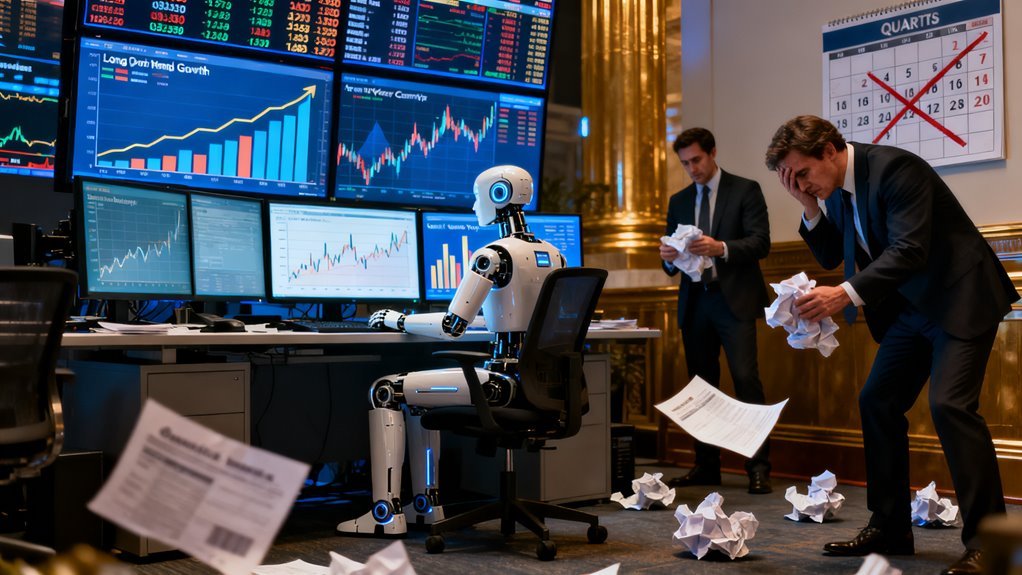

ASML’s latest share price drop is more than another volatile trading day in a hot semiconductor stock. It captures a pivotal moment where China’s push for self-sufficiency in chipmaking equipment is finally colliding with Western export controls and investor expectations about the future of artificial intelligence hardware. When a company as central as ASML loses more than eight percent of its market value in one session, the move is usually telling investors that something fundamental is shifting. Additionally, the expanded attack surface created by AI integrations poses significant security risks for interconnected systems.
A new Chinese challenger in deep ultraviolet lithography
The immediate trigger for the sell-off was news that a state-backed Chinese enterprise has started production of its own immersion deep ultraviolet lithography tools, a category that has long been an ASML stronghold. Early reports point to a Shanghai-based company with government support that has begun producing scanners that broadly match the performance of ASML systems from almost two decades ago rather than its cutting-edge hardware. Production volumes through 2027 are described as single-digit or low double-digit unit counts, far from the scale implied by headlines about mass production. On paper, that does not sound like a direct threat to ASML’s latest generation immersion platforms, which are deeply integrated into the most advanced logic and memory fabs outside China. Yet from a strategic and political standpoint, the symbolism matters as much as the specifications.
China’s state-backed immersion DUV tools echo ASML’s 2000s-era machines, but the strategic signal is unmistakable.
These first domestic systems show that China is no longer confined to trailing edge lithography and legacy tools. They signal a determined effort to localize a category that had been effectively monopolized by ASML and constrained by Western export rules. Investors are reacting to both the long-term competitive trajectory and the shorter-term narrative risk. Even a modestly capable domestic tool in immersion deep ultraviolet can eventually absorb incremental demand inside China that would otherwise have gone to ASML, especially in nodes that do not require the most advanced patterning.
The perception of a closing technology gap, powered by state capital and policy support, is enough to recalibrate expectations about how much pricing power and unit share ASML can exert over China in the coming decade.
How export controls are reshaping ASML’s China story
The competitive news hit at a time when regulatory risk around ASML’s China business is already escalating. Since 2023, the Dutch government has required export licenses for ASML’s most advanced immersion deep ultraviolet systems, including TWINSCAN NXT 2000i and newer models, with licenses for higher-end tools such as NXT 2050i and NXT 2100i revoked at the start of 2024.
The United States has been pushing allies to harden these controls, concerned about the role of lithography tools in enabling China’s progress in high-performance computing and AI processors. In April 2026, a bipartisan group of United States lawmakers introduced the MATCH Act, legislation designed to coordinate export controls with allied governments and explicitly target Chinese access to deep ultraviolet immersion systems and related parts and services from suppliers such as ASML.
Market commentary around the bill has emphasized that, if enacted in its tougher form, it would represent one of the first formal expansions of deep ultraviolet restrictions since the Dutch measures of late 2024, closing off more of China’s path to advanced manufacturing equipment. These proposals are not yet law, and analysts have generally modeled the direct revenue impact on ASML in single-digit percentage terms, with some expectation that demand from other regions would partially offset lost China sales.
Still, the pattern in the stock has been clear. ASML shares have repeatedly sold off when new export restrictions are announced or when lawmakers float tighter controls, including drops of several percent on days when the MATCH Act and similar proposals were front in mind for investors.
China historically has been one of ASML’s largest end markets, but the share of net system sales coming from Chinese customers has already declined as successive export rules have taken effect. Recent earnings updates show ASML raising its overall sales guidance for 2026, to a range of roughly 36 to 40 billion euros, while at the same time acknowledging that the China portion of its business is increasingly constrained.
That combination of strong global demand and shrinking China contribution has produced trading days where the stock fell around the mid-single-digit range despite positive fundamentals elsewhere, highlighting investor sensitivity to every data point about Chinese exposure. The latest proposed curbs go beyond new shipments. They contemplate tighter restrictions on servicing and upgrades for existing deep ultraviolet immersion tools in China, which would directly touch ASML’s lucrative installed base.
If enacted aggressively, such rules could cap incremental upgrade cycles, limit maintenance revenues, and raise questions about how much support ASML can offer to tools already deployed in Chinese fabs. That is why geopolitics increasingly shows up not just in revenue forecasts but in cash flow models and valuation ranges.
Where AI demand fits into the picture
All of this is happening against a backdrop where demand for advanced lithography remains driven by the global race to build AI accelerators, high-performance CPUs, and dense memory chips. ASML has raised its guidance twice in 2026, supported by strong bookings from customers ramping production for AI workloads, yet the stock reaction has often been muted or even negative on those days because investors are focused on regulatory uncertainty rather than near-term earnings strength.
The deeper tension is that the same tools capable of enabling cutting-edge AI chips also sit at the center of national security debates. United States officials have expressed concern about any path that might give China access to extreme ultraviolet systems, and ASML has stressed that it has never shipped an EUV machine or EUV-specific components to Chinese customers.
As policymakers widen their attention from EUV to high-end deep ultraviolet immersion tools, ASML must walk a narrow line between serving global demand and complying with a shifting set of country-level rules. From an AI industry perspective, the company remains a critical bottleneck. Every incremental restriction on its ability to sell or service tools in a major market complicates capacity planning for chipmakers and introduces more variability into the timing and geography of AI infrastructure buildouts.
The emergence of a domestic Chinese alternative in older generation immersion deep ultraviolet does not change the fact that ASML is the only supplier of EUV and still the dominant provider of leading-edge immersion systems. It does, however, hint at a future in which global AI capacity is increasingly fragmented, with parallel tooling ecosystems evolving inside and outside the Western export control perimeter.
How investors should read an eight percent drop
Large single-day moves are not unusual for ASML. The stock has previously fallen in the mid-single digits when guidance disappointed or when new restrictions on China were announced, and it has also rallied sharply on days when AI-related optimism swamped regulatory concerns. The latest eight-plus percent decline fits this pattern of swings driven by a combination of headline risk and genuinely uncertain long-term outcomes.
On one hand, earnings and demand indicators for AI hardware remain strong. ASML’s raised guidance and robust bookings suggest that global chipmakers are still committing capital to expand capacity for AI and high-performance computing, and that the secular uptrend in lithography intensity per wafer is intact. Despite the sell-off, ASML’s net income has increased by more than 30% year over year, underscoring the disconnect between strong financial performance and rising market anxiety. On the other hand, the path for doing business in China is narrowing, and domestic Chinese efforts to develop their own deep ultraviolet tools introduce a new source of potential competition in at least part of the technology stack.
For investors, the crucial question is not whether the first generation of Chinese immersion scanners can match ASML’s newest systems. Current evidence suggests they are closer to much older models and available in limited quantities. The real issue is whether sustained state backing allows Chinese suppliers to iterate rapidly, build out service networks, and eventually become credible alternatives for a portion of the mid-range market inside China.
Even a modest shift of orders from imported to domestic tools would matter in a market already constrained by export rules. It is also important to recognize the feedback loop between policy and technology. ASML’s chief executive has previously warned that tighter curbs would push China further toward developing competing tools, essentially accelerating the very dynamic that Western policymakers are trying to slow.
The latest breakthrough news appears to validate that concern and may influence how future restrictions are designed, potentially favoring more targeted, multilateral measures over broad unilateral bans.
What this means for technology, business, and society
Technologically, the development of a domestic Chinese immersion deep ultraviolet tool marks a meaningful milestone even if it is not yet world-leading. It shows that the combination of long-term investment, technology transfers before recent bans, and intense state focus can produce functional complex equipment in a relatively compressed timeframe.
Over time, that could reduce China’s dependence on foreign suppliers for mature and mid-range nodes, freeing Western tools to focus more on the highest-end applications but also eroding a revenue stream that has historically underpinned scale and learning for companies like ASML. For businesses, the message is that supply chain and market concentration risks are becoming more entangled with geopolitical decisions.
Chipmakers must hedge not only against demand cycles but also against changes in export policy and the emergence of new regional suppliers with different regulatory obligations. Equipment sellers must plan for scenarios where some installed bases are effectively walled off from certain services or upgrades, affecting long-term contract structures and earnings visibility.
Societally, this episode illustrates how deeply lithography tools sit at the center of economic and security strategies. Decisions about who can buy or maintain a deep ultraviolet system now carry implications for AI capabilities, surveillance and defense applications, and broader industrial policy. These are inherently political questions that financial markets will continue to price in through bouts of volatility whenever new information appears.
Key takeaways and what to watch next
The current sell-off in ASML captures three overlapping forces. China is making visible progress in its quest to localize critical chipmaking equipment. Western governments are stepping up efforts to control access to advanced tools, with the MATCH Act and related proposals signaling further tightening could still come.
At the same time, global AI demand is strong enough to keep ASML’s long-term growth story intact even as one major market becomes more uncertain. The practical takeaway is that ASML’s valuation now embeds a wider range of possible outcomes than in earlier cycles. Scenarios span from a relatively orderly transition where China’s share stabilizes at a lower level while other regions absorb the slack, to more complex outcomes where Chinese domestic tools steadily replace a portion of ASML’s presence and export controls grow stricter over time.
Investors and industry observers should watch three things in the months ahead. First, hard data on the actual performance and shipment volumes of the Chinese immersion systems, which will separate genuine capability from headline exaggeration. Second, the legislative fate and final wording of any new export control laws, especially those touching service and upgrades rather than only new shipments.
Third, how ASML adjusts its guidance and strategy to reflect both AI-driven demand and this evolving regulatory and competitive landscape. Taken together, these developments confirm that the intersection of AI, geopolitics, and semiconductor manufacturing is not a passing theme but the new normal for companies like ASML. Volatility is likely to persist, but so is the structural need for advanced lithography in building the next generation of computing.
Conclusion
ASML just experienced one of its sharpest single day drops this year, with the stock sliding roughly eight and a half percent after reports that China has begun mass producing its own immersion deep ultraviolet lithography machines. This sudden move matters because it challenges the assumption that ASMLs near monopoly on advanced chipmaking tools is secure and it underlines how central China has become to the economics of the global semiconductor industry.
What triggered ASMLs sudden selloff
The immediate catalyst was a report that a Shanghai based company with state backing has started manufacturing domestically developed immersion deep ultraviolet lithography systems, a class of machines that ASML has long dominated. These immersion deep ultraviolet tools are critical for producing chips at mid to advanced process nodes and until now Chinese chipmakers relied heavily on imported equipment, with ASML as the primary supplier.
Several outlets report that the Chinese manufacturer plans to deliver about five immersion deep ultraviolet machines this year and to ramp output to roughly twenty units next year. Initial customers are expected to include leading domestic foundries and memory producers such as Semiconductor Manufacturing International Corporation, Hua Hong and Changxin Memory Technologies.
News of this production plan quickly hit market sentiment. ASML shares erased early gains and finished the session down between seven and nine percent, marking one of the steepest declines in months and wiping billions of euros from the companys market value. The drop also pressured United States chip equipment peers including Applied Materials, Lam Research and KLA as investors reassessed how long Western suppliers can treat China as a reliable growth engine.
How ASML built its position in chipmaking tools
To understand why this selloff drew so much attention it helps to recall how ASML reached its current position. Over the past two decades the company steadily advanced from deep ultraviolet systems to extreme ultraviolet platforms and now to the next generation of High NA tools, becoming the only vendor capable of supplying production ready extreme ultraviolet scanners. This technology is essential for the most advanced logic nodes used in cutting edge processors and high performance chips.
Deep ultraviolet tools remain commercially important. While extreme ultraviolet handles the most advanced layers, immersion deep ultraviolet machines still carry much of the workload at mature and mid range nodes that power smartphones, automobiles and industrial electronics. Chinese customers leaned heavily on these systems in recent years and China at one point represented about twenty nine percent of ASMLs total revenue, mostly driven by deep ultraviolet sales because extreme ultraviolet exports to China have been restricted.
As export controls tightened, that share began to normalize. ASML guidance and industry analysis suggest that China now contributes around twenty percent of revenue in 2025 and 2026, with its portion of net system sales reported at fourteen percent in the second quarter compared with nineteen percent in the first. Meanwhile growth is increasingly coming from Korea and Taiwan, where memory and foundry customers have placed large orders for extreme ultraviolet tools.
Against this backdrop China has been pushing for greater self sufficiency in chipmaking gear. A report earlier this year described United States legislative proposals that would further restrict sales and servicing of deep ultraviolet immersion equipment to Chinese clients if the Netherlands implements them, underscoring Beijing’s incentive to localize this technology.
What China has actually achieved with domestic immersion deep ultraviolet
The new Chinese immersion deep ultraviolet machines represent a meaningful milestone in that localization drive, but the reality is more nuanced than headlines suggest. The reports describe a nascent production run, with only a handful of units slated for this year and a modest ramp over the next. By comparison ASML ships far more deep ultraviolet systems globally each year and has had decades to refine throughput, reliability and overlay performance.
Analyses from financial and technology outlets emphasize that the Chinese tools are still capacity constrained and that their performance remains unproven at scale. Some sources note that the machines are expected to support leading domestic chipmakers, yet they stop short of confirming that the systems can match current ASML deep ultraviolet immersion models on productivity or process control. In other words China has crossed an important threshold by moving from laboratory prototypes to commercial production, but the gap in maturity and ecosystem support is likely still wide.
There are also supply chain questions. Building a competitive immersion deep ultraviolet platform requires precision optics, advanced light sources, high speed stages and complex control software, as well as a dense network of service engineers and spare parts logistics. Even if the core tool is now domestically produced, maintaining yield across multiple fabs and nodes will demand sustained investment and coordination that goes beyond the initial announcement.
Why investors reacted so strongly
The reaction in ASMLs share price says as much about investor psychology as it does about immediate fundamentals. Deep ultraviolet immersion tools have been a major revenue pillar for ASML in China and in 2024 that market accounted for close to one third of total sales. When reports indicate that some of those customers may soon have a domestic alternative, even at limited volumes, the market quickly prices in the possibility of erosion in a key region.
At the same time investors have grown accustomed to viewing ASML as a company with an exceptionally wide moat. The firm enjoys a monopoly in production extreme ultraviolet systems and a dominant share in high end deep ultraviolet, supported by close collaboration with partners such as Zeiss for optics and long term roadmaps that extend to High NA and beyond. Any sign that one part of that moat could be chipped away tends to trigger a strong reaction, especially in an environment where geopolitical risks are already front of mind.
There is also a broader narrative at work. China has been accelerating investment in semiconductor equipment and tooling in response to tightening export controls, and each reported breakthrough, whether in lithography, etch, deposition or inspection, feeds into a story of emerging domestic capability that could redirect future capital spending. For global investors that translates into a potential valuation discount for suppliers heavily exposed to Chinese demand, even if near term revenue remains solid.
The strategic context for ASML and global chipmaking
From a technology perspective the development of domestic Chinese immersion deep ultraviolet tools is significant but does not immediately threaten ASMLs dominance in the most advanced nodes. Extreme ultraviolet scanners and forthcoming High NA systems still sit at the top of the lithography stack for leading edge logic and memory and these remain out of reach for Chinese manufacturers under current restrictions. Advanced processors for artificial intelligence workloads, high end smartphones and data center systems rely on these cutting edge nodes, so ASMLs strategic importance to global chipmakers is intact.
Where the shift could matter is in the volume business of mature and mid range nodes. If Chinese tools prove reliable enough for high volume manufacturing at geometries commonly used in automotive, industrial and mass market consumer electronics, domestic fabs might gradually allocate more lines to local equipment. Over time that could reduce dependence on foreign suppliers for those nodes, while leaving the most advanced processes still tied to non Chinese tools.
Geopolitically the development reinforces a trend toward more fragmented technology ecosystems. Export controls originally aimed at limiting Chinese access to the highest end tools are now encouraging accelerated local innovation across the stack, from design software to manufacturing hardware. This raises the possibility that two partially distinct industrial systems could emerge, one centered on fully global supply chains and extreme ultraviolet enabled advanced nodes, and another more regionally focused and built around domestic Chinese equipment at slightly older nodes.
The implications for artificial intelligence are indirect but important. Many inference workloads and edge devices can run on chips produced at mid range geometries, and domestic Chinese lithography progress may support a wider base of local hardware for these applications over time. At the same time the most compute intensive training tasks still depend on the latest nodes and associated packaging, which keeps pressure on international cooperation and on the availability of advanced tools that China cannot yet replicate.
What this means for ASMLs long term moat
Taken together the Chinese immersion deep ultraviolet initiative is less an immediate existential threat to ASML than a reminder of how central China has become to its revenue base and to the psychology around the stock. With China representing roughly twenty percent of ASMLs expected revenue in 2025 and 2026 and with much of that tied to deep ultraviolet systems, investors now see a clearer path for domestic substitution, even if it unfolds slowly.
ASML still holds critical advantages. Its extreme ultraviolet platform remains unique and its roadmaps for High NA and potential future architectures build on deep experience, a long installed base and close ties with leading chipmakers in Korea, Taiwan, the United States and Europe. The company also benefits from service relationships and process integration know how that are difficult for new entrants to replicate quickly.
However the episode underscores that strategic dependence on a single region exposed to geopolitical tension can translate into a structural valuation discount. Earlier discussions in United States policy circles about further limiting deep ultraviolet equipment sales and service to China already pointed to regulatory risk that could affect ASML regardless of Chinese domestic progress. Now that some local capability has emerged, investors may assume a more conservative trajectory for Chinese orders and assign lower multiples to cash flows tied to that market.
For ASML management the logical response is to continue diversifying its customer mix and to deepen collaboration with leading fabs outside China, while also pushing its technology roadmap forward so that the most valuable parts of its portfolio remain beyond the reach of emerging competitors. At the same time maintaining transparency around exposure to different regions and around how export controls interact with demand will be important for sustaining trust among global investors.
Key takeaways and what to watch next
The sharp share price drop following reports of Chinese immersion deep ultraviolet production is a clear signal that markets are highly sensitive to any perceived challenge to ASMLs position in lithography equipment. Yet the underlying facts suggest a measured interpretation. The Chinese tools are at an early stage, production volumes are small, and performance at scale has not been fully demonstrated, while ASML retains a unique role in extreme ultraviolet and next generation platforms.
Over the next several years the key questions will be whether domestic Chinese immersion deep ultraviolet systems can achieve reliable high volume manufacturing, how quickly local ecosystems of suppliers and service providers mature, and how export control regimes evolve. For technology leaders and investors alike this development is best seen as the opening chapter in a longer story about competition, resilience and fragmentation in global chipmaking rather than the end of ASMLs dominance.