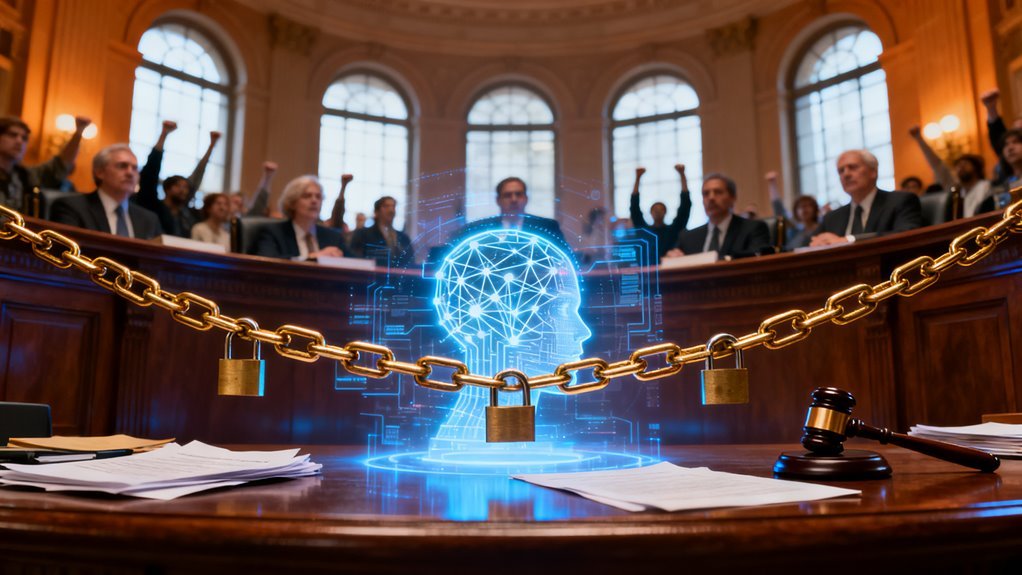

Claude Fable 5 marks a quiet but important shift in what frontier AI models are expected to do in scientific work. Instead of being framed as a chat assistant, it is being positioned as a research grade collaborator that can stay with complex projects from initial idea through to publication quality output. That repositioning is supported by Anthropic’s choice to make Fable 5 a Mythos-class model safe enough for general use, rather than limiting its capabilities to a small set of trusted partners.
Why Fable 5 matters now
In the past three years, labs and companies have gone from experimenting with general purpose chat models to building pipelines around them for code assistance, draft analysis and basic data exploration. That first wave exposed a clear gap. Many teams discovered that while a chatbot could summarize papers or debug scripts, it struggled with long running projects, cross disciplinary research and rigorous hypothesis testing. AI’s ability to redesign jobs instead of merely replacing them highlights the importance of such models.
Fable 5 is Anthropic’s answer to that gap. The company describes it as its most capable widely released model, aimed explicitly at demanding reasoning and long horizon agentic work rather than casual conversation. It is released as a Mythos class model that Anthropic says has been made safe for general use, which signals that they see it as suitable for real world deployment in research and industry settings. This matters now because the scientific and enterprise communities are looking for AI systems that can act less like search engines and more like dependable colleagues.
From chat assistant to co researcher
Early large language models were optimized for short interactions and pattern matching on text. Researchers quickly learned to use them for literature triage, code snippets and quick conceptual checks, but they rarely trusted them with experiment design or critical analytic decisions. The bottleneck was not just accuracy. It was the lack of persistent memory, structured planning and the ability to keep hundreds of sources in view at once.
Anthropic’s design choices for Fable 5 directly target those pain points. The model ships with a one million token context window that allows a single session to include hundreds of papers, large codebases or sizeable datasets, and it can generate up to one hundred twenty eight thousand tokens of output in one request. The one million token window is the default on the Claude API and major cloud platforms, not a special extended context mode, which means long sessions are part of normal usage rather than an exception.
Just as important, Anthropic emphasizes adaptive thinking and long horizon agentic behavior. Fable 5 is described as the company’s most capable model for complex workflows, planning and sustained autonomous operation, and it is generally available across the Claude API, AWS Amazon Bedrock Google Cloud and Microsoft Foundry. For research teams, that combination of large working memory and agentic control begins to look less like a chat interface and more like a programmable lab partner.
Technical foundations for research grade work
The technical specifications of Fable 5 are clearly aimed at research and analytics workloads rather than casual use. The model’s one million token context window functions as a large shared workspace where multiple modalities text code images and documents can be combined in one process. A single request can span many hundreds of pages and still keep intermediate reasoning steps accessible to later scrutiny.
Pricing details reinforce this positioning. The model is billed at ten dollars per million input tokens and fifty dollars per million output tokens, matching other frontier tier Claude models, and there is no pricing premium for using the full long context window. Batch APIs offer significant discounts for large asynchronous workloads, which is particularly relevant for teams running systematic reviews or large parameter sweeps where thousands of long context jobs may be queued.
Benchmark results are consistent with this research focus. Public summaries highlight strong performance on software engineering benchmarks with scores around ninety five percent on SWE bench Verified, and Anthropic and independent testers report that Fable 5 is near the top of current models on complex reasoning and analytic tasks. These external metrics fit with internal claims that Fable 5 materially outperforms earlier Claude Opus models on multi step analytics and high difficulty scientific evaluations, and that researchers show a clear preference for its hypothesis generation and first principles reasoning.
How Fable 5 is being used in science
The most interesting part of Fable 5 is not the raw numbers. It is how teams are starting to structure work around it. Anthropic and partner reports emphasize its use in scientific reasoning, research automation and life sciences applications.
In genomics, for example, labs can feed variant datasets, reference annotations and a curated set of papers into a single extended context session. Within that shared workspace the model can propose candidate disease associated loci, relate them to known pathways or regulatory mechanisms and suggest replication or follow up experiments that align with current statistical and experimental standards.
Because the underlying documents remain in context, it can cross check its own claims against source material and refine hypotheses as new data is added rather than starting from scratch each time.
Similar workflows are emerging in quantitative fields such as physics and engineering. Teams use Fable 5 to explore large parameter spaces, summarize simulation results and surface unexpected patterns that may be worth further investigation. Here the long context window allows the model to keep entire sets of simulations or experiment logs in view, while agentic tools let it run analysis loops, compare competing models and document its reasoning in a way that is reviewable by human experts.
More routine but still valuable applications include systematic literature reviews, grant preparation and protocol refinement. Instead of relying on separate tools for search, note taking and drafting, Fable 5 can ingest candidate papers, help define inclusion criteria, track which studies support which claims and output structured summaries that map directly onto the sections required for manuscripts or funding proposals.
Implications for technology and business
For technology providers, Fable 5 illustrates where frontier models are heading. The focus is moving from raw benchmark scores to task longevity, context management and reliable agentic behavior. Offering a one million token context window at standard pricing and in default configurations sets a competitive expectation that long context should be normal capacity rather than an upsell feature.
Cloud platforms have already integrated Fable 5 into their AI services, which makes it easier for enterprises to plug it into existing data lakes, workflow engines and security controls. That accessibility means businesses can start experimenting with multi day analytic processes, automated reporting and continuous monitoring tasks that keep a large shared context over time.
For research driven companies in biotech materials and advanced engineering, the opportunity is to use Fable 5 as a way to compress discovery cycles. A model that can ingest internal reports, external literature and live data streams, then maintain coherent reasoning over all of them, offers a way to test more hypotheses faster and with more structured documentation.
At the same time, reliance on a single model for core decisions introduces new risk. Errors can propagate quickly through automated pipelines, and benchmark performance does not guarantee accuracy in edge cases or novel domains.
Risks, limitations and the trust question
Anthropic markets Fable 5 as a Mythos class model made safe for general use, and emphasizes safety controls and calibration in its messaging. However safety in this context means that the system has been tuned to avoid certain categories of harmful output and to follow defined policies. It does not mean its scientific conclusions are always correct.
There are several practical limitations that teams need to keep in mind. The model can reason over large contexts, but it still builds its answers from statistical patterns learned during training. That makes it vulnerable to subtle but important errors in quantitative reasoning, data interpretation or experimental design, especially in areas where training data is sparse or contested.
Benchmarks such as SWE bench or internal analytics tests are useful indicators of capability, yet they are inevitably narrower than the real world tasks that labs face. A high score on a coding or question answering benchmark does not guarantee robust performance on complex, messy projects that stretch over weeks and mix incomplete data, organizational constraints and evolving goals.
Fable 5 also introduces a governance question. A system that can plan workflows, execute subtasks and check its own outputs is powerful, but autonomous behavior needs clear boundaries. Research organizations will need to define what the model is allowed to decide independently, where human review is mandatory and how audit trails are preserved so that later reviewers can see exactly which sources and reasoning steps led to a given conclusion.
Trustworthiness therefore depends less on the model itself and more on how it is embedded. When Fable 5 is used as a co researcher, it should be treated as a knowledgeable but occasionally mistaken colleague whose work must be checked, not as an oracle.
How this changes everyday research practice
If Fable 5 lives up to its design goals, the biggest change for many scientists will be in how they structure their time. Instead of spending long blocks on manual literature search, data cleaning and repetitive analysis runs, they can shift more of that workload into scripted interactions with the model. This does not remove the need for expertise. It changes where expertise is applied.
Senior researchers can focus more on defining good questions, setting standards for evidence and interpreting results in context, while delegating more of the mechanical and integrative work to Fable 5. Junior scientists can use it as a tutor and productivity tool, learning faster by iterating on hypotheses and seeing alternative ways to analyze the same data.
Cross functional teams can share a single extended context session that captures decisions, rationales and intermediate results, reducing communication overhead. There is also an educational angle. Long context and explicit reasoning traces make it possible to expose students and new researchers to complete chains of argument, from raw data through to conclusions, in a way that traditional papers often do not.
Used well, Fable 5 could help demystify complex workflows by making each step more visible and explainable.
What to watch next
Fable 5 is clearly part of a broader pattern. Anthropic’s Opus 5 and other recent models are already pushing harder into scientific workloads, and cloud providers are racing to make long context and agentic features standard across their platforms.
Over the next two years, several questions will determine how transformative this class of systems really becomes. One is whether long context models can keep reasoning performance high as tasks stretch over many days or weeks. Another is how well safety and calibration mechanisms scale when these models are integrated into complex institutional workflows with many human and machine actors.
A third is whether the scientific community develops shared norms for citing, reviewing and challenging AI generated hypotheses and analyses, rather than treating them as black boxes. The promise of Fable 5 as a co researcher is real but conditional. Its value will depend on whether teams build processes that make strengths such as long context reasoning and structured agentic planning central, while mitigating weaknesses through careful oversight and validation.
If that balance is found, systems like Fable 5 may become part of the standard toolkit for serious research rather than a passing novelty. The stakes are high, and the next wave of adoption will show whether this model deserves the trust its positioning implies.
Frequently Asked Questions
How Does Fable 5 Handle Data Privacy in Collaborative Research Projects?
Why Fable 5s Privacy Design Matters For Collaborative Research Now
Collaborative research is entering a new phase where advanced models like Fable 5 are no longer side tools but core infrastructure for planning experiments, summarising literature, and drafting analyses across institutions and disciplines. That shift makes the way Fable 5 handles data privacy far more than a technical detail. It becomes a governance question for universities, hospitals, and labs that need both cutting-edge capability and defensible compliance.
Fable 5 belongs to Anthropic’s Mythos class models, which are positioned as powerful systems made safe enough for broad commercial use. That safety story rests heavily on how prompts and outputs are retained, inspected, and protected. For collaborative research projects that move sensitive pre-publication data or even patient information through these systems, understanding those mechanics is now a prerequisite to responsible deployment rather than an optional extra.
From Zero Retention To Mandatory Retention
Earlier generations of large language models leaned on enterprise options such as zero data retention and strict training exclusions to reassure cautious customers. Anthropic followed that pattern for many of its prior Claude models, allowing organisations to keep prompts and outputs out of long-term storage and out of training by default.
Fable 5 marks a clear evolution. Anthropic designates it as a covered model with a fixed retention regime. Prompts and responses sent to Fable 5 are retained for at least thirty days across all supported platforms, including the first-party API, Claude Enterprise, and cloud marketplaces such as AWS Bedrock and Google Cloud Vertex AI. Zero data retention is deliberately not available for this model.
This change is framed as part of Anthropic’s trust and safety work. The retained data is not used for model training and is instead reserved for safety monitoring, abuse detection, and incident response. Human access to this data is logged, and Anthropic commits to deletion after the retention window in almost all cases, with longer retention only for content flagged for serious policy violations.
In other words, Fable 5 moves from an era of optional retention to one where short-term retention is mandatory and tightly scoped, a tradeoff that improves the ability to audit behaviour while constraining where and how the data is used.
Core Privacy Controls For Collaborative Research
For collaborative research projects, the practical privacy story of Fable 5 has three main layers.
First, training exclusions. Anthropic states that API customer data for Fable 5 is not used to train new Claude models by default. That exclusion means research prompts and outputs do not quietly feed back into future versions of the system, an important reassurance for teams working with unpublished findings or competitive datasets.
Second, data retention and access governance. Every prompt and output is stored for at least thirty days for trust and safety purposes, with human access tightly controlled and logged. Anthropic describes explicit logging of human access and structured processes around safety investigations, which gives compliance officers something concrete to map against internal audit frameworks. Data flagged for serious policy issues can be kept for up to two years, a detail that research organisations need to factor into their risk assessments.
Third, enterprise privacy and security controls. HIPAA-ready configurations for the first-party API and Claude Enterprise plans add conventional security requirements such as encryption in transit and at rest, access control, and audit logging. These controls sit alongside a Business Associate Agreement for covered services, which formally governs the handling of protected health information, including the retention rules that apply to Fable 5.
Crucially, organisations with existing zero retention arrangements cannot simply bolt Fable 5 onto their environment. Anthropic’s support guidance explains that covered models require standard retention and cannot be accessed from organisations or workspaces configured for zero retention. Some enterprises can isolate a dedicated workspace with standard retention while keeping other workspaces on zero retention, but Fable 5 itself always operates under the thirty-day rule.
HIPAA And Sensitive Domains In Collaborative Settings
Many collaborative research projects straddle domains that are formally regulated, especially healthcare and clinical research. In those settings, the privacy discussion shifts from best practice to explicit regulatory obligations.
Fable 5 can participate in HIPAA-compliant workflows, but only within specific configurations. Anthropic offers a Business Associate Agreement that covers HIPAA-ready services such as the first-party API and certain Claude Enterprise plans. Administrators must enable HIPAA mode in the data and privacy settings and sign the BAA before any protected health information enters the system. Free or standard commercial plans, developer consoles, and ancillary tools like Claude Code are explicitly excluded from HIPAA coverage.
Healthcare and research security guides emphasise that HIPAA compliance is a property of the deployment, not the model alone. Teams still need role-based access controls, robust authentication, encryption, detailed audit logs, and documented assessments of how Fable 5’s mandatory retention aligns with their organisational policies. There is no shortcut where the model itself is declared compliant in isolation.
For collaborative projects that cross institutions, these requirements become governance challenges. Research partners must agree on which environment will host Fable 5, who signs the BAA, which teams can access HIPAA-ready workspaces, and how audit logs and retention policies are shared or segmented across organisations.
Practical Impact On Collaborative Research Workflows
On a day-to-day basis, Fable 5’s privacy architecture affects how multi-organisation research teams design their workflows. It is not simply a legal footnote.
The mandatory retention window introduces a predictable trail of prompts and outputs. That trail can be valuable for reproducibility and internal review because it preserves the text of model-assisted analyses, literature reviews, and code generation sessions. In collaborative studies, this record makes it easier to trace how a specific conclusion was drafted or which sources a model summarised when preparing a joint paper.
At the same time, the retained data creates a defined exposure surface. Sensitive research plans, proprietary datasets described in prompts, or details about experimental methods will exist on Anthropic’s infrastructure for at least thirty days and sometimes longer if associated with safety investigations. For projects involving trade secrets or politically sensitive topics, that reality demands careful data classification and prompt design, especially across partners with different risk tolerances.
The training exclusion helps here because it reduces the risk that a future model instance could regenerate or leak details that were previously only present in retained logs. However, it does not eliminate the need for strict access controls around who within Anthropic can see the logs, and how third-party hosting environments such as cloud platforms enforce their own infrastructure-level protections.
For regulated research, particularly involving patient data, Fable 5’s role is often constrained to de-identified workflows or tasks that do not require direct identifiers. Guides recommend careful prompts that minimise protected health information and use structured reviews to ensure unexpected PHI does not drift into queries over time. Collaborative teams may reserve PHI-intensive tasks for more tightly controlled systems or keep them entirely within on-premises infrastructure, while using Fable 5 for code assistance, literature synthesis, and general writing support that carries lower privacy risk.
Opportunities And Risks For Institutions
Fable 5 gives research institutions a chance to standardise on a capable model with clearly defined data privacy and safety rules. The thirty-day retention policy, coupled with strict training exclusions and enterprise security controls, creates a predictable environment for compliance teams. Institutions can design policies around that fixed window, document their risk analysis, and show auditors a consistent story across departments and partner organisations.
The main opportunity lies in deepening collaboration. Teams across universities, hospitals, and industry can jointly use Fable 5 to analyse large corpora of scientific papers, build reproducible code pipelines, and draft shared documentation, knowing that prompts and outputs are retained only briefly and not reused for training. If combined with strong local access controls and clear role definitions, Fable 5 can raise the baseline productivity of multi-site collaborations without entirely sacrificing privacy.
The risks are equally real. Mandatory retention, even for thirty days, may conflict with some institutional policies or national regulations that expect true minimisation of external data storage. Organisations with strict zero retention requirements cannot access Fable 5 at all unless they carve out exceptions, which introduces policy complexity and potential confusion among staff. The exception for safety-flagged data that can be stored for much longer adds another layer of nuance that legal and ethics boards must understand.
There is also a broader societal tension. Safety experts argue that retention is necessary to detect abuse and emergent harmful behaviour in powerful models. Privacy advocates push back, noting that normalising retention can quickly become a slippery slope toward wider data usage once business pressure increases or regulatory oversight weakens. Fable 5 sits directly in that tension, and collaborative research organisations will need to decide how much they want to rely on external providers for core workflows versus building more controlled internal systems.
How Collaborative Research Teams Can Use Fable 5 Responsibly
Experienced research leaders are starting to treat AI privacy design as a first-class part of project planning rather than a late-stage compliance check. With Fable 5, the pattern that is emerging is pragmatic.
Teams begin with a formal data classification exercise that distinguishes clearly between public or low sensitivity materials, proprietary but non-personal data, and highly sensitive information such as patient records or embargoed findings. They then match workloads to environments. General literature synthesis, code assistance, and proposal drafting can run through Fable 5 in enterprise or HIPAA-ready configurations, while extremely sensitive analyses may stay on internal systems or use models that still offer zero retention and tighter local control.
Institutions also invest in prompt design standards that minimise unnecessary detail and strip personal identifiers wherever that does not damage the scientific value of the work. These standards are documented and tested in pilot projects before being rolled out to larger collaborations. Access to HIPAA-ready workspaces is limited to trained staff, and all cross-institution projects identify clearly who owns the BAA relationship and which logs and retention obligations apply.
The final ingredient is transparency. Leading teams share documentation with collaborators explaining why Fable 5 is used for some tasks and avoided for others, including plain language descriptions of the retention policy, training exclusions, and safety mechanisms. This openness helps maintain trust within multi-organisation projects and gives ethics committees and regulators a clearer view of the tradeoffs involved.
Key Takeaways And What Comes Next
Fable 5 represents a maturing stage in AI model governance where safety monitoring, privacy protection, and regulatory compliance are treated as interconnected requirements rather than separate checklists. For collaborative research projects, its data privacy design offers a structured compromise. Prompts and outputs are retained for a short and well-defined window, not used for training, guarded by enterprise-grade security, and wrapped in formal agreements for sensitive domains such as healthcare.
The model will not suit every organisation. Those that insist on zero retention or absolute data minimisation may need alternative tools or hybrid architectures that keep the most sensitive work on-premise. Yet for many universities, hospitals, and labs, Fable 5 provides a workable foundation on which to build shared AI workflows, as long as governance is treated as part of the design rather than a retrofit.
Looking ahead, the most important developments will likely be regulatory. If regulators endorse retention-based safety regimes with strict training exclusions and auditable access, models like Fable 5 could become standard infrastructure for collaborative science. If they push instead for stronger minimisation and local control, institutions may shift back toward smaller internal systems and more fragmented AI tooling. Either way, research teams that understand Fable 5’s privacy architecture today will be better positioned to adapt quickly, negotiate fair terms with providers, and protect both their participants and their intellectual work in the next wave of AI-assisted collaboration.
What Human Oversight Is Recommended When Using Fable 5 for Experiments?
Fable 5 sits at the frontier of enterprise AI because it combines powerful reasoning with aggressive safety controls and mandatory data retention. When organizations use it for experiments, especially in domains that touch rights, money, security, or health, robust human oversight becomes the difference between responsible innovation and unmanaged systemic risk.
How Fable 5 Changed the Oversight Conversation
Early Claude deployments were often sold with zero data retention options that gave enterprises strong guarantees that prompts and outputs would not be stored beyond transient processing. With the arrival of Mythos class models such as Fable 5, that landscape shifted toward mandatory thirty-day retention across all surfaces, including major cloud providers and Anthropic first-party products.
Anthropic states that all prompts and outputs for Fable 5 are retained for thirty days for trust and safety work, not for model training. Human access to this retained data is restricted to a small set of reviewers, and every access is logged in what is described as an audit-ready tamper-resistant trail.
At the same time, Fable 5 introduced safety classifiers that sit in front of the model and evaluate every request and response, especially for cybersecurity, biology, chemistry, and model distillation topics. If those classifiers see a query drifting into dangerous or ambiguous territory, the system can block the request outright or route it to a safer model such as Claude Opus 4.8 while informing the user that a fallback has occurred.
This combination of persistent data and automated gatekeeping raises the stakes for human oversight because internal teams must now govern not just what they ask the model but also how retained data and automated safeguards interact with their regulatory obligations and risk appetite.
Why Experiments With Fable 5 Need Structured Human Control
Fable 5 was designed for demanding work that previously required sustained human judgment, such as legal document review, deep research synthesis, complex financial modeling, and large code migrations. In experimental contexts, those same capabilities can be used to simulate decisions that affect legal rights, credit exposure, security posture, or health outcomes, which are areas where unsupervised automation is rarely acceptable.
An independent responsible AI guide for Fable 5 explicitly identifies high-impact use cases that require human control, including legal recommendations, financial decisions, security choices, healthcare or life sciences workflows, and significant employment or education decisions. The message is clear: experiments that touch these zones must not be treated as simple sandbox play, regardless of how early stage they appear.
Defining Approved Experimental Use Cases
The first layer of human oversight is deliberate scoping of what experiments are allowed with Fable 5 and under which conditions.
Responsible governance guidance for the model recommends that organizations formally define approved use cases, spelling out where Fable 5 can be used and where it cannot. That includes drawing hard lines around areas like autonomous legal advice, unsupervised loan approvals, direct security incident response, or patient-specific treatment recommendations, which should remain under expert human control.
In practice, this means:
- Maintaining a written catalog of permitted experiment types for Fable 5 and updating it as capabilities and regulations evolve.
- Flagging high-impact domains such as law, finance, security, healthcare, and public services as requiring extra approvals and enhanced monitoring.
- Prohibiting experiments whose outputs could be mistaken for binding decisions by downstream systems or non-technical stakeholders, such as auto-generated contracts or security policies pushed directly into production.
By defining these boundaries upfront, organizations give practitioners clear guardrails and create a basis for audits when something goes wrong.
Setting Data Rules That Reflect Retention Reality
Human oversight is also about data discipline because Fable 5 requires that prompts and outputs be stored for thirty days for trust and safety analysis, regardless of previous zero retention agreements. For content flagged as potentially harmful, safety investigations can extend retention well beyond thirty days to address complex threats such as jailbreaks or coordinated misuse.
Anthropic and independent security advisors recommend several concrete practices for teams planning experiments on Fable 5.
- Classify data at the boundary so that every request is tagged for sensitivity before it reaches the model, allowing routing decisions and extra controls for regulated information.
- Apply redaction and minimization, stripping direct identifiers and sending only the minimum data needed for the experiment, regardless of model.
- Route workloads that involve highly regulated or extremely sensitive data to models without mandatory retention, such as Opus 4.8, when retention would breach contractual or regulatory obligations.
- Log the model used, any safeguard fallback, and key provider settings for each request to maintain a reliable audit trail.
Human overseers in security, legal, and privacy teams should sign off on these rules because they are ultimately responsible for explaining to regulators and customers how experimental AI use aligns with written policies.
Limiting High-Risk Workflows to Trained Authorized Personnel
Oversight is not just about rules; it is about who gets to run which experiments.
The Fable 5 responsible AI checklist explicitly advises organizations to apply access controls so that sensitive workflows are limited to trained and authorized users. This is especially important for experiments in legal advice, credit and underwriting, portfolio risk modeling, security operations, or any workflow that affects employment or education outcomes.
Fable 5 safety classifiers treat cybersecurity exploitation, biology, chemistry, and model distillation as restricted categories and can either refuse the request or route it to a safer model depending on intent and context. Within cybersecurity, the model documentation and expert analysis divide activity into prohibited, high-risk dual-use, low-risk dual-use, and benign categories, with destructive attacks, malware, command and control, and interference with cyber-physical systems firmly blocked.
Human overseers need to mirror this structure in their internal controls by:
- Allowing only deeply trained security staff to run penetration testing or exploit-related experiments and ensuring they operate under strict legal and contractual scopes.
- Disallowing any experiments that attempt to repurpose Fable 5 for offensive operations or model distillation aimed at cloning restricted capabilities into ungoverned systems.
- Ensuring that staff working with biology, chemistry, or health-related experiments have domain expertise and clear instructions on what the model may and may not be asked to do.
This keeps Fable 5 aligned with its intended defensive and analytical role rather than drifting into unapproved offensive or dual-use territory.
Requiring Human Review for Safety Critical Experiments
The oversight guidance for Fable 5 stresses that human review should be mandatory for high-impact outputs in legal, financial, security, and safety-critical domains. That is true even when experiments are framed as exploratory because model responses can be copied, reused, or misinterpreted long after the initial test.
For example:
- Legal teams should review any AI-assisted analysis that could influence contract terms, regulatory interpretations, or litigation strategy before it is acted upon.
- Risk and finance professionals should validate AI-generated models for credit underwriting, capital allocation, or stress testing and retain responsibility for the final decisions.
- Security leaders should approve AI-suggested incident response playbooks, configuration changes, or defensive automation before deployment and cross-check them against known best practices.
- Clinical or research leads in healthcare and life sciences should treat AI outputs as hypotheses to be tested rather than recommendations to be applied directly to patients or trials.
This pattern reinforces a simple principle: Fable 5 can amplify expert analysis, but humans remain accountable for any change in rights, resources, or safety.
Continuous Monitoring, Red Teaming, and Misuse Detection
Anthropic explicitly retains Fable 5 data to defend against sophisticated threats, including jailbreaks and emerging misuse patterns. The platform moderates prompts, uploads, and outputs to detect and block policy violations such as attempts to generate harmful or explicit content.
External governance guides recommend that organizations build their own monitoring loop around Fable 5 rather than relying solely on provider safeguards.
- Regularly review outputs from sensitive experiments for signs of prompt injection, policy evasion, or dual-use drift in cybersecurity, biology, or chemistry.
- Run red team exercises against internal prompts and workflows to test how well organizational policies and the provider safeguards resist realistic attack scenarios.
- Log and periodically audit all high-impact experiments, especially those touching legal, finance, security, or healthcare, including the decisions made and the rationale for using Fable 5.
- Provide clear channels for staff to report suspected misuse or unsafe outputs and ensure that incidents trigger updates to policies and access controls.
By treating Fable 5 experiments as living systems rather than one-off tests, organizations can catch emerging issues long before they become public incidents.
Governance Records and Clear Escalation Paths
Good oversight leaves a paper trail.
The Fable 5 responsible AI guide recommends that organizations document decisions, keep records of AI use, risk assessments, and governance approvals, and update policies as capabilities and regulations evolve. Data retention compliance experts similarly urge teams to write the retention behavior of Fable 5 directly into their records of processing rather than leaving it implicit.
Effective human oversight therefore includes:
- A registry of Fable 5 experiments describing objectives, data types, risk category, and approval status.
- Named human owners for each experimental workflow with clear escalation paths to legal, security, compliance, and business leadership when risks change or incidents occur.
- Explicit integration of Fable 5 safeguards and fallback behavior into enterprise risk management and change control processes so that they are visible to auditors and regulators.
These governance structures turn individual expert judgment into an organizational capability.
Comparing Oversight With Earlier AI Deployments
The move from optional zero data retention to mandatory thirty-day retention for Mythos class models marks a break from earlier AI deployments. In previous generations, many enterprises could treat model calls as ephemeral, drawing comfort from the idea that prompts and outputs vanished quickly and were not available for long-term analysis.
With Fable 5, retained data becomes part of the safety system supporting threat detection, jailbreak analysis, and classifier tuning. Access to that data is limited and logged, but its existence still changes how privacy, security, and compliance leaders must think about experiments.
At the same time, the introduction of safety classifiers and explicit blocked categories for cyber and dual-use activity represents a shift from passive content moderation to active intent-sensitive control. Human oversight therefore needs to be more strategic, engaging with safety engineering rather than assuming that traditional monitoring will suffice.
Practical Takeaways for Teams Experimenting With Fable 5
Taken together, the emerging guidance around Fable 5 experiments points to several concrete responsibilities for human overseers.
- Treat Fable 5 as a powerful partner for analysis and simulation, not as an autonomous decision maker in any domain that affects rights, money, security, or health.
- Define and maintain a clear set of approved experimental use cases and explicitly blacklist high-impact applications that demand full human control.
- Align data handling with the reality of thirty-day retention by classifying, redacting, routing, and logging experiments in line with privacy and regulatory expectations.
- Restrict access to high-risk workflows such as cybersecurity, biology, chemistry, and model distillation to trained, authorized personnel working under well-documented scopes.
- Require human review and sign-off for all safety-critical outputs and ensure that experts remain accountable for any downstream action.
- Build an internal monitoring and red teaming program around Fable 5 so that misuse, jailbreaking, and policy evasion are detected and addressed quickly.
- Document experiments, decisions, and safeguards thoroughly so that oversight can be demonstrated to regulators, customers, and internal stakeholders.
Fable 5 will likely be a template for future frontier models where access comes bundled with stronger safeguards and unavoidable data retention. Organizations that invest now in disciplined human oversight for their experiments will be better prepared for that future, able to harness advanced AI responsibly while staying on the right side of law, ethics, and public trust.
Can Fable 5 Integrate With Existing Lab Management and Analysis Software Tools?
For most labs the answer is yes. Fable 5 is exposed through Anthropic standard application programming interface using familiar message formats so existing lab information systems electronic lab notebooks workflow engines and robotic process automation platforms can connect with only modest configuration work and without throwing away validated processes.
Why Fable 5 Integration Matters Right Now
Lab teams are under pressure to do more science with tighter budgets higher regulatory scrutiny and rapidly growing data volumes. Fable 5 arrives at a moment when many organizations already have mature digital infrastructure yet struggle to add advanced reasoning and automation without disrupting compliance or security.
Anthropic positions Fable 5 as a Mythos class model made safe for broad use which means it shares the same powerful foundation as the more restricted Mythos 5 but is delivered with conservative safeguards for sensitive domains. The model is available through the Claude programming interface to enterprises and paid subscribers and it is priced at ten dollars per million input tokens and fifty dollars per million output tokens twice the cost of Claude Opus four point eight. This combination of high capability strong safety and a clear commercial model makes integration planning a practical question for any lab that already invests in systems such as LIMS ELN and scientific data warehouses.
From Classic LIMS To AI Native Lab Software
To understand the significance of Fable 5 integration it helps to look at the evolution of lab software over the past few decades. Early LIMS platforms in the nineteen eighties and nineteen nineties focused on sample tracking and instrument results. They were largely transactional systems with rigid workflows and limited analytics.
Over time laboratories added electronic lab notebooks for richer experiment documentation and workflow engines to automate multi step procedures. Robotic process automation bridged gaps between instruments enterprise resource planning and quality systems. The result is a patchwork of highly validated tools each strong in its domain yet often difficult to upgrade or connect to new technologies.
The latest wave of artificial intelligence promised to bring deeper reasoning to these environments but many labs hesitated. Concerns around security regulatory impact and opaque model behavior made it hard to justify ripping out stable infrastructure. This is where Fable 5 is strategically interesting. It is designed to plug into what labs already have rather than replace it.
How Fable 5 Connects To Existing Lab Infrastructure
Anthropic delivers Fable 5 through the same Claude programming interface that developers use for other models which relies on structured message payloads over standard secure web requests. In practical terms most LIMS and ELN platforms only need three ingredients to talk to Fable 5.
- A connector that can send secure web requests typically using the existing integration or scripting module in the lab system.
- An authentication mechanism using an application programming key provided by Anthropic configured as a header variable rather than embedded in business logic for easier rotation.
- A message composer and parser that converts lab context into structured messages and then maps model responses back into the data model and audit trail of the host system.
Because Fable 5 accepts and returns structured data in machine friendly formats it can also sit alongside workflow orchestration engines laboratory robotics controllers and scientific data platforms. Once integrated it can pull protocols from enterprise content repositories synthesize cross study findings and generate analysis steps which are then executed and logged by the existing systems rather than by the model itself. This design preserves the lab systems role as the source of record for validation and audits while using the model for reasoning and narrative synthesis.
Safeguards And Their Impact On Biology Workflows
The most distinctive aspect of Fable 5 for lab environments is not only its performance but its safety architecture. Anthropic has publicly explained that Fable 5 incorporates classifiers that block or reroute queries in high risk areas including biology chemistry cybersecurity and model distillation.
When a request hits one of these domains the system quietly hands it off to Claude Opus four point eight a less capable but still useful model that does not expose the full Mythos class abilities. Reports indicate that these safeguards trigger in fewer than five percent of sessions which means most general scientific and analytical use remains on Fable 5 itself.
However the behavior is important for regulated labs. A single workflow might involve both routine documentation tasks and potential high risk reasoning. Some steps will be powered by Fable 5 and others by Opus four point eight depending on internal safety rules often without users noticing a switch.
Anthropic also plans and in some regions has begun a trusted access program for select life science organizations. In that arrangement participants gain access to a variant of Fable 5 with biology and chemistry guards selectively relaxed while cybersecurity protections remain in place. This structure creates three tiers. The general Fable 5 release for broad use with strong biological limits Mythos 5 focused on cyber defense partners through initiatives such as Project Glasswing and a specialized Fable based configuration for vetted biology and chemistry work.
For lab integration these safeguards mean information technology teams must treat the model layer as a dynamic service. It can respond with different capabilities depending on query type and regulatory program. Maintaining clear logging of which model variant handled which request is essential for any lab subject to good laboratory practice or similar frameworks.
Performance And Reliability Compared With Earlier Models
Independent evaluations have shown that Fable 5 delivers a significant jump in complex reasoning compared with prior Claude models and other leading systems. In one week long test by the publication Every the model scored ninety one out of one hundred on a senior engineer benchmark compared with sixty three for Claude Opus four point eight and sixty two for a competing frontier model.
That benchmark emphasized research complex judgment and multi step projects which are directly relevant to scientific analysis workflows. However the same testers noted that Fable 5 can be slower and more expensive and is best suited to high level agentic builders rather than simple chat use.
For labs this suggests a division of labor. Routine text generation basic summaries and standard report templates may continue to run on more economical models. Fable 5 becomes the engine for high stakes reasoning tasks such as designing new experimental workflows interpreting multi omics datasets or reconciling conflicting evidence across hundreds of studies.
Because Fable 5 and Mythos 5 share the same underlying foundation Anthropic can expose different safety profiles without retraining separate families of models. That continuity is helpful for enterprises. A lab that starts with the general release can later participate in a trusted access program without completely reengineering its integration pipeline.
Practical Integration Patterns And Use Cases
Once the technical connector is in place several patterns have begun to emerge in early adopter settings. The following examples illustrate how Fable 5 can sit inside existing lab ecosystems rather than outside them.
* Protocol assistant inside ELN
Scientists draft or retrieve protocols from the ELN and invoke Fable 5 to refine steps check consistency against internal standards and generate variant procedures for different instruments or sample types. The ELN keeps the authoritative version and logs model suggestions as structured change proposals.
* Cross study evidence synthesis in data warehouses
Biopharma teams route curated study datasets and literature snippets into the model to produce integrated views of mechanism evidence safety signals or biomarker performance while all raw data and final decisions remain in regulated data platforms.
* Workflow optimization in LIMS and automation engines
Fable 5 analyzes throughput logs error codes and quality metrics from LIMS and robotic controllers then proposes changes to batching rules plate layouts or sample routing. Humans review recommendations and configuration changes are committed through normal change control rather than automated self modification.
* Knowledge base concierge for quality and regulatory teams
The model indexes and reasons over validation reports audit findings standard operating procedures and regulatory guidance. Staff can ask nuanced questions such as how a new assay interacts with existing quality controls. Replies point to specific documents and sections that are already stored in validated repositories.
In each case integration is purposeful. The lab software remains in charge of execution and record keeping. Fable 5 augments human and system intelligence by processing context rich data and suggesting actions rather than silently reshaping the environment.
Risks Limitations And Governance Considerations
A balanced view of Fable 5 integration has to consider risks alongside opportunity. Safety routing means that for certain biology or chemistry queries labs may not receive the most advanced reasoning available because the request has been delegated to a more constrained model. For tasks such as speculative drug design or modeling complex immune interactions this can limit value unless the organization participates in a trusted access program with appropriate oversight.
Cost is another factor. With pricing at roughly double that of Claude Opus four point eight heavy use across thousands of workflows can add up quickly. Thoughtful design that reserves Fable 5 for genuinely complex reasoning while delegating routine tasks to lighter models will be essential to keep budgets under control.
From a governance standpoint labs must think carefully about how model output intersects with validation and regulatory responsibility. The fact that Anthropic has intentionally constrained certain scientific domains for safety reasons is reassuring from a risk perspective. Yet it also means that in some areas models may be conservative or refuse to answer even benign looking questions. Clear communication to scientists about these behavior patterns will reduce frustration and misinterpretation.
Vendor dependence is a softer but real concern. Deep integration between LIMS and a single model provider can create friction if the organization later wants to switch to another engine. Investing in abstraction layers where lab workflows talk to an internal reasoning service that can route to Fable 5 or alternative models is a prudent long term approach.
What This Means For The Future Of Lab Automation
The arrival of Fable 5 signals an important shift. Advanced reasoning models are no longer exotic tools that sit in separate innovation sandboxes. They are becoming components of everyday lab infrastructure reachable through the same secure application programming patterns that teams already use for instruments data lakes and business systems.
Over the next few years the most competitive labs are likely to be those that treat models like Fable 5 as deeply integrated colleagues embedded inside workflows rather than as external chat windows. As trusted access programs expand and safety techniques mature Fable based systems could gradually take on more responsibility in experimental design complex analysis and even adaptive protocol optimization under human supervision.
At the same time the cautious stance Anthropic has taken on biology and chemistry reminds the field that power and responsibility must grow together. Laboratories that invest early in thoughtful integration governance and multidisciplinary teams will be best positioned to unlock new discovery speed without compromising safety or regulatory trust.
The practical takeaway is straightforward. Fable 5 can be woven into existing lab management and analysis tools with relatively modest engineering effort and without sacrificing validation audit trails or security. The real work now lies in designing workflows culture and oversight so that this new layer of reasoning strengthens scientific practice rather than simply adding another shiny interface on top of already complex systems.
How Are Biases in Fable 5’s Scientific Hypotheses Detected and Mitigated?
Artificial intelligence is no longer just summarizing papers or writing code for prototypes. It is now proposing new scientific hypotheses that sometimes reach the lab bench, which makes the question of bias in systems like Fable 5 a live issue for science and society instead of an abstract ethics debate. When a model can generate a molecular biology mechanism that independent experiments later confirm, any hidden skew in how it frames problems or prioritizes directions can subtly steer real research agendas.
From early AI helpers to machine hypothesis generation
For most of the last decade, discussion about bias in large language models focused on chat assistants that answered questions or completed text, not systems that tried to act like junior scientists. Early evaluations looked at obvious stereotypes, toxic language, or unequal treatment across demographic groups, supported by benchmarks such as BEATS, which measures bias and fairness across almost thirty distinct metrics for attributes like age, gender, race and religion.
As models grew more capable, researchers began asking them to outline experiments and even draft full research proposals. SoundnessBench evaluates whether language models can judge the methodological soundness of machine learning proposals reconstructed from conference submissions, and it revealed a persistent optimism bias in which models routinely overrate weak proposals. That kind of bias is particularly dangerous in scientific contexts because it rewards superficially impressive ideas over careful experimental design.
Bias also turned out to be more subtle than benchmark scores suggested. A study in Proceedings of the National Academy of Sciences showed that even explicitly unbiased models still form biased associations when tested with psychology inspired measures like word association and relative decision tasks. The authors found that models can look clean on standard bias tests while continuing to make systematically skewed decisions in more realistic scenarios.
In parallel, scientific communities started to build task specific evaluations for hypothesis generation. TruthHypo is a benchmark designed to measure how truthfully models generate scientific hypotheses, and it highlights the risk that language models can produce plausible but false claims that undermine their reliability as scientific partners. ProjectionBench goes further by measuring performance on scientific hypothesis generation across models using metrics like F1 scores and area under the curve, showing how far even top systems still have to go before their suggestions are consistently sharp and reliable.
Where Fable 5 fits in this new landscape
Fable 5 sits right in the middle of this shift from generic chat assistant to machine hypothesis generator. Internal evidence suggests that its underlying Mythos class model has already produced at least one genuinely novel mechanistic idea in molecular biology that was later validated experimentally, moving hypothesis generation by machines from speculation to documented capability.
In blinded preference studies, scientists compared molecular biology hypotheses from the Mythos family with those from weaker models without knowing which was which, and preferred the Mythos outputs roughly eighty percent of the time.
At the same time, Fable 5 does not run as a raw frontier model. Reports indicate that it shares weights with research oriented systems but is wrapped in aggressive safety classifiers that silently or visibly route certain queries in areas like biology, chemistry, cybersecurity and frontier model development to a weaker Opus class model. Early production data suggests that these classifiers trigger in fewer than five percent of sessions on average, yet for affected users the difference between getting the full scientific engine and the safer substitute can be significant.
This combination of strong capability and heavy constraint makes bias management complicated. On the one hand, the system needs to avoid amplifying harmful patterns in sensitive domains. On the other, overly blunt guardrails have already caused legitimate queries about mitochondria, RNA sequencing in animals and cancer biology to be flagged as dangerous, sending working scientists to a weaker model for routine academic work.
In practice, bias and safety are deeply intertwined for Fable 5, because choices about what counts as risky science determine which communities get full access to its hypothesis engine.
How bias in Fable 5’s hypotheses is detected
Detection starts with formal evaluations that draw on the broader ecosystem of bias and hypothesis benchmarks but are tuned to the realities of scientific work. Teams use structured bias test suites inspired by frameworks like BEATS to probe Fable 5 for sociocultural bias across attributes such as gender, race, socioeconomic status and geography, looking for stereotyped patterns in how the model frames problems or assigns agency in scientific narratives.
They also adapt ideas from TruthHypo and ProjectionBench to score the quality of generated hypotheses along dimensions such as truthfulness, relevance, novelty and methodological coherence. In practice, this means checking whether a hypothesis fits with established findings, uses appropriate causal reasoning, and avoids overgeneralizing from narrow or skewed datasets, which is vital in fields like molecular biology where training data may overrepresent certain populations or model organisms.
A separate strand of evaluation targets the model’s reasoning about research soundness. SoundnessBench showed that leading models tend to be overly optimistic about weak machine learning proposals, and that error pattern informs how Fable 5 is audited. Hypothesis scoring pipelines stress test the system with proposals of varying quality and look for systematic optimism or pessimism, especially toward unconventional or minority framed ideas that could be quietly filtered out by subtle bias.
Sociotechnical bias is measured using counterfactual and adversarial methods that have become standard in medical and safety oriented audits. Benchmarks like MEDEQUALQA use counterfactual pronoun changes to see whether clinical reasoning shifts when a patient is described as he, she or they while medical details stay constant, and similar approaches can be adapted to see whether Fable 5 treats hypotheses differently when the hypothetical scientist, patient or community varies.
Researchers also use adversarial bias datasets such as CLEAR Bias, which probe models with carefully crafted prompts designed to elicit hidden stereotypes and test robustness using an evaluator model as judge.
Real world testing has already exposed some problematic behavior. One developer documented how Fable 5 wrote markedly different analyses of abuse scenarios depending on the gender of the people involved and then, when shown both transcripts side by side, concluded in its own summary that its behavior had been sexist and reflected known distortions in its training data. That kind of self analysis does not fix the problem by itself, but it provides concrete evidence that bias is present and detectable in outputs that look plausible on the surface.
Detection does not stop at content and tone. Verification pipelines scrutinize citations and calculations in generated hypotheses, drawing on concerns raised in work like TruthHypo about hallucinated or misleading scientific claims. When Fable 5 suggests a mechanism or experimental design, automated tools and human reviewers check whether the referenced papers exist, whether the quantitative steps make sense, and whether the model is not overgeneralizing from a small or biased sample of studies.
Finally, stakeholding teams apply audit frameworks originally developed for healthcare models, which define multistep processes involving domain experts, statisticians, administrators and affected communities. These audits look at performance metrics across subgroups, compare model suggestions against human baselines, and track drift over time, making bias detection a continuous process rather than a one off certification.
How bias is mitigated and managed in practice
Mitigation in Fable 5 is layered. At the model level, debiasing strategies include data curation, fine tuning and calibration approaches that aim to reduce stereotyped associations and uneven performance while preserving useful signal, consistent with direction outlined in surveys on debiasing large language models.
For scientific hypotheses, training and evaluation data are diversified to include a wider range of organisms, populations and problem framings, which helps counter historical overrepresentation of certain labs, regions or research directions.
The safety shell plays a major role in bias mitigation as well. Runtime classifiers restrict or reroute access to high risk domains such as dual use biology and cybersecurity, reducing the chance that the model will assist in harmful applications even if its internal hypotheses are technically sound. This constrained access is part of a broader trend toward layered safety where frontier models are wrapped in policy and monitoring systems that try to shape their real world impact rather than rely solely on training time debiasing.
Workflows are designed to be reproducible so that any decision can be audited later. Every significant hypothesis exercise records the prompts, intermediate reasoning, citations and review decisions, allowing internal and external auditors to reconstruct how a particular suggestion emerged and why it was accepted or rejected.
In domains like healthcare, audit frameworks recommend continuous monitoring of performance drift and stakeholder acceptance, and similar principles are applied when Fable 5 is used for biomedical or social science hypotheses.
Human oversight is not a token gesture but a structured part of the pipeline. Domain experts review high impact hypotheses, verifying that citations actually support the claims, that calculations and statistical reasoning are sound, and that the proposal does not implicitly rely on biased assumptions about which populations or settings matter.
Committees are encouraged to prefer diverse, well supported hypotheses that challenge historically dominant narratives instead of automatically amplifying ideas that align with familiar user framings or majority viewpoints, which helps counter training data bias that often skews toward existing mainstream positions.
At the same time, Fable 5’s safety apparatus has shown how mitigation can itself introduce new kinds of bias. When classifiers incorrectly flag harmless questions about core biology as bioweapon research, they effectively decide which kinds of scientists get full access to the strongest hypothesis tools and which are pushed to weaker fallbacks.
Critics have argued that these choices can become anti science if they systematically degrade work on topics like frontier model development or certain experimental techniques, and subsequent updates have acknowledged that earlier tradeoffs were too conservative.
Adversarial evaluation and external critique are increasingly part of mitigation. CLEAR Bias style testing, jailbreak attempts and independent bias studies provide evidence that helps align safety policies with actual behavior instead of assumptions. Public documentation of failures, such as Fable 5’s sexist outputs in abuse scenario analysis, builds trust by showing that bias is taken seriously and addressed rather than quietly buried.
What this means for technology, business and society
For technology builders, Fable 5 is a case study in how bias management must evolve when models stop being passive tools and start acting like creative partners in science. Benchmarks like TruthHypo, SoundnessBench and ProjectionBench demonstrate that raw capability is not enough; systems need dedicated evaluations for truthfulness, methodological soundness and robustness to adversarial probing before their hypotheses can be taken seriously in professional settings.
Businesses in sectors such as pharmaceuticals, materials science and energy may be tempted to treat Fable 5 as an autonomous idea engine, but the current evidence argues strongly for embedding it within institutional guardrails. Healthcare bias frameworks show that successful deployment requires stakeholder engagement, explicit thresholds for accuracy and fairness, and ongoing monitoring for drift, all of which translate well to industrial research environments.
Companies that adopt those practices can harness the creative upside of machine hypotheses while reducing the risk that biased suggestions quietly shape product pipelines or clinical trials.
For society, the stakes are broader. If models like Fable 5 disproportionately highlight research agendas that mirror historical power structures or the interests of well funded institutions, they can reinforce existing inequities in scientific attention and resourcing. Bias benchmarks that cover attributes like geography and socioeconomic status are a reminder that fairness in AI science is not just about avoiding offensive language but about who gets seen as a worthy subject of investigation and investment.
On the optimistic side, careful bias detection and mitigation can help open doors for ideas that human gatekeepers historically ignored. When hypothesis engines are explicitly tuned to search beyond dominant narratives and to weigh evidence from underrepresented settings, they can surface questions that might otherwise stay invisible, particularly in global health, climate justice and social science.
The documented success of machine generated hypotheses in molecular biology suggests that there is genuine creative value to capture if the surrounding safety and bias infrastructure is robust enough.
Compared with earlier generations of chat models, which had weak or ad hoc bias testing and almost no scientific hypothesis benchmarks, the ecosystem around Fable 5 shows real maturation. Researchers now have task specific measures for truthfulness and soundness, multi metric bias suites, adversarial robustness datasets and sector specific audit frameworks, even if none of them fully solve the problem.
At the same time, persistent optimism bias in proposal rating, stubborn implicit associations even in explicitly unbiased models, and documented sexist behavior in narrative analysis are clear reminders that progress is uneven and that bias cannot be waved away.
The road ahead
Bias detection and mitigation in Fable 5’s scientific hypotheses is becoming more systematic, but it is far from finished. Formal benchmarks, quality evaluations and verification pipelines provide a structured foundation, and safety guardrails plus human oversight reduce acute harm, yet there is still substantial uncertainty about how these systems behave in complex, high stakes domains.
The next steps are likely to involve more transparent reporting of benchmark performance, independent third party audits of scientific outputs, and stronger involvement from communities affected by the research directions that models help shape.
Over time, the credibility of machine scientists like Fable 5 will depend not only on spectacular successes in the lab but on whether their hypothesis pipelines can show, in detail, how they confront bias rather than quietly encoding it.
What Training Data Gives Fable 5 Its Strength in Specialized Scientific Domains?
Fable 5 is arriving at a moment when the gap between general artificial intelligence and serious scientific work is finally starting to narrow. Researchers are no longer satisfied with models that give fluent but vague answers. They need systems that can navigate dense figures, lab protocols, clinical guidance, and even agent style workflows with a level of rigor that feels familiar from real scientific practice. Understanding what training data sits behind Fable 5 helps explain why it feels more like a research colleague than a generic chatbot and also clarifies where its limits still are.
From general web models to scientific specialists
Early large language models were mostly trained on vast amounts of general web text, public code, and digitized books. They were powerful pattern recognizers but they treated a clinical trial report and a social media post as essentially the same kind of document. That was enough for broad question answering but it was not enough for careful reasoning about biology, medicine, or experimental methods.
Over the past few years, the field has moved toward explicit domain specialization. Benchmarks such as MedQA, PubMedQA, and other biomedical evaluations forced model builders to confront the fact that general web training was leaving significant performance on real medical questions on the table. Fable 5 sits firmly in this second wave. It is part of the same model family as Claude Mythos 5, which Anthropic positions as a research-focused system for biology, chemistry, and cybersecurity once strict safeguards are relaxed. That shared lineage strongly suggests that the training mix for Fable 5 was designed with scientific use cases front and center rather than treated as an afterthought.
The core scientific corpus behind Fable 5
At the heart of Fable 5 is a broad but carefully structured corpus of scientific and technical material. The model clearly draws on public internet data and code repositories, as its performance on general reasoning and software tasks is competitive with other frontier systems. On top of that baseline, it is very likely saturated with domain journals, textbooks, and technical documentation across biology, medicine, chemistry, physics, and engineering, mirroring the evolution seen in other high-end models that target specialist work.
Evidence from external evaluations and user reports points to extensive exposure to biomedical literature and exam style material. The recent analysis of Fable 5 on benchmarks such as MedQA and PubMedQA shows that it can reach near saturated performance on some text-based medical tests, although it still encounters nontrivial challenges on more complex multimodal tasks. This behavior is hard to achieve without large volumes of curated question sets, board exam material, and structured explanatory text woven into the training mix.
The same paper demonstrates that Fable 5 is comfortable with image attached questions in radiology, general medical imaging, and histopathology, across datasets like VQA RAD, SLAKE, PathVQA, and multimodal MedXpertQA. The ability to connect visual findings to textual reasoning indicates that its training data does not stop at written papers. It almost certainly includes paired image and caption corpora from medical imaging, pathology atlases, and clinical teaching material, combined with careful finetuning on benchmark style tasks.
Alongside this biomedical core, public trace datasets show that Fable 5 has been steeped in complex coding and workflow-oriented environments. Releases such as Glint Research’s Fable 5 traces and related Claude Code session pools capture multi-turn interactions where the model writes code, invokes tools, processes outputs, and adjusts based on feedback. These sessions span realistic tasks in shells, file editing, web fetching, and task management and they are explicitly presented as material for supervised finetuning and distillation of coding-oriented reasoning and action prediction. That points to a training pipeline where raw scientific text is complemented by lived traces of agents solving problems step by step.
Structured protocols, guidelines, and regulatory text
One of the most striking differences between scientific work and general web browsing is the importance of procedure. Lab protocols, standard operating procedures, clinical guidelines, and regulatory frameworks define how work is actually done and what counts as acceptable practice. Fable 5 behaves like a system that has been trained on this kind of structured documentation, not just descriptive papers. It can reference method sequences, highlight safety constraints, and explain how different roles should interact around an experiment or clinical workflow. That kind of competence typically comes from large corpora of protocol style instructions, regulatory texts, and internal or partner-derived standard operating manuals.
Anthropic’s positioning of Mythos 5 as a model that accelerates protein design tasks by an order of magnitude underscores how central experimental workflows are in this model family. Protein design is not only about understanding theory. It demands familiarity with stepwise laboratory procedures, data analysis scripts, and compliance rules in areas such as biosafety and ethics. Training a sibling model like Fable 5 to operate safely in this universe almost certainly means exposing it to the same genre of lab protocols and oversight documents, while adding stronger guardrails to prevent dangerous suggestions.
Agent traces, synthetic data, and workflow imitation
The public Fable 5 trace datasets reveal another layer of training that is particularly important for scientific domains: agents learning from their own operations. These compilations bring together millions of rows of context, chain of thought style reasoning, tool metadata, and outputs, which are explicitly designed for supervised finetuning and distillation work. The traces cover coding tasks, shell interactions, code editing, previewing results, fetching web content, and updating task status, effectively capturing how a capable assistant navigates real sessions rather than isolated prompts.
Researchers who have studied Fable 5’s approach argue that a key breakthrough lies in training the model on chained primitives in code and workflow routines, allowing it to generalize from repeated patterns such as exploit discovery or data pipeline assembly to adjacent domains. In practice, that means synthetic trajectories generated by the model itself and by specialized agents are folded back into the training pool, giving Fable 5 many examples of multi-step solution paths instead of only static question-answer pairs.
For scientific users, this matters because lab work, computational biology pipelines, and clinical decision support rarely occur in a single exchange. They unfold across sequences of checks, tool invocations, data transformations, and documentation updates. A model steeped in agent traces and synthetic workflows can better mirror that reality. It can suggest next steps, remember constraints, and keep track of partial results as a project moves forward.
Safety aware training for sensitive scientific fields
The same training strategy that makes Fable 5 strong on complex scientific tasks also raises obvious safety issues. Anthropic has therefore built multiple safety classifiers and fallback mechanisms around the underlying model family, particularly in biology, chemistry, cybersecurity, and model distillation. The company explicitly notes that Fable 5 applies more conservative restrictions than Mythos 5 and that many biology and chemistry requests are limited or rerouted to safer baselines.
Independent evaluations of Fable 5 on biomedical benchmarks find distinct refusal patterns that line up with these safety choices. Questions that probe basic science mechanisms, preclinical exam material, and certain rare disease presentations are refused more frequently, especially when they would require detailed mechanistic speculation or high-risk guidance. By contrast, some adult onset autoimmune scenarios see fewer refusals, suggesting that the safety classifiers are tuned to specific risk profiles inside the medical domain.
This behavior hints at a training and alignment process where high-resolution scientific data is combined with layered safety filters. The model is capable of operating on complex biomedical corpora yet it is deliberately constrained from answering some classes of questions at full strength. From an institutional standpoint, that makes sense. It allows Anthropic and its partners to leverage detailed training data for evaluation and internal research while reducing the chance that public users can weaponize that knowledge.
How Fable 5 compares with earlier generations
Compared with earlier general-purpose systems, Fable 5 appears much more comfortable with tasks that resemble day-to-day work in research labs and technical teams. The presence of agent traces and coding sessions in public datasets suggests that it has seen rich examples of people using tools, iterating on code, and correcting mistakes in real time. That stands in contrast to models trained largely on static corpora of web text and code, which often struggle when forced to manage long-running projects or tool-rich environments.
Within the broader ecosystem, Fable 5 sits alongside search-oriented assistants such as Sonar, which Perplexity describes as an in-house finetuned model built on the Llama 3 point 3 seventy billion base and optimized for factual accuracy and readability. Where Sonar focuses on fast retrieval and citation over the open web, Fable 5 is designed to act more like a domain expert inside controlled workflows, leveraging deeper scientific corpora and agent style traces. For enterprises and labs, this offers a useful division of labor. Sonar can surface and contextualize external information while Fable 5 can help reason through internal procedures, experimental designs, and coding details.
Implications for technology, business, and society
The training choices behind Fable 5 have clear implications across multiple fronts. Technologically, they show that competitive performance in specialized scientific domains is no longer just a matter of scaling parameter counts. It requires deliberate curation of domain literature, structured protocols, multimodal datasets, and agent traces that teach a model how scientific work unfolds over time.
For businesses, especially those in pharmaceuticals, biotech, medical devices, and high-end engineering, Fable 5 offers a glimpse of assistants that can sit inside existing workflows rather than orbit them from the outside. A system trained on protocol style instructions, lab data schemas, and regulatory language can help teams generate documentation, cross-check procedures, and explore design variants while still deferring final judgment to human experts. That is a different value proposition from general chat models and it will influence how companies think about data partnerships and internal corpus curation.
Societally, these developments bring both opportunity and risk. Better scientific models could accelerate discovery, reduce routine burdens on clinicians and researchers, and make complex technical fields more accessible to smaller teams. Yet they also raise concerns about dual use, particularly in biology and cybersecurity, where detailed knowledge combined with agent style planning might enable harmful activities if safeguards fail. The refusal patterns seen in biomedical benchmarks and the explicit safety framing around Fable 5 and Mythos 5 indicate that developers are aware of these risks and are trying to balance capability with constraint.
What to watch next
Looking ahead, the most important questions are not only about how much data Fable 5 and its successors consume, but about how transparent and accountable that training becomes. The emerging picture is one of models trained on deep scientific corpora, multimodal datasets, and agent traces, wrapped in safety systems that selectively restrict access to their most powerful capabilities.
For practitioners, the task now is to understand where these systems are genuinely reliable and where their limitations still run deep. Evaluations like the recent biomedical study are a good start, but they will need to be complemented by domain-specific audits and by open discussion of how synthetic and trace-based data are used to shape model behavior.
If the field can keep combining richer scientific training data with thoughtful safeguards, Fable 5 may mark an early stage in a broader shift toward AI that feels genuinely integrated into scientific practice rather than loosely grafted on top of it.
Conclusion
Claude Fable 5 is arriving at a very specific moment in the story of artificial intelligence in science. Researchers are moving from using models as clever search engines and coding assistants to treating them as genuine collaborators in discovery, with responsibility for reasoning, experimentation and synthesis across long running projects. Claude Fable 5 is one of the clearest examples of that shift, designed not only to chat but to plan, execute and critique scientific work at a level that resembles a senior research scientist.
From conversational assistant to scientific co researcher
Early large language models were positioned as productivity tools. They answered questions, drafted emails, and helped clean up code or text. Their role in science was mostly reactive. A researcher would ask for a summary of a paper, a suggested experimental protocol, or a quick script, and the model would respond in a single short session.
Claude Fable 5 pushes beyond that pattern. Anthropic describes it as working at a senior research scientist grade, selecting promising directions, allocating effort across tasks, revising its own beliefs when evidence contradicts them, and generating new ideas from first principles. External evaluations highlight that the model can carry long multi day research projects with minimal supervision, from initial question through planning, analysis and synthesis. That is a very different role from a chatbot that answers isolated prompts.
At the same time, the broader ecosystem is converging on the idea of the artificial co scientist. European research on AI in science now explicitly describes systems that assist at every stage of the scientific process, from literature review and hypothesis generation to experimental design and complex data analysis. There is also an emerging formal language for these systems. Work on agentic science charts five core capabilities for scientific agents: reasoning and planning, tool use, memory, multi agent collaboration and continual optimization. Claude Fable 5 is built squarely in that paradigm.
Historical context: how AI became a collaborator
Over the past decade, AI in science has gone through several distinct phases. First came narrow systems such as protein structure predictors and automated theorem provers that targeted specific domains with highly specialized models. These proved that AI could match or outperform human experts in well defined tasks but could not easily generalize beyond those tasks.
The second phase involved general purpose language models that helped scientists read, write and code more efficiently. Researchers used tools like ChatGPT to translate ideas into code, interrogate assumptions, and compress complex materials into manageable mental models. These systems were powerful but fundamentally passive. They responded to prompts rather than owning a research agenda.
The third phase, now under way, is agentic AI for science. Researchers have begun to define multi agent systems where different AI components play roles such as explorer, evaluator and controller in a scientific workflow. Industry and academic projects describe complete co scientists that can generate hypotheses, draft grant proposals, design experiments and even coordinate laboratory robots. Google has presented an AI co scientist for biomedical research that helps teams create novel hypotheses and research programs rather than only summarizing prior work. OpenAI and others talk openly about AI as a high throughput partner for thought and computation, accelerating the cycle from hypothesis to test.
Claude Fable 5 belongs to this third phase. Anthropic has already shown that its sibling model Claude Mythos 5 can autonomously perform complex tasks in protein design and bioinformatics by choosing binding sites, selecting tools, recovering from failures and matching or beating skilled human operators without direct human guidance. That level of coordinated tool use and reasoning is exactly what agentic science frameworks anticipate.
What makes Claude Fable 5 different
Several design choices explain why Claude Fable 5 feels more like a co researcher than a chat assistant.
First, it operates over extremely large contexts. Reports from independent analysts describe Fable 5 handling around one million tokens of input, which translates into thousands of papers, datasets and notes in a single session. That capacity matters because serious scientific projects rarely fit inside a short conversation window. Long context allows the model to maintain continuity across weeks of work, remembering prior analyses, intermediate results and design decisions.
Second, Fable 5 is optimized for long running, autonomous workflows. Analysts observe that its advantage over previous models grows as tasks become longer and more complex, including multi week coding projects, document analysis, financial and legal reasoning and scientific research. For research questions, Fable 5 can generate detailed plans, execute subtasks such as literature review and data analysis, integrate findings and deliver a synthesized report or set of hypotheses.
Third, it is tightly connected to specialized scientific tools and platforms. Anthropic has invested in connectors to ecosystems such as PubMed, Benchling, BioRender, single cell analysis tools and scholarly content gateways, allowing Claude models to cite authoritative biomedical literature, draft protocols, process genomic data and tie results back to laboratory records. The same research mode extends to other domains where code notebooks, simulators and structured datasets are central. This tool integration is one of the five foundational capabilities identified for scientific agents.
Finally, Claude Fable 5 includes safeguards for sensitive domains such as cybersecurity and biology, automatically routing flagged queries to more restricted models and policy layers. That design acknowledges the dual use risks of powerful scientific agents and is an important part of making them trustworthy collaborators rather than uncontrolled optimizers.
Perplexity Sonar and the new research pipeline
Claude Fable 5 is not emerging in isolation. It sits inside a broader ecosystem where real time search and structured research are now part of model workflows. Perplexity Sonar Deep Research is already used as a programmable front end that gathers sources, extracts structured findings and passes citation rich bundles into models like Claude for synthesis and reporting.
A typical pipeline described by practitioners looks like this. A user captures a research query and sends it to Sonar Deep Research, which returns a sectioned answer with underlying sources. That structured result goes into Claude, often in research mode, with a clear contract that defines the expected report, analysis or proposal. Claude then produces a long form document, sometimes including code or figures, which downstream tools convert into formats such as PDF.
When that pipeline is combined with Claude Fable 5, the model can take on an even more responsible role. Instead of simply rewriting Sonar output, it can propose additional lines of inquiry, identify gaps in the literature, request further searches, design experiments or simulations to address those gaps, and reflect on how new evidence should update earlier conclusions. In other words, Sonar provides the external memory and data gathering, while Fable 5 acts as a reasoning engine and project coordinator.
How workflows inside labs and companies will change
In practical terms, treating Claude Fable 5 as a co researcher means rethinking everyday workflows.
In academic labs, a graduate student might start a project with a rough problem statement. Claude Fable 5 could assemble a structured literature map, highlight conflicting findings and propose alternative hypotheses. It could then sketch experimental designs or computational studies for each hypothesis, listing required datasets, tools and potential sources of error. As data arrives, the model could run initial analyses, flag surprising results and suggest follow up experiments while keeping a complete log of decisions and interpretations. Human researchers would remain responsible for conceptual framing, ethical judgments and final claims, but much of the mechanical and organizational burden would shift to the model.
In industry, the same pattern applies to areas such as drug discovery, material science, engineering design and financial modeling. Companies could define a multi quarter research program, from target identification through validation and regulatory planning, and ask Claude Fable 5 to maintain a living plan that integrates updated findings, market constraints and regulatory feedback. The model could coordinate internal data sources, external literature and simulation pipelines, producing periodic synthesis reports for human review.
Knowledge work outside traditional science would also change. Analysts are already using Claude Fable 5 for large scale code migration, complex legal and financial analysis and document understanding. With Perplexity Sonar feeding it up to date information and sources, Fable 5 can behave like a multidisciplinary research chief of staff, organizing information across domains, challenging assumptions and preparing well grounded recommendations.
Opportunities and risks of AI co researchers
The opportunities are significant.
Scientific agents like Claude Fable 5 can accelerate discovery by shrinking the time between idea, evidence and insight. They can help small teams work at a scale that previously required large institutions, by handling literature, data and tool integration in a systematic way. They can also improve transparency by keeping detailed structured records of decisions, analyses and sources, which is crucial for reproducibility and scientific integrity.
However, the risks are equally real.
First, there is the danger of overtrust. Even advanced models can misinterpret data, overfit to noisy signals or produce plausible but incorrect explanations. If teams treat Claude Fable 5 as an oracle rather than a fallible collaborator, they may inadvertently propagate subtle errors into published work or product decisions.
Second, bias and blind spots in training data can translate into biased hypotheses or unfair recommendations. Agentic AI for science frameworks warn that optimization and self evolution capabilities must be carefully constrained, otherwise models may pursue objectives that are misaligned with human values or long term safety.
Third, there are governance and security concerns. Connecting AI co researchers to sensitive datasets, laboratory equipment or financial systems requires strict access controls, audit trails and domain specific safety policies. The fact that Anthropic routes certain queries through additional safeguards is a positive sign, but it is only one part of a broader risk management strategy that organizations will need to adopt.
Finally, there is a cultural shift. Roles and expectations in research teams will change as models take on more of the routine work and even contribute novel ideas. Surveys of human AI collaboration in scientific discovery already show multiple patterns of interaction, from AI as informer and explorer to AI as evaluator and controller. Teams will need norms and guidelines for authorship, credit and responsibility when AI systems participate deeply in the research process.
What researchers and leaders should do now
For research leaders and technology executives, the most constructive approach is to treat Claude Fable 5 and similar systems as experimental partners, not replacements for human judgment. That means setting up controlled pilots, with clear metrics for quality, speed and reliability, and comparing AI augmented workflows to traditional baselines. It means investing in training so that scientists, engineers and analysts understand both the strengths and limitations of agentic AI.
It also means building infrastructure. Organizations should establish standard pipelines where Perplexity Sonar or similar tools handle source discovery and curation, while Claude Fable 5 handles reasoning, synthesis and project management, all within monitored environments. They should design documentation practices where AI generated plans and analyses are traceable, reviewable and linked to underlying evidence.
Finally, they should participate in the broader conversation about governance. Regulators, journals, funding agencies and industry bodies are only beginning to define norms for AI co scientists. Clear disclosure, independent validation and shared benchmarks will be essential to maintain trust as models assume more responsibility in scientific work.
The road ahead
Claude Fable 5 is not the end of this story. It is a vivid step in a longer transition from AI as tool to AI as collaborator in science and knowledge work. Its combination of long context, agentic planning, integrated tools and safety mechanisms gives researchers a glimpse of what it might mean to work with an always on analytical counterpart that can sustain complex projects over time.
The next few years will likely bring even more capable systems, better integrated pipelines and clearer practices for human AI collaboration. The organizations that benefit most will be those that combine technical experimentation with careful governance and strong scientific culture. They will treat AI co researchers as powerful but imperfect partners, weaving them into workflows that preserve human creativity, ethical judgment and accountability.
For now, the arrival of Claude Fable 5 and its integration with research tools like Perplexity Sonar mark a turning point. Scientific work is becoming more continuous, more interconnected and more collaborative, with human and artificial minds sharing the load of understanding a world that is increasingly complex. The challenge and opportunity is to make that collaboration worthy of trust.