The sheer volume of data pouring from modern sky surveys has quietly forced a reckoning in observational astronomy. Every night, instruments like the Zwicky Transient Facility generate hundreds of thousands of alerts flagging objects that have changed brightness. When the Vera C. Rubin Observatory begins full operations, that number will leap into the millions. No team of human astronomers, no matter how large or well funded, can manually classify transients at that scale. The bottleneck is not telescopes or detectors. It is people.
That reality explains why AI classification frameworks have moved from experimental curiosity to operational necessity. Tools such as SuperNNova and SNIascore now sit inside production pipelines, ingesting photometric light curves and spectral snapshots, then outputting classification probabilities in seconds. SuperNNova uses recurrent neural networks to parse time series photometry, learning the temporal signatures that distinguish a Type Ia supernova from a core collapse event or an active galactic nucleus flare. SNIascore takes a different approach, applying convolutional architectures to low resolution spectra and delivering a classification score that can prioritize targets for expensive follow up observations on larger telescopes. Both systems operate in real time, meaning classification decisions that once took days of expert review now happen before the next exposure begins.
The practical consequence is worth spelling out. Type Ia supernovae serve as standardizable candles, objects whose intrinsic brightness can be calibrated well enough to measure cosmic distances. Those distance measurements underpin our estimates of the Hubble constant and our constraints on dark energy, two of the most consequential numbers in physics. Better classification directly translates into cleaner supernova samples, which reduces statistical noise in cosmological parameter fits. When researchers at the Dark Energy Survey or the upcoming Legacy Survey of Space and Time need to select thousands of Type Ia events from contaminated photometric datasets, the accuracy of the classifier is not a convenience. It is the foundation of the science.
What makes this moment different from earlier machine learning experiments in astronomy is operational trust. Five years ago, these tools were benchmarked on archival data and treated as promising but unproven. Today they run autonomously in survey pipelines, and their outputs feed directly into cosmological analyses published in major journals. That transition from proof of concept to production deployment mirrors what has happened across other scientific domains, from protein structure prediction to weather forecasting, where neural networks graduated from interesting demos to infrastructure.
But the shift introduces a class of risk that astronomers are still learning to manage. Systematic bias propagation is the most serious concern. Training sets for supernova classifiers are built from spectroscopically confirmed events, and spectroscopic confirmation is biased toward brighter, nearer, and more accessible objects. If the classifier learns those biases, it will preferentially select supernovae that resemble the training distribution while underrepresenting faint, distant, or unusual events. In a cosmological context, this is dangerous. The entire point of using Type Ia supernovae is to measure distances across a wide redshift range. A classifier that subtly favors low redshift events or penalizes peculiar subtypes can introduce correlated errors that propagate silently through the distance ladder.
Overconfident misclassification compounds the problem. Neural networks are notoriously poor at expressing genuine uncertainty. A classifier may assign a 98 percent probability to a Type Ia label when the underlying data is ambiguous, and downstream analyses that treat those probabilities as calibrated will inherit the error without any obvious warning. Calibration techniques exist, but they require careful validation against representative test sets, and representative test sets are exactly what the spectroscopic selection bias makes difficult to construct.
This is not a hypothetical worry. The cosmology community is already debating how to account for classifier contamination in Hubble constant measurements. Small amounts of non Ia contamination in a supernova sample can shift the inferred value of H0 by amounts comparable to the tension between local and cosmic microwave background measurements. In a field where the disagreement between different measurement methods sits at roughly five kilometers per second per megaparsec, even a fraction of a percent contamination rate matters.
The broader pattern here is instructive for anyone watching AI deployment in high stakes domains. Astronomy is encountering the same trust and validation challenges that medicine, autonomous driving, and financial modeling have faced. The tool works well enough to be indispensable, but not well enough to be trusted without extensive guardrails. The solution is not to retreat to manual classification, which simply cannot scale, but to build robust uncertainty quantification, bias correction pipelines, and hybrid workflows where AI triage is followed by targeted human or spectroscopic verification for borderline cases.
Looking ahead, the Rubin Observatory’s first light will be the real stress test. Ten million alerts per night will demand classifiers that are not only accurate but also transparent in their failure modes. Teams developing these frameworks are already exploring simulation based training, where synthetic light curves generated from physical models supplement the biased spectroscopic training sets. Others are experimenting with active learning strategies that direct follow up resources toward the events where the classifier is least certain, closing the feedback loop between AI and telescope time allocation.
What this tells us about the direction of AI in science is straightforward. The bottleneck has moved. Raw data collection is no longer the limiting factor in many fields. The constraint is intelligent, reliable, and well calibrated interpretation at scale. The groups that solve the calibration and bias problems for supernova classification will not just improve cosmology. They will establish patterns and tools that transfer to every other domain where AI operates on messy, incomplete, and systematically biased observational data. That is most of science, and increasingly, most of industry.
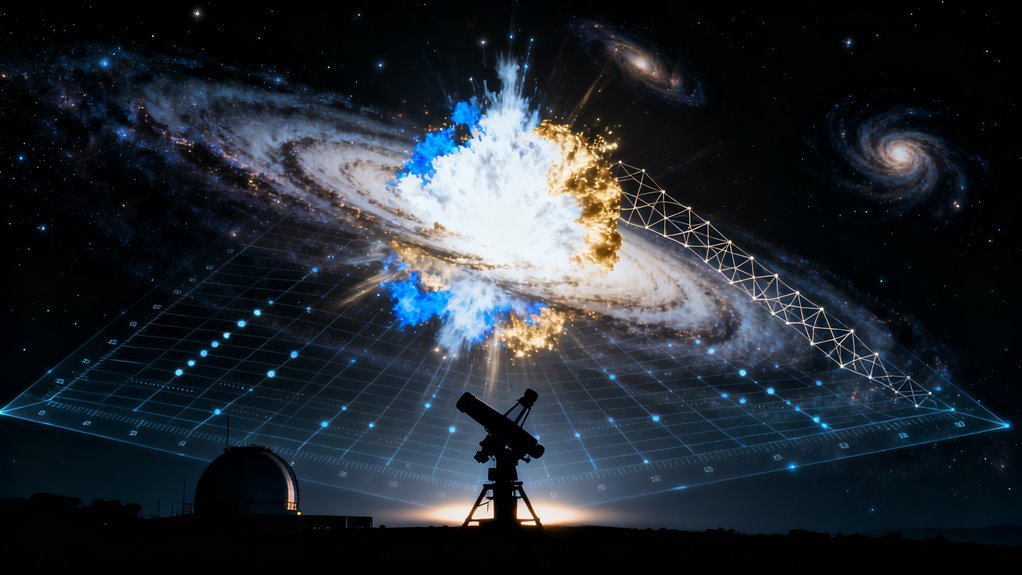
The universe produces supernovae at a pace that no team of astronomers can keep up with. That statement has been technically true for years, but only now is the gap between data volume and human capacity becoming an operational crisis. Modern sky surveys generate transient alerts by the millions, each one a potential supernova, a potential cosmological data point, a potential discovery that could refine our understanding of dark energy and cosmic expansion.
The old model of graduate students manually reviewing light curves and classifying candidates is not just slow. It is structurally incompatible with the scale of data that next generation telescopes are already producing.
What has emerged in response is a quietly maturing ecosystem of AI powered supernova frameworks. These are not experimental tools sitting in research papers. They are deployed, operational systems that ingest raw survey data, preprocess it, run model inference, and generate classification alerts with minimal human involvement.
The shift mirrors what we have seen across other scientific domains where machine learning moved from a novelty to infrastructure, but the astronomy use case carries a distinctive wrinkle: classification errors here have downstream consequences for precision cosmology. Get the typing wrong, and your constraints on the Hubble constant degrade. The stakes are subtle but real.
The Architecture of Autonomous Discovery
Understanding why these frameworks matter requires appreciating the sheer heterogeneity of the inputs involved. A supernova does not announce itself through a single data modality. Photometric light curves capture how brightness evolves over time. Spectra reveal chemical composition and expansion velocity. Host galaxy context provides redshift estimates and environmental clues.
Historically, astronomers synthesized all of this mentally, drawing on years of pattern recognition. The AI systems replacing that workflow must handle the same multimodal complexity, and the most capable frameworks now do.
On the photometric side, SuperNNova represents one of the more sophisticated approaches. Rather than engineering hand crafted features from light curves and feeding them to a classical classifier, it applies recurrent neural networks directly to the raw photometric time series.
The Bayesian neural network variants are particularly notable because they produce probabilistic outputs with genuine uncertainty quantification. This is not a small detail. In cosmology, knowing how confident you are in a classification matters as much as the classification itself. A Type Ia supernova misidentified as a core collapse event introduces systematic bias into distance measurements. Calibrated uncertainty lets downstream analyses weight each event appropriately, similar to how AI models in solar storm prediction emphasize reliability.
SNMACHINE takes a different architectural philosophy, deploying an ensemble of classical and modern methods including k nearest neighbors, support vector machines, neural networks, and boosted decision trees to separate Type Ia from non-Ia events.
The reported performance, AUC values consistent with up to 95 percent purity, is strong enough for production use. Real world validation on Pan-STARRS1 data, where roughly 82 percent accuracy was achieved across 2,315 supernovae classified purely from photometry, gives a concrete sense of where the technology stands.
That number will strike some readers as modest. But consider the alternative: without these systems, most of those 2,315 events would never have been classified at all.
When Spectra Enter the Picture
Photometric classification alone has fundamental limits. Light curves can distinguish broad supernova categories, but precise subtyping, age estimation, and host contamination correction often require spectral data. This is where systems like DASH and SNIascore become critical.
DASH replaced traditional template matching, a technique that involved cross correlating observed spectra against libraries of known supernova templates, with a convolutional neural network that classifies spectra by type, age, redshift, and host galaxy properties simultaneously.
The practical implications are significant. Template matching is computationally expensive and scales poorly. It also tends to fail gracefully in the wrong direction, returning plausible but incorrect matches when the observed spectrum is noisy or atypical. A trained CNN can learn to handle degraded inputs more robustly, and DASH packages this capability into both a graphical interface and a Python library suitable for automated batch processing.
SNIascore deserves particular attention because of where it operates. Deployed within the Zwicky Transient Facility pipeline, it autonomously classifies Type Ia candidates from spectra and reports confirmed events to the Transient Name Server in near real time.
This is not a research prototype. It is an operational component of one of the most productive transient surveys currently running. The fact that AI is already making authoritative classification decisions that get published to the international astronomical community’s canonical database tells you something about how far trust in these systems has advanced.
STag occupies an interesting middle ground, using multi-label logistic regression to assign probabilistic spectral feature tags before feeding them into a neural network for final classification.
The two-stage approach has an elegant property: it creates an interpretable intermediate representation. Astronomers can inspect which spectral features the system identified before the final class determination, providing a form of explainability that pure end-to-end models lack.
What the Broader AI Industry Should Notice
There is a pattern here that extends well beyond astronomy. The evolution from individual ML models to integrated, autonomous decision pipelines is happening across every domain where data volume has outpaced human processing capacity.
In radiology, pathology, materials science, and climate modeling, we see the same trajectory: first, proof of concept classifiers. Then, deployed systems embedded in operational workflows. Finally, frameworks that handle the full pipeline from raw data to actionable output.
What makes the supernova case instructive is the emphasis on calibrated uncertainty. Most commercial AI deployments optimize for accuracy and treat confidence scores as an afterthought. Astronomers cannot afford that luxury because their downstream analyses propagate errors in ways that are mathematically well understood.
The Bayesian approaches embedded in systems like SuperNNova reflect a maturity of thinking about AI reliability that many industries have yet to adopt. If you are building AI systems where classification errors compound, whether in financial risk assessment, clinical diagnostics, or infrastructure monitoring, the astronomical community’s insistence on principled uncertainty quantification is worth studying. Northwestern University’s BTSbot exemplifies this philosophy in practice, having been trained on over 1.4 million historical images from nearly 16,000 sources to fully automate the search, detection, and classification of supernovae without human involvement.
The Vera Rubin Factor
Every discussion of AI in astronomy eventually arrives at the same inflection point: the Vera C. Rubin Observatory and its Legacy Survey of Space and Time, expected to begin full science operations in the near future.
LSST will generate roughly ten million transient alerts per night. That number is not a projection based on optimistic assumptions. It is an engineering specification derived from the telescope’s field of view, cadence, and depth.
No combination of human astronomers on the planet can classify ten million alerts per night. The frameworks described here are not optional infrastructure for the LSST era. They are prerequisites.
Without autonomous classification pipelines operating at scale, the scientific return on a multi-billion dollar telescope would be severely diminished. The investment in AI powered supernova classification is, in effect, an investment in making LSST scientifically viable.
This creates an interesting dynamic. The astronomical community has built these tools primarily with scientific motivations, but the engineering challenges they solve, real-time classification of heterogeneous streaming data with calibrated uncertainty at massive scale, map directly onto problems that commercial organizations face.
The techniques being refined for supernova classification could inform approaches to anomaly detection in network security, fraud detection in financial systems, or quality control in manufacturing.
Who Benefits and What Comes Next
The immediate beneficiaries are cosmologists studying dark energy and the expansion history of the universe. Larger, purer, better characterized supernova samples translate directly into tighter constraints on cosmological parameters.
The promise of AI here is not just automation for its own sake. It is the construction of datasets that would be physically impossible to assemble through manual effort.
But there is a subtler benefit for the broader AI research community. Astronomy provides a rare combination of massive labeled datasets, well understood physics that constrains what correct answers look like, and a culture of rigorous validation.
Models developed and validated in this environment carry a credibility that is hard to achieve in domains where ground truth is ambiguous.
The risk worth watching is overconfidence. As these systems become more autonomous and their outputs flow directly into scientific databases, the potential for systematic biases to propagate undetected increases.
An AI system that consistently misclassifies a rare subtype of supernova could introduce subtle errors into cosmological analyses that take years to identify. The community is aware of this, which is why uncertainty quantification and human-in-the-loop verification for unusual cases remain active areas of development.
What we are witnessing is not just the automation of a scientific workflow. It is the construction of essential infrastructure for the next decade of observational cosmology.
The frameworks being deployed today will determine how effectively humanity can exploit the flood of data from next generation telescopes. In a field where each data point is a star dying billions of light years away, the ability to classify what we see accurately, rapidly, and at scale is not a convenience. It is the difference between data and discovery.