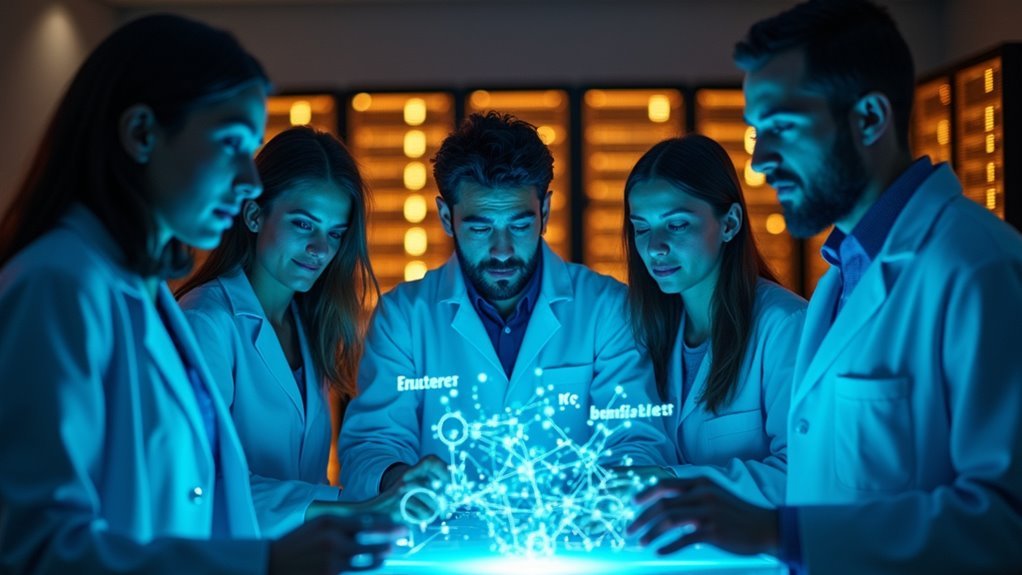

Artificial intelligence is quietly stepping out of chat windows and into real laboratories, where it is beginning to plan experiments, steer robots and refine ideas in real time. That shift matters now because several trends are converging at once: powerful language models, cheaper and more flexible lab hardware and mature automation frameworks are finally making self-driving labs practical beyond a handful of elite facilities. What once sounded like science fiction is turning into a new layer of scientific infrastructure that may change how discovery is done in chemistry, materials science, biology and beyond. In parallel, AI-driven systems are reshaping immunization coverage and healthcare delivery by enhancing patient prioritization, chronic disease management and vaccine distribution in vulnerable populations. Furthermore, the advancements in Mixture of Experts architectures are enabling these systems to operate efficiently with reduced overhead.
How we got from pipetting robots to self driving labs
Lab automation is not new. As early as the nineteen seventies, researchers explored autonomous experimentation and closed loop systems that could run sequences of experiments with limited human intervention. High throughput screening platforms in the nineteen nineties and two thousands pushed this further, letting teams test thousands of samples in parallel, but decisions about what to try still mostly came from humans.
The modern idea of a self-driving laboratory brings two strands together. One is the automation of experimental workflows through robotics and instruments that can prepare samples, run reactions and record measurements without manual handling. The other is the automation of data-driven decision making, where machine learning models and other algorithms choose which experiments to do next in order to achieve a defined objective.
Self-driving labs fuse robotic workflows with AI-driven experiment selection into a closed-loop engine of discovery
Reviews in chemistry and materials science now define a self-driving lab as an autonomous experimentation platform that integrates automated hardware, artificial intelligence and data infrastructure to close the loop between experiment design, robotic execution, in-line analysis and algorithmic decision making. These systems aim to accelerate the entire scientific method, from hypothesis generation through to updated hypotheses after each cycle of results.
What agentic AI actually does in the lab
The key change is that AI systems in the lab are no longer acting as isolated tools that answer questions on demand. Instead, they behave as agents that pursue objectives, decompose those objectives into tasks, call on digital tools and adjust plans based on incoming data.
Recent work in chemistry demonstrates this clearly. One group reported a robotic AI chemist driven by a hierarchical multiagent system called ChemAgents, powered by an onboard large language model with tens of billions of parameters. This system can design and execute complex multistep chemical experiments with minimal human intervention, deciding on reaction sequences, orchestrating robotic actions and interpreting measurement results to choose the next steps.
Broader reviews of autonomous laboratories describe the same pattern across domains. AI models plan experiments, design synthesis recipes, optimize reaction conditions and analyze characterization data, then propose improved experiments using techniques such as active learning and Bayesian optimization. In advanced platforms, the software effectively automates most of the steps of the scientific method, including generating and refining hypotheses based on cycles of evidence. Humans still define goals, constraints and safety limits, but day-to-day decision making about which experiment to run next increasingly sits with the agent.
Robots as the hands of AI
In this new architecture, robotic systems and automated instruments become the physical embodiment of the agent. Autonomous laboratories integrate liquid handlers, robotic arms, automated reactors and analytical instruments into coordinated workcells that can run around the clock.
These setups can perform tasks such as reagent dispensing, mixing, temperature control, plate handling and inline measurements without the need for constant human presence. Studies of autonomous robotic labs highlight their ability to conduct thousands of experiments per day, dramatically accelerating the exploration of chemical and materials spaces and improving synthetic chemistry automation.
By taking over repetitive or hazardous tasks, robotic platforms reduce human error, improve safety and free researchers to focus on higher-level reasoning and interpretation.
Concrete deployments show this model moving out of prototypes into industry. Atinary has launched a self-driving lab in Boston that integrates machine learning optimizers, robotics and data analytics to run closed-loop experimental campaigns for industrial research and development. In China, large autonomous laboratories combine robotic platforms, intelligent models and management systems to close the predict-make-measure loop for chemical discovery at scale.
Across these examples, the physical lab is increasingly treated as a programmable resource that software agents can control.
Closing the loop from design to discovery
The most important structural change is the move from isolated automated tools to end-to-end closed loop workflows. In an ideal self-driving lab, instruments and AI engines form a continuous cycle that spans design, fabrication, testing and analysis.
A typical loop looks like this. First, a decision engine selects experiments to run, often using active learning or Bayesian optimization to explore a large design space efficiently. Then, robotic systems execute the experiments, controlling conditions and collecting rich streams of sensor and instrument data as they go.
Next, software analyzes the results, quantifies uncertainty and updates models of the system under study. Finally, the decision engine uses those updated models to choose the next set of experiments, closing the loop and starting the cycle again.
Modern platforms emphasize the importance of unified data and metadata management to make this possible. Reviews of self-driving labs and autonomous experimentation stress that consistent data pipelines, laboratory information systems and orchestration software are as crucial as the robots themselves.
When instruments, databases and AI controllers are wired into persistent feedback cycles, experimentation stops being a sequence of manually scheduled steps and becomes a continuous process that can run for days or weeks with limited human adjustment.
From chatbots to lab in the loop ecosystems
The story is not just about individual labs upgrading their equipment. Industry collaborations and research consortia are building ecosystems where laboratories are directly integrated with high-performance computing and specialized AI platforms.
Commentators sometimes describe this as putting the lab in the loop with AI, rather than simply putting AI in the loop of analysis. Reports in major journals describe how self-driving labs are being adopted by start-ups and industrial research units to speed up chemical development and materials discovery.
A growing number of companies now operate autonomous experimentation platforms that can design and run research campaigns with much less day-to-day human intervention than traditional labs. The Acceleration Consortium and others maintain extensive collections of self-driving lab projects, spanning catalysis, energy storage, polymers, nanomaterials and more.
These initiatives reflect a broader trend toward viewing research infrastructure as a stack that combines hardware, robotics and software. AI agents sit on top of this stack, coordinating experiments and interpreting results, while underlying platforms manage scheduling, safety checks and resource allocation.
As this stack matures, the boundary between digital and physical experimentation becomes more porous, with simulations, literature mining and automated lab work feeding into one another.
Why this moment is different
Autonomous laboratories are not just a more polished version of older automation. Several specific advances make this wave qualitatively different.
First, large language models and related AI techniques allow agents to work with natural language protocols, scientific literature and informal problem descriptions, then translate them into detailed experimental plans. This is a step beyond the rule-based systems and constrained optimization routines that underpinned earlier automation efforts.
Second, hardware has become more modular and affordable. Reports note that falling prices for robotics, improved computer vision and more flexible automation frameworks enable smaller teams to assemble capable self-driving platforms without custom engineering every component.
Third, there is now a clearer understanding of how to architect autonomous experimentation systems. Recent reviews propose frameworks that distinguish degrees of autonomy in both software decision making and hardware execution and outline best practices for orchestration, safety and data management.
This shared vocabulary helps organizations design systems that can evolve from partial automation to higher autonomy over time, rather than aiming unrealistically for instant full autonomy.
Opportunities for science and business
If these systems reach scale, the upside is significant. Reviews across chemistry, materials science and biology argue that self-driving labs can greatly accelerate discovery by exploring more candidates, more intelligently, than human-guided trial and error can manage.
In synthetic biology, for example, self-driving labs that combine robotics with AI-driven experiment selection aim to test not just new conditions but new underlying hypotheses about genetic constructs and circuits, potentially speeding up design-build-test-learn cycles.
Autonomous laboratories also promise improvements in reproducibility and institutional memory. When every action, parameter and measurement is recorded as part of a machine-readable workflow, it becomes easier to audit experiments, share protocols and rerun studies with precise conditions.
That could help address long-standing concerns about reproducibility in several fields. For businesses, the value is both strategic and operational. Companies such as those running self-driving labs in Boston use closed-loop platforms to optimize formulations, process conditions and product performance across multiple objectives, from cost to sustainability to regulatory constraints.
Autonomous experimentation can shorten iteration cycles in areas like catalysis, battery materials and pharmaceuticals, which translates into faster time to market and better use of research budgets.
At the same time, these systems change the nature of scientific work. As more manual tasks are automated, researchers can focus on framing questions, designing campaigns, validating surprising results and connecting discoveries to real-world constraints.
Early adopters describe a shift toward scientists acting as supervisors of autonomous campaigns and interpreters of patterns, rather than as operators of individual instruments.
Risks, limits and misconceptions
The picture is not purely optimistic. It is important to be clear about what these systems can and cannot do today.
Experts interviewed about current self-driving labs emphasize that no facility operates in a truly fully autonomous manner. Human scientists still set objectives, validate results, intervene when systems behave unexpectedly and handle complex judgment calls.
Reviews of autonomous laboratories similarly stress that present platforms require substantial human oversight for safety, maintenance, troubleshooting and scientific interpretation. There are also real technical risks. AI agents can chase narrow optimization goals and miss broader scientific insights if their reward functions are poorly designed.
They can learn biases from historical data, reinforcing existing blind spots in the literature or industrial practice. Closed-loop systems that explore a small region of a design space very efficiently may give a false sense of completeness if the initial region was poorly chosen.
Safety and security are additional concerns. Autonomous laboratories dealing with hazardous chemicals or biological agents require robust safeguards to prevent accidents or misuse. Cyber-physical security becomes deeper than traditional information security, because an intrusion could in principle modify experimental plans or instrument parameters with physical consequences.
Review articles propose integrated management and decision systems to monitor and control these risks, but implementing them well is non-trivial and remains an open challenge.
Finally, there are workforce and ethical questions. While autonomous labs can reduce tedious work, they may also change job profiles and expectations for technicians and early career researchers. Institutions will need to rethink training, evaluation and credit for work that involves designing and supervising autonomous campaigns rather than conducting each experiment by hand.
How researchers and organizations can prepare
Given these opportunities and risks, it helps to treat agentic AI in the lab as a capability to be built deliberately rather than a product to be installed.
The first foundation is data. Successful self-driving labs rely on high-quality structured data, standardized metadata and integrated laboratory information systems. Research groups that begin by organizing their data pipelines and digitizing protocols will be better positioned to benefit from autonomous experimentation later.
The second is interdisciplinary skill. Autonomous labs sit at the intersection of domain science, automation engineering, machine learning and software operations. Teams that invest in cross-training, shared vocabularies and collaborative workflows will adapt more smoothly as more autonomy is introduced.
The third is governance. As reviews note, closing the loop between AI and physical experimentation requires careful thinking about safety thresholds, stop conditions and human-in-the-loop escalation paths. Organizations should develop clear policies for what kinds of experiments are eligible for autonomous execution, how results are validated and how responsibility is shared between human supervisors and automated systems.
Many groups will find it practical to start with semi-autonomous loops in narrow applications, such as optimizing a single reaction or characterization procedure, before scaling up to broader discovery campaigns. This stepwise path allows teams to gain confidence, refine their infrastructure and learn where the real bottlenecks and risks lie in their own context.
The next decade of agentic science
Looking ahead, autonomous laboratories and AI agents are likely to become a normal part of scientific infrastructure rather than a headline novelty. Reviews already describe a trajectory in which self-driving labs gradually automate more of the scientific method, while humans remain essential for creative leaps, cross-domain framing and interpretation.
In a mature ecosystem, a researcher might specify a goal in natural language, for example, a target property in a new material or a performance constraint for a chemical process. An agent would then design a campaign, draw on literature and simulation, orchestrate experiments in one or more robotic labs and return not just optimized candidates but also uncertainty estimates and alternative hypotheses.
Human experts would decide which paths to pursue, how to generalize the findings and how to connect them to societal needs and constraints.
The labs that thrive in this future will likely be those that treat automation and AI as extensions of human inquiry rather than replacements for it. Trustworthy systems will be transparent about their data, methods and limits, and organizations will reward the kind of scientific judgment that knows when to accept an automated result and when to challenge it.
Self-driving labs will not make human scientists obsolete. They will change what it means to do science well, shifting attention from operating instruments to designing questions and systems. For researchers, businesses and policymakers, the real challenge is not whether to adopt agentic AI in the lab, but how to guide it so that faster discovery also means better, safer and more responsible discovery.
Conclusion
Viewed from a distance, the shift is unmistakable. The most consequential AI systems are no longer the chatbots trading jokes and summaries on our screens. They are emerging as quiet collaborators at the lab bench, woven into the instruments that design experiments, manipulate matter, and uncover patterns in data that would overwhelm unaided human intuition. This matters now because the infrastructure for autonomous scientific discovery is finally arriving at scale. Agent based AI systems are connecting directly to robotic labs, simulation platforms, and real time data streams, turning laboratories into engines of accelerated discovery rather than just places where models are tested after the fact.
From chatbots to lab collaborators
The public story of modern AI has been dominated by conversational systems. Large language models became the face of the technology because they are easy to demo and intuitively impressive. Yet most of the real value for science does not come from composing emails or summarizing papers. It comes from models that can propose a new catalyst, refine a biological sequence, or redesign an experiment overnight.
In 2026 AI is already generating scientific hypotheses, designing and running experiments through automated equipment, predicting molecular structures and drug interactions, and collaborating with researchers across biology chemistry materials science and medicine. Industry leaders describe this as a transition from AI as assistant to AI as collaborator. Peter Lee at Microsoft Research, for example, highlights systems that can not only suggest hypotheses but also operate tools and applications that directly control scientific experiments while working alongside human and AI colleagues. These capabilities move AI from the fringes of the research process into the core of how new knowledge is discovered.
How AI entered the laboratory
The move from chatbot to lab collaborator did not happen in a single leap. Early machine learning in science focused on narrow tasks such as image recognition in microscopy, statistical pattern finding in clinical data, and optimization of chemical reactions. Over the last decade progress in generative models and reinforcement learning allowed AI to begin proposing candidate molecules, materials, and experimental conditions rather than just ranking what already existed.
The current phase is defined by so called autonomous or agentic scientific workflows. Recent surveys describe frameworks where intelligent agents manage a closed loop cycle of observation, hypothesis generation, experimental planning and execution, result analysis, and validation. In this model the AI does not simply answer questions. It orchestrates the entire research pipeline, continually refining its models with each batch of experimental results. Horizon scanning work in the life sciences points to emerging lab in the loop systems in which molecular design, wet lab testing, and model retraining are integrated into continuous automated cycles. Once that loop closes, laboratories cease to be purely human driven environments and become hybrid ecosystems of scientists code and machinery.
What lab based AI can do today
The most immediate impact is in domains with rich data and complex search spaces. Drug discovery offers a clear example. Comprehensive reviews covering recent years show AI methods operating across the entire pipeline from target identification and hit discovery through lead optimization and even clinical development stages. Models screen vast libraries of compounds, predict binding affinities, and suggest modifications that improve efficacy or reduce toxicity, cutting years off traditional discovery timelines.
In materials science generative models propose new alloys, polymers, or battery chemistries and then iterate through simulated properties to identify promising candidates for physical testing. In climate and environmental research AI accelerates simulations, optimizes experimental designs, and links remote sensing data with laboratory measurements to improve models of complex systems. Across these fields agent based AI systems are moving from narrow analytical tools to integrated collaborators that help choose what to test next, not just interpret what has already been tested.
Robotic laboratories amplify this effect. Recent analyses describe AI scientists as systems of agents that work autonomously alongside human teams, coordinating instruments, assays, and data pipelines across the research lifecycle. In connected environments AI systems can schedule experiments, adjust parameters on the fly based on preliminary results, and maintain detailed logs that feed directly back into model training. The result is a lab in which ideas can be explored much faster than human bandwidth alone would allow.
The role of web grounded models and Perplexity Sonar
To function as collaborators rather than isolated tools, AI systems in the lab need access to accurate and current knowledge. Web grounded models such as Perplexity Sonar show how this layer can work in practice. Sonar is an in house model optimized for answer quality and user experience, built to deliver real time research grounded in a wide corpus of online information and scientific literature. The Sonar Pro API extends this capability to developers, allowing them to build generative search functions into their own tools while preserving citation links and clear reasoning trails.
In a laboratory context models like Sonar can sit at the interface between global knowledge and local experimentation. They can synthesize the latest papers, regulatory guidance, and preprints, connect that synthesis to internal data, and then feed constraints or insights into agent systems that control experiments. This combination closes an important gap. It reduces the risk that lab AI systems operate on outdated or incomplete assumptions, and it helps human researchers see how a proposed experiment fits into the broader landscape of the field.
Why this shift matters for technology and business
For technology companies the emergence of AI as a lab collaborator changes the center of gravity. Value moves away from eye catching chat interfaces toward robust back end platforms that can integrate data sources, reasoning engines, and physical automation. Providers that can combine trusted web grounded models with domain specific scientific engines and reliable lab integration will hold a structural advantage. Investment is already flowing heavily into life sciences where commercial AI companies are building biological design tools, agent capabilities, and lab integration infrastructure.
For businesses in pharmaceuticals materials and energy the implications are equally large. If AI can reliably shorten discovery cycles and increase the hit rate of successful candidates, it reshapes research and development economics. Companies can pursue more exploratory projects, run parallel lines of inquiry, and respond faster to new scientific opportunities or threats. At the same time, relying on AI for core intellectual property introduces new dependencies and risk profiles. Competitive advantage may hinge on who has access to the most capable lab integrated AI systems, not just on who hires the best scientists.
Societal impacts and new risks
A world where AI operates inside laboratories rather than primarily on screens carries both promise and serious concerns. On the positive side, faster discovery could translate into earlier treatments for disease, more efficient materials for clean energy, and more responsive tools for managing climate and ecological challenges. Agentic AI systems can help explore high dimensional spaces of possible solutions in ways that are simply beyond human cognitive limits.
However, horizon scans in the biosecurity community emphasize that the same capabilities lower barriers to potentially harmful experimentation. Protein design tools, advanced coding agents, and lab integrated models expand what smaller groups can attempt in biology and chemistry. Without strong governance, transparent auditing, and controlled access, the acceleration of beneficial research could be mirrored by acceleration of risky or malicious work.
There are also more subtle challenges. Overreliance on AI generated hypotheses and experimental plans may bias science toward directions that are more legible to current models and away from genuinely novel paradigms that do not fit well within existing data. Reproducibility can be compromised if autonomous workflows are not thoroughly logged and if models or code are updated without clear versioning. Ethical questions arise around attribution of discovery when AI systems contribute substantially to research outcomes, raising issues for publication credit patent law and public trust.
Experience expertise and trust in lab based AI
For this shift to be genuinely positive, laboratories need more than clever software. They need new practices that integrate experience and expertise with machine capabilities. Current research frames the human role in these systems as curation, direction, and interpretation. Scientists decide which AI generated hypotheses are worth pursuing, design experimental regimes that will yield discriminating results, and place the data in historical and theoretical context. AI handles breadth and speed, while humans provide depth judgment and responsibility.
Trustworthiness then becomes a shared property of the entire system. Web grounded models such as Sonar can provide transparent citations and reasoning chains that allow researchers to audit the information used to guide experiments. Agent frameworks for scientific discovery are increasingly designed with explicit logging, validation steps, and performance benchmarking across multiple domains. Governance efforts in the life sciences urge the development of standards for lab in the loop AI systems, including provenance tracking for designs, access controls for sensitive capabilities, and red team style evaluations of dual use risk.
What comes next
On a near term horizon experts expect steady improvement across language models biological design tools and agent capabilities, along with deeper integration of AI with wet lab systems. Over the next several years the most transformative developments are likely to be fully closed loop discovery platforms where molecular or material design, automated experimentation, and continual model retraining operate as a single coordinated system. In such environments, the boundary between hypothesis and experiment blurs. Exploration becomes an ongoing conversation between human researchers and machine collaborators conducted through code instruments and models rather than chat windows.
The key takeaway is that the next AI revolution will not be defined by how natural a chatbot feels or how impressive a synthetic essay looks. It will be defined by how many real discoveries are made in laboratories that have quietly woven AI into every stage of their work, and by how responsibly those discoveries are pursued, shared, and governed. For technology leaders scientists and policymakers the task now is to build systems that combine speed with rigor and innovation with safety, so that these new lab collaborators extend the frontiers of knowledge without undermining the foundations of trust reddit