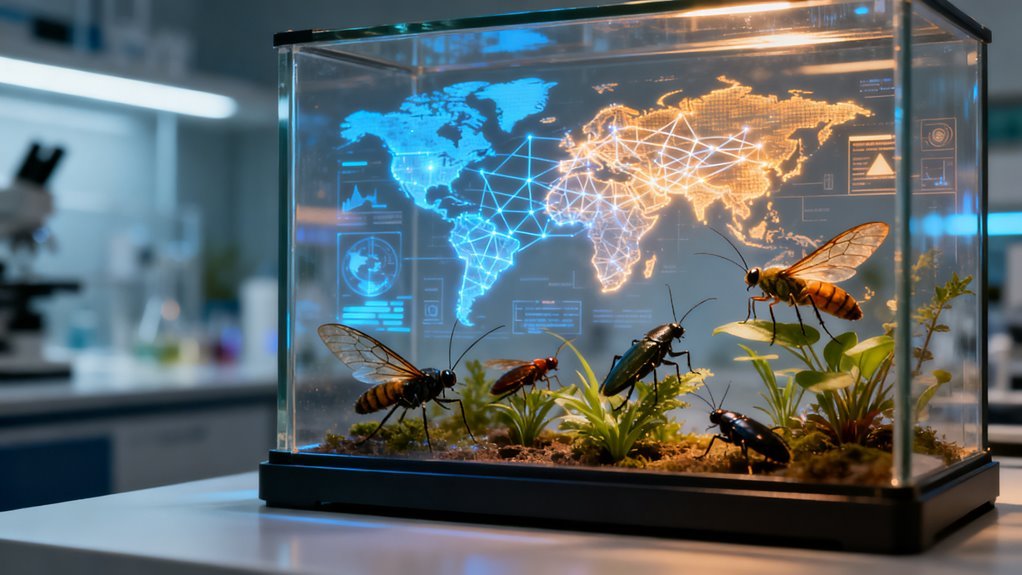

Climate change is quietly rewriting the rules of insect life, and that is starting to rewrite the rules of agriculture, public health, and conservation along with it. Insects respond faster to shifting temperature and moisture than most plants or vertebrates, which makes them both early warning signal and frontline risk. The fact that scientists are now using artificial intelligence to forecast how insects will adapt is not a niche research story. It is the beginning of a predictive layer for food systems, ecosystems, and biosecurity.
For years, climate and ecology models captured insect dynamics as a side effect inside large scale simulations. Those tools were built for average trends and broad ranges, not for the noisy, eruptive behavior of locusts, beetles, and crop pests that can swing from harmless to catastrophic in a single season. The current wave of AI driven entomology changes that balance. Computer vision systems trained on massive image archives can already distinguish species, estimate abundance, and track diversity far beyond what human observers can manage in real time. Neural networks that ingest climate data, land use records, and historical insect counts are learning the nonlinear relationships that govern outbreaks and collapses. These systems push insect forecasting from descriptive ecology toward something closer to operational infrastructure. Notably, public health agencies are actively exploring the integration of AI in monitoring insect behavior due to its implications for disease dynamics. Furthermore, research shows that AI conversations in this domain often focus on collaborative problem-solving rather than full automation. This trend aligns with the U.S. advantage in AI compute resources, which enhances the capacity for such predictive modeling.
The technical stack behind this is not exotic for anyone working with modern machine learning, but its deployment into the messy reality of fields and forests is significant. Models that would look familiar in industry sit at the core. Convolutional networks interpret video streams from smart traps and field cameras, counting and classifying insects as they arrive. Sequence models and gradient boosted ensembles absorb time series of weather, soil moisture, and vegetation indices to estimate the probability and intensity of future outbreaks. Species distribution models, long a workhorse of conservation planning, are being upgraded with AI enhanced workflows that combine scenario based climate projections with fine scale ecological data to map where suitable habitat for key species is likely to appear or vanish. By linking camera-trap imagery with machine learning models, these systems can automatically detect novel moth species and quantify the range shifts that signal climate-driven redistribution.
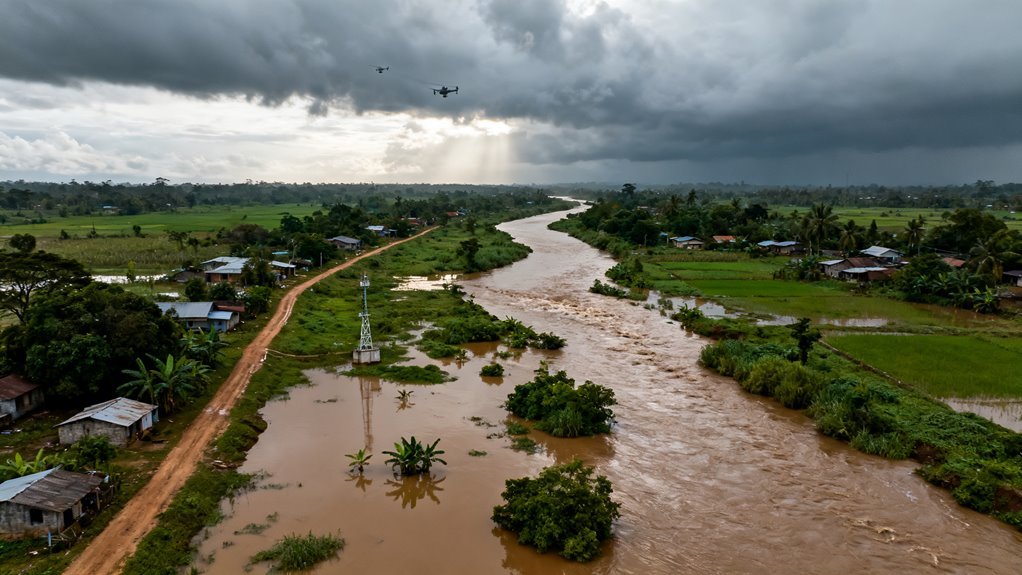
What has changed is not the existence of these algorithms, but their integration into continuous monitoring and forecasting pipelines. Remote sensing and AI already underwrite many precision agriculture platforms that optimize irrigation and fertilization. The same approach is now moving into pest risk. Drones with thermal and multispectral cameras scan orchards and forests. Ingestion pipelines process imagery and weather feeds. Predictive models generate daily risk surfaces rather than seasonal summaries. Instead of a researcher publishing a paper that says a beetle is likely to expand northward under a certain warming scenario, an operational system can tell a grower that risk in a specific field is rising next week.
This shift mirrors a larger pattern in climate AI. Early projects focused on mitigation levers, such as optimizing energy systems or tracking methane leaks. In the last two years, more attention has moved toward adaptation. AI models now improve extreme weather forecasts, integrate diverse data sources to understand regional climate impacts, and help planners test different resilience strategies. Insect adaptation sits at the intersection of these trends. It touches food security, ecosystem stability, and disease dynamics at once. It is one of the clearest cases where adaptation cannot be reactive. By the time a swarm is visible, it is too late.
From a business perspective, that opens a new category of products. Agtech has long promised predictive pest management, often built around rule based decision support tools and relatively simple degree day models. Those systems are useful but limited to known relationships and local calibration. AI driven platforms that learn from global datasets of pest incidence, satellite imagery, and climate reanalyses can, in theory, generalize better and update themselves as conditions drift. Venture backed startups already pitch climate resilient farming dashboards. Adding credible insect adaptation forecasts turns those dashboards into risk instruments relevant not only to growers, but to insurers, commodity traders, and supply chain managers.
For governments, the strategic value is even more direct. National plant protection agencies and forest services deal with invasive species and native pests that respond strongly to climate signals. Ecological forecasts of insect ranges suggest that many taxa will shift toward cooler regions, with clear regional winners and losers under future scenarios. AI systems that monitor borders, ports, and transport hubs with automated traps and image recognition can raise alarms earlier when a dangerous species appears outside its historical range. Combined with climate scenario analysis, such systems help agencies prioritize surveillance funding and quarantine rules where risk is actually climbing, not where it has traditionally been high.
The comparison with past AI breakouts is instructive. When large scale language models arrived, they shifted how information work is done because they gave a general tool that could be applied across domains. Insect adaptation forecasting is the opposite. It is sharply domain specific. It depends on entomological expertise, curated ecological datasets, and long term field monitoring. That makes it less likely to become a mass consumer interface, but more likely to embed deeply into specialized workflows in agriculture, conservation, and climate services. The direction of AI for the next several years is arguably defined by this kind of specialization. Foundation models provide broad capabilities. Value comes from stitching those capabilities into pipelines that solve concrete problems under data and regulatory constraints.
Technically, the challenging part is not training yet another neural network. It is learning causal structure in a system where climate, land use, and species interactions all drive outcomes. Time series machine learning frameworks in ecology are beginning to reconstruct how variables like temperature and precipitation cause changes in insect abundance, including lagged effects and density dependence. That matters because simple correlations are brittle as regimes shift beyond historical bounds. If a model understands that a series of warm winters raises baseline survival for a pest, which then amplifies damage under a subsequent drought, it can flag compound events that old statistical regressions glossed over.
However, there are risks in embracing these models as truth engines. Ecological datasets are sparse in some regions, biased toward economically important species, and often limited to short time windows. Species distribution models are sensitive to those limitations, and forecasts can diverge significantly depending on modeling choices. AI amplified systems inherit and magnify those quirks. A platform that overestimates risk can drive unnecessary pesticide use and economic loss. One that underestimates risk can leave communities exposed to crop failure or ecosystem collapse. This is not hypothetical. Studies of AI in entomology highlight the need for validation, public reference datasets, and integration with molecular tools to avoid misclassification and overconfidence.
Ethically, there is a tension between surveillance and stewardship. Smart traps that record insects at high temporal resolution across landscapes are powerful for conservation, particularly where baseline monitoring has been weak. They also create continuous data about land use and agricultural practices. In regions where farmers already worry about data ownership and platform lock in, adding insect monitoring to the mix could deepen mistrust if governance is not clear. As AI systems start recommending pesticide regimes or planting schedules, the usual questions about transparency and accountability apply. Who is responsible if a forecast is wrong and a harvest fails? How are models audited? Can local communities influence how risk thresholds are set?
Regulatory frameworks are only beginning to catch up. Climate policy documents increasingly acknowledge the role of AI in adaptation, from early warning systems to ecosystem monitoring. Yet insect specific regulation remains fragmented. Plant protection rules were written for inspection and reporting, not for high frequency predictive analytics. Environmental regulators will need to decide how to treat AI based biodiversity forecasts in impact assessments and conservation planning. Insurance regulators will need to think about how to handle models that reprice agricultural risk on the fly. The technology does not wait for these decisions. Once robust models exist, commercial pressure to deploy them is strong.
For developers and AI teams, insect adaptation forecasting is a reminder that frontier models are only part of the story. The most interesting work happens when those models are embedded in messy sensing environments. Building a locust early warning network means dealing with drones that miss flights, sensors that drift, traps that get clogged, and farmers who sometimes ignore alerts. It is closer to building a real time trading system than to publishing a benchmark leaderboard. The demand is for platforms that can ingest unreliable data, express uncertainty clearly, and still produce actionable guidance.
Looking ahead, one plausible path is convergence between these ecological prediction systems and general purpose AI platforms from major players like OpenAI, Google, and Microsoft. Those companies are investing heavily in climate related AI, including weather models, earth system simulations, and geospatial analytics. As interfaces mature, domain specific insect models could become modules inside broader climate risk stacks. A utility planner might ask a system to evaluate a new transmission corridor. The same platform could surface not only flood and fire risk, but also predicted shifts in insect communities that affect forest health and maintenance schedules.
Another path is more bottom up. Local cooperatives, research institutes, and regional governments might use open source models and data to build their own insect adaptation tools, tailored to specific crops and ecosystems. That would reduce dependence on global platforms and allow closer alignment with local knowledge. The fact that researchers are publishing detailed case studies on AI enhanced insect monitoring and forecasting suggests that the ingredients for such ecosystems are already available. Whether the market favors centralized climate risk services or distributed community based tools remains an open question.
What is clear is that insect adaptation forecasting will not stay confined to journal articles. Once you can turn streams of ecological data into quantitative predictions of where and when populations will shift, you have something that looks very much like an operating system for living landscapes. In the same way that logistics and finance were transformed by the ability to see and predict flows in real time, agriculture and conservation are now on the cusp of being reshaped by visibility into insect dynamics. That development matters today because climate driven change is no longer a future scenario. It is unfolding in current planting decisions, current forest management plans, and current disease surveillance strategies.
The biggest mistake would be to treat AI for insect adaptation as a clever tool for scientists and nothing more. It is an early example of how predictive ecology and climate AI will fuse into decision systems that touch every part of the economy. The organizations that learn to use these forecasts thoughtfully, with an eye on uncertainty, equity, and long term resilience, will have a structural advantage in a world where insects are no longer behaving as they used to.
Conclusion
Ultimately, the convergence of entomology and artificial intelligence is turning insect forecasts into a strategic early warning system for a world in flux. Models that digest massive ecological datasets into signals of risk and resilience show where insect populations are likely to expand, retreat or collapse as climate, land use and chemistry shift. These projections do not slow planetary disruption, but they sharpen the choices available to conservation agencies, farmers and health officials by revealing which interventions matter most and when. Used well, this intelligence moves planning from reflex to anticipation, aligning policy, supply chains and public health programs with the ways insects are poised to reshape ecosystems, markets and everyday life.