Most people still think of deepfakes when they hear about AI cloning. That framing is outdated. What is emerging now is something far more ambitious and far more consequential: full digital replicas of individual humans, built to think, speak, remember and decide the way you do. Not for a single viral video. For years. Possibly forever.
A wave of startups and platforms is racing to build these personal digital clones, and the technology is maturing faster than the public conversation around it. The implications stretch from grief tech to corporate productivity to questions about identity that legal systems are not remotely prepared to answer. Understanding what is actually being built, and why, matters more than most people realize.
What “Cloning” Actually Means Now
The word clone conjures science fiction, but the engineering is grounded in well understood techniques stitched together in new ways. Voice synthesis, face generation, large language model fine tuning, retrieval augmented generation and persistent memory systems are all individually familiar to anyone following AI. The novelty is in the integration: combining all of these into a single coherent system that is trained on and continuously learns from one specific person.
The real breakthrough isn’t any single AI technique — it’s stitching them all together around one person.
Companies like HeyGen and Morfoz focus on the audiovisual layer, generating realistic video avatars that reproduce a person’s face and voice with minimal input. Ten seconds of audio can produce a passable voice clone. Thirty minutes of recorded speech yields something considerably more convincing, and several hours of data pushes the output into territory where casual listeners cannot reliably distinguish the clone from the original.
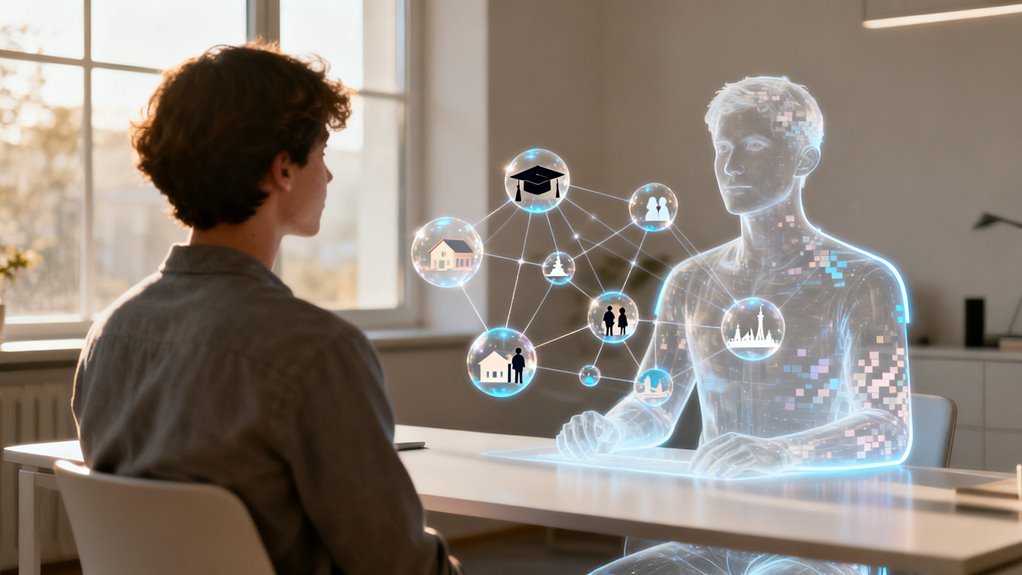
But the more interesting and more unsettling work is happening at a deeper layer. MindBank Ai, Twineo and Uare.ai are building what they call digital twins: systems that ingest not just biometric data but social media histories, chat logs, uploaded documents, personal files and ongoing conversation transcripts. The goal is not to reproduce how you sound. It is to reproduce how you think. Uare.ai has raised roughly $10.3 million to pursue this, which signals real investor conviction even at this early stage.
Eternime takes the concept further into what might be the most emotionally charged use case: posthumous interaction. The platform is designed to shadow a user throughout life, collecting memories, preferences and behavioral patterns so that after death, an avatar can continue to interact with loved ones. Replika, which originated from a memorial chatbot, operates in adjacent territory as a companion AI, though it approximates personality rather than attempting exact replication.
Why Memory Changes Everything
The technical leap that separates today’s digital clones from last year’s chatbots is persistent, structured memory. Modern conversational AI engines can now store long term context pulled from chats, uploaded files and connected applications. They combine explicitly saved information with automatically inferred insights that background processes curate over time.
Users can typically view, edit or delete this stored data, but the default trajectory is accumulation. This matters because memory is what transforms a language model from a generic conversational partner into something that feels like a specific person. When a clone remembers your ongoing projects, your dietary preferences, the names of your children and the argument you had with your business partner last Tuesday, the interaction starts to feel qualitatively different. It crosses a line from tool to simulacrum.
The architecture typically works through a combination of vector databases for semantic retrieval, structured knowledge graphs for relational data and system level prompts that encode values, decision making heuristics and personality traits. Each conversation with the clone becomes additional training signal, creating a feedback loop where the replica becomes more accurate the more it is used. The person being cloned is, in effect, continuously teaching the system to be them.
Who Benefits and Who Should Be Worried
The obvious beneficiaries are the platforms themselves. The market for personal AI is growing rapidly and digital cloning represents a powerful retention mechanism. Once a user has invested dozens of hours feeding data into a digital twin, switching costs become enormous. That data moat is arguably more defensible than any technical advantage.
For individual users, the appeal varies by use case. Content creators can scale their presence by deploying clones to answer fan questions or appear in videos. Executives can delegate routine communications to a digital twin trained on their decision making style. Families dealing with terminal illness or loss see genuine emotional value in preserving a loved one’s voice and personality. The commercial side is also accelerating, as these clone platforms now allow translated video messages to be delivered in over 175 languages with synchronized lip movement, removing one of the biggest barriers to global reach.
But the risks are substantial and underexplored. Consent is the most immediate problem. If someone can clone your voice from ten seconds of audio scraped from a podcast appearance, what meaningful consent framework applies? Existing deepfake legislation focuses primarily on nonconsensual pornography and election interference. It does not address the creation of a persistent, interactive replica of a living person without their knowledge. AI hiring tools can similarly perpetuate biases if not properly monitored.
Data ownership presents equally thorny questions. When a platform ingests your chat logs, social media posts and personal files to build a digital twin, who owns the resulting model? If the company is acquired or goes bankrupt, what happens to the clone? Can it be subpoenaed? Can it testify? These are not hypothetical edge cases. They are foreseeable outcomes of technology that already exists.
The Identity Problem Nobody Is Solving
There is a deeper issue that the industry has barely begun to grapple with. A sufficiently accurate digital clone does not just represent you. In many practical contexts, it becomes indistinguishable from you. If your clone responds to a business partner’s email in a way that is consistent with your communication style and decision making patterns, is that communication binding? If your posthumous clone makes statements about your wishes that conflict with your written will, which takes precedence?
Legal systems worldwide are not equipped for these questions. Digital identity law was built for passwords and biometrics, not for autonomous agents that can simulate a person’s cognitive patterns. The European Union’s AI Act classifies certain AI systems by risk level, but personal digital clones sit awkwardly across multiple categories. They involve biometric data processing, which triggers strict requirements, but they also involve creative expression and personal autonomy, which regulators have been reluctant to constrain.
In the United States, the regulatory landscape is even more fragmented. Some states have passed laws protecting individuals’ likeness rights, but these were designed for celebrity endorsements, not for interactive AI replicas that evolve over time. The gap between what the technology can do and what the law addresses is widening with every model improvement.
How This Fits Into the Broader AI Trajectory
Personal digital cloning sits at the intersection of several converging trends that the major AI labs have been driving for the past two years. OpenAI’s investment in persistent memory for ChatGPT, Google’s push toward deeply personalized AI assistants through Gemini, and Apple’s on device intelligence strategy all point toward the same destination: AI systems that know you intimately and can act on your behalf.
The difference is that the major labs are approaching personalization cautiously, constrained by brand risk and regulatory scrutiny. Startups like Uare.ai and MindBank Ai are moving faster precisely because they are smaller and less visible. This creates a familiar dynamic in technology: the most consequential experiments happen at the margins before the incumbents figure out how to respond.
There are echoes of the early social media era here. Facebook did not invent social networking, but it eventually absorbed the innovations pioneered by smaller platforms and scaled them to billions of users. It is reasonable to expect that if personal digital cloning proves commercially viable, the major AI companies will integrate similar capabilities into their existing products. When that happens, the scale of data collection and the complexity of the governance challenges will increase by orders of magnitude.
What Comes Next
The trajectory is clear even if the timeline is uncertain. Within the next two to three years, expect digital cloning tools to become significantly more accessible and significantly more capable. Voice and face cloning will become commodity features. The competitive differentiation will shift toward cognitive fidelity: how well a clone can replicate not just what you say but how you reason, what you prioritize and how you respond under uncertainty.
The companies that win this market will be the ones that solve the trust problem. Users need to believe their data is secure, their consent is respected and their clone will not be misused after they lose control of it. That is a harder problem than any of the underlying AI engineering.
For businesses, the practical advice is straightforward. Start thinking now about policies governing employee digital clones. Consider what happens when a departing executive’s digital twin still exists on a company platform. Evaluate the liability implications of AI communications that are indistinguishable from human ones.
For individuals, the calculus is more personal. The technology to build a version of you that persists beyond your control, and potentially beyond your lifetime, is no longer theoretical. Whether that prospect feels like a gift or a threat probably depends on how much you trust the companies building it. Given the industry’s track record on data stewardship, a healthy dose of skepticism seems warranted.
Conclusion
The real question is not whether digital clones will become indistinguishable from the people they replicate. That threshold is approaching faster than most people realize. The question that should concern technology professionals, founders and policymakers right now is what happens when the infrastructure for personal AI replication becomes cheap, accessible and impossible to regulate after the fact.
We have watched this pattern before. Social media platforms launched with utopian promises about connection and self expression, then spent the next decade retrofitting guardrails after the damage was already embedded in culture. Digital cloning technology is following an eerily similar trajectory, except the stakes are considerably higher. When your clone can remember your life, speak in your voice and interact with others on your behalf, the line between representation and impersonation does not blur. It disappears.
What Actually Changed
Several converging developments pushed digital cloning from research curiosity to practical reality in the past eighteen months. Large language models from OpenAI, Anthropic and others reached a level of conversational fluency where fine tuning on personal data produces outputs that genuinely sound like a specific individual. Simultaneously, voice synthesis technology from companies like ElevenLabs matured to the point where cloning someone’s speaking patterns requires only minutes of audio. Memory architectures, including retrieval augmented generation and long context windows now stretching past a million tokens, allow these systems to maintain coherent personal histories rather than generic responses.
The combination matters more than any single breakthrough. Previous attempts at digital avatars felt hollow because they could mimic surface patterns but lacked the contextual depth that makes a person feel like themselves. That gap is closing rapidly. Startups like Eternos, HereAfter AI and several stealth companies are building platforms specifically designed to ingest journals, messages, photos and conversations, then reconstruct a persistent digital identity that family members or colleagues can interact with indefinitely.
Who Benefits and Who Should Be Worried
The most immediate commercial applications center on legacy preservation and grief technology. The market for this is larger than skeptics assume. A 2024 survey by the Pew Research Center found that nearly 40 percent of American adults expressed interest in some form of digital preservation of a deceased loved one. That represents a substantial addressable market, and venture capital has noticed. Funding for personal AI and digital identity startups tripled between 2023 and early 2025.
But legacy preservation is the gentle use case. The ones that deserve scrutiny involve living people. Consider what happens when a founder creates a digital clone trained on years of strategic thinking and deploys it to handle investor communications. Or when a public figure’s clone generates content at scale without clear disclosure. Or when an estranged family member builds a clone of someone without their consent using publicly available data.
Developers building in this space face a design challenge that goes beyond technical capability. The systems that produce the most convincing clones are also the ones most easily weaponized for fraud, manipulation and unauthorized impersonation. There is no architectural trick that neatly separates legitimate use from abuse when the core technology is fundamentally about replication.
The Regulatory Vacuum
Right now, legal frameworks are woefully unprepared. In most jurisdictions, creating a digital clone of a living person without consent occupies a gray zone. Existing laws around likeness rights, originally designed to prevent unauthorized use of celebrity images in advertising, were never written to address persistent interactive replicas. The EU AI Act includes provisions around deepfakes and synthetic media disclosure, but enforcement mechanisms remain untested. In the United States, a patchwork of state laws offers inconsistent protection at best.
This regulatory gap creates a window that cuts both ways. For legitimate companies, it means room to innovate without immediate compliance burdens. For bad actors, it means room to operate with near impunity. The most likely regulatory response will be reactive rather than proactive, arriving after a high profile incident involving a nonconsensual clone causes enough public outrage to force legislative action.
What This Tells Us About Where AI Is Heading
Digital cloning is not a standalone phenomenon. It sits at the intersection of several trajectories that define the current moment in artificial intelligence: personalization, agent autonomy and the steady erosion of reliable signals for distinguishing human generated content from machine generated content. Each of these trends accelerates the others.
The companies that will define this space over the next three to five years are not necessarily the ones building the largest models. They are the ones solving the trust and verification layer. How do you prove a digital clone was authorized by the person it represents? How do you ensure a clone’s outputs remain faithful to someone’s actual views rather than drifting through model updates? How do you handle a clone’s interactions after the original person dies and can no longer provide corrections?
These are not hypothetical problems. They are engineering and governance challenges that need answers before the technology fully matures. The organizations that solve them credibly will capture enormous value. The ones that ignore them will build products that eventually become cautionary tales.
What makes each person distinct was never just a collection of memories and speech patterns. But a sufficiently convincing approximation, deployed at scale, will force society to articulate that distinction far more precisely than it ever has before.