
The Quiet Revolution in Behavioral Intelligence: How AI Is Decoding the Patterns We Never Knew We Had
Every day, the world generates an almost incomprehensible volume of video. Security cameras, dashcams, bodycams, smartphones, drones, wearable devices. Most of that footage has historically gone unwatched. Not because it lacked value, but because no human organization could feasibly review it at scale. That bottleneck is dissolving fast, and the implications reach far beyond surveillance.
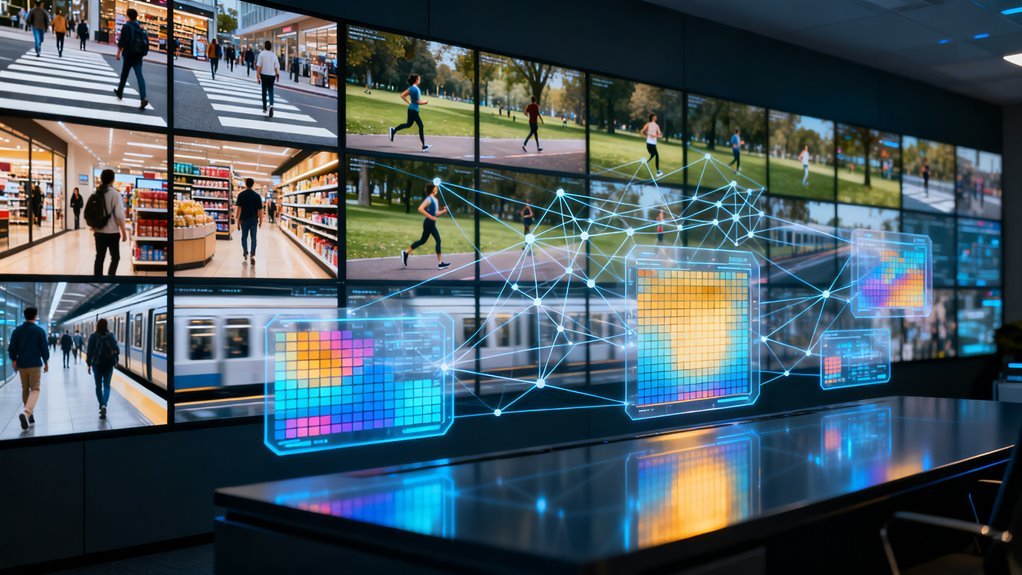
Vision-based AI models have reached a level of sophistication where they can systematically deconstruct complex human activities into discrete behavioral components: target actions, key objects, environmental context. What once required teams of trained researchers coding footage frame by frame over months or years now happens in automated pipelines that run detection, tracking, segmentation, and action recognition against continuous recordings. The output is structured datasets mapping spatial and temporal behavior features with a precision that manual analysis could never achieve consistently.
AI pipelines now deconstruct human activity into structured behavioral data with a precision manual analysis could never sustain.
This is not a theoretical capability sitting in research labs. Cloud scale video intelligence platforms already recognize north of 20,000 distinct objects, places, and actions across both stored and live video streams. Commercial behavioral intelligence tools convert hours of untagged footage into person-level summaries covering movement patterns, interaction dynamics, daily routines, and notable moments. Layered multimodal systems combine scene detection, topic categorization, sentiment analysis, object tracking, face tracking, and optical character recognition to surface engagement patterns across entire video archives. The infrastructure exists. It is operational. And it is getting cheaper to deploy by the quarter.
Social Dynamics as a Data Layer
Perhaps the most revealing frontier is social behavior analysis. For decades, understanding how people interact in groups required painstaking observational research. Now deep learning models detect social interactions between individuals with enough fidelity that their outputs correspond meaningfully with neural activity patterns associated with social perception. That correlation matters because it suggests these systems are not just detecting superficial motion. They are capturing something structurally real about how humans engage with one another.
Part aware group reasoning frameworks take this further by analyzing body part features and interpersonal spatial relationships to infer social clusters within crowds. The result is fine-grained interaction maps that reveal who is engaging with whom, how tightly groups cohere, and where the boundaries between social units fall. Egocentric photo and video analysis can now identify recurring social partners across time and quantify interaction frequency, diversity, and type. Datasets like SALSA, designed specifically for spatial behavior and conversational dynamics in group settings, have enabled automated detection of coordination patterns and participation imbalances that would be invisible to a casual observer and exhausting for a trained one.
The most nuanced work combines multiple social signals simultaneously. Gaze direction, relative body position, and environmental context together enable detection of subtle social segments that go well beyond obvious interactions like handshakes or conversations. This is where the technology starts to feel genuinely new, not just faster at what humans already do, but capable of perceiving social structures we struggle to articulate.
Activity Recognition Approaches Near Perfection on Benchmarks
The accuracy numbers have become almost absurd. Deep learning systems trained on motion sensor data now hit 93.9 percent recognition rates for core activities like walking, sitting, and navigating stairs. Sensor-based frameworks integrating data from as many as 72 wearable and ambient sensors capture fine-grained daily activity patterns in realistic environments, not just controlled lab settings.
Large video motion databases like HMDB51, with over 65,000 clips spanning 51 action classes, enable discovery of subtle variations in everyday movements that earlier systems would have collapsed into a single category. Ensemble deep learning models trained on benchmarks like UCF101 and HMDB51 now report aggregate accuracies approaching 99.5 percent. At that level, the limiting factor is no longer algorithmic capability. It is the quality and representativeness of the training data, the messiness of real-world deployment conditions, and the gap between recognizing an action in a curated clip versus interpreting it correctly in a chaotic, unpredictable environment.
Convolutional, recurrent, and attention-based architectures continue converging, pulling from both video and sensor streams, transforming raw footage into behavioral insight at a scale that did not exist five years ago. A parallel and increasingly important development is the rise of multimodal feature fusion techniques that integrate visual, audio, and textual signals from video content to produce far richer emotional and behavioral understanding than any single data channel can deliver alone.
What People Are Overlooking
The technical progress is impressive, but the more consequential story is about what happens when these capabilities intersect with real institutions. Three dynamics deserve attention.
First, the asymmetry of awareness. Most people have no idea that commercially available tools can already extract detailed behavioral profiles from ordinary video without any manual tagging. This is not classified government technology. It is purchasable software. The gap between public understanding and deployed capability is wide and growing.
Second, the shift from episodic to continuous analysis. Previous generations of video analytics were event-driven. Something triggered a review, and a human examined a clip. Current systems operate continuously, building cumulative behavioral models over time. The difference between analyzing a single interaction and tracking patterns across weeks or months of footage is not incremental. It is categorical. Continuous analysis reveals habits, routines, deviations from routines, relationship patterns, and behavioral trajectories that episodic review cannot surface.
Third, the regulatory vacuum. Most privacy frameworks were designed around the concept of personally identifiable information, names, faces, addresses. Behavioral pattern data does not fit neatly into those categories. A movement signature or social interaction profile might identify someone without ever capturing their face. Existing regulations in the EU, the US, and most of Asia are only beginning to grapple with this. The GDPR’s provisions around profiling are relevant but were not drafted with this level of behavioral granularity in mind. California’s evolving privacy laws touch on it. But nowhere has a comprehensive framework emerged that addresses the specific risks of large-scale automated behavioral intelligence derived from video.
Who Benefits and Who Bears the Risk
The immediate beneficiaries are predictable. Retail operators gain unprecedented insight into customer behavior, store layout optimization, and staffing efficiency. Healthcare providers can monitor patient activity patterns for early signs of cognitive decline or fall risk. Smart city planners can model pedestrian flow, identify dangerous intersections, and optimize public space design using real behavioral data rather than surveys and simulations.
Security and law enforcement applications are obvious and already deployed, though the accuracy and fairness concerns that plagued early facial recognition systems apply with equal force here. Behavioral profiling at scale carries the same risk of encoding and amplifying existing biases, particularly when training data overrepresents certain populations or environments.
The entities bearing the greatest risk are individuals who have no visibility into how their behavioral data is being collected, analyzed, and used. Workers in monitored environments face a particularly acute version of this problem. Warehouse employees, delivery drivers, retail staff, and office workers are increasingly subject to continuous behavioral analysis that tracks productivity, movement efficiency, break patterns, and social interactions. The power imbalance is stark. The employer controls the camera infrastructure, the analytical tools, and the resulting data. The worker often does not even know what is being measured.
Where This Heads Next
Several trajectories are clear. Model efficiency will continue improving, pushing these capabilities from cloud-dependent systems to edge devices. That means behavioral analysis running locally on cameras, drones, and wearable hardware without streaming video to remote servers. This could paradoxically improve privacy by keeping raw footage local, or it could make surveillance more pervasive by eliminating bandwidth as a constraint.
Foundation models for video understanding, following the trajectory that large language models established for text, are an active area of investment at Google, Meta, Microsoft, and several well-funded startups. A general-purpose video understanding model that can be fine-tuned for specific behavioral analysis tasks would dramatically lower the barrier to deployment across industries.
The integration of behavioral video analysis with other data streams, location data, transaction records, communication metadata, biometric signals, will produce composite profiles of individual and group behavior that are qualitatively different from what any single data source can provide. This convergence is already happening in some commercial platforms, and it will accelerate.
For technology professionals, founders, and investors, the opportunity space is substantial but ethically complex. The companies that build transparent, consent-aware behavioral intelligence tools with clear governance frameworks will have a durable advantage as regulation eventually catches up. Those that move fast and break norms will face the same reckoning that facial recognition companies encountered, but potentially on a larger scale, because behavioral pattern data is harder to anonymize and easier to misuse than a photograph.
The technology works. It is here. The harder question, the one that will define the next decade of this field, is not whether we can decode hidden patterns in human behavior at scale. We clearly can. The question is who gets to look, what they do with what they find, and whether the people being observed ever get a meaningful say in the matter.
Conclusion
The ability to watch video has never been the hard part. Cameras are everywhere, and storage is cheap. What has always been missing is comprehension at scale. A human analyst can review maybe eight hours of footage in a shift before fatigue degrades their attention. Multiply that by thousands of cameras across a hospital network, a retail chain, or a city’s transit system, and you have an ocean of visual data that, until recently, amounted to little more than a very expensive insurance policy.
That equation is now changing fast, and the shift deserves more scrutiny than it is getting.
From Detection to Understanding
For most of the last decade, computer vision focused on object detection and classification. Systems could identify a person, a car, or a package with increasing accuracy, but they struggled to interpret what those objects were actually doing in relation to each other over time. Recognizing a face is one thing. Understanding that someone is loitering near an emergency exit, growing visibly agitated, and drawing the attention of nearby individuals is something else entirely.
Recent advances in multimodal large language models and video foundation models have collapsed that gap. Google DeepMind’s Gemini architecture processes video natively alongside text and audio, treating temporal sequences as first class data rather than a series of disconnected frames. OpenAI has pushed similar capabilities through its GPT-4o and subsequent models. Meta’s research into self-supervised video learning, particularly through its V-JEPA framework, has shown that models can learn useful representations of physical activity without being explicitly told what to look for.
The practical result is that AI systems can now ingest continuous video feeds spanning thousands of hours and extract behavioral patterns that no team of human observers could feasibly identify. We are talking about subtle correlations: the way pedestrian flow changes in a shopping district fifteen minutes before a weather shift, or how patient movement patterns on a hospital ward predict falls days before they happen.
Why Now
Three technical developments converged to make this possible in 2024 and early 2025.
First, context windows expanded dramatically. The ability to hold longer sequences of visual tokens in memory means models no longer need to chop video into tiny disconnected clips. They can reason about events that unfold over minutes or hours rather than seconds.
Second, inference costs dropped. NVIDIA’s Blackwell architecture and the broader push toward efficient transformer inference mean that running large vision models against live or archived video is no longer restricted to organizations with research lab budgets. Cloud providers including AWS, Google Cloud, and Azure now offer video AI endpoints priced aggressively enough that midsize enterprises can experiment.
Third, and perhaps most important, training data and techniques matured. The shift from supervised learning, where every behavior must be manually labeled, to self-supervised and contrastive approaches means these systems can discover patterns in video that their creators never anticipated. They are not limited to recognizing behaviors that someone already thought to define.
Who Benefits, and How
The healthcare sector is an early and obvious beneficiary. Hospitals generate enormous quantities of video from patient rooms, corridors, and operating theaters. Startups like Artisight and Care.ai are already deploying ambient monitoring systems that track patient mobility, detect when someone attempts to leave their bed unassisted, and flag deviations from normal behavioral baselines. The clinical value is tangible. Falls are among the leading causes of injury in hospital settings, and catching risk factors hours in advance rather than seconds after impact changes outcomes.
Retail is another domain where video behavior analysis is moving beyond loss prevention. Companies like Standard AI and Trax have built systems that analyze how customers move through stores, where they pause, what they pick up and put back, and how dwell time correlates with purchasing decisions. This is not new in concept. What is new is the granularity and the ability to process months of footage across hundreds of locations to find patterns that hold up statistically rather than anecdotally.
Urban planning and transportation agencies see potential too. Analyzing pedestrian and vehicle behavior across intersections over thousands of hours can reveal dangerous design patterns far more reliably than incident reports filed after someone has already been hurt.
What People Are Overlooking
Much of the public conversation around AI video analysis still revolves around facial recognition, which is understandable given its history but increasingly beside the point. The most powerful applications emerging today do not depend on identifying who someone is. They depend on understanding what people do, how they move, and what those movements mean in aggregate.
This distinction matters enormously for the privacy debate. Behavioral pattern detection can operate on anonymized or depersonalized video, stripping faces and identifying characteristics while still extracting useful insights about crowd dynamics, patient safety, or customer experience. Some of the most sophisticated systems intentionally avoid biometric identification precisely because it creates regulatory exposure under frameworks like the EU AI Act and various state-level privacy laws in the United States.
Yet anonymization is not a complete answer. Even without identifying individuals, behavioral profiling at scale raises questions about autonomy and consent. If a system can determine that a certain pattern of movement through a store correlates with shoplifting risk, and that pattern is more common among specific demographic groups, the system could effectively enable discrimination without ever processing a face. The bias would be laundered through behavior rather than identity.
This is the kind of second-order risk that current regulatory frameworks are poorly equipped to handle. The EU AI Act categorizes surveillance systems based partly on whether they involve biometric data, but behavioral pattern analysis can be equally invasive without crossing that specific threshold.
The Competitive Landscape
Google and Meta are best positioned technically, given their deep investments in video understanding research. Google’s integration of Gemini capabilities into Vertex AI gives enterprise customers a relatively straightforward path to deploying video analysis at scale. Meta’s open weight approach with models like Llama and its video research creates a different kind of advantage, fostering an ecosystem of startups and developers building specialized applications on top of foundational video understanding capabilities.
OpenAI has been comparatively quiet on the video analysis front, focusing more on generation than comprehension, though the multimodal capabilities in its latest models suggest this could change quickly. Microsoft’s position is largely derivative of its OpenAI partnership, channeled through Azure AI services.
Amazon is worth watching. Its real-world deployment experience through Amazon Go stores, Ring cameras, and AWS Rekognition gives it practical behavioral data and distribution channels that pure research organizations lack. The company’s willingness to operate in ethically contested spaces has drawn criticism, but it also means Amazon has more production experience with video behavior analysis than almost anyone.
NVIDIA benefits regardless of who wins the application layer. Every hour of video processed at scale requires GPU compute, and the company’s dominance in inference hardware means it collects tolls on virtually every deployment.
Regulatory Trajectory
Regulation is coming, but it is arriving unevenly and slowly. The EU AI Act provides the most comprehensive framework, classifying certain real-time surveillance applications as high risk or outright prohibited. But its implementation timeline stretches into 2026 and beyond, and the specifics around behavioral analysis remain ambiguous.
In the United States, regulation is fragmented across state and municipal levels. Illinois’ Biometric Information Privacy Act and similar laws address the collection of biometric identifiers but say little about behavioral pattern analysis specifically. Federal legislation remains stalled.
China has moved aggressively in the opposite direction, deploying behavioral analysis across public spaces with minimal constraint. This creates a competitive asymmetry. Companies operating under Western regulatory frameworks face compliance costs and use case restrictions that their Chinese counterparts do not, which could influence where the most advanced applications are developed and deployed first.
What Comes Next
The trajectory here points toward ambient behavioral intelligence becoming a standard layer in physical environments within the next three to five years. Hospitals, airports, retail stores, warehouses, and public transit systems will increasingly be instrumented not just with cameras but with AI systems that continuously interpret what those cameras see.
The quality of that interpretation will improve substantially as models get better at reasoning over longer time horizons and across multiple camera angles simultaneously. Today’s systems can spot that someone fell. Tomorrow’s systems will identify the sequence of subtle gait changes over the preceding week that predicted it.
For businesses, the strategic question is not whether to adopt these capabilities but how to do so in ways that deliver genuine value without creating unacceptable risk. The organizations that figure out how to extract behavioral insights while maintaining trust, both from the people being observed and from regulators, will have a significant advantage.
For the rest of us, the question is whether the governance structures we build can keep pace with systems that are learning to see not just what we do, but why we do it. History suggests they usually cannot. The gap between capability and accountability in AI video analysis is widening, and the window for getting the rules right is narrower than most people realize.