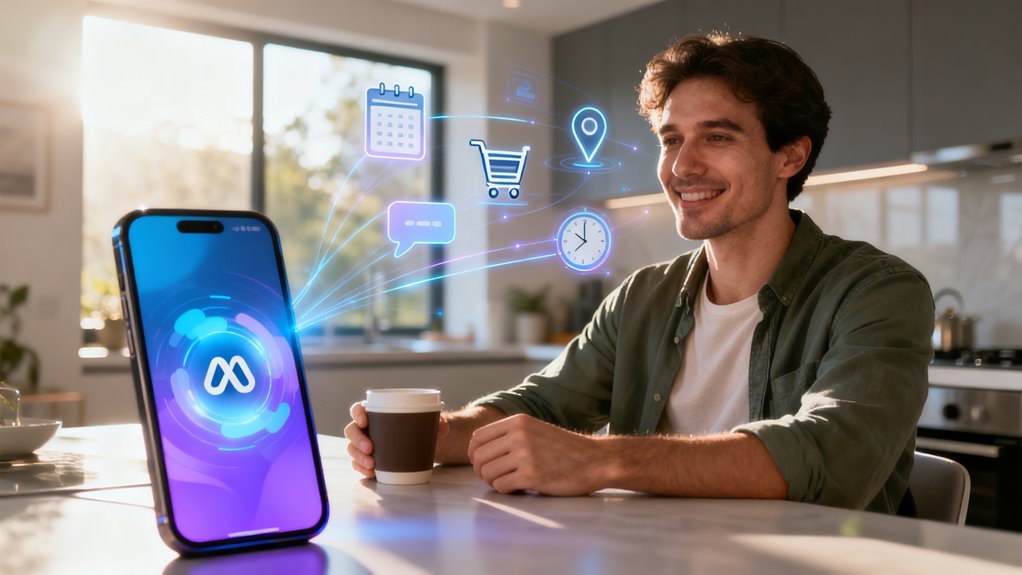

When Meta launched its dedicated AI app on April 29, 2025, the release itself was not the story. The real signal was what sat underneath it: Muse Spark 1.1, the first model to emerge from Meta Superintelligence Labs, a division the company stood up specifically to pursue frontier AI development. That a social media company now ships its own foundation model purpose built for consumer AI products tells you everything about where this race has moved. The battleground is no longer about who has the best chatbot. It is about who controls the persistent AI layer that sits between people and the world around them.
The race is no longer about the best chatbot. It is about who controls the persistent AI layer.
The Hardware Play Changes the Equation
Most AI assistants live on screens. Meta’s lives on your face. The Ray-Ban Meta glasses represent an approach that none of Meta’s direct AI competitors have replicated at comparable scale. Google has its Gemini models embedded across Android and Search. Apple has Siri backed by Apple Intelligence. OpenAI has ChatGPT on every platform. But none of them currently ship a wearable computer with an integrated camera, open ear audio, and voice activation designed from day one as an AI delivery mechanism.
This distinction matters more than it might seem at first glance. When an AI assistant requires pulling a phone from a pocket, unlocking a screen, and launching an app, friction limits usage to deliberate queries. When that same assistant activates through a spoken phrase or a tap on a glasses frame while the user’s hands are occupied, the interaction pattern fundamentally changes. The camera on the glasses means Meta AI can see what the user sees, answer questions about the environment in real time, and push contextual information without any manual input at all.
Livestreaming a point of view to Facebook and Instagram while the assistant annotates the scene is not just a feature. It is a demonstration of how tightly Meta intends to couple its AI with its social graph.
Compare this to the approach Amazon has taken with Alexa. For years, Alexa was the leading ambient AI play, embedded in Echo devices throughout millions of homes. But Alexa was stationary. It lived in kitchens and living rooms. Meta’s glasses go everywhere the user goes, and they collect visual context that a smart speaker never could. The competitive implication is straightforward: ambient AI that moves with the user will eventually absorb use cases that fixed devices cannot reach. The market is already validating this bet, with Ray-Ban Meta glasses becoming the top-selling brand in 60% of Ray-Ban stores across Europe, the Middle East, and Africa.
Muse Spark and the Model Strategy
The decision to build Muse Spark rather than license or adapt an existing open source model, even one of Meta’s own Llama variants, reveals a strategic calculation worth examining. Llama models have been released for broad developer adoption and have driven Meta’s influence across the open source ecosystem. Muse Spark serves a different purpose entirely. It is a proprietary model optimized specifically for the consumer products Meta wants to sell.
The multimodal capabilities baked into Muse Spark, spanning text, image understanding, and real world context processing, are tailored for the smart glasses and app experiences rather than for general purpose developer use. This dual track approach mirrors what Google has done with Gemini, maintaining different model variants for different surfaces.
But Meta’s version carries an additional wrinkle. By housing Muse Spark development under the Superintelligence Labs banner, Meta signals that it views consumer AI products not as lightweight applications sitting on top of commodity models but as systems requiring dedicated frontier research. Whether the “superintelligence” branding is aspirational marketing or a genuine technical roadmap remains to be seen, but the organizational commitment is real.
The practical output so far is incremental rather than revolutionary. Sports scores, restaurant recommendations, calendar management, and navigation assistance are useful but hardly novel. Every major assistant handles these tasks. What differentiates the Meta implementation is the delivery surface.
Getting a restaurant recommendation whispered into your ear while you walk down a street, triggered by the glasses recognizing your surroundings, is a qualitatively different experience from typing the same query into a phone.
From Assistant to Agent: The Roadmap That Matters Most
Meta’s leadership has been explicit about where this is heading. The current assistant is described internally and externally as a foundation for autonomous agents that understand user goals and work continuously to achieve them. This language is not unique to Meta. OpenAI, Google, Anthropic, and Microsoft have all outlined similar visions for agentic AI systems.
But Meta’s version comes with a distribution advantage that the others lack in one critical dimension: social context. Meta operates Facebook, Instagram, WhatsApp, and Messenger. Collectively these platforms hold data on relationships, interests, purchasing behavior, communication patterns, and daily routines for billions of people.
An AI agent that can access even a fraction of this context while running on hardware the user wears throughout the day has a data advantage that is difficult to replicate. Google comes closest through Android, Gmail, and Search history. Apple has device level data but has historically limited its own AI’s access to it for privacy reasons. OpenAI and Anthropic have no native social graph at all.
The business implications extend beyond individual users. Meta has stated that these agents will serve businesses seeking automated support for operations and customer engagement. Consider what this means in practice. A small business owner wearing Meta glasses could have an agent that monitors inventory through visual checks, responds to customer messages on Instagram and WhatsApp, schedules appointments, and surfaces relevant market trends, all without switching between apps or devices.
The infrastructure Meta is assembling connects the hardware layer, the model layer, and the application layer into a single vertically integrated stack.
What People Are Overlooking
The conversation around Meta’s AI strategy tends to focus on whether the glasses are cool enough or whether Meta AI can compete with ChatGPT in raw conversational quality. Both questions miss the larger strategic picture.
First, Meta does not need to win on conversational benchmarks. It needs to win on availability and context. An assistant that is slightly less articulate but always present and visually aware may prove more valuable in daily life than a superior conversational model that requires deliberate engagement.
Second, the privacy implications of camera equipped AI glasses have not received the scrutiny they deserve. When Meta’s glasses livestream to social media while an AI processes the visual feed, every person in the frame becomes an unwitting participant in both a broadcast and an AI training or inference pipeline. Recent studies suggest that AI conversations often lead to partial task automation, not full displacement, highlighting the need for caution.
European regulators have already raised concerns about smart glasses and facial recognition. As these devices become more capable and more common, regulatory friction is virtually guaranteed. Meta’s ability to navigate or preempt that friction will determine whether the glasses remain a niche product or become a mass market platform.
Third, the competitive dynamics here are not just about AI companies. They are about the future of the smartphone itself. If ambient AI delivered through lightweight wearables can handle a growing share of tasks that currently require a phone, the long term threat extends to Apple and Samsung as much as it does to OpenAI or Google.
Meta has no meaningful position in the smartphone market. Building an alternative computing platform that reduces dependence on phones is not just an AI strategy. It is an existential business strategy for a company that has spent years at the mercy of Apple’s App Store policies and Google’s Android ecosystem.
Where This Goes Next
The trajectory is clear even if the timeline is not. Meta will continue expanding the capabilities of Muse Spark, likely releasing successive versions that push further into agentic behavior. The glasses hardware will get lighter, cheaper, and more capable, with prescription lens options and longer battery life removing current adoption barriers.
Integration with Meta’s commerce tools, advertising infrastructure, and business messaging platforms will deepen, creating revenue opportunities that justify the hardware investment.
The open question is whether consumers will accept an always on AI companion from a company whose track record on data privacy remains, to put it mildly, contentious. Trust is the bottleneck. The technology is advancing faster than public comfort with its implications.
Meta is betting that convenience will ultimately override caution, and historically, that bet has paid off more often than not in consumer technology.
For developers and businesses watching this space, the practical takeaway is that the AI assistant market is fragmenting along hardware lines. Building for a world where users interact with AI through glasses, earbuds, and ambient devices rather than through chat windows will require rethinking interface design, data access patterns, and user experience assumptions.
Meta is not the only company pushing in this direction, but it is the one moving fastest to connect a foundation model, a wearable platform, and a social network into a single coherent system. Whether that system delivers on its promise or collapses under regulatory and public pressure will be one of the defining stories in AI over the next several years.