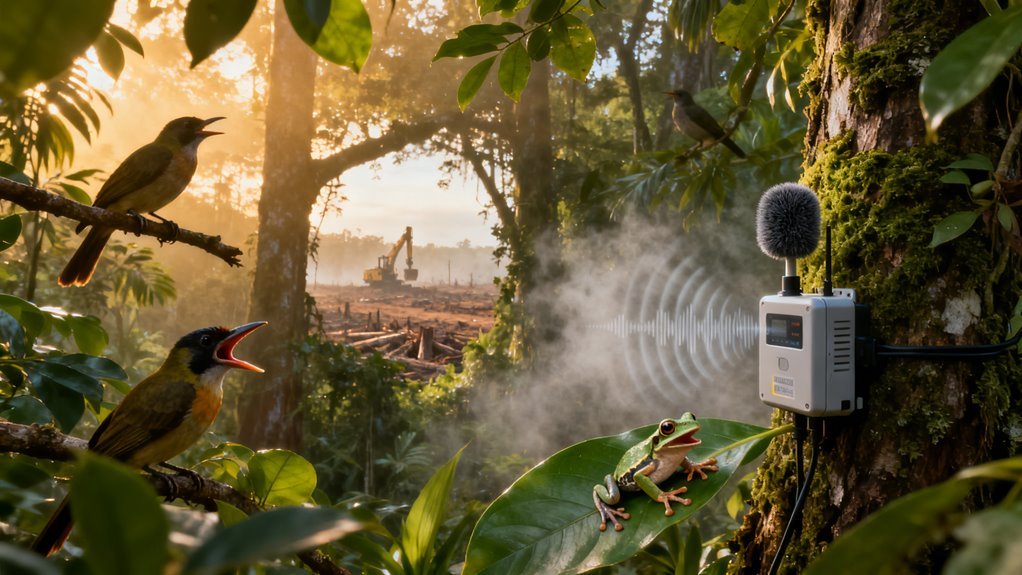

Somewhere in the canopy of a West Sumatran rainforest, a recycled smartphone is doing what no ranger physically could: listening to everything, all the time, and deciding in milliseconds whether the sound it just captured is a hornbill or a chainsaw. That distinction, rendered by a neural network running on hardware worth less than a budget laptop, is reshaping how conservation actually works on the ground. Not in theory. Not in pilot programs. Across at least 37 countries right now.
A recycled phone in the canopy decides in milliseconds: hornbill or chainsaw. Conservation now runs on neural networks, not binoculars.
This is one of those quiet convergences in AI that rarely makes the front page of tech news, overshadowed by the latest foundation model benchmarks or another round of AGI speculation. But what is happening in forest bioacoustics deserves serious attention, because it reveals something important about where applied AI creates disproportionate value: at the intersection of cheap hardware, mature deep learning techniques, and problems where the data already exists but humans simply cannot process it fast enough.
From Spectrograms to Species Maps
The core technical insight here is elegant. Autonomous recording units placed throughout forest plots generate continuous audio streams spanning months or years. No human team could meaningfully review that volume of data.
So researchers convert the raw audio into spectrograms, essentially translating sound into images. That single transformation unlocks the entire ecosystem of computer vision models originally designed for object detection in photographs. Scientific foundation models trained on domain-specific data can enhance this process further.
Convolutional neural networks, vision transformers, and other architectures that the industry spent billions refining for tasks like autonomous driving and medical imaging now classify bird calls, primate vocalizations, and insect choruses with remarkable precision. The models estimate relative species abundance, track compositional shifts across sites, and flag anomalies that might indicate ecosystem stress.
What once required field biologists spending weeks on site with notebooks and binoculars now runs continuously, passively, and at a fraction of the cost.
This matters for a reason that extends well beyond conservation. The pattern of repurposing mature AI architectures for entirely new domains is one of the most productive dynamics in the current phase of applied artificial intelligence. Just as transformer models migrated from machine translation into protein folding, drug discovery, and weather forecasting, computer vision pipelines are proving that the real bottleneck was never the algorithm. It was getting the data into a form the algorithm could consume.
Hardware That Disappears Into the Canopy
The devices powering this shift are deliberately unglamorous. Solar panels. Recycled mobile phones. High sensitivity microphones. They mount in tree canopies, draw minimal power, and operate around the clock with detection ranges stretching from 50 meters in dense undergrowth to 1,500 meters across open canopy.
The Guardian system, one of the most widely deployed variants, has scaled to networks of dozens of sensors per site, all feeding data to cloud platforms like SoundForest for centralized analysis.
The economics here are striking. Traditional biodiversity surveys require trained personnel, travel budgets, repeated visits, and still only capture intermittent snapshots of what is happening in an ecosystem.
A network of acoustic sensors provides continuous coverage at a cost structure that improves every year as phone hardware gets cheaper and edge AI chips get more efficient. For conservation organizations perpetually constrained by funding, this is not a marginal improvement. It fundamentally changes what is financially feasible.
There is a parallel worth drawing to what happened in agriculture over the past decade. Precision farming went from an expensive curiosity to standard practice once the sensor hardware got cheap enough and the models got good enough.
Forest monitoring appears to be on a similar trajectory, just a few years behind.
Chainsaws Before They Start
The most immediately consequential application is threat detection. AI models trained on forest soundscapes can distinguish chainsaws, logging trucks, axes, gunshots, and human voices from natural ambient noise.
One system reportedly predicts chainsaw events with roughly 96 percent accuracy up to five days in advance by detecting subtle shifts in background sound signatures before logging actually begins.
That last point deserves emphasis. The system is not merely detecting illegal activity as it happens. It is identifying precursor signals in the acoustic environment that correlate with imminent logging operations.
This is predictive enforcement, and it changes the calculus for illegal operators who previously relied on the sheer remoteness of their targets as protection.
In West Sumatra, at least 27 Guardian sensors now relay chainsaw alerts directly to community patrols through mobile applications. Rangers who once patrolled blind, covering vast territories with no intelligence about where threats were emerging, now receive targeted, time sensitive notifications.
The feedback loop from detection to human response shrinks from days to minutes.
Sound propagates through dense foliage and variable weather conditions in ways that visual and satellite monitoring cannot match. Optical satellites need clear skies and revisit schedules. Drones have limited flight time and airspace restrictions.
Acoustic sensors just listen, constantly, regardless of cloud cover, rain, or nightfall. For a problem set defined by remote locations and unpredictable timing, this makes acoustic AI uniquely well suited as the primary detection layer.
What People Are Overlooking
Several dynamics in this space deserve more scrutiny than they currently receive.
First, the data being accumulated has value far beyond its immediate conservation purpose. Continuous multi-year acoustic records of forest ecosystems represent a scientific dataset of unprecedented scale.
Researchers are only beginning to explore what longitudinal analysis of these soundscapes might reveal about climate adaptation, species migration patterns, and the cascading effects of habitat fragmentation.
The acoustic record of a forest is, in a real sense, a record of its ecological health over time. We have never had that at this resolution before.
Second, there is an underappreciated tension between surveillance capability and community trust. In many of the regions where these systems deploy, relationships between conservation authorities and local communities are already complicated by histories of displacement and enforcement that prioritized biodiversity over livelihoods.
Acoustic monitoring networks that detect human voices and activity patterns could easily become tools of social surveillance if governance frameworks are not carefully designed. The technology is neutral. The institutions deploying it are not always so.
Third, the same acoustic AI pipeline that monitors forests has obvious applicability to other environments. Ocean bioacoustics is already a growing field. Urban soundscape monitoring for noise pollution and public safety is another natural extension.
The companies and research groups building expertise in forest acoustics are developing transferable capabilities that could spawn entirely new product categories.
The Broader Signal
Zoom out from the specific application and the pattern becomes clear. The most impactful AI deployments right now are not happening at the frontier of model capability.
They are happening where proven architectures meet previously untapped data sources in domains starved of automation. Forest bioacoustics checks every box: abundant data that no one could process before, mature model architectures that transfer cleanly, cheap hardware that enables deployment at scale, and a problem domain where the status quo is genuinely inadequate.
This stands in useful contrast to the current fixation on ever larger language models and the race to artificial general intelligence. The organizations deploying acoustic AI in forests are not using GPT class systems.
They are using relatively straightforward classification models, sometimes running inference on edge devices with minimal compute. The sophistication is in the system design, the sensor placement, the data pipeline, and the integration with human response teams. Not in the model size.
For investors and founders paying attention, the lesson is that significant value creation in applied AI still lives in these intersections. The models exist. The hardware is cheap.
The real competitive advantage comes from understanding a specific domain deeply enough to build the full stack from sensor to decision. In Puerto Rico, for instance, species distribution data derived from acoustic monitoring directly influenced government decisions on habitat protection, demonstrating that the value chain extends all the way from forest canopy microphones to national policy outcomes.
The forests are already talking. The question now is how many other environments are generating signals that AI could decode if someone just thought to listen.