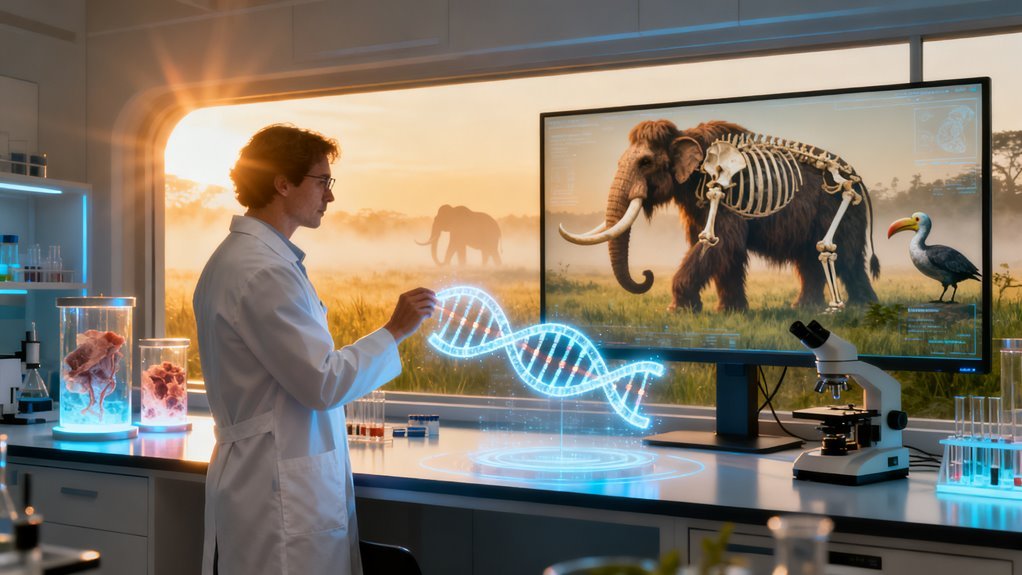

The idea of resurrecting vanished species has floated around the edges of serious science for over a decade, usually tethered to a single charismatic animal and a handful of ambitious researchers. What has changed in the last eighteen months is not the ambition but the infrastructure. Artificial intelligence has moved from a supporting player in de-extinction efforts to the core operational layer, compressing timelines that once stretched across entire academic careers into something closer to industrial product cycles. That shift deserves closer attention than it has received, because the convergence of ancient genomics, generative AI, and synthetic biology is creating a new category of applied biotechnology with consequences that reach well beyond bringing back the mammoth.
From Broken Code to Functional Blueprints
Ancient DNA is a mess. Thousands of years of chemical degradation leave researchers with fragments, not genomes. Bases are missing, sequences are contaminated, and the damage patterns themselves can masquerade as real mutations. For years, the bottleneck in working with ancient genomes was not sequencing but interpretation. You could pull degraded strands out of permafrost or museum specimens, but making sense of what you recovered demanded painstaking manual alignment against reference genomes from living relatives, one painful stretch at a time.
Machine learning changed the math. Modern AI pipelines now align fragmented ancient sequences against living reference genomes, predict missing bases with increasing confidence, and flag which mutations are likely artifacts of degradation versus genuine evolutionary signals. Colossal Biosciences, arguably the most visible company in this space, runs end to end AI workflows for woolly mammoth and dire wolf genome assembly that have compressed what used to be multiyear reconstruction projects into timelines measured in months. The cost reductions are substantial enough that de-extinction has shifted from a question of whether we can reconstruct these genomes to how quickly we can act on the reconstructions. This matters strategically because scientific workflows are increasingly optimized through AI integration.
This matters strategically because genome reconstruction is not the destination. It is the first stage of a pipeline that feeds directly into trait prediction. AI driven comparative genomics can now connect specific gene variants to physical characteristics: dense insulating hair, metabolic cold adaptation, skeletal morphology. The practical output is a ranked list of edits that, introduced via CRISPR into the genome of a closely related living species, would produce a functional proxy organism engineered not for a museum case but for a working ecosystem.
Generative Models Enter the Picture
Here is where the field gets genuinely interesting and where the broader AI community should pay attention. Generative models are no longer confined to reconstructing what an extinct animal looked like at a genetic level. Researchers can now specify desired phenotypes and let the model work backward to identify which combinations of gene variants would produce them. That capability opens a door that strict historical reconstruction never could: engineering organisms tuned not for the Pleistocene but for current and projected environmental conditions.
Think about what that means. Instead of recreating a woolly mammoth optimized for ice age tundra, you could engineer a cold adapted elephant proxy calibrated for the temperature ranges, vegetation, and disease pressures of contemporary Siberia. The target shifts from historical fidelity to ecological functionality. Colossal is already applying this approach to its dodo program, using AI to rank gene variants associated with craniofacial morphology in birds and reconstruct beak and skull geometry from combined genomic and imaging datasets. The dodo work illustrates a broader pattern: generative AI is enabling researchers to treat extinct species not as fixed historical templates but as starting points for engineering decisions.
Predictive biology platforms add another layer. Tools like Astromech simulate trait expression and forecast how an engineered organism might perform under multiple environmental scenarios before a single edit is made in the lab. This computational screening matters enormously at a practical level. Gene editing in large mammals remains expensive, slow, and failure prone. Every edit combination that can be tested in silico rather than in vivo saves months of bench work and significant capital. The ability to focus laboratory effort on high confidence targets rather than exhaustive trial and error changes the economics of the entire enterprise.
The Manufacturing Problem Nobody Talks About Enough
Reconstructing a genome and identifying the right edits is one challenge. Actually producing a viable organism is a different and arguably harder one. This is where the de-extinction field runs into bottlenecks that no amount of computational power can fully resolve, at least not yet.
On the synthetic biology side, automation, robotic process control, and computer vision are working alongside AI to scale species development workflows. AI integration across gene editing and embryo development stages optimizes edit combinations and improves success rates during early experimental cycles. But producing a mammoth proxy, for instance, requires gestating an engineered embryo in a species with one of the longest pregnancies in the animal kingdom.
Artificial womb technologies under development lean on AI guided monitoring to manage the complexity of that gestation, but the technology remains early stage and unproven at the scale needed. This bottleneck is worth flagging because it represents the gap between computational capability and biological reality that defines so much of applied biotech. AI can design an organism with remarkable precision. The physical infrastructure to bring that design to life lags behind, sometimes by years. Investors and observers who focus exclusively on the genomics and AI side of de-extinction risk underestimating how much of the challenge is engineering biology at scale, not just in silico.
Meanwhile, AI enhanced biobanking systems like Colossal’s BioVault are indexing and analyzing preserved genetic material in ways that make biodiversity data far more accessible for future research. Platforms like Form Bio manage the massive genomic datasets these projects generate, executing standardized workflows and visualizing results across distributed research teams. The data infrastructure is maturing rapidly, even if the biological manufacturing side still has ground to cover.
Who Benefits, Who Should Be Watching, and What People Are Overlooking
The immediate beneficiaries are obvious: de-extinction companies, conservation organizations, and the growing ecosystem of AI biotech startups building tools for synthetic biology. But the downstream implications are broader.
The techniques being developed for de-extinction are directly applicable to conservation genetics for endangered living species. If you can reconstruct and edit the genome of a woolly mammoth, you can certainly use the same pipeline to increase genetic diversity in a critically endangered population or engineer climate resilience into a species under pressure. The AI workflows Colossal and others are building are general purpose tools that happen to be aimed at extinct species first but have obvious applications across conservation biology, agriculture, and even human medicine. In a parallel demonstration of this cross-domain potential, Dr. Cesar de la Fuente’s team at the University of Pennsylvania has used AI to mine DNA from extinct species like giant sloths and ancient bears, discovering antimicrobial peptides that show real therapeutic promise in a process the team calls molecular de-extinction.
Regulatory frameworks, predictably, have not kept pace. There is no international consensus on how to classify a genetically engineered proxy organism, where it can be released, or who bears liability if it disrupts an ecosystem rather than restoring one. The European Union, the United States, and individual nations where rewilding might occur all have different and often contradictory regulatory postures toward genetically modified organisms. As the technical barriers to de-extinction fall, the regulatory and ethical questions will move from theoretical seminar topics to urgent policy challenges.
The ethical dimension is also worth engaging with honestly. There is a reasonable critique that de-extinction spending diverts attention and funding from protecting species that are still alive but critically endangered. Proponents counter that the tools and public attention generated by de-extinction projects create a halo effect that benefits conservation broadly. Both arguments have merit. What is harder to dispute is that once the capability to engineer organisms for specific ecosystems exists, the pressure to use it will be significant, and the governance structures to guide that use are largely absent.
What This Tells Us About the Direction of AI
Step back from the specifics of mammoths and dodos and the broader pattern is clear. AI is increasingly the orchestration layer for complex, multidisciplinary scientific programs that no single human team could manage at speed. The convergence visible in de-extinction, where machine learning, generative models, predictive simulation, robotic automation, and data management all feed into a single pipeline, mirrors what is happening in drug discovery, materials science, and climate modeling.
The common thread is AI enabling researchers to move from observation to engineering at a pace that was structurally impossible five years ago. For the AI industry, de-extinction is a compelling proof of concept for vertical integration of AI tools across an entire scientific workflow. For the biotech industry, it signals that the gap between computational biology and physical biology is narrowing, unevenly but unmistakably.
And for everyone else, it raises a question that will define the next decade of applied AI: when the capability to redesign living systems exists, who decides how it gets used? The woolly mammoth may or may not walk the tundra again within the decade. But the toolkit being built to make that possible is already reshaping how we think about conservation, synthetic biology, and the boundaries of what engineering can accomplish. That is the story worth following.