For centuries, creating a new material meant years of painstaking trial and error. A researcher would study the literature, hypothesize a promising combination, mix precursors, heat them, analyze the results, adjust, and repeat. The process was slow, expensive, and deeply dependent on individual intuition. A single novel compound could take months to isolate. An entire career might yield a few dozen.
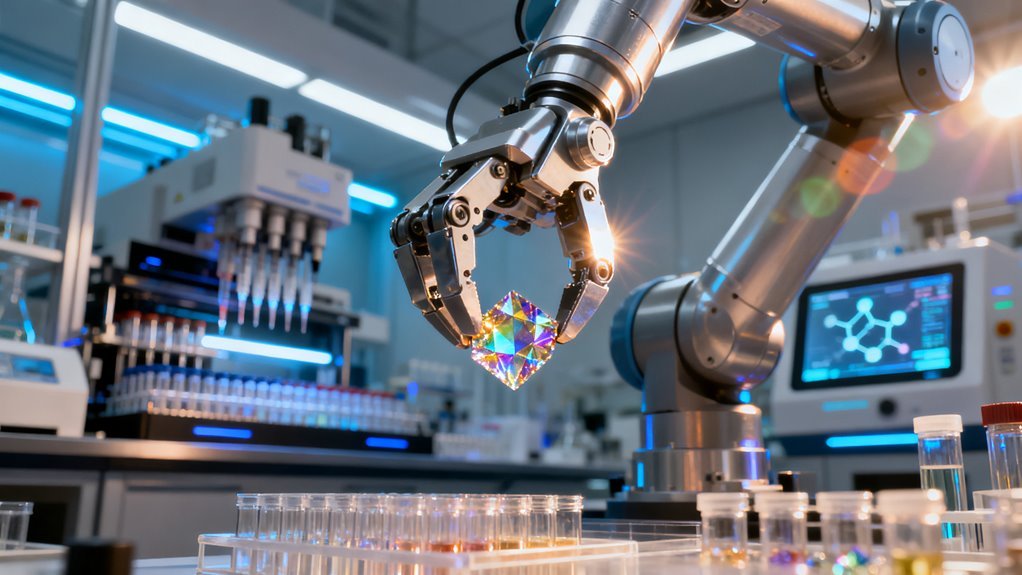
Then a robotic platform at Lawrence Berkeley National Laboratory called A-Lab produced 41 previously nonexistent inorganic crystalline solids in just over two weeks. No human touched a sample. No researcher adjusted a thermostat. The system ran 355 experiments across 17 continuous days, hitting a 71 percent success rate against 58 computationally predicted target materials. That translates to roughly two novel compounds per day, a pace approximately 100 times faster than what manual laboratory workflows typically achieve.
This is not incremental progress. It represents a fundamental shift in how materials science operates, and its implications ripple outward into energy storage, semiconductor manufacturing, battery technology, and the broader trajectory of scientific AI, including advancements in drug discovery.
How A-Lab Actually Works
Understanding why this matters requires understanding the architecture behind it. A-Lab is not simply a robot that follows pre-written recipes. It is a closed loop system where every failed experiment makes the next one smarter.
The platform integrates three physical stations: sample preparation, heating, and characterization. Robotic arms shuttle samples and labware between stations autonomously. But the real sophistication lives in the software layer. Before any physical experiment begins, density functional theory calculations map out the thermodynamic energy landscapes connecting precursors, intermediates, and target products. This computational screening eliminates obviously nonviable pathways before a single gram of powder gets weighed.
Machine learning models trained on synthesis records text-mined from thousands of published papers then propose specific experimental procedures. They specify which precursors to combine, in what ratios, and at what temperatures. Decades of accumulated human synthesis knowledge, encoded in journal articles and technical reports, get compressed into actionable starting conditions.
After each experiment, ML-based phase identification algorithms analyze X-ray diffraction data to determine whether the target phase formed, partially crystallized, or failed entirely. An active learning algorithm ingests these outcomes and updates subsequent strategies. Temperatures shift. Dwell times change. Alternative precursors get substituted. Crucially, failures feed directly back into the model rather than disappearing into a lab notebook never consulted again.
This iterative refinement is what separates A-Lab from high throughput screening approaches that have existed for years. High throughput methods run many experiments in parallel but typically follow a fixed experimental design. A-Lab adapts. Each cycle of synthesis and analysis narrows the search space, converging on conditions that work for compositions where the initial recipe did not succeed on the first try. Similarly, a fully automated system developed at UChicago Pritzker School of Molecular Engineering for creating thin films has demonstrated the ability to achieve precise targets in just a few experimental tries by using the same principle of machine learning driven iteration.
Why This Matters Beyond the Laboratory
The 41 new materials themselves are interesting but not the headline. The targets were air-stable inorganic phases drawn from the Materials Project database, selected for potential relevance to energy storage and conversion technologies. Some may eventually prove useful. Others may not. The specific compounds matter far less than what their creation demonstrates about the scalability of autonomous scientific discovery.
Consider the bottleneck that has constrained materials science for decades. Computational tools like density functional theory have gotten remarkably good at predicting which materials should be thermodynamically stable. The Materials Project alone contains data on hundreds of thousands of predicted compounds. The problem has never been a shortage of theoretical candidates. It has been the inability to synthesize and validate them at anything approaching the rate they can be predicted.
A-Lab directly attacks that bottleneck. A 71 percent success rate against computationally predicted targets is striking not because it is perfect, but because it suggests that the gap between computational prediction and physical realization can be bridged systematically rather than one painstaking experiment at a time. If this approach scales and there is good reason to believe it can, given that the underlying ML models improve with more data, the practical catalog of available materials could expand dramatically within a few years.
The Broader AI Trend: From Language to the Physical World
This development fits into a pattern that has been accelerating since roughly 2020. The most consequential AI applications are increasingly moving beyond digital domains into physical science and engineering.
DeepMind’s AlphaFold solved protein structure prediction in 2020. Google’s GNoME system predicted 2.2 million new crystal structures in 2023. Insilico Medicine pushed an AI-discovered drug candidate into Phase II clinical trials. Microsoft Research has been applying large language models to materials screening. Each of these represents AI crossing from the computational realm into domains where predictions must eventually be validated against physical reality.
A-Lab takes the next logical step. It does not just predict. It synthesizes, characterizes, learns, and iterates, all without human intervention. The closed loop matters enormously because it means the system generates its own training data through real experiments, continuously improving its own models in a way that purely computational approaches cannot.
This is the trajectory that should command attention from investors and technology leaders. The AI systems generating the most transformative value over the next decade will likely be those that operate at the interface between computation and physical experimentation, not those that remain confined to text, code, or image generation.
Who Benefits and Who Should Pay Attention
The most immediate beneficiaries are organizations working on next-generation batteries, catalysts, thermoelectrics, and other functional materials. Battery companies in particular face enormous pressure to find cathode and anode chemistries that improve energy density, reduce reliance on cobalt and nickel, and lower costs. An autonomous platform that can screen and synthesize candidate materials at two new compounds per day could compress what would otherwise be a five-year search into months.
National laboratories and large research universities are well positioned to deploy similar platforms, given their existing infrastructure and computational resources. Smaller companies and startups, however, may find themselves at a disadvantage unless cloud-based or shared-access models emerge. The capital cost of integrating robotics, characterization equipment, and the computational backend is not trivial.
Pharmaceutical companies and chemical manufacturers should also be watching closely. The closed loop architecture A-Lab demonstrates is domain-agnostic in principle. Adapting it to organic synthesis, polymer discovery, or formulation optimization is an engineering challenge, not a conceptual one. Several startups, including Emerald Cloud Lab and Kebotix, have been working on adjacent problems, though none have yet demonstrated the same end-to-end autonomy for novel compound discovery.
What People Are Overlooking
There is a temptation to focus on the 71 percent success rate and declare the problem solved. It is worth examining the 29 percent that did not work. Some targets may have been thermodynamically stable in theory but kinetically inaccessible under the conditions A-Lab could explore. Others may require synthesis environments, such as high pressure or controlled atmospheres, that the current robotic setup cannot provide.
The platform’s capabilities are bounded by its physical hardware, and expanding those boundaries will require significant engineering investment. There is also a subtler issue around the quality and completeness of the training data. The ML synthesis models were trained on text-mined records from published literature. Published literature has well-documented biases. Successful syntheses get reported far more often than failures. Certain material families are overrepresented because they attracted more research funding.
The models inherit these biases, which could mean the system performs well on composition spaces similar to those already explored by humans but struggles with truly unprecedented chemistries. Finally, the characterization pipeline currently relies heavily on X-ray diffraction for phase identification. For many applications, knowing that a target phase formed is necessary but not sufficient. Functional properties like ionic conductivity, catalytic activity, or mechanical strength require additional measurements that A-Lab does not yet perform autonomously.
Closing that gap, moving from “did the right crystal structure form” to “does this material actually do what we need,” remains a significant open challenge.
What Comes Next
The logical next steps are predictable and already underway in various forms. Expanding the range of synthesis techniques beyond solid-state reactions to include sol-gel, hydrothermal, and vapor deposition methods would dramatically broaden the accessible materials space.
Integrating automated functional property measurements would enable the system to optimize not just for successful synthesis but for target performance metrics. Longer term, connecting platforms like A-Lab to large-scale computational screening systems like GNoME creates a pipeline where millions of predicted materials get triaged computationally, the most promising candidates get synthesized and tested autonomously, and the results feed back into both the predictive and synthesis models.
That feedback loop, operating continuously, could fundamentally alter the pace of materials innovation. For the AI industry more broadly, A-Lab underscores a point that sometimes gets lost in debates about large language models and chatbots. The most economically consequential applications of machine learning may ultimately be those that interact with the physical world, generating real experimental data, controlling real instruments, and producing real artifacts.
The companies and institutions that figure out how to build reliable, scalable closed-loop systems bridging computation and physical experimentation will hold enormous strategic advantages in energy, manufacturing, healthcare, and defense. The age of AI-driven scientific discovery is not approaching. It arrived in a robotics lab in Berkeley, running experiments at 3 AM with nobody watching.