For decades, the cruelest feature of Alzheimer’s and Parkinson’s disease has not been the diseases themselves but the timing. By the time a patient walks into a clinic with memory lapses or tremors, neurodegeneration has already been silently destroying brain tissue for years, sometimes more than a decade. Treatment options at that point amount to managing decline rather than preventing it. The fundamental problem has never been a lack of drugs to test. It has been the inability to identify who needs them early enough for intervention to matter.
That calculus is now shifting in ways the neurology community has not seen before. A convergence of deep learning architectures, richer neuroimaging datasets, and multimodal data integration is producing AI systems capable of flagging brain pathology five to ten years before symptoms surface. This is not a theoretical horizon. Working models already exist, and their accuracy rates are reaching levels that demand serious clinical and commercial attention. AI tools are now essential in this transformation.
What the Numbers Actually Tell Us
The headline figures are striking but require careful interpretation. A UCSF cohort study demonstrated Alzheimer’s risk prediction roughly seven years before symptom onset, reporting accuracy around 72%. A prototype system pushed the detection window to ten years while claiming near 94% accuracy using a single MRI scan combined with a short cognitive assessment. Deep learning analysis of individual brain scans has picked up dementia signatures across that same five to ten year presymptomatic window.
These numbers matter, but context matters more. A 72% accuracy rate in a research cohort does not translate directly into a deployable clinical screening tool. False positives in this domain carry enormous psychological weight. Telling a healthy 55 year old that an algorithm predicts Alzheimer’s within a decade, only to be wrong nearly three times out of ten, creates a category of harm that regulators and ethicists have barely begun to address.
The 94% figure from prototype systems is more encouraging, though it comes from tightly controlled research environments rather than the messy reality of diverse clinical populations with varying scanner hardware, imaging protocols, and demographic characteristics.
Still, even imperfect early prediction fundamentally reshapes the treatment landscape. The entire reason anti-amyloid therapies like Leqembi and Kisunla have shown only modest clinical benefit is that they are deployed too late. If AI can reliably identify candidates years before cognitive decline becomes measurable through standard testing, the therapeutic window for these drugs, and the next generation of treatments behind them, expands dramatically.
The Technical Architecture Behind Early Detection
What makes these systems work is not a single breakthrough but several interlocking technical advances that have matured simultaneously.
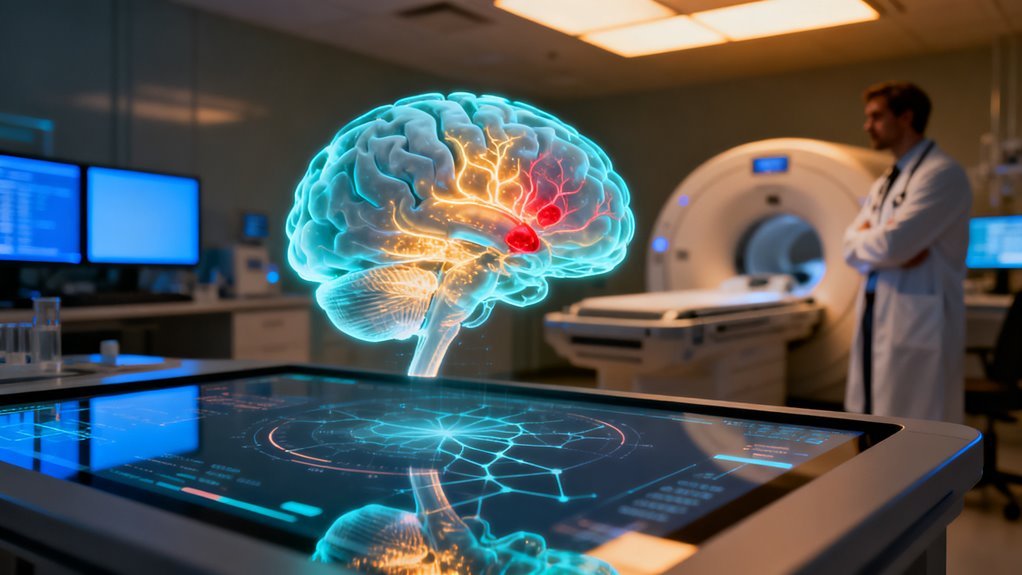
Structural MRI remains the workhorse. AI models have learned to detect subtle atrophy patterns in the hippocampus and entorhinal cortex that precede any clinically observable impairment. These are regions where Alzheimer’s pathology concentrates earliest, and the volumetric changes involved are often too small or too gradual for human radiologists to catch consistently. Deep learning excels precisely in this territory, identifying subvisual patterns across thousands of scans in ways that no individual clinician can replicate.
Diffusion tensor imaging adds another dimension. Fixel based analysis of white matter reveals macrostructural changes linked to tau accumulation, one of the two protein pathologies driving Alzheimer’s alongside amyloid beta. Detecting tau related damage before it manifests as cognitive impairment represents a genuinely important advance because tau burden correlates more closely with symptom severity than amyloid plaques do.
When AI is applied to both MRI and PET imaging together, the results outperform traditional radiological interpretation for classifying Alzheimer’s stages and predicting who will progress from mild cognitive impairment to full dementia. Some deep learning methods report sensitivity near 98% for lesion identification.
Perhaps more remarkable, certain models can generate realistic future brain scans from a single baseline image, essentially projecting what neurodegeneration will look like months or years later. This predictive imaging capability does not just aid diagnosis. It offers a potential tool for tracking therapeutic efficacy in clinical trials without waiting years for cognitive endpoints.
Beyond the Brain Scan
The most promising direction in this field is not better imaging alone. It is the integration of imaging with entirely different data streams.
Models combining MRI, PET, and EEG data are extracting preclinical deviation patterns that no single modality reveals on its own. Machine learning frameworks fusing brain imaging parameters with accelerometry data from wearable devices have demonstrated the highest accuracy for predicting neurodegenerative disease incidence in large population studies like the UK Biobank.
That particular finding deserves attention because it suggests consumer wearable data, the kind already being collected at massive scale by Apple, Google, and Fitbit, could eventually feed into clinical prediction pipelines.
Sleep data is emerging as an unexpectedly powerful signal. AI analysis of gamma band activity during sleep EEG identifies roughly 85% of individuals who later develop cognitive decline, with overall prediction accuracy near 77%. This aligns with a growing body of neuroscience research linking sleep disruption to amyloid clearance failure and accelerated neurodegeneration.
The practical implication is that sleep tracking devices, already in millions of homes, might eventually contribute meaningful biomarker data.
Cerebrospinal fluid ratios of amyloid beta 42 to tau, when integrated with imaging and behavioral biomarkers, further sharpen conversion predictions. The trend here is unmistakable. Every additional data modality improves model performance, and multimodal deep learning frameworks consistently outperform single modality approaches in both accuracy and the length of the predictive window.
Speech, Movement, and the Promise of Passive Screening
Some of the most accessible prediction tools require no imaging at all. Speech based AI systems using brief verbal tests have demonstrated the ability to predict Alzheimer’s onset roughly seven years before clinical diagnosis with about 70% accuracy.
The linguistic markers involved, subtle changes in fluency, coherence, word finding patterns, and semantic complexity, are invisible to casual conversation partners but detectable through natural language processing.
This matters enormously for scalability. An MRI based screening program for the general population would be prohibitively expensive and logistically impossible. A five minute verbal test administered through a smartphone app is not. The accuracy is lower, but as a first stage filter that identifies candidates for deeper neuroimaging workup, speech analysis could transform population level screening economics.
Movement patterns captured through accelerometry offer similar passive screening potential, particularly for Parkinson’s disease, where motor changes precede diagnosis by years. The integration of movement, sleep, and speech data into unified prediction models points toward a future where early neurodegenerative risk assessment happens continuously in the background through devices people already own.
Who Benefits, Who Should Be Watching
The pharmaceutical industry has an enormous stake in this technology. The commercial failure of many Alzheimer’s drugs has been driven partly by the impossibility of enrolling patients early enough in the disease course.
AI based early identification could dramatically reduce clinical trial costs by enabling precise patient selection and shorter endpoint timelines. Biogen, Eli Lilly, Roche, and every company with a neurodegeneration pipeline should be actively investing in or partnering with the teams building these predictive systems. Some already are.
Health systems and insurers face a more complicated calculation. Early detection creates demand for expensive follow up testing, monitoring, and potentially early treatment. In systems already struggling with cost containment, the economic case for presymptomatic screening will need to demonstrate that early intervention reduces the staggering downstream costs of dementia care, currently estimated at over $300 billion annually in the United States alone.
The data to make that case definitively does not yet exist, but the logic is compelling.
Regulatory bodies, particularly the FDA and EMA, need to develop frameworks for AI based presymptomatic disease prediction that do not currently exist in mature form. The approval pathway for a diagnostic that tells an asymptomatic person they may develop dementia in seven years is fundamentally different from approving a tool that identifies existing pathology.
The psychological, legal, and insurance implications of such predictions are profound and largely uncharted.
What People Are Overlooking
The discussion around AI in neurodegeneration has focused heavily on Alzheimer’s, and understandably so given its prevalence and societal cost. But the same technical approaches apply across a broader neurodegenerative spectrum.
Parkinson’s, frontotemporal dementia, ALS, and Huntington’s all involve presymptomatic structural and functional changes that imaging and behavioral AI could potentially detect. The platform nature of this technology is underappreciated. Researchers have also noted that these predictive techniques may extend beyond neurodegeneration to other difficult-to-diagnose conditions such as endometriosis and lupus.
There is also a significant equity question that the field has not adequately confronted. The datasets used to train these models are overwhelmingly drawn from populations in high income countries with access to advanced imaging. Performance in diverse ethnic, socioeconomic, and geographic populations remains largely unvalidated.
If these tools are deployed without addressing that gap, they risk becoming precision medicine for the privileged while leaving the most vulnerable populations behind.
The comparison to AI in oncology is instructive. Cancer screening AI went through a similar arc of impressive research results followed by slower than expected clinical adoption due to regulatory uncertainty, reimbursement challenges, and workflow integration friction.
Neurodegenerative AI will face all of those same barriers, plus the added complexity of predicting future disease in currently healthy people.
The Direction This Points
What we are watching is the early formation of a predictive neurology infrastructure that did not exist five years ago. The technology is real, the accuracy is improving, and the clinical need is undeniable.
The remaining obstacles are not primarily technical. They are regulatory, economic, ethical, and logistical.
Within three to five years, expect to see the first FDA cleared AI tools for presymptomatic Alzheimer’s risk stratification entering clinical practice, likely starting in specialist memory clinics rather than primary care.
Within a decade, multimodal screening combining consumer wearable data with periodic cognitive assessments could become routine for at risk populations.
The deeper significance extends beyond any single disease. This represents a test case for whether AI can shift medicine from reactive treatment to genuine prediction and prevention.
Neurodegenerative disease, with its long presymptomatic window and devastating late stage outcomes, is perhaps the most consequential arena for that shift. If AI can prove its value here, the implications for predictive medicine across every major disease category will be impossible to ignore.