
AI Is Quietly Rewriting the Rules of Paleontology, and the Implications Go Far Beyond Dinosaur Bones
Paleontology has never moved fast. For most of its history, the discipline required researchers to spend months hunched over a single fossil, painstakingly cleaning matrix from bone with dental picks, manually cataloging specimens, and debating taxonomic classifications that could take years to resolve. That tempo is now being shattered. A convergence of machine learning, computer vision, and advanced imaging hardware is compressing timelines that once stretched across entire academic careers into days or weeks. The shift is worth paying attention to not because “AI plus fossils” makes for a fun headline, but because what is happening in paleontology labs right now illustrates something much larger about how AI transforms domains that depend on expert pattern recognition at scale.
What Actually Changed
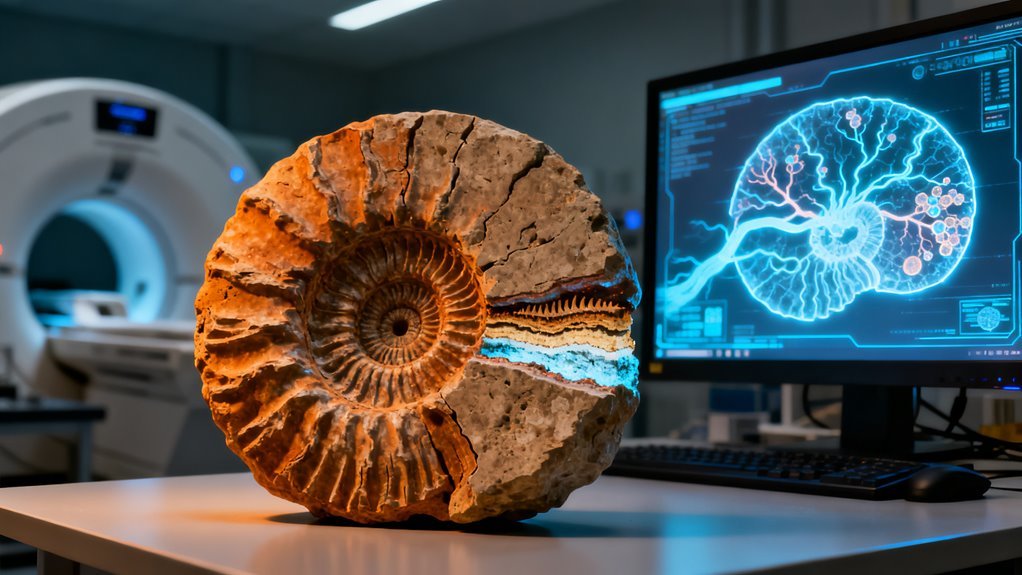
The raw capability is striking. Deep learning segmentation applied to computed tomography datasets can now produce high fidelity 3D reconstructions of fossil interiors after researchers manually annotate roughly one to two percent of slices in a large volume. For context, traditional segmentation of a complex specimen could require a trained technician to label every single slice by hand, sometimes numbering in the thousands. On Triassic reptile specimens dating back approximately 240 million years, AI driven workflows have compressed what used to be months of processing into days.
AI segmentation compresses months of fossil processing into days, requiring manual annotation of just one to two percent of slices.
That alone would be notable. But the real story is the breadth of the transformation happening simultaneously across multiple subdisciplines.
On the classification side, deep convolutional neural networks trained on around 415,000 fossil images now achieve better than ninety percent accuracy at both phylum and class levels. Vertebrate fossil classifiers hit mean accuracy near ninety nine percent with relatively modest training sets of 200 to 500 images per class. Even with as few as 50 specimens per species, image based algorithms maintain accuracy above ninety percent. AI powered identifier applications trained on millions of museum verified images are returning species names, geological eras, and locality data with reported accuracy around ninety five percent.
At the microscopic scale, semantic segmentation networks can locate microfossils within tomographic rock volumes automatically, a task that previously required a specialist to spend hours at a microscope sorting through bore core material grain by grain. These capabilities directly feed into biostratigraphy, paleoecology, and, perhaps most consequentially for commercial interests, petroleum exploration, where faster and more accurate core analysis translates into real money.
Why This Matters Beyond the Lab
The pattern here mirrors what we have seen AI do to radiology, materials science, and drug discovery. Whenever a field depends heavily on trained humans visually interpreting complex imagery, the introduction of modern computer vision tends to produce the same sequence of events: initial skepticism, followed by proof of concept results that match or exceed human performance on narrow tasks, followed by rapid adoption that restructures workflows and, eventually, the career paths within the discipline itself.
Paleontology is following this arc almost exactly. The difference is that paleontology operates with far smaller datasets and far fewer practitioners than medicine or pharma. A typical vertebrate paleontology lab might have a handful of graduate students and postdocs, not a department of hundreds. This means the leverage that AI provides per researcher is, proportionally, enormous. One graduate student with access to an AI segmentation pipeline can now accomplish what previously required a small team working for an entire funding cycle.
That leverage cuts in multiple directions. Researchers who adopt these tools early gain a significant competitive advantage in publication speed and volume. Labs that lack the computational infrastructure or the machine learning expertise to implement them risk falling behind. The democratization narrative around AI tools is real, but so is the infrastructure gap. Running micro CT scans and training segmentation models requires expensive hardware and nontrivial cloud compute budgets. Smaller institutions and researchers in lower income countries may find themselves further from the frontier, not closer to it, unless deliberate effort is made to share models and datasets openly.
The Petroleum Connection Most People Are Overlooking
The automated microfossil identification pipeline deserves particular attention because it sits at the intersection of pure science and extractive industry economics. Biostratigraphy, the practice of using microfossil assemblages to date and correlate rock layers, is a foundational tool in oil and gas exploration. Companies routinely pay specialized consultants to analyze bore core samples and determine the age and depositional environment of subsurface formations. This work is slow, expensive, and dependent on a shrinking pool of experienced micropaleontologists.
AI that can perform this analysis faster and with comparable accuracy represents a direct cost reduction for exploration companies. It also creates an interesting tension. The same technology that helps academic researchers study ancient climate change more efficiently also helps fossil fuel companies find new reserves more cheaply. This is not a hypothetical conflict. It is already playing out as petroleum service companies invest in automated core analysis tools that draw on the same deep learning architectures developed in university labs.
What the Accuracy Numbers Actually Tell Us
The reported accuracy figures, ninety percent for broad classification, ninety nine percent for vertebrate identification with adequate training data, are impressive but require careful interpretation. In paleontology, the cost of misclassification is not evenly distributed. Confusing one species of Cretaceous ammonite with a closely related cousin might be scientifically inconvenient but practically harmless. Misidentifying a microfossil assemblage in a way that leads to an incorrect age assignment for a rock formation could misguide an entire research program or, in a commercial context, an exploration decision worth millions.
The field is still working out how to handle edge cases, ambiguous specimens, and the inevitable situations where training data does not adequately represent the diversity of real world variation. This is the same challenge every domain faces when deploying AI classification at scale, from medical imaging to autonomous vehicles. The solution tends to be hybrid workflows where AI handles the bulk sorting and initial classification while human experts review flagged cases and make final determinations. Paleontology appears to be converging on exactly this model. In one recent study on a procolophonid parareptile skull, the segmentation model captured remarkably fine details such as internal bone struts and nutrient foramina but still required manual correction for complex areas, reinforcing that the hybrid approach is not just preferred but practically necessary for now.
Photon Counting CT and the Hardware Side of the Equation
One development that deserves more attention than it typically receives is the integration of photon counting detector CT with AI analysis pipelines. Traditional CT gives you structural information. Photon counting CT adds spectral data, essentially telling you not just what shape something is but what it is made of, at higher resolution and without destroying the specimen.
For paleontology, this means researchers can map mineral composition within a fossil, distinguish original bone from diagenetic replacement minerals, and identify inclusions that would be invisible on conventional scans. When you layer AI analysis on top of this richer data, you get insights into taphonomic history and preservation chemistry that were simply inaccessible before. The combination of better sensors and smarter algorithms is a pattern that shows up across every AI application domain. The hardware improvements are not glamorous, but they are often the rate limiting factor that determines when a breakthrough in algorithmic capability actually becomes useful in practice.
Where This Goes Next
Several trajectories seem probable over the next three to five years.
First, expect open model repositories for fossil segmentation and classification to proliferate, similar to what happened in biomedical imaging with projects like nnU-Net. The paleontology community is relatively small and collaborative, which favors open science norms. Shared pretrained models could dramatically lower the barrier to entry for labs that lack machine learning expertise.
Second, large museum collections that have been digitized but never systematically analyzed will become targets of opportunity. Institutions like the Smithsonian, the Natural History Museum in London, and the Beijing Museum of Natural History hold millions of specimens. Running trained classifiers across these collections could surface taxonomic patterns, geographic distributions, and temporal trends that no individual researcher could detect by manual inspection.
Third, the integration of AI dating frameworks with geochemical data and fossil classification will push toward more holistic, data driven stratigraphic models. The current fragmentation, where imaging, classification, dating, and geochemistry are handled by separate tools and often separate teams, is an obvious inefficiency that AI pipelines are well positioned to address.
Fourth, the commercial applications in petroleum exploration and mining will likely outpace the academic ones in terms of investment, creating both funding opportunities and ethical questions for researchers whose work finds dual use applications.
The Bigger Picture
What paleontology is experiencing right now is a compressed version of what happens when modern AI meets a data rich, expertise constrained field. The fossils were always there. The CT scanners have been improving for decades. The taxonomic knowledge has been accumulating for centuries. What changed is that deep learning finally got good enough at visual pattern recognition to act as a reliable force multiplier for the small number of humans who possess the domain expertise to interpret these materials.
This is not a story about AI replacing paleontologists. It is a story about AI making each paleontologist dramatically more productive, which in turn changes what questions the field can afford to ask. When processing a single specimen no longer consumes an entire dissertation’s worth of effort, researchers can think bigger. They can tackle comparative studies across hundreds of specimens, analyze entire fossil assemblages quantitatively, and revisit museum collections that have sat in drawers for decades.
The tools reshaping paleontology are the same ones reshaping medical imaging, industrial inspection, and satellite analysis. The underlying architectures are not exotic. The lesson is not that AI is coming for dinosaur science. The lesson is that any field built on expert visual interpretation of complex data is now on notice. The question is not whether AI will transform these disciplines, but how quickly the practitioners, institutions, and funding structures adapt.