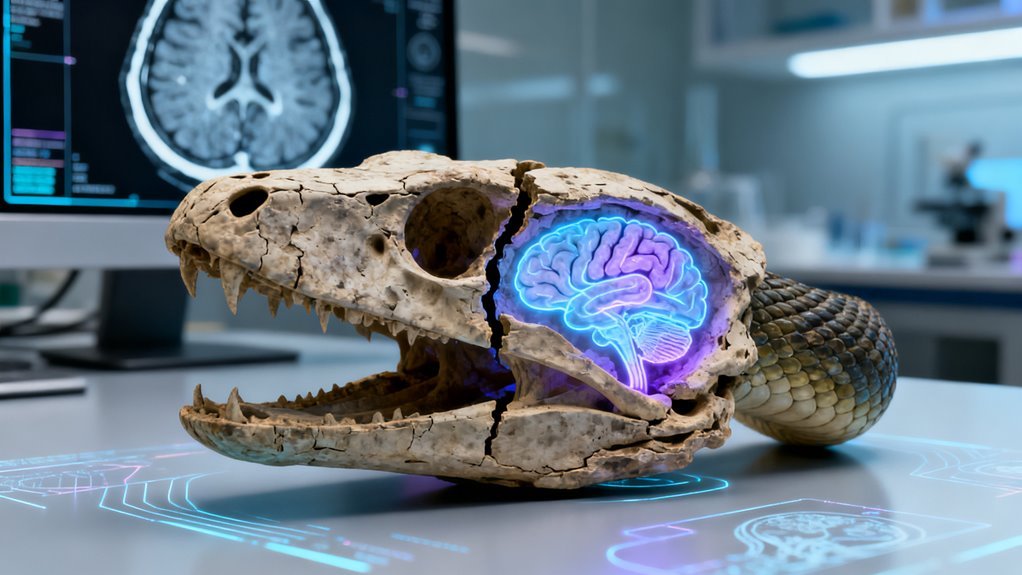

When a team of paleontologists and computer scientists fed CT scan data from a 80 million year old fossil skull into a machine learning pipeline trained on the comparative anatomy of more than 50 living species, the result was not just a digital reconstruction. It was a window into a sensory world that no longer exists, one that raises hard questions about how we model evolutionary trajectories and, more broadly, about what AI can now extract from incomplete physical evidence.
The species in question is *Tametara mirim*, a small Cretaceous snake whose skull was preserved in three dimensions with unusual fidelity. That level of preservation is rare for any vertebrate fossil, let alone a snake, whose delicate cranial bones tend to crush flat over geological time. The AI reconstruction revealed a brain architecture that does not fit neatly into any existing category. It diverges from modern snakes. It diverges from other known Cretaceous species. And the pattern of divergence points toward sensory adaptations linked to a burrowing lifestyle that apparently represents an entire ecological strategy lost to extinction.
That finding alone would be notable in herpetology journals. But the real story here is methodological, and it matters far beyond paleontology.
What Actually Happened, Technically
The researchers built a supervised learning pipeline using high resolution morphometric data from dozens of extant snake and lizard species. Each modern brain was mapped in three dimensions, segmented by region, and annotated with known functional correlations. The model learned the statistical relationships between skull geometry and brain structure across a broad phylogenetic sample. Then they applied it to the fossil.
This is not hallucination or artistic license. The approach is grounded in a well established principle of comparative anatomy: skull shape constrains and reflects brain shape, especially in reptiles where the braincase fits tightly around neural tissue. What the AI did was formalize and scale that principle far beyond what any individual anatomist could do manually. It synthesized spatial relationships across fifty plus species simultaneously and projected them onto fragmentary ancient evidence.
The output was a probabilistic reconstruction, not a photograph. But the statistical confidence was high enough that the team could identify specific regions of the brain, including the olfactory bulbs and optic tectum, and draw functional inferences about how the animal perceived its environment.
Why This Matters Beyond Paleontology
For anyone tracking the expansion of AI into scientific research, this study sits at an interesting intersection. Over the past three years, we have watched machine learning reshape protein folding prediction through AlphaFold, accelerate drug candidate screening, and transform materials science. What those applications share is a common pattern: AI excels when the underlying data is structured, the relationships are complex but lawful, and the volume of prior knowledge is large enough to train on but too large for any human to synthesize unaided.
Paleontology has historically been data poor compared to genomics or chemistry. Fossils are rare, fragmentary, and expensive to scan. But the combination of increasingly affordable micro CT technology and transfer learning from well studied living species is changing that equation. This study is one of the clearest demonstrations yet that AI can generate genuinely novel biological insight from physical specimens that have been sitting in museum drawers for decades.
Google DeepMind showed what was possible when you throw enormous compute at biological structure prediction. What this paleontology team showed is something subtly different: that carefully curated training data from a modest number of species, combined with domain expertise in anatomy, can produce scientific results that no amount of manual analysis would have reached. The constraint was never compute. It was the intellectual framework for connecting living anatomy to fossil morphology at scale.
The Evolutionary Surprise and What People Are Missing
The reconstruction suggests early snakes were experimenting with sensory configurations we do not see today. The brain of *Tametara mirim* appears to have been optimized for a subterranean lifestyle in ways that differ from modern burrowing snakes, which implies that the sensory toolkit for underground life was reinvented at least once during snake evolution rather than inherited in a straight line from a single ancestor.
This matters because one of the longest running debates in herpetology concerns whether snakes originated as burrowers or as aquatic swimmers. The molecular and morphological evidence has been contradictory for years. A single fossil brain reconstruction will not settle the argument, but it adds a genuinely new data type to a debate that has been stuck cycling through the same categories of evidence.
What most coverage of this research will miss is the broader implication for how AI changes the epistemology of historical sciences. Paleontology, archaeology, and geology all share a fundamental problem: the evidence is destroyed or degraded by time, and you cannot run the experiment again. AI does not solve that problem. But it dramatically expands the information you can extract from whatever evidence survives. The fossils have not changed. What changed is our ability to read them.
Strategic Implications for AI in Science
Several trends converge here. Museum collections worldwide hold millions of unscanned specimens. Micro CT scanning costs have dropped by roughly an order of magnitude over the past decade. And transfer learning techniques mean you do not need millions of training examples if the underlying biological relationships are consistent enough.
For AI companies and research tool developers, natural history collections represent an enormous untapped dataset. The Smithsonian alone holds over 146 million specimens. Most have never been digitized, let alone analyzed with modern computational methods. Any organization that builds robust pipelines for ingesting, segmenting, and analyzing three dimensional biological scans will find a waiting market across paleontology, zoology, botany, and anthropology.
For investors, the signal is that AI’s value in science is no longer confined to the data rich fields that attracted early attention. The long tail of scientific disciplines, the ones with small datasets but deep domain knowledge, is becoming accessible. That broadening of AI’s scientific footprint will create opportunities in specialized tooling, domain specific model development, and data infrastructure that are less glamorous than foundation model races but potentially more durable as businesses.
What Comes Next
Expect more studies like this one over the next twelve to eighteen months. The methodology is transferable to any vertebrate fossil with reasonable cranial preservation, and there are thousands of candidates in collections worldwide. The limiting factor will be access to scanning facilities and the availability of researchers who combine computational skills with genuine anatomical expertise.
The deeper question is whether AI reconstructions of ancient brains will eventually reach the resolution needed to infer not just sensory capabilities but behavioral patterns. That remains speculative, but the trajectory is clear. Each improvement in training data, scanning resolution, and model architecture brings the boundary of inference a little further into the past.
Eighty million years is a long time. The fact that a machine learning model can now extract functional neuroanatomical information from a skull that old should reframe how we think about the shelf life of scientific evidence. The data was always there, locked in the geometry of bone. We just needed a new way to read it.
The most detailed reconstruction of an ancient snake’s brain ever produced didn’t come from a scalpel or a microscope. It came from a machine learning pipeline trained on comparative anatomy datasets spanning more than 50 modern species, combined with high resolution micro CT scanning of a fossil pulled from Late Cretaceous rock in Brazil. The species, *Tametara mirim*, is now offering neuroscience a window into deep evolutionary time that simply did not exist before AI entered the picture.
This is worth paying attention to not because of the snake itself, though the biology is genuinely fascinating, but because of what the underlying methodology signals about AI’s expanding role in scientific discovery. We are watching artificial intelligence move from pattern recognition in digital datasets to inferring the physical structures of organisms that have been dead for 80 million years. That transition matters.
AI is no longer just recognizing patterns — it is reconstructing biological realities that vanished tens of millions of years ago.
What Actually Happened
The fossil in question is extraordinary by paleontological standards. *Tametara mirim* preserves a three dimensional skull and vertebral column in articulation, which is rare for any snake fossil, let alone one from the Cretaceous. Crucially, the braincase and inner ear structures survived intact. Those are the features that make neuroanatomical reconstruction possible, and they almost never survive fossilization in early snakes.
Researchers scanned the skull using high resolution micro CT, producing volumetric data of the internal cranial cavity. Digital segmentation then generated a detailed endocast, essentially a 3D map of the space where the brain once sat. Cinematic rendering resolved individual cranial nerves, inner ear geometry, and fine neuroanatomical landmarks with a level of clarity that would have been unthinkable a decade ago.
But here is where the AI component becomes essential. Fossil endocasts capture bone surfaces, not soft tissue. The brain itself is long gone. To bridge that gap, the research team deployed AI driven predictive modeling that draws on comparative datasets of living snakes and lizards, statistically inferring what the soft tissue architecture likely looked like based on osteological correlates. The model essentially asks: given these bone structures, and given what we know about the relationship between bone and brain tissue across dozens of modern species, what is the most probable configuration of this animal’s nervous system?
The answer was surprising. The reconstructed brain looks nothing like those of most living snakes. Visual processing centers are dramatically reduced. The forebrain is simplified. Meanwhile, the otic region and inner ear structures are disproportionately large, consistent with an animal that navigated primarily through substrate borne vibrations rather than sight. Cranial nerve mapping supports a subterranean lifestyle. Every independent anatomical system points in the same direction: this was a burrowing snake adapted to darkness.
Why the AI Methodology Matters More Than the Snake
Paleontology has always been a discipline of inference. You find fragments, you compare them to known organisms, you build hypotheses. What changes with AI assisted reconstruction is the rigor and scale of that inference. Instead of a single expert comparing a fossil to a handful of reference specimens, a trained model can integrate morphological data from 50 to 100 species simultaneously, weighting statistical correlations that no human could hold in working memory.
This approach sits at the intersection of several AI capabilities that have matured rapidly over the past three years. High resolution 3D segmentation of medical and scientific imaging has improved dramatically, driven in part by advances in computer vision architectures originally developed for autonomous vehicles and radiology. Predictive modeling of biological structures has benefited from the same transformer based approaches that power large language models, adapted to work with spatial and morphological data rather than text. Additionally, the use of geometric deep learning opens new avenues for analyzing complex biological structures.
And the sheer computational cost of running these pipelines has dropped enough to make them accessible to research teams that are not sitting inside a Big Tech lab. The parallel to what is happening in protein structure prediction is hard to miss. DeepMind’s AlphaFold demonstrated in 2020 that AI could predict three dimensional protein configurations from amino acid sequences with accuracy approaching experimental methods. That work earned a Nobel Prize and fundamentally changed structural biology.
What we are seeing in paleontology now follows the same logic: AI models trained on known relationships between structure and function are being used to reconstruct unknowns that were previously inaccessible. The difference is that AlphaFold works with living molecules that can be experimentally validated. Paleontological reconstruction of soft tissue from fossil bone cannot be validated in the same way because the ground truth is gone.
This creates an important epistemic limitation. The *Tametara mirim* reconstruction is probabilistic, not definitive. The researchers were careful to frame it that way, using quantitative analysis rather than qualitative speculation. But as these methods proliferate, the temptation to present AI inferred reconstructions as established fact will grow, and the field will need robust standards for communicating uncertainty.
What This Reveals About Early Snake Evolution
Setting the AI angle aside for a moment, the biological findings genuinely reshape the scientific picture. Before this reconstruction, the prevailing assumption was that early snakes shared a relatively uniform neuroanatomical template. *Tametara mirim* breaks that assumption. Its brain architecture diverges significantly not only from modern snakes but also from other known Cretaceous species like *Dinilysia patagonica* from Argentina.
This suggests that stem snakes were experimenting with diverse sensory strategies tied to different ecological niches much earlier than previously recognized. The fossorial adaptation is particularly significant. The combination of reduced optic lobes, reinforced cranial bone microstructure suited to resisting the mechanical stress of burrowing, and inner ear morphology linked to ground vibration detection creates a convergent picture supported by multiple independent anatomical systems.
This is not one data point suggesting a burrowing lifestyle. It is several data points from different biological systems all arriving at the same conclusion, which is exactly the kind of multi system convergence that makes scientific inferences robust. For evolutionary biology more broadly, this adds weight to the hypothesis that burrowing played a central role in early snake diversification. The research, led by Tiago Simes from Princeton University with senior authors including Nicolas Di-Po and Annie Hsiou, was published in Nature and underscores the significance of these findings for the broader scientific community.
The loss of limbs, the elongation of the body plan, the reduction of visual processing: these traits make more sense in the context of underground life than they do as adaptations for surface dwelling or aquatic environments, two alternative hypotheses that have competed in the literature for decades.
The Broader Trajectory of AI in Scientific Discovery
This project sits within a clear trend line. AI is no longer confined to optimizing ad targeting or generating chatbot responses. It is becoming infrastructure for scientific reasoning in domains where data is sparse, noisy, or incomplete.
In astronomy, machine learning models are classifying galaxy morphologies and detecting exoplanet transits in datasets too large for human review. In materials science, generative models are proposing novel compounds with target properties before any lab synthesis occurs. In drug discovery, AI driven molecular screening has compressed timelines from years to months at companies like Recursion and Insilico Medicine.
Google DeepMind, Anthropic, and OpenAI have all signaled that scientific reasoning is a priority capability for next generation foundation models. What the *Tametara mirim* reconstruction demonstrates is that this trend extends to historical sciences where the data is not just incomplete but genuinely unrecoverable. The fossil record is finite. No new Cretaceous snake brains are going to appear in a laboratory.
AI’s value here is not in collecting more data but in extracting more information from the data that exists. That is a fundamentally different mode of scientific contribution, and it is one where AI has a structural advantage over unaided human analysis.
What to Watch Next
Several developments are likely to follow from this kind of work. First, expect a proliferation of AI assisted paleontological reconstructions over the next two to three years. The methodology is generalizable. Any fossil with preserved cranial structures could potentially undergo similar analysis, and research groups around the world are already scanning museum collections that have sat in drawers for decades.
Second, the debate over validation standards will intensify. How do you peer review an AI reconstruction of tissue that no longer exists? The statistical frameworks used here are defensible, but as the models grow more complex and the reconstructions more detailed, the scientific community will need to establish clearer benchmarks for what constitutes a credible inference versus an overfit prediction.
Third, this kind of work will accelerate the integration of AI expertise into fields that have historically operated without it. Paleontology departments are not typically staffed with machine learning engineers. That will change, either through direct hiring, through collaboration with computer science departments, or through the development of turnkey tools that domain experts can operate without deep technical knowledge.
The pattern has already played out in genomics and radiology. Paleontology is simply next in line. Finally, there is a commercial dimension worth noting. Companies building specialized AI tools for scientific imaging and analysis, particularly in 3D segmentation and predictive morphological modeling, stand to benefit as demand from research institutions grows.
The market is niche today, but the underlying technology overlaps significantly with medical imaging AI, which is a multibillion dollar sector. Cross pollination between these domains is inevitable. The reconstruction of *Tametara mirim*’s brain is a single study. But it represents something larger: the point at which AI becomes capable of telling us things about the natural world that we had no other way of knowing. That threshold, once crossed, does not get uncrossed.