An AI System Just Found a Yellowstone-Scale Magma Reservoir Hiding Beneath Tuscany. That Should Change How We Think About AI in the Geosciences.
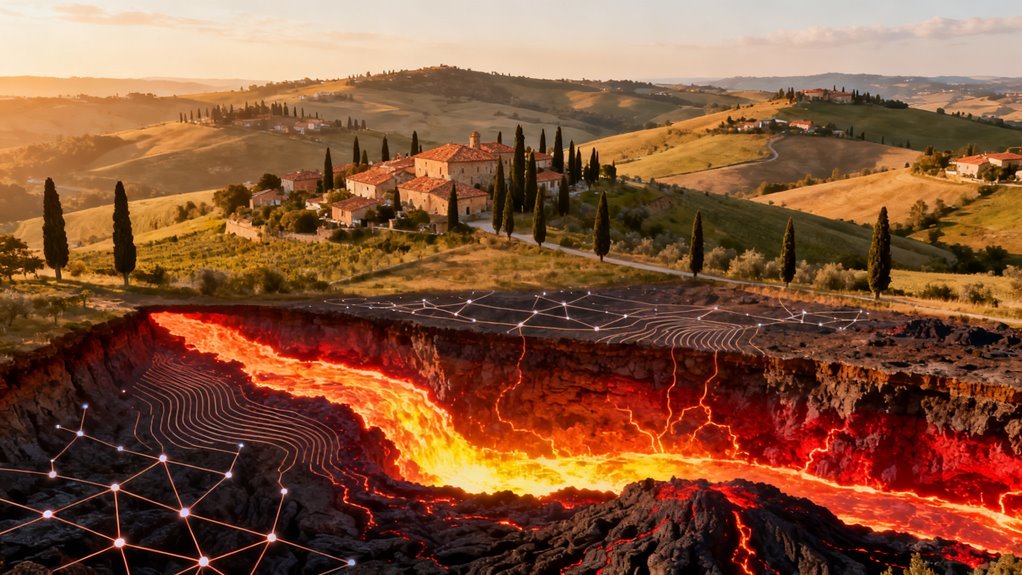
Beneath the rolling hills and vineyards of Tuscany, a magma body roughly 20 kilometers across has been sitting undetected for as long as humans have walked the region. It took an artificial intelligence system called Gaia, processing seismic signals that would overwhelm traditional analytical methods, to finally see it. The reservoir holds an estimated 6,000 cubic kilometers of partially molten rock between 8 and 15 kilometers deep in the middle crust, putting it in the same category as the magma systems beneath Yellowstone and Indonesia’s Toba supervolcano.
This is not a story about volcanoes. It is a story about what AI can find when pointed at problems that have defeated conventional analysis for decades.
Why Traditional Methods Missed It
Seismologists have studied the subsurface geology of central Italy for years. The region sits on an active tectonic setting, and geothermal energy has been harvested in Tuscany since the early 1900s, most notably at the Larderello geothermal field. The signs were there. Elevated heat flow, hydrothermal activity at the surface, and anomalous seismic signals all hinted at something significant at depth.
But ambient noise tomography, the technique at the core of this discovery, generates enormous volumes of data. The method works by recording the faint, continuous vibrations traveling through the Earth from ocean waves, wind, and even human activity, then using those signals to build three-dimensional images of subsurface structures. The challenge has never been collecting the data. It has been interpreting it at sufficient resolution and scale to distinguish a diffuse zone of partial melt from surrounding rock.
This is precisely where machine learning excels. Gaia was trained to identify subtle velocity anomalies in seismic wave propagation that indicate the presence of melt. Where human analysts might spend months working through the data and still miss gradual transitions in rock properties, the AI system identified patterns across the full dataset simultaneously, resolving the reservoir’s geometry with a clarity that manual interpretation could not achieve.
The Significance Goes Well Beyond Geology
The discovery matters on two levels, and neither is the one most headlines will focus on.
First, the practical implications. A magma body of this scale represents a potentially transformative geothermal energy source. Italy already generates more geothermal electricity than any other country in Europe, and the Larderello field has been producing power for over a century. But current geothermal operations tap relatively shallow hydrothermal systems. Understanding the geometry and thermal output of a deep crustal magma reservoir could inform next-generation geothermal projects, including supercritical geothermal systems that access much higher temperatures and energy densities than conventional wells.
On the hazard side, a reservoir comparable to Yellowstone or Toba does not mean an eruption is imminent or even likely within any human timescale. Magma bodies of this size typically persist for hundreds of thousands of years. But knowing it exists changes risk models for the region and requires updated monitoring strategies. The Italian civil protection apparatus will need to account for this.
Second, and more relevant to the AI industry, this discovery is a case study in what happens when machine learning is applied not to consumer products or enterprise software but to fundamental scientific observation. The reservoir was not hidden because of a lack of data. It was hidden because the data exceeded the interpretive capacity of existing workflows. Gaia did not replace geophysicists. It gave them a tool that could operate at the scale and resolution the problem demanded.
Where This Fits in the Broader AI Trajectory
Over the past three years, the most visible AI developments have been in language models, image generation, and coding assistants. OpenAI, Google, Anthropic, and others have competed fiercely on benchmarks tied to text and reasoning. Meanwhile, some of the most consequential applications of AI have been quietly advancing in the physical sciences.
DeepMind’s AlphaFold transformed structural biology by predicting protein folding with unprecedented accuracy. Microsoft and Pacific Northwest National Laboratory used AI to screen millions of potential materials and identified a promising new battery chemistry in a matter of days. Climate modeling, drug discovery, and materials science have all seen breakthroughs driven by machine learning applied to large, complex datasets that resisted conventional analysis.
The Tuscany discovery belongs in this lineage. It demonstrates that AI’s transformative potential extends far beyond generating text or optimizing ad spend. When the problem is pattern recognition across massive, noisy datasets with high dimensionality, neural networks consistently find structure that human experts cannot.
This also raises a question the geosciences community will need to confront: how many other significant geological features remain undetected simply because the data has not been processed with modern AI tools? Seismic networks around the world have been recording ambient noise for decades. Much of that data sits in archives, analyzed only with the methods available at the time of collection. Reprocessing those archives with systems like Gaia could reveal subsurface structures that reshape our understanding of volcanic systems, fault mechanics, and resource potential globally.
The Geothermal Energy Angle Deserves Serious Attention
The timing of this discovery aligns with growing interest in geothermal energy as a complement to solar and wind. The energy transition needs firm, baseload power sources that do not depend on weather conditions or time of day. Geothermal fits that requirement, but its expansion has been limited by the difficulty of identifying viable heat sources at accessible depths.
AI changes that equation. If machine learning can reliably map deep thermal structures using existing seismic data, the exploration risk for geothermal projects drops substantially. That matters for investors and developers who have historically viewed geothermal as too uncertain compared to solar or wind. Companies like Fervo Energy in the United States and Quaise Energy, which is developing millimeter-wave drilling to reach supercritical temperatures, stand to benefit from better subsurface imaging. So does any government looking to diversify its energy portfolio without adding intermittency.
Italy in particular could leverage this discovery to expand its geothermal capacity significantly. The European Union’s push toward energy independence following the disruption of Russian gas supplies has made domestically sourced, reliable power generation a strategic priority. A confirmed deep magma reservoir beneath one of Italy’s most geologically active regions provides both the resource and the justification for increased investment.
What People Are Overlooking
Most coverage of this story will focus on the size of the magma body and the inevitable Yellowstone comparison. That comparison, while technically valid in terms of scale, risks distracting from the more important point.
The real story is methodological. Gaia represents a new category of scientific instrument. Not a telescope or a seismometer, but an interpretive layer that sits between raw data and human understanding, extracting signal from noise at a scale and speed that changes what questions scientists can ask. The discovery of the Tuscan reservoir is the output. The capability that produced it is what will compound over time.
Consider the implications if similar AI systems are deployed to reanalyze seismic data from the Pacific Ring of Fire, the East African Rift, or the Cascadia subduction zone. Each of these regions has extensive seismic monitoring networks and decades of archived data. The potential for new discoveries is substantial.
There is also a governance question that no one seems to be asking yet. If AI tools can identify previously unknown volcanic hazards or geothermal resources, who controls access to those tools and their outputs? The economic and strategic value of subsurface intelligence is significant. Nations and corporations with access to the best AI-driven geophysical analysis will have a meaningful advantage in resource development and risk management. This is not a hypothetical concern. It is an emerging reality.
What Happens Next
In the near term, expect the Italian geological community to launch follow-up studies aimed at refining the reservoir’s properties, including its melt fraction, temperature distribution, and any connections to shallower hydrothermal systems. Monitoring networks in the region will likely be expanded.
For the AI industry, this discovery adds to a growing body of evidence that some of AI’s highest-value applications lie not in consumer technology but in augmenting scientific observation. The companies and research institutions that build domain-specific AI systems for the physical sciences are positioning themselves at the intersection of two powerful trends: the maturation of machine learning and the urgent need for better understanding of the Earth’s systems in an era of climate change and energy transition.
The magma was always there. The data was always there. What changed was the ability to see what the data contained. That shift, quiet and technical, is one of the most important things happening in AI right now. And it is getting almost no attention compared to the latest chatbot benchmark.
For decades, geologists treated southern Tuscany as a geothermal curiosity. The Larderello steam fields have powered turbines since 1913, making the region one of the oldest geothermal energy sites on Earth. But nobody could fully explain why so much heat kept flowing from below. Now, a combination of ambient noise tomography and an AI system called Gaia has revealed the answer: a magma reservoir spanning roughly 20 kilometers in diameter and holding between 5,000 and 6,000 cubic kilometers of partially molten rock sits beneath the rolling hills, medieval villages, and vineyards. That puts it in the same league as the magma systems beneath Yellowstone and Toba.
What makes this discovery remarkable is not just its scale. It is that a reservoir this massive existed beneath one of the most studied geological regions in Europe without anyone detecting it until AI and advanced seismic processing made it visible. This highlights the potential of AI to transform geosciences by revealing previously hidden geological structures.
What Actually Happened
A team from the University of Geneva, CNR-IGG, and INGV deployed approximately 60 high-resolution seismic sensors across Tuscany and applied ambient noise tomography, a technique that treats the constant low-level vibrations from ocean waves, wind, and human activity as a useful signal rather than interference.
Statistical algorithms and advanced signal processing extracted coherent data from what would otherwise be noise, building a three-dimensional velocity model of the upper crust. The resulting image is striking. The reservoir sits at depths between 8 and 15 kilometers within the middle continental crust. Its inner core appears to be roughly 80 percent molten magma, surrounded by a zone of crystal-rich mush.
Rather than a narrow vertical pipe feeding toward the surface, the structure spreads laterally, forming a broad sill-like geometry. This explains why southern Tuscany shows no volcanic cones, no recent eruptions, and no obvious surface evidence of a supervolcano-class magma body. The heat diffuses upward through a wide, stable structure rather than concentrating in a way that would build a volcanic edifice.
Separately, the AI application Gaia was developed to infer magma chamber depth by analyzing the chemistry of clinopyroxene, a mineral that crystallizes at specific temperatures and pressures within magma. By training machine learning models on known mineral-depth relationships, the system can estimate where magma bodies sit beneath the surface using chemical fingerprints alone.
The research was published in Communications Earth & Environment under a title that leaves little ambiguity about its significance: “High-enthalpy Larderello geothermal system, Italy, powered by thousands of cubic kilometres of mid-crustal magma.”
Why This Matters for AI in the Geosciences
The Tuscany discovery lands at a moment when AI is fundamentally changing how scientists observe the Earth. And the pattern here is worth paying attention to because it mirrors what is happening across multiple scientific domains.
The core problem was not a lack of data. Seismologists have recorded ground vibrations across Tuscany for years. The problem was that the signal indicating a giant magma body was buried inside noise that traditional methods could not adequately separate from useful information.
Machine learning changed the equation by identifying statistical patterns across massive datasets of ambient vibrations, patterns that human analysts working with conventional tools would struggle to isolate at this resolution. This is the same dynamic playing out in drug discovery, protein structure prediction, materials science, and climate modeling.
The data often already exists. What was missing was the analytical capability to extract meaning from it. AlphaFold did not generate new protein experiments. It reinterpreted existing sequence data in ways that revealed three-dimensional structures. Similarly, Gaia did not require new geological samples. It reinterpreted existing mineral chemistry to estimate magma depth.
The trend is accelerating. Google DeepMind’s GraphCast system now produces global weather forecasts faster and often more accurately than traditional numerical models. NVIDIA’s Earth-2 platform applies generative AI to climate simulation. Microsoft’s Aurora foundation model handles atmospheric prediction at scale.
What connects all of these efforts, and now this Tuscany study, is a shift from physics-first modeling to data-first inference, with AI acting as the interpretive layer that makes previously invisible phenomena detectable.
The Energy Angle No One Should Overlook
The geothermal implications here are potentially enormous and underappreciated. Larderello already produces significant power, but the economics and planning of geothermal energy have always been constrained by uncertainty about what lies beneath.
Drilling geothermal wells is expensive. Missing a productive zone by even a small margin can turn a viable project into a financial loss. The fundamental challenge is that subsurface imaging has historically lacked the resolution needed to reduce that risk to acceptable levels.
This study changes the calculus. Knowing that a 5,000 to 6,000 cubic kilometer magma body powers the Larderello system provides hard constraints for modeling how much thermal energy is available, how long it might last, and where the most productive drilling targets are.
Monte Amiata’s volcanic complex and nearby geothermal areas connect to the same mid-crustal system, suggesting that the exploitable geothermal footprint may be substantially larger than previously assumed. The timing matters. Europe is scrambling for energy security and decarbonization pathways simultaneously.
Geothermal energy produces baseload power with near-zero carbon emissions, does not depend on weather, and occupies a small surface footprint. But it has remained a niche contributor to European energy partly because subsurface uncertainty made project financing difficult.
If AI-enhanced seismic imaging can reliably map deep heat sources across geologically complex regions, it could unlock geothermal potential not just in Tuscany but across the Mediterranean, Iceland, East Africa, and the western Americas. Several startups and established energy companies are already moving in this direction.
Fervo Energy in the United States is applying advanced drilling and monitoring techniques to enhanced geothermal systems. Quaise Energy is pursuing ultra-deep drilling into hot rock. What none of them have had, until very recently, is the kind of detailed subsurface imaging that AI-driven seismic analysis now makes possible. The Tuscany study is a proof point that this imaging capability has reached a practical threshold.
What People Are Overlooking
Three things deserve more attention than they are getting.
First, the volcanic hazard question. The researchers are careful to note that the reservoir shows no signs of imminent eruption, and its sill-like geometry suggests stable, diffuse heat transfer rather than the kind of focused magma ascent that precedes eruptions.
But a Yellowstone-scale magma body beneath a densely populated part of Italy is, at minimum, something that civil protection agencies will need to integrate into long-term risk assessments. The fact that it was invisible until now raises an uncomfortable question: how many other large magma reservoirs exist beneath regions that appear volcanically quiet?
AI-enhanced seismic surveys may start answering that question within the next few years, and some of those answers could be unsettling.
Second, the methodological precedent matters more than the specific discovery. Ambient noise tomography powered by machine learning does not require active seismic sources like explosions or specialized vibrating trucks. It works passively, using vibrations that are already present everywhere on Earth.
That makes it scalable and relatively inexpensive compared to active seismic surveys. If this approach can find a 5,000 cubic kilometer magma body that was previously undetected, it can likely reveal many other subsurface structures relevant to energy, mining, water resources, and hazard assessment. The technique is not limited to Italy or to magma. It applies anywhere there is ground to listen to.
Third, the Gaia AI system for interpreting mineral chemistry opens a parallel pathway. Geologists have accumulated vast collections of mineral samples from volcanic and plutonic rocks worldwide.
Reanalyzing that existing data with trained machine learning models could generate a global map of magma reservoir depths without any new fieldwork. That is an extraordinary return on investment for what is essentially a software project applied to archived geological data.
Where This Leads
The broader trajectory is clear. AI is becoming the default interpretation layer between raw Earth observation data and actionable geological knowledge. The transition will not happen overnight, and traditional geophysical methods will remain essential for data acquisition.
But the analytical bottleneck, turning noisy, ambiguous signals into reliable subsurface images, is increasingly an AI problem rather than a purely human one. For the geothermal industry specifically, this study provides a concrete example of AI-driven imaging reducing subsurface uncertainty at a commercially relevant scale.
Expect to see geothermal developers, particularly those targeting enhanced geothermal systems in complex geological settings, incorporate similar AI-assisted seismic workflows into their exploration pipelines within the next two to three years. Beyond geothermal energy, these same deep magmatic systems are linked to the formation of lithium and rare earth elements, making the discovery equally significant for critical mineral exploration tied to the energy transition.
For the AI industry more broadly, this is another data point in a growing collection showing that some of the highest-value applications of machine learning are not consumer-facing chatbots or image generators. They are scientific instruments that reveal things about the physical world that were previously beyond our capacity to observe.
The Tuscany magma reservoir was always there. It took 1,100 years of Italian science and a few modern algorithms to finally see it.