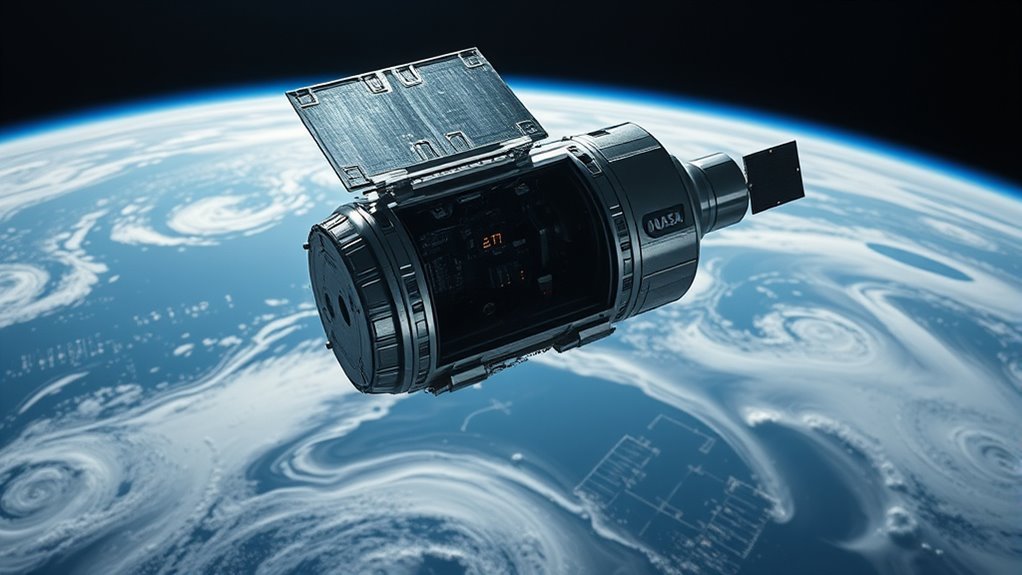

For the first time, a modern vision language model is living inside a working Earth observation satellite and making sense of the images it sees before anything is sent down to the ground. Gemma 3 running on the NAVI Orbital experiment is a quiet but important shift in how space agencies and commercial operators may design satellites and data pipelines in the coming years.
This move matters because the bottleneck in space imaging is no longer how many pixels a satellite can capture. It is how much useful information can flow through limited radio links and how quickly analysts can act on it. Putting a capable multimodal model like Gemma 3 into orbit begins to flip that equation so that insight rather than raw data becomes the main product. In NAVI-Orbital, satellite images are analyzed using Google’s Gemma 3, turning onboard understanding into concise descriptions rather than bulk data.
In orbital imaging, the real bottleneck is insight over bandwidth, not pixels over time
From fire hoses of pixels to satellites that understand scenes
For decades, Earth observation followed a familiar pattern. Satellites captured as much imagery as possible, stored it onboard and streamed large batches down to ground stations where human analysts or data center systems did the actual interpretation.
Bandwidth limits, contact windows and storage constraints shaped mission design more than how quickly anyone could understand what was in the images.
In the last ten years, the edge computing movement began pushing processing closer to sensors on Earth in factories, vehicles and smartphones. Space systems lagged behind because of harsh radiation, strict safety requirements and the difficulty of updating complex flight software once a spacecraft is launched.
Most satellites that did onboard analysis used comparatively simple algorithms, such as threshold detectors or small convolutional networks tuned for narrow tasks.
NAVI Orbital marks a step change. Instead of acting as a passive camera that constantly downlinks imagery, the YAM 9 spacecraft can now look at a scene, describe it in plain language and classify what it sees while still in orbit. That turns a satellite into something closer to an autonomous observer than a remote sensor.
What exactly NASA and Loft Orbital put in orbit
NAVI Orbital is a software framework developed at NASA Jet Propulsion Laboratory and deployed on Loft Orbital’s commercial satellite YAM 9, which operates in low Earth orbit at roughly five hundred kilometers altitude.
On April sixteen twenty twenty six, the team achieved what they describe as the first in orbit demonstration of a vision language model performing multimodal inference entirely onboard a spacecraft.
At the heart of the system sits Google DeepMind’s Gemma 3, a family of relatively lightweight multimodal models designed for edge deployment. The mission uses the Gemma 3 four billion parameter open weights edition, compressed to run in about eight gigabytes of memory.
This footprint is small enough for laptop class and embedded hardware yet substantial enough to provide rich scene descriptions and question answering capability over satellite imagery.
Gemma 3 executes on an Nvidia Jetson Orin AGX module, a compact system on module widely used in robotics and embedded AI. For this mission, the hardware and software stack had to be qualified for the thermal and radiation environment of orbit and integrated with the spacecraft’s imaging payload.
The model receives image data directly from the onboard camera as soon as frames are captured, avoiding intermediate storage layers and reducing latency from capture to analysis.
Crucially, NAVI Orbital is isolated from core flight control functions. The software stack has access to read imagery and generate descriptions, but it cannot modify flight software or send spacecraft commands.
JPL designed strict boundaries so that even if the AI payload misbehaved, it would not jeopardize pointing, power or communications systems. This separation is important for trustworthiness and will likely be mandatory for future autonomous payloads.
How NAVI Orbital uses Gemma 3 in practice
The NAVI Orbital framework translates high level natural language prompts from operators into structured image classification and description tasks executed onboard.
Instead of specifying exact pixel operations, engineers can ask questions like “show me infrastructure around railway hubs” or “identify coastal settlements with nearby agricultural land,” and the system will search its current or recent imagery for relevant scenes.
LangGraph orchestrates an agent style workflow inside the payload computer, managing prompts, model calls and responses. The flight configuration described by the team uses a graph of cooperating components that route new images through Gemma 3, run classification and captioning, and handle operator follow up questions, all while enforcing the safety boundaries that keep flight software separate.
Before launch, the team benchmarked Gemma 3 on a standard aerial imagery dataset. In one reported experiment, a four bit quantized version of the four billion parameter model achieved about eighty eight percent accuracy on seven thousand nine hundred sixty images without task specific fine tuning.
That result is important. It suggests that a properly tuned but not retrained model can generalize well enough to many kinds of satellite scenes, which is critical when in orbit retraining is either impossible or extremely constrained.
In operations, YAM 9 no longer needs to stream continuous image feeds. Instead, it can send down concise reports and selected thumbnails that highlight features of interest, such as land use patterns, cloud cover types or coastal structures.
The communications link carries human readable insight, while the heavy raw data remains mostly in onboard storage or is discarded when it is not needed.
Why this is a turning point for orbital AI
Several aspects make this demonstration more than just another satellite technology story.
First, it is one of the first publicly documented cases where a general purpose multimodal model runs in orbit and interacts with operators through natural language, rather than executing a fixed menu of detection algorithms.
That moves satellites closer to being collaborators that can answer questions about what they see rather than simple data collectors.
Second, the hardware footprint is intentionally modest. Gemma 3 running in around eight gigabytes on Jetson Orin shows that powerful vision language capability can fit into the power and mass budgets of small commercial spacecraft.
Space AI no longer requires custom accelerators or data center class GPUs. It can ride along on edge hardware that is already common in terrestrial robotics.
Third, the model is open weights. Using the Gemma 3 four billion parameter edition means researchers and companies can inspect and reproduce the experiment, explore failure modes and extend the setup to their own missions with the same publicly available parameters.
That openness is essential for building confidence in safety and reliability, and it lowers the barrier for new entrants who want to experiment with orbital AI without negotiating proprietary licenses.
Benefits for Earth observation and space operations
The most immediate benefit is bandwidth efficiency. A single high resolution Earth observation satellite can produce more data than it can practically send down during short ground station passes.
Letting an onboard model sift through imagery and prioritize scenes that match current questions or mission goals can dramatically reduce downlink volume while increasing the relevance of what analysts see.
For emergency response, that could translate to faster identification of flooded areas, wildfire progression or damaged infrastructure after earthquakes.
Operators might ask the satellite to scan newly captured imagery for roads cut off by landslides or hospitals near impacted zones, and receive text descriptions and selected images within the same orbit.
The combination of time sensitive sensing and onboard reasoning is particularly powerful in crises when every minute counts.
Commercial operators can also adjust business models. Rather than selling raw imagery by the gigabyte, future constellations could offer subscription services for alerts and structured reports about specific assets or regions.
NAVI Orbital provides a template in which satellites act as edge analytics nodes, turning constellations into distributed sensing and reasoning networks.
For mission operations, onboard understanding may reduce routine work. Spacecraft could filter out images where clouds fully obscure the ground, automatically detect when sensors are misconfigured or identify subtle issues with pointing and exposure.
While the current NAVI Orbital configuration keeps the AI payload strictly separated from control systems, future designs might allow certain vetted autonomic actions, such as retargeting a camera or adjusting exposure settings, as long as they stay within safety envelopes.
Risks, limitations and the trust question
The NAVI Orbital team emphasizes safety boundaries and limited access precisely because a model that misinterprets scenes or fails unpredictably could lead to harmful decisions if given control authority.
Vision language models are known to exhibit biases, occasional hallucinations and sensitivity to prompt phrasing. Those behaviors do not disappear simply because the model is in orbit.
Accuracy figures from ground testing are encouraging but not absolute guarantees. The benchmark to around eighty eight percent accuracy still leaves a significant minority of cases where classifications may be wrong or incomplete.
Satellite scenes also vary widely based on angle, lighting, sensor characteristics and atmospheric conditions, so performance in orbit requires careful monitoring.
There are also security considerations. A satellite that responds to natural language queries and makes prioritization decisions based on those queries must be protected against unauthorized access or malformed instructions.
JPL and Loft Orbital keep NAVI Orbital fenced off from flight controls and operate within existing mission security frameworks, but broader deployment across many commercial constellations would require robust authentication, auditing and perhaps policy layers on top of model prompts.
Finally, there is a governance question. As orbital AI systems gain more autonomy, regulators and international bodies may need new norms around how these systems are tested, how failures are reported and how transparency is maintained.
Open weights models like Gemma 3 help by making independent assessment possible, yet they also raise concerns if powerful capabilities become trivially deployable by actors with less emphasis on safety.
How this fits into the broader AI and space timeline
From an AI history perspective, NAVI Orbital sits at the intersection of several trends. Multimodal models that understand both text and images reached practical maturity only in the last few years.
Edge optimized architectures emerged in parallel as the industry sought to run large models on phones, cars and industrial devices.
Space agencies for their part have been experimenting with AI onboard missions for some time. Previous efforts included applying simple machine learning models to classify cloud cover, detect volcanic plumes or select science images on deep space missions.
What distinguishes NAVI Orbital is the use of a broadly capable, conversational, open weights vision language model rather than a bespoke detector tuned for one phenomenon.
This is also a notable case of collaboration between a major research lab, a commercial space infrastructure provider and a leading AI group. NASA JPL contributes decades of flight and autonomy experience, Loft Orbital brings the satellite bus and operations, and Google DeepMind provides the Gemma model family tailored for edge environments.
That combination strengthens both technical execution and confidence in the reported results.
Looking ahead, one can expect other agencies and companies to adapt similar architectures. Future missions may combine radar, multispectral imagery and non imaging sensor data with multimodal models that can reason across modalities.
The orbital environment will test how well these systems maintain performance under radiation induced bit flips, intermittent connectivity and constrained energy budgets, pushing the broader AI community to take robustness and efficiency more seriously.
Key takeaways and what to watch next
NAVI Orbital running Gemma 3 aboard YAM 9 is a genuine milestone for space based AI, not because it is flashy, but because it quietly proves a practical pattern.
A modern multimodal model can run on modest hardware in orbit, stay safely isolated from flight control and still deliver useful, natural language insight from freshly captured imagery.
The experiment points toward a future where satellites act less like cameras and more like colleagues, able to answer targeted questions about what they see and to prioritize information according to human intent.
It shows that open weights, edge capable models can meet the strict constraints of space missions and opens the door to broader experimentation by academia and industry.
Over the next few years, important signals to watch will include whether operators entrust more decision making to onboard AI, how regulators respond to increasingly autonomous spacecraft and whether standards emerge for testing and reporting the behavior of models in space.
Equally important will be how the community manages the risks of misclassification, bias and security, keeping humans firmly in the loop while still benefiting from faster, more selective orbital intelligence.
If those pieces come together, Gemma 3 in orbit will be remembered not just as a technical first, but as one of the early steps toward a more intelligent, responsive and ultimately more useful planetary sensing infrastructure.
Conclusion
NASA quietly turned a corner in space operations when it ran Googles Gemma 3 model directly on the YAM 9 satellite. Instead of acting like a flying camera that dumbly beams everything down, the spacecraft began to answer questions about what it saw in its own words. Satellites are starting to move from image factories to active analysts.
Why this moment matters now
Earth observation has a bandwidth problem. Modern satellites collect more data than they can send back, especially during disasters, military crises, or dense overflight schedules. Operators must choose which images to prioritize, which delays time sensitive decisions.
Running a vision language model like Gemma 3 in orbit directly attacks that bottleneck. NASA and Loft Orbital showed that a relatively compact, open weights model can classify scenes, summarize imagery, and respond to natural language questions in space without streaming raw pixels to Earth first. That is a substantial step toward query driven space infrastructure rather than constant firehose downlinks.
It also lands at a moment when both AI and commercial space are maturing fast. Launch is cheaper, sensor constellations are multiplying, and language models are finally efficient enough to run on edge hardware with tight power and radiation constraints. The timing is no accident.
From film canisters to orbital edge AI
To understand how big a shift this is, it helps to look backward.
Early spy satellites literally dropped film canisters back to Earth. Everything was captured, nothing was analyzed in orbit. Later generations digitized the process but kept the same pattern. Satellites collected, ground centers interpreted.
In the 2000s and 2010s, more sophisticated imaging constellations arrived, along with basic on board automation. Satellites could compress data, apply simple heuristics, and sometimes do basic cloud detection, but real interpretation still happened on the ground.
The idea of orbital edge AI changes that architecture. Orbital edge AI means running models for tasks like object detection or land use classification directly on the spacecraft rather than shipping raw data to ground based servers. This approach has been discussed for years, but was usually limited to narrow, task specific models.
Gemma 3 and systems like NAVI Orbital move from single purpose algorithms to general multimodal models that understand both images and language. Instead of a hard coded pipeline for one mission, you gain a flexible onboard analyst that can adapt to many questions without retraining.
What exactly NASA flew on YAM 9
The recent demonstration centered on NASA Jet Propulsion Laboratorys NAVI Orbital software, running aboard Loft Orbitals commercial YAM 9 satellite in low Earth orbit at roughly five hundred kilometers altitude.
Several key technical points stand out:
- NAVI Orbital uses Gemma 3, a multimodal large language model from Google DeepMind that can interpret images and text together.
- The team deployed a four billion parameter variant in a four bit quantized format, small enough to fit space class hardware while still delivering useful accuracy.
- The model ran on an Nvidia Jetson Orin AGX module, a modest edge compute platform already used in terrestrial robotics and embedded AI.
- Before launch, Gemma 3 achieved about eighty eight percent accuracy on a benchmark of seven thousand nine hundred and sixty aerial images, all in a zero shot setting with no fine tuning for the specific categories.
- Importantly, the same base Gemma 3 model available for download was used in space without special retraining for orbital imagery.
During two live capture tests in orbit, the satellite imaged regions including Toulouse in France and the coast of Argentina. Gemma 3 then generated plain English descriptions of the scenes and answered scripted questions about them, such as whether the area was residential or commercial or whether natural features like rivers or coastlines were present.
In many cases, the satellite did not send down any raw images at all. It transmitted only text descriptions and answers produced on board. That is a profound change in what the space to ground link actually carries.
Behind the scenes, a LangGraph based orchestration layer coordinated the workflow, from image capture through model prompts to final responses, demonstrating that multi agent AI pipelines can operate autonomously in orbit.
Why running AI in orbit changes the game
This is more than a clever proof of concept. It rebalances where intelligence lives in the space stack.
First, it tackles bandwidth scarcity. Earth observation satellites often collect far more imagery than they can downlink, especially when multiple high resolution instruments are sharing a limited radio link. If a model like Gemma 3 can filter, summarize, and prioritize content before transmission, operators can reserve bandwidth for the most relevant material and ignore routine or uninteresting scenes.
Second, it cuts response time. Instead of waiting for images to be routed to analysts, processed, and interpreted, a ground operator can ask a question in natural language such as identify infrastructure near railway hubs or highlight where urban development meets natural habitat and receive an answer directly from the satellite. That reduces latency in time critical situations like wildfire tracking, flood monitoring, or dynamic military operations.
Third, it simplifies tasking. Traditional satellites rely on carefully crafted command sequences that specify what to image, when, and with which sensor settings. With a vision language model onboard, many of those details can be abstracted away. Operators can express intent in plain language and let the onboard system plan, interpret, and triage within predefined safety constraints.
Fourth, it enables richer metadata. Instead of just tags or coordinates, you get narrative descriptions, scene level classifications, and answers to targeted questions. That can feed downstream systems that were built for text, from search and knowledge graphs to incident reporting and decision support tools.
Opportunities for science, business, and government
If this approach scales, it will reshape multiple sectors.
For scientific missions, on board AI can boost discovery efficiency. Space telescopes could prioritize unusual or transient phenomena for high resolution follow up. Earth science satellites could automatically track changing coastlines, glacier retreat, or deforestation without shipping terabytes of repetitive imagery. Limited downlink from deep space probes would benefit even more, since every bit matters.
For commercial operators, orbital AI becomes a competitive differentiator. Constellations that deliver structured answers rather than raw pixels can integrate more easily into enterprise workflows and charge for higher value products. Insurance, agriculture, logistics, and energy companies all care more about questions like Which roads are flooded today or How many trucks are at this depot than about the underlying imagery itself.
For defense and civil security use cases, the implications are even sharper. Systems that can autonomously flag new construction, vessel patterns, or unusual activity could streamline surveillance and reduce analyst overload. At the same time, they raise serious questions about oversight, error handling, and escalation when the first stage of interpretation happens off planet.
Governments and regulators will also face new policy questions. When satellites can answer natural language prompts about human activity, the line between Earth observation and persistent automated monitoring becomes thinner. That intensifies debates around privacy, dual use AI, and space as a domain of strategic competition.
Risks, limitations, and what this experiment did not show
Despite the milestone, it is important to be clear about what this demonstration did not resolve.
Accuracy and robustness remain central concerns. An eighty eight percent classification accuracy on a curated benchmark is impressive given the constraints, but it still implies a meaningful error rate, especially at the edges of the distribution. Real world orbital imagery varies dramatically in lighting, angle, atmospheric conditions, and sensor quirks. The experiment included only a small number of in orbit test scenes, so it does not yet provide statistical guarantees for operational deployment.
The prompts were carefully scripted. Questions such as Is this a residential area or Are there natural features present are well within the comfort zone of present vision language models. Open ended or adversarial inputs were not the focus. That means this is closer to a tightly scoped automation pipeline than a free form AI agent, which is appropriate for a first flight but still far from general orbital autonomy.
Hardware constraints cap model complexity. The Gemma 3 variant flown fits into eight gigabytes class memory with four bit quantization, which is remarkable but still orders of magnitude smaller than flagship models running in data centers. Some tasks that require fine grained reasoning or multi step planning may simply be out of reach on current space qualified hardware.
There are also safety and security issues. A model making semantic judgments in orbit could be attacked via adversarial inputs, sensor spoofing, or even crafted scenes on the ground. While there is no evidence such threats were part of this experiment, they will become relevant as more operational decisions rely on orbital AI outputs.
Finally, governance is an open question. Who is accountable when an on board model misclassifies a flood zone or misses a critical infrastructure change that should have triggered an alert This first demonstration deliberately kept a human in the loop on the ground, but long term economic pressure will push toward more automated chains.
How this fits into the broader AI and space timeline
The Gemma 3 flight slots into a longer arc of making satellites more autonomous.
Single purpose on board analytics are not new. Missions have used object detectors for tasks like cloud masking and event triggers in the past. What is new here is the combination of an open weights, general purpose vision language model with natural language query capability, running under strict power and radiation constraints in a commercial orbiting platform.
The fact that Gemma 3 is an open weights family, with parameter scales ranging from roughly one billion to twenty seven billion, is strategically significant. Open weights improve reproducibility, external auditing, and collaboration between government labs, academia, and industry. At the same time, they lower the barrier for other actors anyone from startups to state intelligence agencies to replicate similar orbital AI pipelines.
Edge focused design choices also matter. Gemma 3 uses a SigLIP style visual encoder to convert images into token embeddings that the language model can reason over jointly with text. That makes it natural to express tasks as questions like Show where natural habitat meets human development and receive coherent answers, even when the imagery is noisy or partially uncalibrated.
From a space systems viewpoint, the NAVI Orbital architecture shows that multi agent workflows and model orchestration frameworks like LangGraph can function in the harsh environment of low Earth orbit. That opens the door to more complex chains in future missions combining planning agents, specialized models, and traditional control software on the same spacecraft.
The takeaway and what comes next
NASA and its partners did not just squeeze another algorithm onto a satellite. They demonstrated that a modern multimodal language model can live in space, understand what it sees, and converse about it in plain language without sending down a single raw pixel in some cases.
In practical terms, this points toward three likely developments over the next few years.
First, satellites will increasingly expose question and answer interfaces instead of file transfer interfaces. Customers will ask What changed since last week instead of Request scene ID X at resolution Y.
Second, orbital AI will become a layered triage system. Lightweight models onboard will filter, summarize, and tag data, while heavier ground based models will handle deep analysis where bandwidth and compute are plentiful.
Third, oversight frameworks will need to evolve. As more interpretation happens beyond human sight, regulators, operators, and users will demand better validation tools, confidence measures, and red teaming of orbital AI systems.
The YAM 9 mission shows that this future is no longer theoretical. It is running right now on commercial hardware in low Earth orbit, quietly turning images into language before they ever touch the ground.