The intersection of conservation biology and computer vision has produced some of the most quietly consequential AI applications of the past decade. Satellite imagery models that count whales. Audio classifiers that identify bird species from field recordings. Drone systems that spot poachers before they reach endangered animals.
These tools rarely make headlines in the mainstream AI discourse, which tends to fixate on language models and generative media. But a new dataset and detection pipeline out of Guinea-Bissau represents something genuinely novel: a deep learning system designed not just to identify animals in the wild, but to diagnose disease in them.
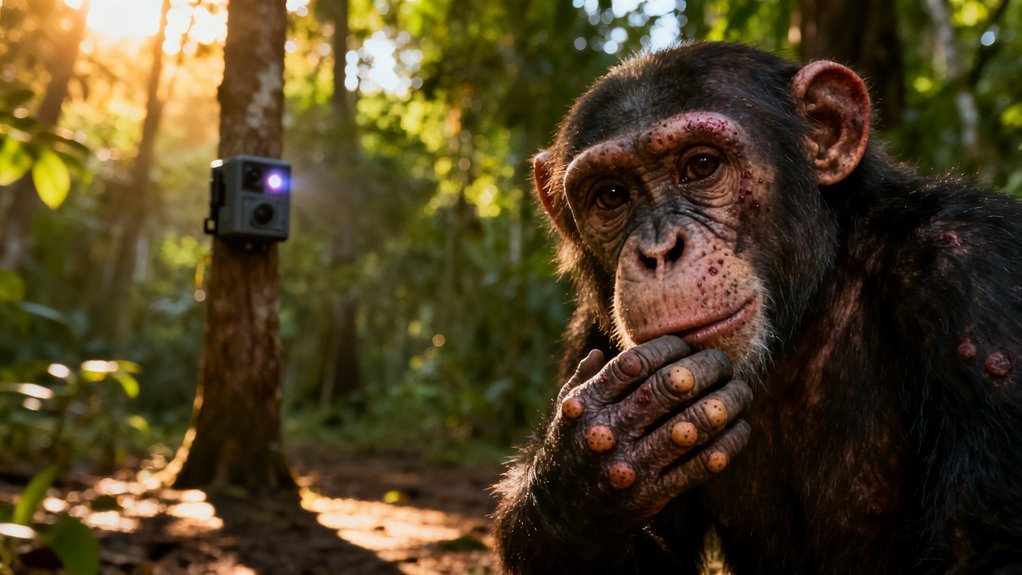
Researchers working in Cantanhez National Park have built what they call PanLep300, a purpose-built dataset of more than 125,000 annotated image crops extracted from five years of camera trap footage. The system trains convolutional models to visually detect leprosy lesions on wild western chimpanzees, a species already critically endangered and now facing a bacterial threat that until recently was barely understood outside human medicine.
What makes this more than an interesting academic exercise is the operational reality it addresses: these chimpanzees cannot be examined by veterinarians. They are unhabituated, meaning they flee from humans. Camera traps are the only systematic observation tool available, and the volume of footage those cameras produce has already outstripped any team’s ability to review manually.
These chimpanzees flee from humans, so camera traps are the only eyes we have — and the footage is overwhelming.
The Disease Problem Nobody Saw Coming
Leprosy in wild great apes was essentially unknown until researchers confirmed *Mycobacterium leprae* infections in chimpanzee populations at two sites: Cantanhez in Guinea-Bissau and Taï National Park in Côte d’Ivoire. The discovery itself was startling.
Leprosy is ancient in humans and has been found in armadillos and red squirrels, but its presence in our closest living relatives opened uncomfortable questions about cross-species transmission, environmental reservoirs, and the vulnerability of already small populations to chronic infectious disease.
Molecular work on fecal and lesion samples revealed something particularly interesting. The strains circulating in these chimpanzees belong to rare genotypes, designated 4N/O and 2F, that diverge significantly from the lineages most commonly found in human patients. This suggests the chimpanzees did not simply catch leprosy from nearby human communities, though that possibility has not been fully ruled out.
The implication is that *M. leprae* may have independent or very old transmission chains in nonhuman primates, a finding with real significance for understanding the pathogen’s ecology.
Symptomatic animals show the hallmarks familiar from human leprosy: skin nodules, depigmented patches, thickened or deformed ears, and progressive damage to hands and feet. Across multiple chimpanzee communities in Cantanhez, researchers documented affected individuals at different stages of disease progression. The pattern points to active intraspecific transmission rather than isolated spillover events.
For a species numbering roughly 55,000 individuals across West Africa and declining, adding a chronic bacterial disease to the threat matrix of habitat loss, poaching, and respiratory viruses is genuinely alarming.
Why Manual Surveillance Cannot Scale
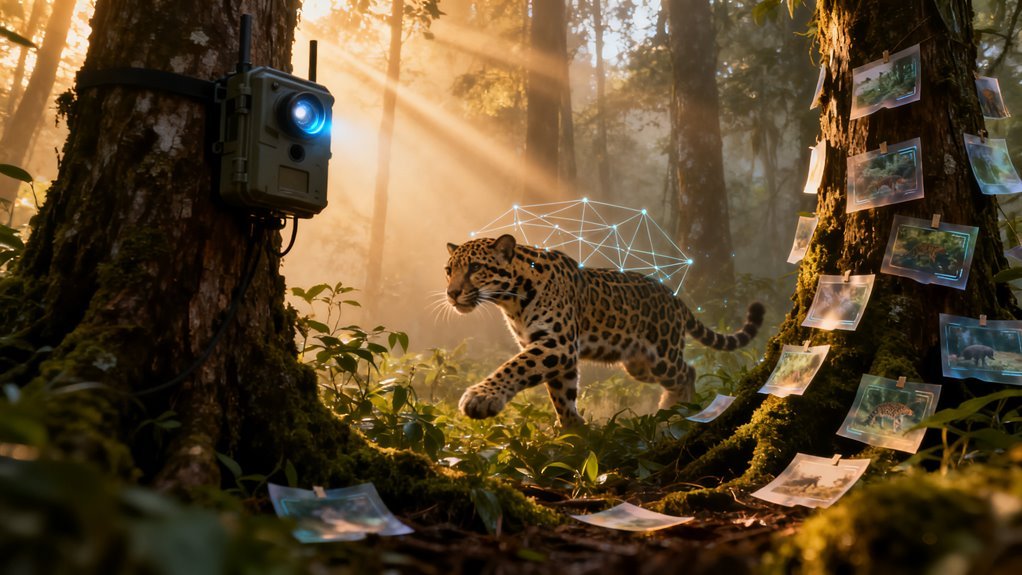
The monitoring infrastructure at Cantanhez consists of camera trap units deployed across 211 locations spanning forest, mangrove edges, and orchard habitats. These units run continuously in video mode, triggered by movement, recording clips that range from 10 to 60 seconds.
Over several years, this network has generated hundreds of thousands of videos and still frames. That volume is the core problem. Expert reviewers can identify individual chimpanzees and assess their health from footage, but the time required to screen even a fraction of the total output means that disease detection lags badly behind data collection.
Restricting review to a manageable subset means accepting gaps in spatial and temporal coverage, which in turn means infected individuals or newly affected communities can go undetected for months or years. For a slow-progressing disease like leprosy, that delay might seem tolerable.
But in a small, fragmented population where every individual matters demographically, late detection translates directly into missed intervention windows. This bottleneck is not unique to leprosy surveillance. It is the defining constraint of camera trap science broadly.
The hardware has gotten cheap and reliable enough to deploy at enormous scale, but the data pipeline downstream remains stubbornly dependent on human eyes. Citizen science platforms like Zooniverse have helped, and basic species classifiers have been available for years.
What PanLep300 introduces is a task that sits at a much harder level of the recognition hierarchy: not “is there a chimpanzee in this frame” but “does this specific chimpanzee have visible signs of a specific disease.”
Inside PanLep300
The dataset draws from 303 camera trap videos collected between 2021 and 2025, yielding 71,508 frames from which the 125,670 annotated bounding box crops were extracted. Each crop carries two labels: the identity of the individual chimpanzee and their leprosy status.
This dual annotation is what makes the dataset genuinely useful for machine learning. It supports both disease classification and longitudinal tracking, meaning a model trained on this data can theoretically follow a named individual across multiple sightings over time and flag changes in their condition.
The dataset design reflects hard-won lessons from computer vision research on wildlife. The evaluation splits are ecologically motivated, withholding specific named individuals and specific camera installations from the training set.
This forces models to prove they can generalize to chimpanzees they have never seen at locations where they have never observed animals, rather than simply memorizing the appearance of known subjects against familiar backgrounds. Anyone who has worked with wildlife image classifiers knows how easily a model can learn to recognize a particular tree or rock formation rather than the animal in front of it.
The Cantanhez team has built their benchmark to penalize exactly that kind of shortcut learning. The footage itself captures substantial visual variation: different habitat types, shifting light conditions, varying camera angles and distances.
This is not a controlled laboratory dataset. It is messy, real-world field data, which is precisely what makes it valuable as a benchmark for future development.
Where This Fits in the Broader AI Landscape
Computer vision for wildlife monitoring has matured considerably since the early days of basic species classifiers. Microsoft’s AI for Earth program, Google’s Wildlife Insights platform, and Conservation AI’s real-time detection systems have collectively pushed the field from proof of concept toward operational deployment.
But most of these systems operate at relatively coarse classification levels: species identification, activity recognition, population counting. Disease detection from visual data represents a qualitatively different challenge.
In human medicine, dermatological AI has advanced rapidly. Systems from companies like DermaSensor and research groups at Stanford and Seoul National University have demonstrated skin lesion classifiers that approach or match dermatologist-level performance on conditions like melanoma.
But these systems benefit from standardized imaging conditions, controlled lighting, high-resolution cameras held at consistent distances, and cooperative patients who hold still. None of those advantages exist in the camera trap context.
The subjects are wild animals that pass through a fixed camera’s field of view unpredictably. Image quality varies enormously. Occlusion from vegetation is constant. The same individual may appear at different distances, angles, and times of day across sightings.
Training a model to reliably detect subtle skin changes under these conditions is a substantially harder problem than the medical imaging analogy might suggest. What makes the PanLep300 approach credible is its scale and its methodological rigor rather than any claim of diagnostic perfection.
The researchers are not asserting that their models match veterinary accuracy. They are demonstrating that automated screening can flag candidates for expert review at a throughput that manual screening cannot achieve.
This triage model, where AI handles the first pass and humans handle the hard cases, has proven effective across domains from radiology to content moderation. Its application here follows the same logic.
What People Are Overlooking
The immediate reaction to work like this tends to focus on the conservation application, which is important but not the whole story. Several broader implications deserve attention.
First, this is a proof of concept for remote disease surveillance in populations that cannot be physically examined. That description applies not only to wild chimpanzees but to many wildlife populations, livestock in remote pastoral systems, and potentially to human communities in areas with limited healthcare access.
The pipeline of camera-based data collection, automated visual screening, and expert confirmation has applications well beyond primatology. Second, the rare leprosy genotypes found in these chimpanzees raise questions that intersect with One Health frameworks now gaining traction in public health policy.
If *M. leprae* maintains independent transmission chains in nonhuman primates, understanding those chains has direct relevance for human disease control, particularly in regions where humans and great apes share habitat and occasionally come into direct or indirect contact.
Third, the dataset’s design philosophy, withholding individuals and locations during evaluation, sets a standard that much wildlife AI research still does not meet. The temptation to report inflated accuracy numbers by allowing training and test sets to share individuals or backgrounds is pervasive.
PanLep300’s approach should become the default for any wildlife disease detection benchmark going forward.
What Happens Next
The immediate path forward involves expanding the model architectures tested against the benchmark. The current work evaluates spatial 2D models for frame-level detection, but temporal models that analyze sequences of frames could capture gait abnormalities or behavioral changes associated with advanced leprosy.
Chimpanzees with progressive hand and foot deformities move differently. A system that combines visual lesion detection with movement analysis could achieve higher sensitivity than either approach alone.
Scaling the monitoring network is another obvious next step. Cantanhez is one park. Western chimpanzees range across Guinea, Sierra Leone, Liberia, and other countries where camera trap infrastructure is sparse or nonexistent.
Deploying this pipeline at scale would require partnerships with national wildlife agencies and international conservation organizations, along with the logistical challenge of maintaining camera networks in tropical forest environments.
There is also the question of intervention. Detecting leprosy in a wild chimpanzee is useful only if it leads to some actionable response. In habituated populations, targeted treatment might be feasible.
In unhabituated groups like those at Cantanhez, the options are more limited. Environmental management, reducing potential pathogen reservoirs, monitoring for population-level impacts, and informing decisions about habitat connectivity to prevent transmission between communities are all plausible responses, but they require the kind of early detection data that this system is designed to produce. Researchers have also noted that *M. leprae* may persist in the environment itself, with experimental evidence showing the bacterium can multiply in amoebae(https://www.ncbi.nlm.nih.gov/pmc/articles/PMC8940534/) suggesting that soil and water sources could serve as overlooked transmission pathways that environmental management strategies would need to address.
The broader trajectory here is clear. AI-powered disease surveillance in wildlife is moving from theoretical to operational. The tools are not perfect, and the challenges of field deployment are real.
But the alternative, relying entirely on manual review of an ever-growing mountain of camera trap footage, is already failing to keep pace with the data. For critically endangered species facing novel disease threats, the question is not whether automated monitoring will become standard practice, but how quickly it can be deployed where it is needed most.