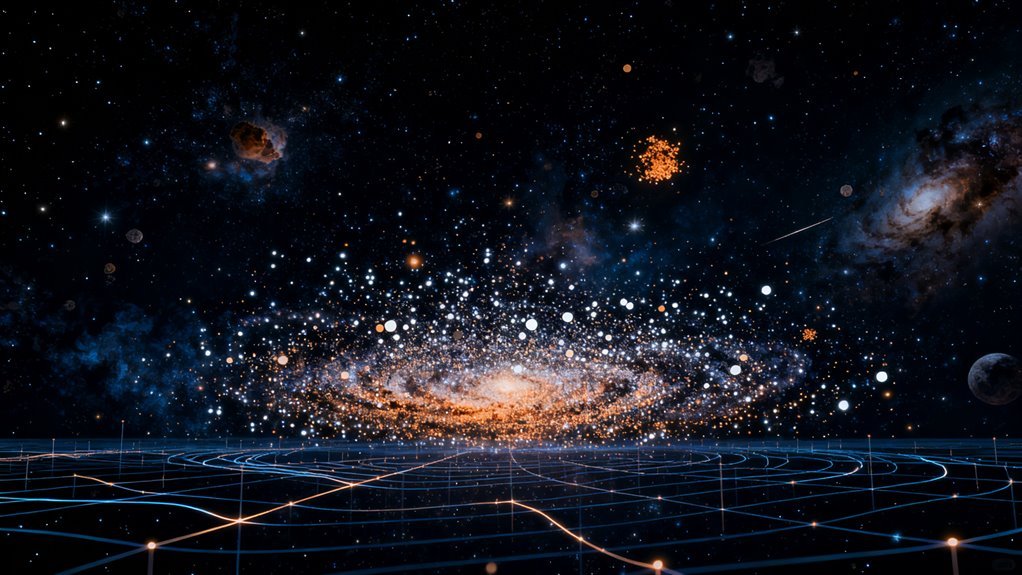
The most remarkable thing about the 1.5 million previously unknown celestial objects that machine learning algorithms just pulled from NASA’s archives is not the discovery itself. It is the fact that every single data point was already sitting on a server, collected years ago, studied by human researchers, and officially classified as thoroughly analyzed. The objects were always there. Nobody saw them.
That gap between what humans extracted from the data and what AI extracted from the same data is not a minor discrepancy. It is a factor of millions, and it tells us something important not just about astronomy but about how much latent value remains locked inside datasets across every scientific and commercial domain.
What Actually Happened
NASA’s NEOWISE telescope, originally launched as WISE, spent more than a decade surveying the sky in infrared wavelengths before the spacecraft was decommissioned. Over that period it generated roughly 200 billion infrared data entries, hundreds of terabytes of photometric measurements capturing the brightness of objects across the observable universe.
Astronomers analyzed this data extensively. Papers were published. Catalogs were built. The archive was considered mature.
Then a team applied a custom machine learning framework built around an algorithm called VarNet, designed specifically for detecting variability patterns in infrared observations. Instead of examining individual sources one at a time, the way a human analyst would, VarNet processed billions of data points simultaneously. It hunted for tiny brightness fluctuations, the subtle flickers and dimmings that signal astrophysical activity but fall below the threshold of human perception when buried in instrumental noise.
The result was a catalog of 1.9 million objects exhibiting variable brightness. Nearly 1.5 million of those were entirely absent from existing astronomical records. The candidates include quasars, supernovae, unidentified variable stars, and possible black holes. Many of them sit behind dense interstellar dust clouds that block optical telescopes but leave faint infrared signatures, exactly the kind of weak signals that a neural network optimized for sensitivity to rare sources can catch and that conventional analysis pipelines systematically discard.
Why This Matters Beyond Astronomy
The obvious significance is scientific. Expanding the known catalog of variable celestial objects by 1.5 million in a single pass gives astrophysicists entirely new populations to study. Some of these objects likely belong to rare or extreme categories that have been statistically undersampled for decades.
Once systematic classification and follow-up observations proceed across multiple wavelengths, researchers expect to identify not just more examples of known object types but potentially new classes of cosmic variables that no one has described before.
But the deeper lesson here extends well beyond space science.
Consider what the NEOWISE archive represents in structural terms. It is a large, high dimensional, time series dataset with significant noise, collected by a standardized instrument over a long observation window. That description applies to an enormous number of datasets across industries: financial market data, medical imaging archives, seismic surveys, climate monitoring records, industrial sensor logs, genomic databases.
The pattern is the same everywhere. Humans analyze data with the tools and time available, extract what they can, publish findings, and move on. The residual signal left behind is not trivial. In the case of NEOWISE, it contained 1.5 million objects.
The question every research institution, every enterprise sitting on years of collected data, and every government agency with legacy archives should now be asking is straightforward: what are we missing in our own data?
The Technical Shift That Made This Possible
VarNet is not a general purpose large language model repurposed for science. It is a neural network engineered from the ground up for a specific task: identifying time domain variability signatures in noisy infrared photometry.
This matters because it illustrates a broader trend in applied AI that often gets overshadowed by the headline competition between foundation model builders like OpenAI, Google DeepMind, Anthropic, and Meta.
The frontier model race captures most of the attention and investment. But some of the most consequential real world applications of AI are happening through purpose built systems trained on domain specific data for narrowly defined but enormously valuable tasks.
AlphaFold cracking protein structure prediction was one example. AI models detecting diabetic retinopathy in retinal scans was another. VarNet finding hidden objects in archived telescope data fits squarely in the same category.
What these systems share is a design philosophy that prioritizes sensitivity and specificity over generality. VarNet does not write poetry or summarize documents. It does one thing: it separates genuine astrophysical signals from instrumental artifacts across billions of measurements with a level of consistency and throughput that no team of human analysts could approach.
The value comes not from intelligence in the conversational sense but from pattern recognition at a scale and resolution that fundamentally exceeds human capacity.
This is worth noting because the commercial AI industry is currently fixated on making models more general. The astronomical discovery suggests that in many applied domains, the opposite direction, making models more specialized continues to yield outsized returns.
A Parallel Discovery Reinforces the Pattern
The NEOWISE finding did not happen in isolation. A separate effort applied a neural network called AnomalyMatch to the Hubble Legacy Archive, scanning nearly 100 million image cutouts for anomalous sources that previous analyses had overlooked. That system flagged candidates in just 2.5 days, demonstrating the extraordinary speed at which AI can process decades of accumulated observations.
This parallel project demonstrates that AI driven reanalysis of space telescope data is not a one-off experiment but an emerging systematic methodology.
Together, these two efforts suggest something that should concern anyone who assumed legacy scientific archives had been fully exploited: the first generation of analysis on nearly every major dataset probably left significant discoveries on the table. The tools simply were not powerful enough to find them. Now they are.
For space agencies and observatories, this creates an interesting economic proposition. Building and launching a new space telescope costs billions of dollars and takes a decade or more of planning.
Running a machine learning pipeline on an existing archive costs a fraction of that and can surface discoveries in months. That does not eliminate the need for new instruments, but it dramatically changes the cost-benefit calculation for archival science and suggests that funding agencies should be directing substantially more resources toward computational reanalysis of data already in hand.
Who Benefits and What Comes Next
The immediate beneficiaries are astrophysicists who now have vastly expanded samples of variable and transient objects to study. Larger samples mean better statistics, which means more robust tests of theoretical models for everything from stellar evolution to the expansion rate of the universe.
Telescope operators and space agencies benefit because the return on investment for missions they have already completed just increased significantly. Every archived survey becomes a candidate for AI reanalysis, and the expected yield based on these results could be substantial.
AI researchers working on scientific applications benefit from a high-profile demonstration that purpose built models applied to domain specific data can produce discoveries of the first order. This strengthens the case for funding and institutional support for scientific AI beyond the foundation model paradigm.
The broader technology industry should take note as well. If astronomical archives that were considered exhausted still contained 1.5 million undiscovered objects, the implication for other data rich domains is hard to overstate.
Pharmaceutical companies sitting on decades of clinical trial data, energy companies with extensive geological surveys, financial institutions with deep transaction histories, all of them are plausible candidates for the same kind of AI driven reanalysis. The specific algorithms will differ, but the underlying principle is identical: modern machine learning can extract signals from noise at scales and sensitivities that previous analytical methods could not reach.
Looking further ahead, this discovery is also a preview of what will happen when AI is applied not retrospectively to old data but prospectively to new instruments. The Vera C. Rubin Observatory, expected to begin its decade long survey of the southern sky soon, will generate roughly 20 terabytes of data per night.
No human team will analyze that in real time. AI pipelines similar to VarNet will be essential infrastructure from day one. The NEOWISE result is effectively a proof of concept for the operational model that next generation astronomy will require.
The Overlooked Implication
There is a subtler point here that deserves attention. The 1.5 million objects were not hidden by distance or faintness alone. They were hidden by the limitations of previous analytical methods applied to the data.
The data was adequate. The analysis was not.
This distinction matters because it reframes the value proposition of AI in science and industry. The bottleneck in many fields is not data collection. Sensors, telescopes, sequencers, and monitoring systems have been generating data at enormous rates for years.
The bottleneck is analysis. And that bottleneck is exactly where machine learning has the most leverage.
The NEOWISE discovery is not just a story about finding new things in space. It is evidence that the analytical debt accumulated across decades of data collection is real, large, and now systematically addressable.
Organizations that recognize this and invest accordingly will have a significant advantage. Those that continue to treat their archives as fully exploited will be leaving their own version of 1.5 million hidden objects on the table.